How To Become A Dropshipper In 2026: Step-By-Step Guide

So you want to know how to become a dropshipper. The honest answer is that it is one of the most accessible ways to start an online business in 2026 – no warehouse, no upfront inventory, and no technical degree required. But accessible does not mean automatic. There is a process, and skipping steps is exactly why most beginners stall before they make their first sale.
This guide walks you through the entire dropshipping model from scratch – what it actually is, what it realistically earns, how to set up your store, find winning products, and drive traffic without burning your budget. Whether you are starting from zero or you have dabbled before and want a clearer roadmap, you will find the full picture here.
Quick Answer: To become a dropshipper, you choose a niche, set up an online store, source products from a supplier (typically AliExpress or a domestic alternative), and market those products. When a customer buys, the supplier ships directly to them – you never touch the stock. Startup costs can be as low as $0–$50 with the right platform.
The dropshipping model has been around for over a decade, but 2026 is arguably the best year yet to enter it as a beginner. Supplier networks are larger, automation tools are more powerful, and the barrier to launching a polished store has dropped dramatically. If you have been sitting on the idea, the infrastructure is ready – the question is whether you are.

What is the dropshipping model?
The dropshipping model is a retail fulfillment method where you sell products through your own online store without holding any physical inventory. When a customer places an order, you forward it to your supplier, who ships the product directly to the customer on your behalf. Your profit is the margin between what the customer pays you and what the supplier charges you.
It sounds simple, and the core mechanic genuinely is. What makes dropshipping a real business rather than a get-rich-quick scheme is everything wrapped around that mechanic – product research, store branding, customer experience, and consistent marketing. Those are the skills that separate profitable dropshippers from people who quit after two weeks.
The model works across virtually every product category: home décor, pet supplies, fitness gear, electronics accessories, beauty tools, and much more. Most beginners using AliExpress-based dropshipping can launch with less than $50, and some platforms now offer free turnkey stores that remove the setup cost entirely.
Why this works in 2026: Global ecommerce is projected to exceed $6.3 trillion this year, and mobile shopping continues to grow. More consumers than ever are buying from stores they discover through social media – which is exactly the traffic channel dropshippers rely on most.
There are a few variations of the dropshipping model worth knowing. Standard AliExpress dropshipping is the most common entry point for beginners. Print-on-demand is a subset where designs are printed onto products at the time of sale.
Domestic dropshipping uses local suppliers for faster shipping times. And niche stores – focused on one product category – tend to outperform general stores for new sellers because branding is tighter and ad targeting is more precise.
How much can you realistically earn as a dropshipper?
This is the question everyone asks first, and it deserves a straight answer. Earnings in dropshipping vary enormously based on niche selection, marketing skill, time invested, and how long the store has been running. Here is a realistic breakdown by stage.
These figures reflect net profit after product costs and basic marketing spend. The beginner range assumes organic traffic or low-budget social media. The established range assumes at least one winning product and a functional paid ad strategy.
One note on the ceiling figures: The $8,000+ range is real but not typical in year one. Most dropshippers who reach that level took 9–18 months of consistent effort and multiple rounds of product testing. Treat the first 60–90 days as your learning investment, not your payday window.
Daily earnings follow a similar pattern. A store in its early testing phase might see $10–$30/day on good days, nothing on slow ones. A store with a proven product and running ads can realistically hit $80–$200/day within six months. Full-time dropshippers managing multiple stores or scaling aggressively with paid ads can exceed $500/day – but that is a business operation at that point, not a side hustle.
How to become a dropshipper: the step-by-step process
Here is how to go from zero to a running dropshipping business. Each step builds on the last, and skipping any of them is usually the reason stores underperform.
Step 1: Choose your niche
The biggest mistake in dropshipping for beginners is going too broad. A general store selling everything from kitchen gadgets to phone cases gives customers no reason to trust you over Amazon. A niche store – focused on, say, ergonomic home office accessories or outdoor pet gear – builds trust faster and is far easier to market.
How to pick a winning niche
Start with your own interests, but validate them with data. Use Google Trends to check whether interest in your niche is growing or declining. Browse AliExpress bestseller lists and look for products with thousands of orders but relatively few branded competitors. Check Reddit communities and Facebook groups in the niche – if people are actively discussing problems that a product could solve, that is a strong signal.
Good beginner niches in 2026 include: home organization, pet accessories, fitness recovery tools, eco-friendly everyday products, and baby gear. These have consistent demand, manageable competition at the mid-tier, and customers with a clear purchase intent.
Step 2: Set up your online store
You have a few options here. The most common for beginners are Shopify (paid, from $39/month), WooCommerce (free plugin, requires WordPress hosting), and AliDropship (which offers a free turnkey store already built and stocked). Each has tradeoffs, but the key decision is: do you want to build from scratch, or do you want to launch fast?
Build vs. ready-made
Building from scratch gives you full control over design and structure but takes weeks if you are new to ecommerce. A ready-made or turnkey store gets you live in days with a professional design, products already loaded, and basic SEO in place. For most beginners, the faster you can get a real store in front of real customers, the faster you learn what actually works.
Important note: Whatever platform you choose, make sure your store has a clear return policy, an About page, and working contact information. These three elements alone dramatically increase conversion rates because they signal legitimacy to first-time visitors.
Step 3: Find and import products
Product research is an ongoing activity, not a one-time task. Your first batch of products will not all be winners – that is normal and expected. The goal in the early months is to test multiple products at low cost and identify which ones convert.
Where to source products
AliExpress remains the dominant sourcing platform for beginner dropshippers. It has tens of millions of products, suppliers willing to dropship in small quantities, and buyer protection on most orders. Look for suppliers with at least 500 orders on a product, a feedback rating above 4.5, and responsive communication.
For faster domestic shipping (particularly important for US customers), platforms like Spocket, Zendrop, and DSers connect you with local suppliers. Shipping times drop from 2–4 weeks to 3–7 days, which significantly reduces customer complaints and refund requests.
Product selection criteria
When evaluating any product, run it through this quick checklist. Is it solving a clear problem or fulfilling a strong desire? Does it have a markup of at least 2x–3x the supplier price? Is it lightweight enough to keep shipping costs low? Is it not already dominated by Amazon or a major retail brand? If you get four out of four, it is worth testing.
Step 4: Write product listings that convert
Copying the supplier’s product description verbatim is one of the most common beginner mistakes. Those descriptions are written for wholesale buyers, not retail customers – and they are often poorly translated. Rewriting your listings in clear, benefit-focused language is one of the highest-leverage things you can do for free.
Listing structure that works
A strong product listing has a benefit-led title (not just a spec-led one), a short paragraph explaining what the product solves or improves, a bullet-point feature list, at least four high-quality product images, and a clear call to action. If you can add a short video – even a supplier-provided one – conversion rates typically improve by 15–30%.
Step 5: Drive traffic to your store
A well-built store with no traffic earns nothing. Traffic is the single biggest challenge for new dropshippers, and it is where most of the learning curve actually lives. There are two broad routes: organic (free but slow) and paid (fast but costs money to learn).
Organic traffic methods
SEO-optimized product pages and blog content can drive consistent traffic over time with no ongoing ad spend. Social media – particularly TikTok and Instagram Reels – has become a powerful free channel for product discovery.
Short videos showing the product in use, solving a problem, or delivering a satisfying result regularly go viral in niches like home organization, pet products, and kitchen tools. Building a TikTok account around your niche and posting 3–5 times per week is a legitimate zero-budget traffic strategy that several full-time dropshippers credit as their primary channel.
Paid traffic methods
Meta ads (Facebook and Instagram) remain the most commonly used paid traffic source for dropshippers. They offer detailed audience targeting, allow you to test products quickly, and scale well once a winning product is identified. Google Shopping ads work well for products with clear search intent. TikTok ads are increasingly effective for visual, impulse-buy products targeting the 18–35 demographic.
Start with a small daily budget – $10–$20/day per product test – and run each product for 3–5 days before deciding to scale or cut. This approach lets you test several products without exhausting your budget before you find a winner.
Stop guessing – find your ideal ad platform
Tell us about your audience age, product type, daily budget, video creation ability, and search demand – and our picker will recommend the single best ad platform for you, backed by a tailored explanation of why it fits your unique situation.
Legal and ethical considerations for dropshippers
Dropshipping is a legitimate business model, but like any business it comes with legal and ethical responsibilities. Getting these right from the start protects you from chargebacks, account bans, and reputational damage.
What to avoid absolutely
Never sell counterfeit or branded products – this includes replica designer goods, knockoff electronics, and anything using a trademarked logo without authorization. Never use misleading shipping time claims. If your supplier ships from China and delivery takes 2–4 weeks, your store must say so. Misrepresenting delivery times is one of the top causes of chargebacks and PayPal disputes for new dropshippers.
Avoid dropshipping products that are regulated or restricted without understanding the compliance requirements – this includes supplements, electronics with safety certifications, and children’s products. One customer complaint to a payment processor can freeze your account before you have time to respond.
What to do instead
Source products that are clearly unbranded or white-label. Be transparent in your store about where products ship from and realistic delivery windows. Use a clear, fair refund policy that does not try to discourage returns. Register your business properly – a simple LLC in most US states costs under $100 and protects your personal assets.
Key principle: Treat your customers the way you would want to be treated as an online buyer – clear information, honest timelines, and a straightforward resolution process when things go wrong.
How to choose your approach based on your profile
Not every beginner is in the same situation. Here is how to think about your starting point and match it to the right approach.
Complete beginner
If you have never run an online store before, your priority is speed to launch over perfection. Use a ready-made or turnkey store so you are not stuck in setup limbo for weeks. Choose one niche, load 10–20 products, and focus entirely on getting your first 100 visitors before worrying about optimization. The learning comes from running a live store, not from planning one.
Intermediate – part-time seller
If you have some ecommerce experience or have tried dropshipping before without great results, the issue is usually product selection or traffic. Revisit your niche with stricter criteria – look for products with clear problem-solving utility and at least 1,000 AliExpress orders. Invest more time in TikTok organic content or a small Meta ads budget, and track results systematically instead of guessing.
Advanced – full-time income goal
If you are aiming to replace a salary within 12 months, you need to treat this as a business from day one. That means registering a legal entity, using proper accounting software, building an email list from your first sale, and planning for ad spend of at least $500–$1,000/month during the scaling phase.
Reaching $3,000–$5,000/month in profit is realistic in this timeframe with full-time effort – but it requires the same discipline you would bring to any serious business venture.
Whatever your profile, the single biggest predictor of success in dropshipping is how quickly you iterate. Test a product, get data, cut what does not work, scale what does. The dropshippers who fail are overwhelmingly the ones who spend three months perfecting their store design instead of putting it in front of customers.
AliDropship: Your complete all-in-one solution for starting dropshipping in 2026
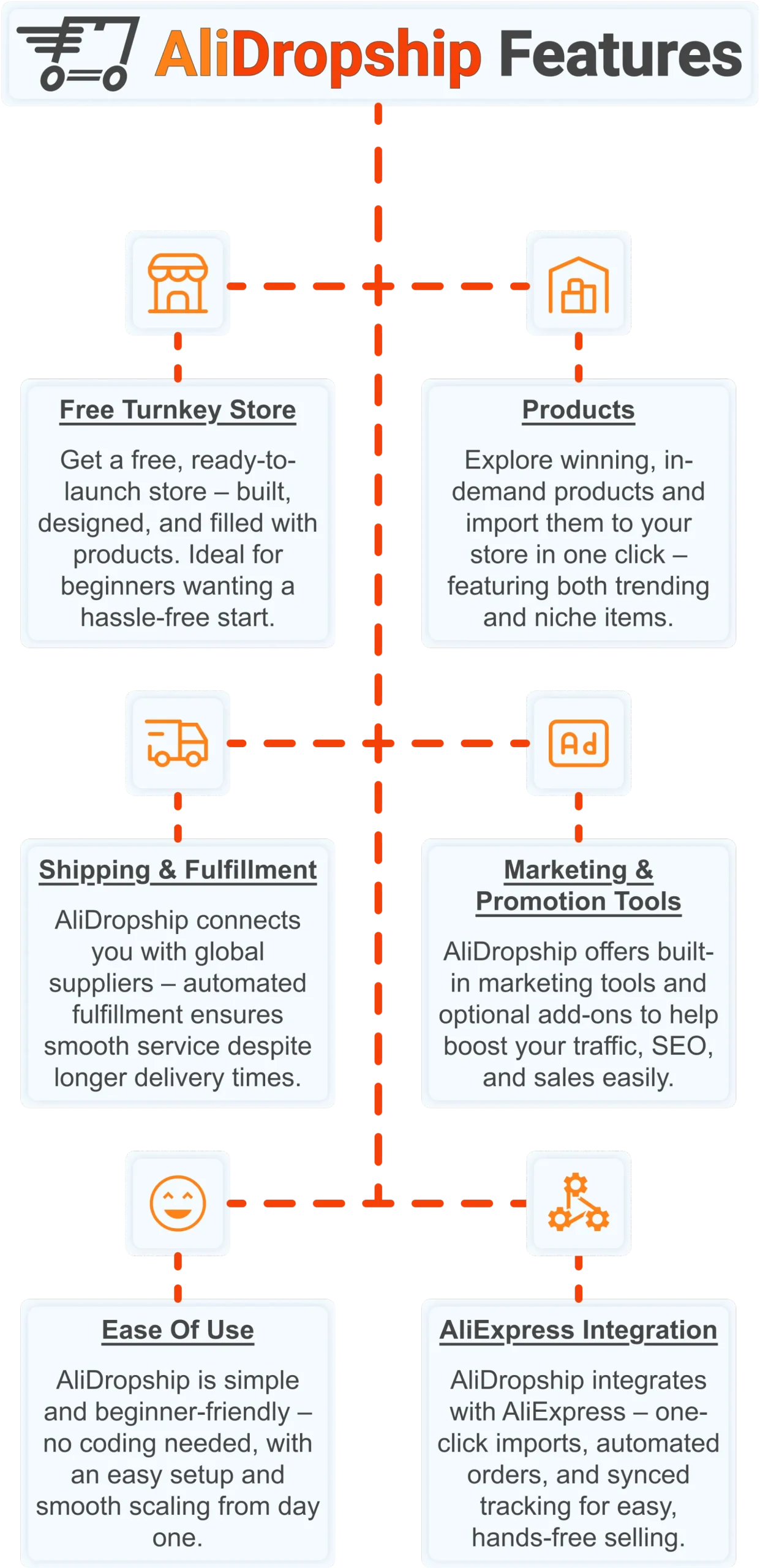
If you want the simplest possible way to start dropshipping – especially if you are brand new – AliDropship remains one of the most beginner-friendly tools available in 2026. It brings together store creation, product imports, automation, and marketing into a single streamlined system designed to help you launch quickly and grow confidently.
Free turnkey store 🛍️
Get a free turnkey store – built, designed, and filled with products. Ideal for beginners wanting a hassle-free start, the store comes fully optimized to attract customers right away, saving you time on setup. Plus, it includes professional design elements to give your business a polished, trustworthy look from day one. This ready-made foundation makes it easy to move seamlessly into product selection.
Products 📦
Once your store is set up, you can explore winning, in-demand products and import them in one click – featuring both trending and niche items. This wide selection lets you cater to diverse customer interests and test what works best. Regular updates ensure you always have fresh products, keeping your store competitive and relevant. With great products in place, smooth shipping becomes the next essential step.
Shipping & fulfillment 🚚
AliDropship connects you with global suppliers, and automated fulfillment ensures seamless order processing despite international delivery times. Customers receive real-time tracking updates, which builds confidence and trust in your store. Once shipping is handled reliably, you can focus on promoting your store and attracting traffic.
Marketing & promotion tools 📣
To maximize sales, AliDropship offers built-in marketing tools and optional add-ons that help boost traffic, SEO, and conversions. From email campaigns and discounts to social media integration, these tools empower you to reach and retain customers without needing prior marketing experience. With promotion strategies in place, managing your business becomes simpler and more efficient.
Ease of use 👌
AliDropship is beginner-friendly – no coding needed, with an intuitive dashboard that guides you through every step. Easy setup and smooth scaling let you expand your store without stress. As your business grows, adding new features, products, and marketing campaigns remains hassle-free, giving you more time to focus on sales.
AliExpress integration 🛒
Finally, AliDropship integrates seamlessly with AliExpress, enabling one-click imports, automated orders, and synced tracking. Your inventory stays up-to-date with the latest products and prices, while automated order processing frees you from manual tasks. Combined with the turnkey setup, reliable shipping, and built-in marketing tools, this integration ensures your dropshipping business is fully equipped for growth and success.
Learning how to become a dropshipper is the first step – having the right platform behind you is what turns that knowledge into revenue. Get your free turnkey store and start building your dropshipping business today.
What does a dropshipper actually do?
How much does it cost to become a dropshipper?
Startup costs for dropshipping can be very low. With platforms like AliDropship, beginners can access a free turnkey store and launch without paying for inventory. Ongoing costs typically include a domain name (around 10 to 15 dollars per year), optional paid tools, and marketing spend if using paid ads. It is possible to start and test products for under 50 dollars in total. Paid ad budgets of 10 to 20 dollars per day are common during the product testing phase.
How long does it take to make money with the dropshipping model?
Most beginners see their first sale within 30 to 60 days if they are actively driving traffic. Consistent daily profit – in the range of 30 to 80 dollars per day – typically develops after 3 to 6 months of product testing and optimization. Reaching full-time income levels of 3,000 dollars or more per month usually takes 9 to 18 months with consistent effort. The timeline depends heavily on niche selection, traffic strategy, and how quickly you iterate on underperforming products.
Is dropshipping for beginners still profitable in 2026?
Yes, the dropshipping model remains profitable in 2026 for sellers who approach it as a real business. Global ecommerce continues to grow, and tools for store automation, product research, and ad targeting have improved significantly. Margins have become more competitive in oversaturated niches, which is why niche selection and product research are more important than ever. Beginners who focus on a specific audience and build genuine trust with customers consistently outperform those running generic general stores.
What is the best niche for someone learning how to become a dropshipper?
The best niches for beginners combine consistent demand with manageable competition and products that solve a clear problem. Strong options in 2026 include pet accessories, home organization, ergonomic office tools, eco-friendly everyday products, and outdoor fitness gear. Each of these niches has an active buyer community, repeatable purchase potential, and a wide range of products available through AliExpress. Avoiding electronics and fashion – which have the highest return rates and most established competition – is generally good advice for anyone just starting out.


Recommended for You