Your 2026 SEO Ecommerce Checklist: Boost Traffic And Sales Like A Pro

Want more people finding your ecommerce store? Let’s be real – you could have the coolest products and the slickest store design, but if nobody can find you on Google, you’re basically invisible. And trust me, nobody’s scrolling to page 7 of search results to find your store. (Okay, maybe grad students writing their thesis, but that’s it.
Here’s the good news: getting your dropshipping store to show up in search results isn’t rocket science. It just takes a bit of know-how and some smart moves. This SEO ecommerce checklist will walk you through everything you need to do in 2026 to get more eyeballs on your store and more sales in your pocket.
Whether you’re brand new to dropshipping or you’ve been at it for a while, this guide has you covered. We’re keeping it simple, straightforward, and actually useful. Let’s dive in!
1. Nail your keywords (because they’re everything)
Think of keywords as the bridge between what people type into Google and your store. Get them right, and customers find you. Get them wrong, and you’re shouting into the void.
Find your main keyword
Your main keyword is like your store’s home base. It should describe what you sell in 3-4 words max. For example, if you’re selling space-themed room decor, try something like “space room decor” or “galaxy bedroom accessories.”
Here’s how to check if your keyword is actually good:
- Head to Google Keyword Planner (it’s free, just sign up with a Google account)
- Type in your keyword idea
- Set your target country and language (make sure they match!)
- Sort results by “Avg. monthly searches”
- Look for keywords with 1K-10K monthly searches – sweet spot for competition vs. opportunity
Pro tip: In 2026, AI-powered tools like Ahrefs and Semrush have gotten even better at predicting search trends. They can show you what keywords are about to blow up, not just what’s popular right now. Worth the investment if you’re serious about growth.
Build your supporting keywords
One keyword isn’t enough – you need a squad of them. These supporting keywords help you create your store structure, name your categories, and write product descriptions that actually rank.
Ways to find supporting keywords:
- Check Google Keyword Planner suggestions – the system shows related searches people actually use
- Use Semrush or Ahrefs – these tools also show you which websites are ranking for your keywords (hello, competitor research!)
- Try ChatGPT or Claude – yep, AI can help brainstorm keyword variations and synonyms. Just ask: “Give me 20 keyword variations for space room decor”
- Google Autocomplete – start typing your keyword and see what Google suggests. These are real searches people make!
- Google Related Searches – scroll to the bottom of any search results page to see what else people are searching for
- AliExpress search bar – see what products exist and what terms sellers are using
Aim for 10-15 solid supporting keywords. Mix in some specific ones (like “LED galaxy projector lamp”) with broader ones (like “space themed bedroom”).

Match your store structure to your keywords
Okay, so you’ve got your keywords. Now what? Time to organize your store around them. This helps Google understand what your site is about and rank you higher.
Here’s the hierarchy:
- Homepage: Use your main keyword
- Category pages: Use supporting keywords
- Product pages: Use super specific, long-tail keywords
Think of it like a pyramid – broad at the top, super specific at the bottom.
Don’t stuff your keywords (seriously, don’t)
Real talk: repeating the same keyword 50 times on one page doesn’t work anymore. Google’s AI (like Search Generative Experience) is way too smart for that in 2026. If you try to game the system with keyword stuffing, you’ll actually hurt your rankings.
Use keywords naturally:
- In your page title
- In one or two headings
- A couple times in your main text
- In your URL
- In your meta description
That’s it. Write for humans first, search engines second.
2. Make your store fast and user-friendly
Nobody – and I mean nobody – waits around for a slow website in 2026. If your store takes more than 3 seconds to load, people bounce. And Google notices that bounce rate.
Speed up your site (it really matters)
Check your current speed:
- Use Google PageSpeed Insights or GTmetrix (both free)
- Pay attention to Core Web Vitals – Google uses these for rankings in 2026:
– LCP (Largest Contentful Paint): Should be under 2.5 seconds
– FID (First Input Delay): Under 100ms
– CLS (Cumulative Layout Shift): Under 0.1
How to speed things up:
- Compress your images: Use tools like TinyPNG or ShortPixel. Your product images don’t need to be 4000×3000 pixels – 800×800 is plenty for most displays
- Get better hosting: If you’re using cheap shared hosting and your store is slow, it’s time to upgrade. AliDropship works great with quality hosting providers
- Enable caching: This stores a version of your site so it loads faster for repeat visitors
- Use a CDN: Content Delivery Networks like Cloudflare speed up your site globally
Make navigation super easy
If visitors can’t figure out where to click, they’ll leave. Simple as that.
Navigation checklist:
- Organize categories from broad to specific (e.g., “Home Decor” → “Bedroom” → “Galaxy Bedding”)
- Name categories clearly – if you sell pillow cases, sheets, AND towels, don’t call it “bedding,” call it “textiles” or “home fabrics”
- Link related products together – this helps SEO AND keeps people browsing longer
- Add a search bar that actually works (more on this later)
- Make sure your site works perfectly on mobile – over 70% of shoppers browse on phones now
Optimize your images and videos
Visual content sells products, but it can also slow down your site if you’re not careful. Plus, Google can’t “see” images the way humans do – you need to help it understand what’s in your photos.
Image SEO checklist:
- Name files descriptively: Instead of “IMG_1234.jpg,” use “galaxy-projector-lamp-bedroom.jpg”
- Write ALT text: Describe what’s in the image. Example: “Purple galaxy projector lamp illuminating a dark bedroom with stars”
- Compress without killing quality: Use modern formats like WebP – they’re smaller and load faster
- Lazy loading: Images below the fold only load when users scroll down – huge speed boost
- Video hosting: Don’t upload huge video files to your server – use YouTube or Vimeo and embed them
Fix your internal site search
About 30% of ecommerce visitors use the search bar, and they’re 2-3x more likely to buy. If your search doesn’t work well, you’re losing sales.
Make your search smarter:
- Handle typos and misspellings (“galxy lamp” should still show galaxy lamps)
- Recognize synonyms (“LED light” = “LED lamp”)
- Use Google Analytics to see what people are actually searching for on your site
- In 2026, AI-powered search plugins can predict what users are looking for as they type
Kill those 404 errors
Nothing screams “unprofessional” like broken links. If someone clicks a link and gets a 404 error, they’re probably leaving your site.
How to fix it:
- Use Google Search Console to find broken links
- Set up 301 redirects to send people to the right page
- Check your site regularly – links break when you remove products or change URLs
3. Optimize for AI and voice search (this is HUGE in 2026)
Here’s what’s changed: people aren’t just typing into Google anymore. They’re asking ChatGPT, using Perplexity, talking to Siri, and getting AI-generated answers. If your store isn’t optimized for this, you’re missing out on a massive chunk of traffic.
Optimize for AI search engines
AI tools like ChatGPT, Perplexity, and Google’s AI Overviews pull information from websites to answer questions. You want your store to be one of their sources.
How to show up in AI results:
- Answer questions directly: Write content that answers common questions in your niche. Example: “What’s the best galaxy projector for small bedrooms?”
- Use structured data (Schema markup): This helps AI understand your content. Add schema for products, reviews, FAQs, and how-to guides
- Create helpful buying guides: AI loves comprehensive, well-organized content that helps users make decisions
- Focus on E-E-A-T: Experience, Expertise, Authoritativeness, Trustworthiness. Show you know your stuff!
Nail voice search
More people are searching by voice – “Hey Siri, find me galaxy room decor.” Voice searches are conversational and question-based.
Voice search optimization:
- Use natural language: Write like people talk. “Where can I buy space-themed bedding?” instead of “buy space bedding”
- Target long-tail keywords: Voice searches are longer – 4-6 words on average
- Create an FAQ page: Answer common questions in a conversational way
- Optimize for local if relevant: Many voice searches are local (“near me” type queries)
Add schema markup (your secret weapon)
Schema markup is code that tells search engines exactly what your content is about. It helps you show up in rich snippets – those fancy search results with star ratings, prices, and product info.
What to add schema for:
- Products (name, price, availability, reviews)
- Reviews and ratings
- FAQs
- Breadcrumbs (for navigation)
- Organization info (for your About page)
You can generate schema markup using tools like Schema.org’s generator or use WordPress plugins if you’re on WordPress. It might look technical, but it’s copy-paste easy once you get the hang of it.
4. Optimize every page (yes, every single one)
Alright, time to get into the nitty-gritty of optimizing individual pages. Whether it’s your homepage, category pages, or product pages, there are some universal rules that apply everywhere.
Universal SEO elements for every page
For each page, make sure you:
- Pick a focus keyword: One main keyword per page
- Use it in your URL: yourstore.com/galaxy-bedroom-decor (not yourstore.com/page?id=123)
- Write a killer title tag: Under 60 characters, includes your keyword, makes people want to click
- Create a meta description: Up to 160 characters, includes keyword, tells people what they’ll find
- Use H1 heading: Only ONE H1 per page, and it should include your keyword
- Add H2 and H3 subheadings: Break up your content, use keywords naturally in some of them
Most AliDropship stores have built-in SEO fields for all this stuff – just fill them out!
Homepage optimization
Your homepage is usually the first impression people get of your store. Make it count.
Homepage tips:
- Title: Include your main keyword + your brand name (“Galaxy Room Decor | CosmicHome Store”)
- Write clear, benefit-focused copy: Tell visitors what you sell, who you help, and why they should care
- Add trust signals: Free shipping, money-back guarantees, customer reviews
- Feature bestsellers or trending products
- Keep it fast and mobile-friendly
Category page optimization
Category pages are goldmines for SEO because they can rank for broader keywords.
Category page checklist:
- Write 300-500 words of unique content about the category (not just a list of products)
- Explain what types of products are in the category
- Add helpful info – buying tips, how-to advice, common questions
- Use your category keyword in the title, headings, and description
- Link to related categories and products
Example: If your category is “Galaxy Projectors,” don’t just list products. Write about what galaxy projectors are, who they’re for, how to choose one, and where they work best.
Product page optimization (where sales happen)
Product pages are where the magic happens – this is where people decide to buy. Get these right and you’ll see more sales AND better rankings.
Product page SEO checklist:
- Write unique product descriptions: Never copy-paste from AliExpress. Rewrite in your own words
- Include all specs: Size, color, weight, materials, power requirements, etc.
- Use the right measurements: If you sell to the US, use inches and pounds. Europe? Centimeters and kilograms
- Focus on benefits, not just features: Don’t just say “LED light with 16 colors.” Say “Transform your bedroom into a cosmic oasis with 16 color options”
- Add high-quality images: Multiple angles, lifestyle shots, close-ups of details
- Include customer reviews: Social proof boosts conversions AND helps with SEO (fresh content!)
- Use long-tail keywords: “Purple galaxy projector lamp for small bedrooms” ranks easier than “galaxy lamp”
- Add an FAQ section: Answer common questions right on the product page
Pro tip: Use AI tools like ChatGPT to help rewrite product descriptions (but always edit them to sound human and add your own personality!).
5. Your complete ecommerce SEO checklist (grab this!)
This checklist covers everything you need to optimize your ecommerce store for search engines in 2026.
Keyword Research and Strategy
Site Structure and Technical SEO

Content and On-Page SEO
Images and Visual Content
AI and Voice Search Optimization
User Experience and Navigation
Analytics and Monitoring
Ongoing Maintenance
AliDropship: Your complete all-in-one solution for starting dropshipping in 2026
If you want the simplest way to start dropshipping – especially if you are brand new – AliDropship is one of the most beginner-friendly platforms in 2026. It brings together store creation, product imports, automation, and marketing into a single streamlined system. Plus, it comes with built-in SEO advantages to help you rank faster and grow confidently.
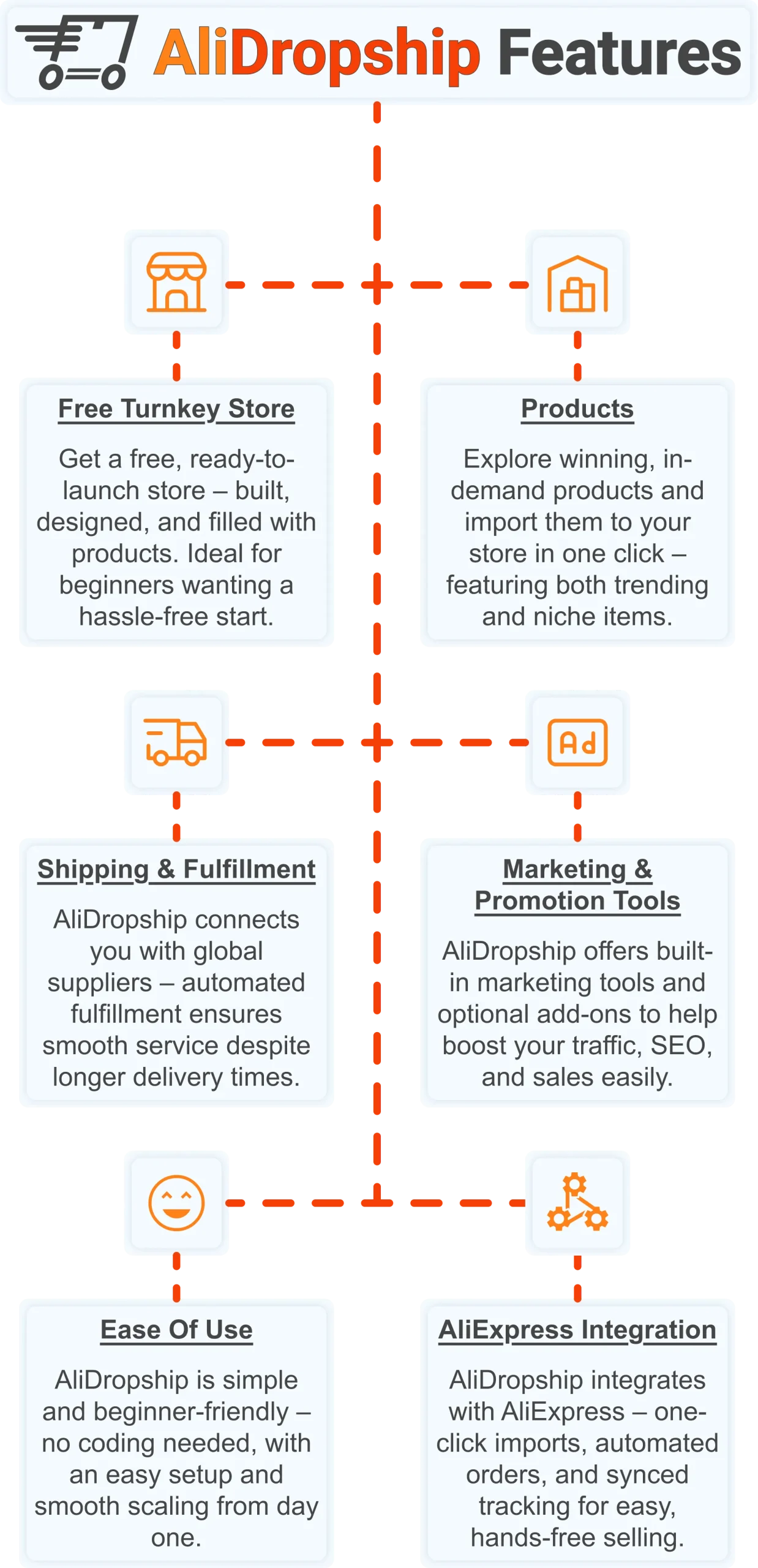
Free turnkey store
You get a free turnkey store that is already built, designed, and filled with products. Perfect for beginners who want a hassle-free start, the store comes fully optimized with SEO-friendly URLs, proper site structure, and fast loading speeds right out of the box. This professional foundation saves you weeks of setup time and gives you a head start on search rankings.
Products
Once your store is ready, explore winning, in-demand products and import them with one click. AliDropship offers both trending items and niche products, so you can test what resonates with your audience. Regular updates keep your catalog fresh and competitive. Plus, each product import includes optimized titles and descriptions you can customize for better SEO performance.
Shipping and fulfillment
AliDropship connects you with reliable global suppliers, and automated fulfillment handles order processing seamlessly. Customers get real-time tracking updates, which builds trust and reduces support inquiries. With shipping handled reliably, you can focus on what matters – driving traffic and optimizing your store for search engines.
Marketing and promotion tools
Boost your traffic and conversions with built-in marketing tools and optional add-ons. From email campaigns and discount codes to social media integration and SEO optimization features, these tools help you attract and retain customers without needing prior marketing experience. Everything works together to improve your visibility in search results and maximize sales.
Ease of use
AliDropship is designed for beginners – no coding required. The intuitive dashboard guides you through every step, from setting up your first product to scaling your business. As you grow, adding new features, products, and marketing campaigns stays simple and stress-free, giving you more time to focus on SEO and sales.
AliExpress integration
AliDropship integrates seamlessly with AliExpress for one-click imports, automated orders, and synced tracking. Your inventory stays current with the latest products and prices, while automated processing frees you from manual tasks. Combined with the SEO-optimized setup, reliable shipping, and built-in marketing tools, this integration gives your dropshipping business everything it needs to rank well and succeed in 2026.
Wrap it up: You’ve got this!
Look, SEO isn’t a one-and-done thing. It’s more like going to the gym – you’ve got to keep at it to see results. But here’s the thing: if you follow this checklist and stick with it, you will see more traffic. You will get more sales. It just takes a bit of time and patience.
The good news? In 2026, we’ve got better tools than ever before. AI can help you write content, find keywords, and even optimize your images. Google’s gotten smarter about understanding what users actually want. And with AliDropship, you’ve already got a solid foundation – now you just need to build on it.
Start with the basics – nail your keywords, speed up your site, optimize your product pages. Once those are solid, move on to the advanced stuff like AI optimization and Schema markup. Rome wasn’t built in a day, and neither is a high-ranking ecommerce store.
And remember: at the end of the day, you’re creating this store for real people, not just search engines. Write content that actually helps your customers. Make your site genuinely useful. Answer their questions. Solve their problems. Do that, and Google will reward you.
Now get out there and make it happen. Your future customers are waiting to find you!
AliDropship gives you everything you need to rank and profit. Launch your FREE store today + get $100 for business-boosting upgrades, cutting-edge tools, and bestselling products!
How to do SEO for ecommerce?
What are the 3 Cs of SEO?
What are the 4 pillars of SEO?
Is SEO worth it for ecommerce?
How long does it take to see SEO results for an ecommerce store?


Recommended for You