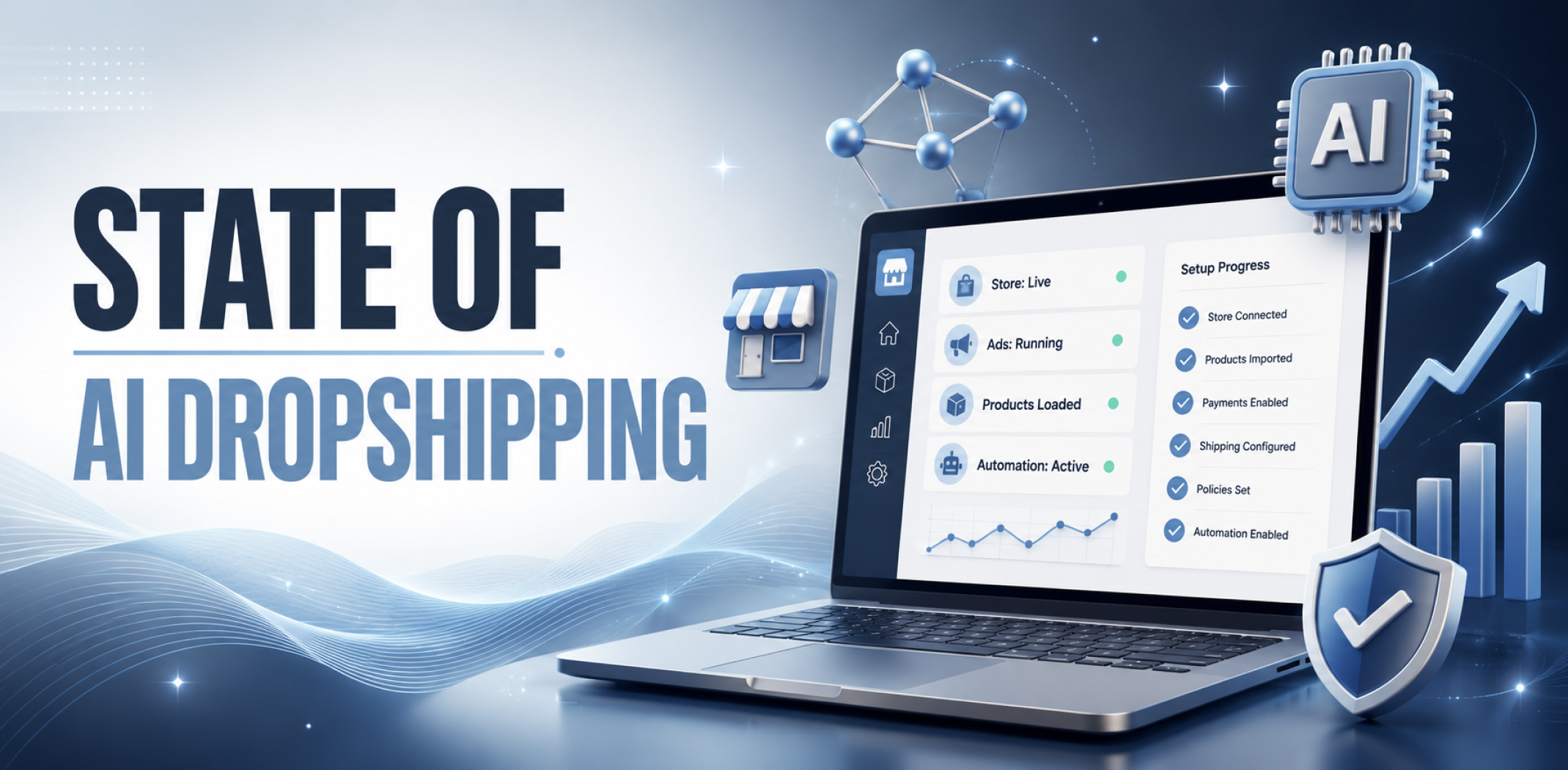
State Of AI Dropshipping In 2026: Full Category Breakdown
Two years ago, “AI dropshipping” was mostly a buzzword tacked onto ad copy. In 2026, it describes a real, measurable shift in how online stores get built and run, with product research, ad creative, and day-to-day operations leaning on artificial intelligence in ways that were not available to the average seller back in 2023.
AI dropshipping means running a store where artificial intelligence handles a large share of the repetitive work: scanning for products with real demand, generating and testing ad creative, and keeping fulfillment and basic customer questions moving without a person doing it all by hand. AliDropship is a digital-only online business platform built around this same idea, pairing a ready-made store with one-click ads and a catalog of digital products and AI-powered toolkits, so a seller does not need five separate AI subscriptions to get the benefit.
⚡
Quick Answer
In 2026, AI dropshipping means product research, ad creative, and basic fulfillment tasks are increasingly automated, while product judgment, supplier trust, and brand building still require a person. Adoption is high, but the tools vary widely in how much they actually do.
🛍️
📦
📣
Your store, already built for 2026
14-day free trial • Cancel anytime • $39/month after trial
Start with size. Dropshipping is not a fringe activity anymore; several market research firms now size the global market above half a trillion dollars for 2026, growing at a double-digit annual rate for the rest of the decade. AI adoption inside that market moved just as fast, with most online retailers now using AI in at least one part of the business.
Global dropshipping market, 2026
$580B+
One widely cited 2026 industry estimate, growing at a double-digit rate every year since.
Retailers using AI in some form
80%+
Most online retailers now use AI somewhere in the business, up sharply from a few years ago.
AliDropship digital product margin
50-70%
The share sellers keep on each digital sale, with nothing lost to inventory or shipping.
Exact estimates vary by research firm, but the direction is consistent: this is one of the fastest-growing corners of ecommerce. The more interesting number is what AI is actually doing inside that market: reshaping the unit economics of running an online business by cutting the time and cost of tasks that used to need specialized skills or a small team.
Real example – one sale
Customer pays $25
Product cost −$8
You keep, this sale $17
AI Productivity Toolkit. One-sale example.
What this means for you
The same margin repeats on every digital sale. No inventory cost eats into it.
AI toolkits like this one generate a personalized result the moment a buyer answers a few questions, so there is nothing to restock or ship. The margin holds whether a store sells one toolkit or a hundred.
No inventory Instant delivery 50-70% margin
That single-sale math does not change no matter how many sales happen in a month; it is a structural fact, not a forecast. What changed is how fast a seller gets from idea to a live, ad-ready store.
How AI actually changes the dropshipping workflow
Every online store goes through the same three stages: finding something worth selling, getting it in front of buyers, and delivering the order. In 2026, each stage has an AI layer underneath it, handling analysis and drafting work a person used to do by hand. For the broader mechanics behind this, AliDropship’s own rundown of AI dropshipping covers the tooling side in more depth.
🔍
Find what to sell
AI scans demand signals across search and social far faster than manual browsing.
📣
Get it in front of buyers
Ad creative gets generated and tested in batches, then routed to the right audience.
⚡
Deliver and support
Digital delivery and first-line questions run on automation, freeing a person for exceptions.
None of this means a store runs itself. It means the floor for how fast one person can move through those three stages has dropped, which is the real story behind the category.
AI-assisted vs manual: what actually changed
Here is what typically changes moving from a manual, tool-by-tool setup to a store built around AI from the start.
Type A
Manual, tool-by-tool
Stitching together separate apps
Product research timeDays per week
Ad creative testingOne variation at a time
Tools and subscriptionsFive or more, often unconnected
Learning curveSteep, tool by tool
Who catches missed trendsWhoever checks most often
⚠️ Still works, but the setup time and tool costs add up fast for a solo seller.
Type B
AI-assisted, built in
One platform handles the layers
Product research timeMinutes, ongoing
Ad creative testingMultiple variations at once
Tools and subscriptionsBuilt into one store
Learning curveOne dashboard to learn
Who catches missed trendsThe system, continuously
✓ Less time spent stitching tools together, more time spent on product and brand decisions.
Neither column removes the need for judgment. It moves where a seller spends attention: away from repetitive setup work, toward the decisions that actually determine whether a store lasts.
Your share of every digital sale
50-70%
14-day free trial • Cancel anytime • $39/month after trial
“AI dropshipping” covers a lot of ground, so it helps to break the category into the three places AI actually shows up in a working store, rather than treating it as one big feature.
Category · Product discovery
AI Product Research
Most mature
Adoption among active sellersHigh
Manual research steps replacedMost of them
Trend scanning Demand signals Competitor scans
The most mature AI use case in the category. Tools scan search trends and marketplace activity to flag products with real demand, replacing hours of browsing with minutes of review.
⚠️
Watch for this: AI research tools can misjudge demand for a niche product. Treat the output as a shortlist to verify, not a final answer.
Category · Marketing
AI Ad Creative & Testing
Fast-growing
Creative variations testedDozens per week
Manual copywriting neededGreatly reduced
Copy generation Fatigue detection One-click ads
AI now drafts and tests ad creative far faster than a person typing one version at a time, and flags when a winning ad loses steam. AliDropship builds this into its one-click ads, so a seller sets a budget instead of managing campaigns by hand.
✓
Where this helps most: sellers with no marketing background, since the system handles targeting and creative testing behind the scenes.
Category · Operations
AI Fulfillment & Support
Early stage
Order routing automatedVery high
Routine support handled by AIAbout half
Instant delivery First-line replies Order status
Digital delivery was already close to instant, so the bigger shift is on the support side: routine questions about order status increasingly get a first response from AI before a person sees the ticket.
⚠️
Watch for this: this is the least mature of the three areas. Anything past a routine question still needs a person to close the loop.
Product research is the most mature of the three, marketing is catching up fast, and support automation is still early. A platform that is genuinely AI-powered usually shows progress across all three, while an AI-labeled one tends to lean on a single flashy feature and call the rest done. For the wider picture of AI in ecommerce beyond dropshipping specifically, the same three-stage pattern shows up across most online retail.
🛍️
📦
📣
Skip the five-tool stack entirely
14-day free trial • Cancel anytime • $39/month after trial
For a full breakdown of how platforms stack up, see the category-level platform comparison. Most platforms now claim some AI functionality, but the depth varies between a genuinely AI-first build and one with a single bolted-on feature.
14-day free trial · Cancel anytime · $39/month after trial
What this looks like for real sellers
Two composite examples below, built from patterns common among AliDropship store owners, show what this shift tends to look like in practice.
🧑💻
Priya – Austin, TX
AliDropship · Digital toolkit store · 2026
Before AliDropship, Priya paid for three separate AI subscriptions to research products and draft ad copy, and still handled targeting by hand. She switched to a single AliDropship store with the built-in AI ad system turned on and stopped juggling logins. The research and drafting that used to eat her Sunday afternoons now happens inside one dashboard.
Her main takeaway: the time saved came from consolidation, not from any single tool being smarter than the rest.
🧑🎓
Marcus – Leeds, UK
AliDropship · AI Productivity Toolkit · 2026
Marcus was skeptical that AI-labeled platforms did much beyond a chatbot bolted onto checkout. He tested AliDropship AI Productivity Toolkit against a manual planning template he had used for months, and it generated a comparable plan in seconds instead of an hour of drafting. That test changed how he evaluates AI-labeled tools before paying for them.
His main takeaway: a quick side-by-side test against the old manual way is the fastest way to tell a real AI feature from a labeled one.
*Individual results vary and depend on the time you put in. These are composite examples built from common patterns, not single verified individuals.
Neither story involves a dramatic income claim, on purpose. The honest version is about time and workload, not a shortcut to a specific dollar outcome.
Strategies for staying ahead of the category
Four habits separate sellers who benefit from the AI shift from those who just add subscriptions without changing how they work.
🧩
Let one platform do the busywork
Stitching together five AI tools creates its own overhead: five logins, five bills, no single view of what is working. A store built with the AI layer already inside it removes that overhead by default.
Example: replacing 3 separate subscriptions with one built-in system is a common first move.
💡
Treat AI output as a first draft
AI tools sometimes invent product details or overstate a claim. Reviewing generated copy before it goes live catches those mistakes before a customer or an ad platform does.
Example: a 2-minute review pass before publishing a new product listing catches most errors.
🤔
Put your judgment where AI cannot go
Spend the time AI frees up on calls that actually need a person: which products fit your brand, how to handle a frustrated customer, what makes your store worth trusting.
Example: reviewing the top 5 AI-suggested products yourself before adding any of them.
🔍
Track the category, not just your store
This category moves fast. Checking where AI dropshipping trends are actually headed every quarter keeps a seller from getting caught off guard by a shift the rest of the category already adjusted to.
Example: a quarterly 15-minute check on category news is enough for most sellers.
None of these habits require technical skill. They are closer to editorial habits than engineering ones, part of why the category still has room for beginners.
Across the wider dropshipping industry, AI can analyze supplier data, but it cannot verify shipping reliability or how a supplier handles problems once orders scale. That still takes a person checking in directly.
02
Catching inaccurate AI-generated claims
AI tools occasionally invent product specifications or overstate a benefit. Publishing generated copy without reviewing it first risks ad disapprovals and misleading product pages.
03
Building genuine brand trust
Repeat customers come back because a store feels consistent and honest over time, something a person builds through tone and follow-through, not something AI has context for.
04
Handling ambiguous support escalations
AI handles routine order questions well. A frustrated customer with an unusual situation still needs a person who can read the context and make a call the script does not cover.
05
Final compliance and ad-policy calls
Ad platforms and consumer rules change often, and an AI tool trained on older data can miss a recent policy shift. A final human review before anything goes live is the safer habit.
06
Long-term strategic decisions
What to sell next quarter, when to raise a budget, and how to position a brand are decisions AI can inform with data, but a person still has to make the call.
None of this is a knock on the tools. It is a map of where automation is genuinely mature versus where a seller still needs to show up in person, which brings up the questions most people actually ask.
Before you scroll past
The three things most people wonder about
🤔
Is AI dropshipping actually different, or just a label?
It depends on the platform. Genuine AI-powered platforms automate research, marketing, and operations at once, while an AI-labeled platform often has one visible feature bolted onto an otherwise manual system.
💸
If AI runs research and ads, is anything left for me?
Yes. Product choice, reviewing AI output before it goes live, and handling anything past a routine question still fall to a person, no matter how automated the rest of the store gets.
🔍
Is an AI-labeled platform actually AI-powered?
Not always, which is worth checking. AliDropship builds its one-click ad system and AI toolkit catalog directly into the platform, backed by over 1.5 million stores launched and a 4.7 star Trustpilot rating.
Being able to answer those three questions honestly, even when the answer includes a limitation, is a decent test for telling a real AI dropshipping platform from a marketing label.
Are you ready to let AI handle the busywork?
Real margin on every digital sale, not a payout cap that never moves.
14-day free trial · Cancel anytime · $39/month after trial
With the category context out of the way, here is where AliDropship fits into all of this.
Where AliDropship fits into the AI dropshipping category
No experience? No problem. If you want the simplest way to start an online business in 2026, AliDropship is one of the most beginner-friendly platforms out there. It brings your store, your digital products, your fulfillment, and your marketing together in one place, so you can launch fast and grow with confidence. Over 1,500,000 stores have already been built on AliDropship, and the platform has been featured by Forbes, Entrepreneur, Inc., NBC, Business, and Fox News.
1.5M+
stores launched
4.7★
on Trustpilot
$1.5B+
earned by owners
150+
countries
🛍️
Free turnkey store
Your store comes fully built, designed, and stocked with products, ready to go the moment you sign up. There is nothing to code and nothing to design from scratch. It looks polished and professional from day one, so you can skip the setup work and get straight to the business.
📦
Products
Once your store is live, you can build your catalog with digital products like guides, courses, checklists, and AI-powered toolkits delivered instantly, keeping up to 70 percent of each sale. New products are added regularly, so your store always has something fresh to offer.
⚡
Instant fulfillment
Every digital product delivers itself the moment a customer buys, with no packing, no shipping, and no waiting. Guides, courses, checklists, and AI-powered toolkits arrive automatically, so you never touch a single box. Fulfillment runs itself, so you are free to focus on bringing in customers.
📣
Marketing & promotion tools
To help you sell, AliDropship’s built-in ad system is its most popular feature. While most platforms expect you to learn and manage your own marketing, this one does it for you, so there is no need to set up Google Ads or Facebook Ads yourself. Choose your daily budget, anywhere from $10 to $50, and the system handles targeting, creatives, and optimization behind the scenes. No marketing background needed: your store can start selling the same day you turn ads on.
👌
Ease of use
AliDropship is built for beginners: no coding, no confusing dashboards, just a simple, guided setup that walks you through every step. The whole platform works right from your phone, and a personal growth manager is available by chat if you ever get stuck. As you grow, adding new products, ads, and features stays just as simple, so scaling never feels overwhelming.
That is the practical answer to the “AI-labeled versus AI-powered” question raised earlier: the automation sits inside the store and ad system by default, not as a separate add-on. For context on why that changes the math of starting an online business, see the full guide to starting an online business.
Before you decide
Everything included to make starting easy
🆓
14-day free trial
Full platform access. No credit card required to start.
🎯
$40 ad coupon included
Your first campaign costs nothing – the coupon covers it.
❌
Cancel anytime
No lock-in. No cancellation fees. Leave any time.
🏪
Store built for you
No setup, no design, no coding. It is ready when you are.
📦
No inventory ever
Digital products deliver instantly. Nothing to stock or ship.
That is the full picture: a fast-growing category, real AI automation where it is actually mature, and a platform built digital-first around it from day one.
🛍️
📦
📣
Ready to join the AI-first side of the category?
14-day free trial • Cancel anytime • $39/month after trial
Your store arrives prebuilt with a digital product catalog and one-click ads already wired in, so the AI layer this whole category is chasing comes standard.
14-day free trial $39/month after Cancel anytime $40 ad coupon included
✓ Store built for you ✓ No inventory ✓ AI-powered ads built in
FAQ
What is AI dropshipping in 2026?
AI dropshipping means running a store where artificial intelligence automates much of the repetitive work, including product research, ad creative, and basic fulfillment tasks. It does not remove the need for a person to make product and brand judgment calls. Around 80 percent of online retailers now use AI in at least one part of the business.
How big is the AI dropshipping market right now?
Estimates vary by research firm, but most 2026 reports place the global dropshipping market above 500 billion dollars, growing at a double-digit annual rate. AI adoption inside that market has grown just as fast. The exact figures differ because methodologies differ, not because the growth trend is in question.
What can AI actually do for a dropshipping business?
AI is strongest at product research, where some tools report cutting manual research time by as much as 85 percent. It is also used to draft and test ad creative, cutting the time needed to find a winning ad. Fulfillment and support automation is newer, with routine questions increasingly handled by AI first.
What can AI dropshipping tools not do yet?
AI cannot vet a supplier relationship, verify that generated product claims are accurate, or build the brand trust that keeps customers coming back. It also cannot make final legal or compliance calls, since policies change faster than most AI tools update. Only about 7 percent of retailers report having fully scaled their AI use even now.
Is AI dropshipping still worth starting in 2026?
Yes, for sellers who treat it as a tool rather than a shortcut. Digital products on platforms like AliDropship carry a 50 to 70 percent margin per sale with no inventory or shipping cost, and AI cuts the time needed to research products and test ads. Results still depend on the seller reviewing output and putting in the work.