How To Start An AI-Powered Ecommerce Business In 2026


AI is no longer a futuristic concept reserved for tech giants. In 2026, it is a practical, accessible toolkit that anyone – from a first-time entrepreneur to a seasoned seller – can use to build and run a profitable online business. The question is no longer whether AI will reshape ecommerce. It already has. The real question is: are you using it yet?
Quick Answer: Using AI for ecommerce means applying AI-powered tools to automate store setup, product research, content creation, customer service, and marketing – cutting the time and cost of launching and growing an online store significantly. Beginners can go from zero to a live, selling AI store in a matter of weeks.
The global AI in ecommerce market is projected to exceed $22 billion by 2030, growing at a compound annual rate of over 14%. That growth is not happening in Silicon Valley boardrooms – it is happening in the stores of everyday entrepreneurs who figured out how to let AI handle the heavy lifting while they focus on building their brand and scaling their income.
This guide covers everything you need to know about starting an AI-powered ecommerce business in 2026 – from choosing your niche and setting up your AI store to the best AI tools on the market and how to use them to grow fast. Whether you are starting from zero or looking to upgrade an existing operation, the strategies here apply directly.
What is AI for ecommerce?
AI for ecommerce refers to the application of artificial intelligence technologies – machine learning, natural language processing, computer vision, and predictive analytics – to the systems and processes that power online retail.
In practice, this means using AI tools to write product descriptions, generate ad creatives, answer customer questions, predict bestselling products, personalize the shopping experience, and automate repetitive backend tasks that used to eat hours out of every seller’s week.
The shift happening in 2026 is significant. AI tools are no longer expensive enterprise software.
Platforms like ChatGPT, Midjourney, and Claude have made it possible for a solo entrepreneur to operate with the efficiency of a full marketing team, a customer service department, and a data analytics unit – all at a fraction of the traditional cost.
This is what makes an AI ecommerce business genuinely viable for beginners today in a way it simply was not three years ago.
Why this works in 2026: AI tools have crossed a quality threshold where the output – whether it is product copy, ad imagery, or customer responses – is good enough to convert real buyers. Combined with dropshipping, the model becomes highly accessible: no inventory, no upfront stock, no warehouse required.
Understanding AI in ecommerce also means recognizing what it does not replace. AI cannot build a brand on its own, create authentic relationships with customers, or make judgment calls about long-term strategy. Think of it as having an incredibly fast, tireless assistant who handles execution while you focus on direction. That distinction matters for setting realistic expectations from day one.
In 2026, the barrier to entry for AI ecommerce has never been lower. The combination of no-code store platforms, on-demand AI tools, and the dropshipping model means you can test your first product in a real market before committing significant time or money – which is exactly what makes this the right moment to start.
How much can you realistically earn with an AI ecommerce business?
Earnings from an AI-powered ecommerce business vary widely depending on your model, niche, traffic strategy, and how consistently you apply the tools available to you. The table below gives a realistic range based on what entrepreneurs across the AliDropship community and the broader dropshipping space are actually reporting in 2026.
The figures above reflect what is achievable once a store is established and generating consistent traffic. Most new stores take 60–90 days to hit their first meaningful sales, and reaching the upper end of these ranges typically requires full-time effort, ongoing optimization, and a solid paid traffic strategy.
One note on ceiling figures: The $10,000+ monthly range is real, but it is not the starting point. Most entrepreneurs earning at that level spent 6–12 months building their store, testing products, and refining their marketing. The lower end – $500 to $1,500 per month – is far more achievable in the first 90 days with consistent, focused effort.
The biggest advantage an AI ecommerce business has over traditional models is speed. What used to take weeks – writing product listings, creating ad copy, designing store pages – can now be compressed into hours. That speed advantage compounds over time: faster testing, faster iteration, faster scaling toward the numbers that actually matter.
The most important takeaway from these numbers is that AI does not change the fundamental math of ecommerce – it changes the speed at which you can execute. Faster content production, faster ad testing, faster product launches. That execution speed is what separates AI-powered stores from traditionally run ones, and it compounds significantly over the first year.
START FREE WITH AN AI INFLUENCER
How to start an AI-powered ecommerce business in 2026
Starting an AI ecommerce business does not require a technical background, a large budget, or years of retail experience. What it requires is a clear process. Here is how to move from zero to a running AI store in a logical, step-by-step sequence.
Step 1: Choose a niche with AI assistance
The first decision – and one of the most consequential – is picking the right niche. This is where AI tools give you an immediate edge over traditional approaches. Instead of spending weeks manually browsing trends and running competitor research, you can use AI to do it in an afternoon.
Start with a broad category you have some interest or knowledge in – home and garden, fitness, pet products, tech accessories, beauty and wellness.
Then use ChatGPT to generate subcategory ideas, identify specific pain points buyers are searching for, and map out what competitors in that space are missing.
Cross-reference with Google Trends, AliExpress bestseller lists, and subreddit communities to validate demand before committing.
A profitable niche in 2026 typically has three qualities: consistent search demand, a clearly defined buyer persona, and room for differentiation. AI tools can help you evaluate all three quickly. The goal at this stage is not perfection – it is speed and good-enough accuracy so you can move forward and test your assumptions against a real market.
Step 2: Set up your AI store
Once your niche is chosen, the next step is setting up your store. This is where a platform like AliDropship removes nearly all of the technical friction. You get a turnkey store – already designed, already populated with products, and already optimized for conversions – so you can skip the months-long setup process and go straight to selling.
Within your store, AI tools layer on top of the base setup.
Use ChatGPT or Claude to generate custom homepage copy, write compelling about-page content, craft product descriptions that speak directly to your target buyer, and produce SEO-optimized blog posts that build organic traffic over time.
These tools produce store-ready copy in minutes – content that previously required a professional copywriter to produce.
The design side is equally streamlined. AI image tools like Midjourney and DALL-E 3 let you generate product lifestyle images, banner creatives, and logo concepts without hiring a designer. For most beginner stores, a combination of supplier product images and AI-generated lifestyle visuals is more than sufficient to start converting traffic effectively from day one.
Step 3: Automate product research and importing
Product research is one of the most time-intensive parts of running an ecommerce store – and one of the easiest to accelerate with AI. In 2026, AI-powered product research tools can analyze sales velocity, customer review sentiment, seasonal demand patterns, and competitor pricing in real time, delivering data-backed product recommendations instead of guesswork.
Once you identify winning products, platforms like AliDropship let you import them directly into your store in a single click – product images, specifications, pricing, and supplier details included.
You then layer on AI-written product descriptions optimized for both SEO and conversions. This combination – AI research, one-click import, AI copy – means you can go from product idea to live listing in under 30 minutes.
Earning potential: A well-selected product with AI-optimized listings can generate $30–$80 per day from organic search alone once it ranks, and significantly more once you add a paid traffic channel behind it.
Step 4: Use AI to automate your marketing
Marketing is where AI for ecommerce delivers the most dramatic time savings. Writing ad copy, generating creatives, drafting email campaigns, scheduling social posts, and A/B testing landing pages – all of these tasks can now be handled or significantly accelerated with AI tools that cost less per month than a single freelance copywriting session.
For paid advertising, tools like AdCreative.ai generate scroll-stopping ad creatives in seconds, while ChatGPT can produce dozens of headline and body copy variations for Facebook or Google Ads in a single session. This means you can test more angles in less time, find your winning creative faster, and scale ad spend with confidence backed by real performance data.
For email marketing, AI-powered platforms like Klaviyo use behavioral data to personalize campaigns automatically – sending the right message to the right segment at the right time.
Abandoned cart sequences, post-purchase follow-ups, and win-back campaigns can all be configured once and run on autopilot indefinitely. For a beginner store, this level of automation used to require a dedicated marketing team. In 2026, it requires an afternoon of setup.
Step 5: Automate customer service with AI
Customer service is one of the biggest bottlenecks for solo ecommerce operators. Handling order status questions, return requests, product queries, and complaint resolution manually is exhausting and unsustainable at scale. AI chatbots solve this almost entirely, and they do it around the clock.
AI-powered tools like Tidio AI can handle 70–80% of common customer inquiries automatically, 24 hours a day, seven days a week. They integrate directly with your store, pull live order data, and respond to customers in seconds – often resolving issues before they escalate into refund requests or negative reviews.
The result is faster resolution times, higher customer satisfaction scores, and a significant reduction in your daily operational workload.
For more complex issues, AI tools can draft response templates and suggest the appropriate resolution based on the context of the inquiry. You review and approve – the AI does the writing. This hybrid model keeps a human in the loop for edge cases while eliminating the grind of repetitive, time-consuming responses that drain energy from every other part of the business.
With these five steps in place – niche research, store setup, product importing, marketing automation, and customer service – you have the core infrastructure of a functioning AI ecommerce business. Everything from here is optimization and scaling.
Best AI tools for ecommerce in 2026
The AI tools ecosystem for ecommerce has expanded rapidly. Here is a breakdown of the most useful tools by function, based on what is actually working for store owners running AI businesses in 2026.
AI tools for content and copy
ChatGPT (OpenAI)
The most versatile AI writing tool available. Use it for product descriptions, homepage copy, blog posts, email campaigns, ad copy, FAQ sections, and customer service templates.
GPT-4o, the current flagship model, produces high-quality ecommerce copy that requires minimal editing before publishing. A single ChatGPT Plus subscription at $20 per month gives you access to all of this – one of the highest-ROI tools in any AI ecommerce toolkit.
Claude (Anthropic)
Particularly strong for long-form content – detailed product guides, SEO blog articles, and comprehensive brand messaging documents. Claude handles nuanced tone well, which makes it useful when you need copy that feels less templated and more human. It pairs well with ChatGPT for cross-checking outputs and generating variation drafts when you need options to test against each other.
Jasper
Purpose-built for marketing teams and ecommerce brands. Jasper includes templates specifically designed for product listings, Facebook ad copy, Google ad copy, and email sequences. It is slightly more expensive than ChatGPT but includes team collaboration features that become useful when you bring on contractors or a virtual assistant as your store scales.
AI tools for visuals and design
Midjourney
The industry standard for AI image generation in 2026. Use it to create lifestyle product imagery, banner backgrounds, branded social media creatives, and logo concept drafts. Midjourney output has reached a quality level where AI-generated lifestyle visuals are regularly used in high-converting store pages alongside supplier product photos – without any noticeable quality gap for buyers.
Canva AI
Canva’s built-in AI features – including Magic Design, text-to-image, and AI-generated presentation templates – make it the go-to tool for non-designers who need polished store visuals quickly. The free tier covers most basic ecommerce design needs; the Pro plan at $15 per month unlocks the full AI toolkit along with brand kit storage for consistent visual identity across all your store assets.
AI tools for marketing and automation
AdCreative.ai
Generates high-performing ad creatives for Facebook, Instagram, and Google Ads automatically. The platform uses historical performance data to optimize which creative elements – colors, layouts, headline styles – work best for your specific niche and campaign objective. For stores running paid traffic, this tool alone can significantly reduce creative testing time and cost per acquisition.
Klaviyo
The AI-powered email and SMS marketing platform that segments your audience automatically and personalizes campaigns based on real buying behavior. Abandoned cart, browse abandonment, win-back, and post-purchase flows can all be set up once and run continuously without manual intervention.
Klaviyo is the ecommerce email standard for good reason – its AI-driven segmentation consistently outperforms manual list management in conversion rate.
Tidio AI
An AI chatbot and live chat platform built specifically for ecommerce stores. Tidio integrates with WooCommerce and other major platforms, handling customer service inquiries automatically without human involvement.
Its AI resolves common questions about orders, shipping, and returns in seconds, reducing support load dramatically as order volume grows and freeing you to focus on the business decisions that actually move revenue.
Choosing the right combination of AI tools is less about budget and more about understanding which part of your workflow needs the most acceleration. For most beginners, starting with ChatGPT for content and Canva AI for visuals covers 80% of immediate needs. Add tools incrementally as your store grows and your revenue can comfortably support them.
LAUNCH WITH YOUR AI INFLUENCER
Legal and ethical considerations for AI ecommerce
Using AI in ecommerce is largely legal and straightforward – but there are a few important boundaries to understand before you scale, particularly around content authenticity, product claims, and intellectual property. Getting these right from the start protects both your store and your reputation.
What to avoid absolutely
Do not use AI to generate fake product reviews or fabricate customer testimonials. This violates FTC guidelines in the US and equivalent consumer protection regulations in most other major markets.
Platforms like Amazon, Google, and Trustpilot have increasingly sophisticated detection systems, and the consequences – account suspension, legal action, and lasting reputational damage – are not worth any short-term conversion lift.
Do not use AI image tools to replicate branded products or create misleading product imagery that misrepresents what a buyer will actually receive. This applies to both branded knockoffs and AI-generated images that exaggerate product quality or utility. Your product images should accurately represent what is being sold, at the quality level buyers will experience when their order arrives.
Key principle: AI should make your store faster and more efficient – not more deceptive. The most sustainable AI ecommerce businesses are built on authentic product selection, honest marketing, and genuine customer value.
What to do instead
Use AI to write compelling, accurate product descriptions that emphasize real benefits and help buyers make informed decisions. Use AI image tools to create lifestyle context around actual supplier images – not to replace or misrepresent them. Use AI chatbots to respond faster and more helpfully to real customer questions – not to deflect accountability for product or shipping issues.
Intellectual property is another area worth watching closely. AI tools trained on public data can occasionally generate content or images that are too similar to existing copyrighted material. A practical safeguard is to run AI-generated copy through a plagiarism checker and AI-generated images through a reverse image search before using them commercially at scale.
The bottom line is that using AI ethically is also using AI strategically. Sustainable ecommerce businesses are built on repeat customers and word-of-mouth – and those only come from consistently delivering genuine value. AI accelerates that process when applied honestly; it undermines it when used as a shortcut around basic seller responsibilities.
Starting your AI ecommerce business on a foundation of honest practices also protects your ad accounts, marketplace accounts, and payment processor relationships – all of which are significantly harder to rebuild than to maintain from the outset.
How to choose your path: AI ecommerce by experience level
Not every reader is starting from the same place. Here is how to approach an AI ecommerce business depending on where you are right now – and what a realistic roadmap looks like at each level.
Complete beginner
If you are new to ecommerce entirely, your priority is reducing setup friction as much as possible. Start with a fully built turnkey dropshipping store and use AI tools selectively: ChatGPT for product descriptions, Canva AI for basic store visuals, and Tidio for customer service automation.
Keep your niche simple and your product range tight – 10 to 15 focused products outperforms a 200-product catalog for a new store that has not yet found its audience.
Realistic first 90 days: $0–$500 per month. The goal is your first sale, then your first consistent week of sales. Every other metric is secondary at this stage. Learning how to drive traffic and read basic analytics is the skill that unlocks everything that follows.
Intermediate / part-time seller
If you already have some ecommerce or digital marketing experience, the opportunity is to layer AI tools systematically on top of what you already know. Use AI for content at scale – multiple optimized product pages, regular blog posts for organic traffic, and ad copy variations you can test in a structured way.
Introduce email automation through Klaviyo and experiment with AI-generated ad creatives through AdCreative.ai. At this level, targeting $1,000–$3,000 per month within 4–6 months of consistent effort is a realistic medium-term goal.
Advanced / full-time goal
If you are aiming to replace a full-time income through an AI ecommerce business, the focus shifts from tools to systems. This means building repeatable processes for product research and launch cycles, using AI for content at volume across multiple traffic channels, and investing in paid advertising with clean attribution and proper analytics in place.
At full-time effort and investment, the $5,000–$10,000 per month range is achievable within 6–12 months – but it requires treating the business as a business, with the same discipline and consistency you would bring to any professional commitment.
The growth trajectory of AI in ecommerce is sharply upward. Merchants who build AI into their core operations now – rather than waiting – are positioning themselves ahead of the majority of competitors who are still managing their stores manually and spending three times as long on tasks that AI can handle in minutes.
The ecommerce landscape in 2026 rewards those who move quickly and systematically. AI is the tool that makes both possible at once. Starting with the right foundation – a ready-made store, a clear niche, and a handful of well-chosen AI tools – gives you the strongest possible starting position in this market right now.
BUILD YOUR INCOME WITH AN AI INFLUENCER
AliDropship: Your complete all-in-one solution for starting dropshipping in 2026
If you want the simplest possible way to start dropshipping – especially if you’re brand new – AliDropship remains one of the most beginner-friendly tools available in 2026. It brings together store creation, product imports, automation, and marketing into a single streamlined system designed to help you launch quickly and grow confidently.
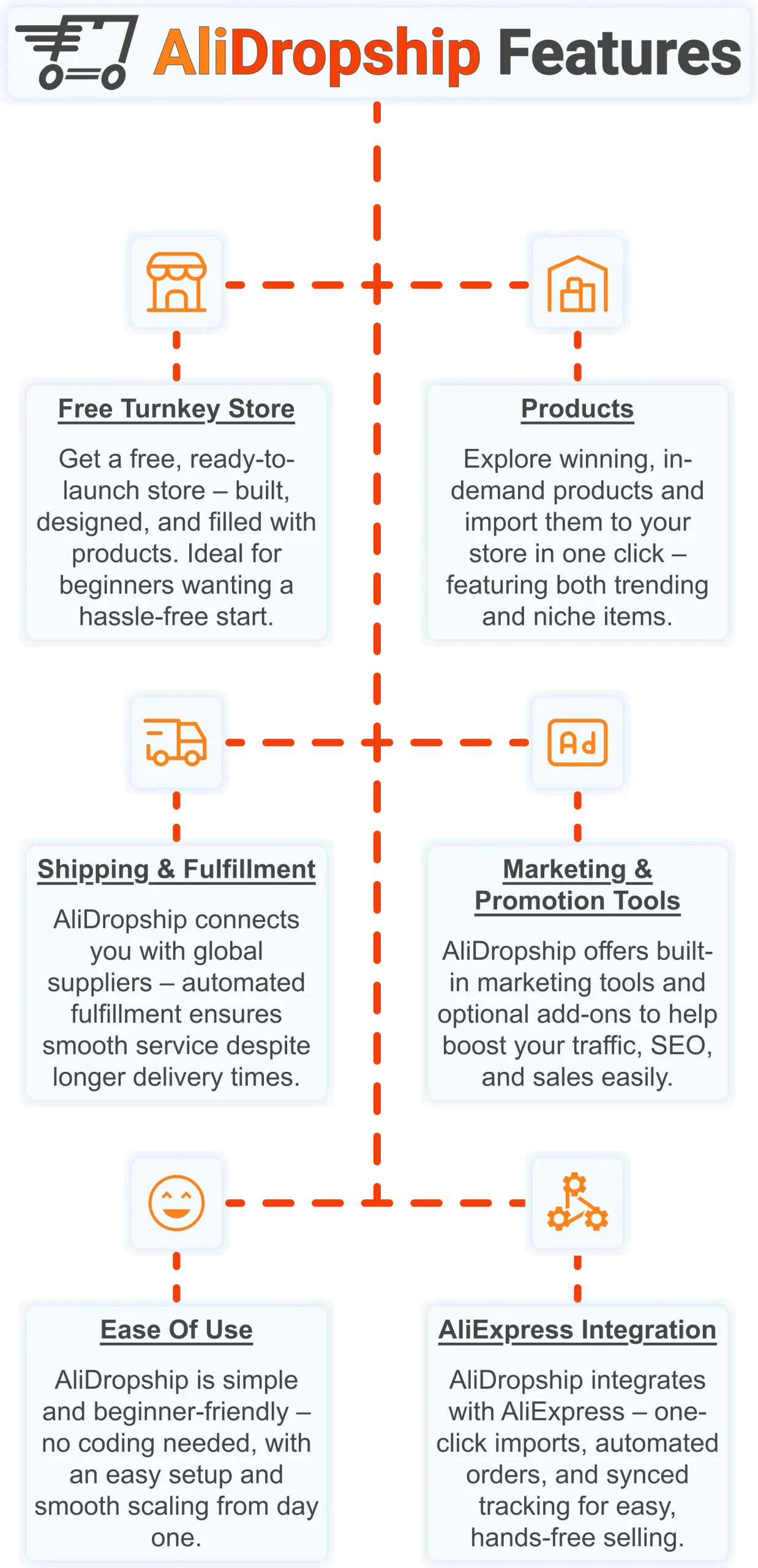
Free turnkey store 🛍️
Get a free turnkey store – built, designed, and filled with products. Ideal for beginners wanting a hassle-free start, the store comes fully optimized to attract customers right away, saving you time on setup. Plus, it includes professional design elements to give your business a polished, trustworthy look from day one. This ready-made foundation makes it easy to move seamlessly into product selection.
Products 📦
Once your store is set up, you can explore winning, in-demand products and import them in one click – featuring both trending and niche items. This wide selection lets you cater to diverse customer interests and test what works best. Regular updates ensure you always have fresh products, keeping your store competitive and relevant. With great products in place, smooth shipping becomes the next essential step.
Shipping & fulfillment 🚚
AliDropship connects you with global suppliers, and automated fulfillment ensures seamless order processing despite international delivery times. Customers receive real-time tracking updates, which builds confidence and trust in your store. Once shipping is handled reliably, you can focus on promoting your store and attracting traffic.
Marketing & promotion tools 📣
To maximize sales, AliDropship offers built-in marketing tools and optional add-ons that help boost traffic, SEO, and conversions. From email campaigns and discounts to social media integration, these tools empower you to reach and retain customers without needing prior marketing experience. With promotion strategies in place, managing your business becomes simpler and more efficient.
Ease of use 👌
AliDropship is beginner-friendly – no coding needed, with an intuitive dashboard that guides you through every step. Easy setup and smooth scaling let you expand your store without stress. As your business grows, adding new features, products, and marketing campaigns remains hassle-free, giving you more time to focus on sales.
AliExpress integration 🛒
Finally, AliDropship integrates seamlessly with AliExpress, enabling one-click imports, automated orders, and synced tracking. Your inventory stays up-to-date with the latest products and prices, while automated order processing frees you from manual tasks.
Combined with the turnkey setup, reliable shipping, and built-in marketing tools, this integration ensures your dropshipping business is fully equipped for growth and success.
AI gives you the tools to compete – an AI influencer gives you the audience, and AliDropship gives you the store to sell from. Claim your free store and AI influencer team to launch your AI ecommerce business today.
What is AI for ecommerce and how does it work?
How much does it cost to start an AI ecommerce business?
What are the best AI tools for ecommerce in 2026?
Can beginners use AI to run an ecommerce store?
How long does it take to make money with an AI online store?