

Payment Processor

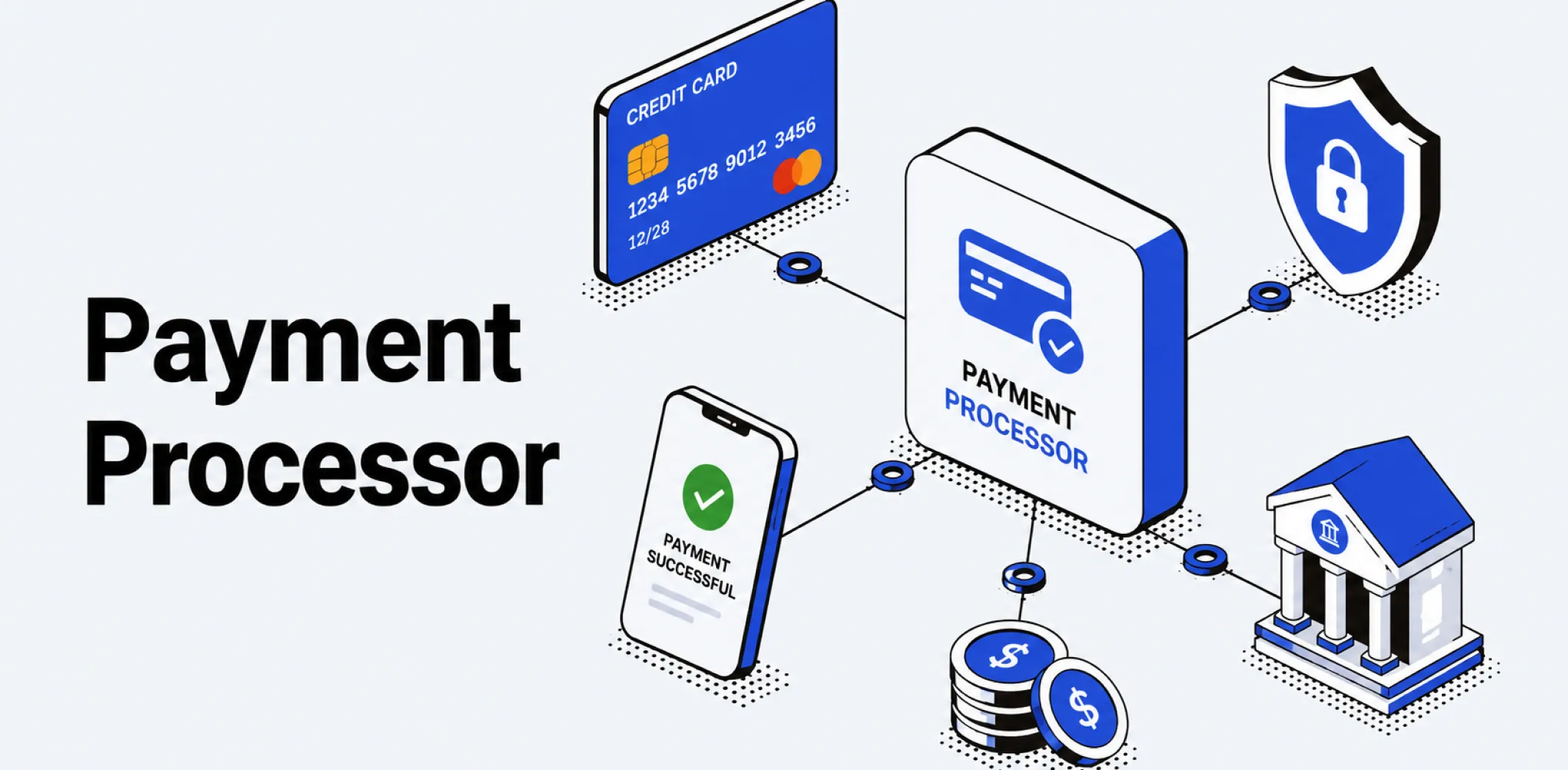
A payment processor is the entity that communicates with card networks, issuing banks, and acquiring banks to authorize and settle a transaction, distinct from a payment gateway, which simply transmits the payment data rather than executing the financial side of credit card processing itself.
Merchants generally access a payment processor through one of two structurally different models.
A dedicated merchant account is opened in the business’s own name through a traditional processor, bank, or independent sales organization (ISO), requiring formal underwriting that includes a credit check and business verification; this typically takes one to three business days, but results in an account isolated from other merchants’ risk and generally more negotiable pricing at higher volumes.
An aggregator, also called a payment facilitator or PayFac, instead pools many merchants under one shared master merchant account, letting a new business start accepting payments within minutes with no credit check, since the aggregator itself is the merchant of record and absorbs the underwriting risk. Providers such as Stripe, PayPal, Square, and Shopify Payments operate primarily on this model.
The trade-off between the two models centers on risk and control. Because an aggregator’s shared account pools transactions across thousands of unrelated businesses, card networks and the aggregator’s risk systems apply uniform policies across that pool; a spike in chargebacks or fraud linked to other merchants on the same account can trigger reviews, holds, or sudden freezes unrelated to an individual merchant’s own conduct.
Aggregators commonly apply a rolling reserve, withholding 5 to 10 percent of processed volume for 90 to 180 days as a risk buffer, particularly for newer or higher-risk merchants. A dedicated account, by contrast, is underwritten specifically for that one business, making freezes comparatively rare once approved, though the upfront process is slower.
As a general guideline, aggregators tend to suit merchants under roughly $500,000 in annual volume, while higher-volume or higher-risk businesses increasingly migrate to a dedicated account for stability and pricing leverage.
Example
A new dropshipping store signs up with an aggregator-model provider and begins accepting payments within minutes, with no credit check or documentation required upfront. As order volume grows, the store experiences a brief account hold after a cluster of unrelated chargebacks hits other merchants sharing the same aggregator pool. To gain more stability and negotiate lower rates, the store eventually applies for a dedicated merchant account, going through a multi-day underwriting process in exchange for an account isolated from other merchants’ risk.
Key characteristics
- Distinct from a payment gateway: A processor executes the actual authorization and settlement of funds, while a gateway only transmits payment data between checkout and processor.
- Two primary access models: A dedicated merchant account is underwritten individually for one business, while an aggregator pools many merchants under a shared master account for faster onboarding.
- Aggregators carry shared risk exposure: Since transactions from many unrelated merchants flow through the same account, one business can be affected by holds triggered by other merchants sharing that pool.
- Rolling reserves are common for aggregators: A percentage of processed volume, typically 5 to 10 percent, is often withheld for several months as a risk buffer for new or higher-risk merchants.
- Volume and risk profile drive the right choice: Lower-volume businesses generally favor an aggregator’s speed, while established merchants often move to a dedicated account for stability and negotiated rates.
Related terms
- Payment gateway – the technology layer that transmits payment data to the processor, distinct from the processor’s role in executing authorization and settlement.
- Credit card processing – the broader authorization, clearing, and settlement system that a payment processor carries out on a merchant’s behalf.
- Stripe – a payment service provider operating primarily on the aggregator model, combining gateway and processor functions under a shared merchant account.
- PayPal – one of the most widely used aggregator-model providers, pooling merchants under its own master merchant account.
- Shopify Payments – a built-in payment processor for Shopify merchants that, like other aggregators, operates under a shared account structure rather than individual merchant underwriting.
Frequently asked questions
What is the difference between a payment processor and a payment gateway?
A payment gateway transmits payment data securely between the checkout and the processor. A payment processor is the entity that actually executes authorization and settlement, communicating with card networks and banks to approve the transaction and move funds. Many providers bundle both functions into a single service.
What is the difference between a dedicated merchant account and an aggregator?
A dedicated merchant account is underwritten individually for one business, requiring a credit check and documentation but offering more stability once approved. An aggregator pools many merchants under one shared account, enabling near-instant approval but exposing each merchant to shared risk policies based on the entire pool’s activity.
Why do payment aggregators sometimes freeze merchant accounts?
Because aggregators pool transactions from many unrelated merchants into a shared account, a spike in chargebacks or suspected fraud linked to other merchants on that same account can trigger reviews or holds that affect a merchant even when their own activity was not the cause.
When should a business move from an aggregator to a dedicated merchant account?
Many businesses consider switching once annual processing volume grows well beyond roughly $500,000, or once account stability and the ability to negotiate lower transaction rates become more important than the faster, simpler setup an aggregator offers.
AliDropship: An all-in-one platform for starting dropshipping in 2026
AliDropship is a dropshipping platform that covers store creation, product imports, order automation, and marketing within a single system. It is designed for users with no prior ecommerce experience, though it also supports scaling for more established stores.
🛍️ Free turnkey store
New users receive a free pre-built store – set up, designed, and stocked with products. The store includes a ready-to-use product catalogue and a standard storefront design. It also comes with hosting, a domain, SSL, and payment systems already set up and included.
📦 Products
The platform provides access to a product catalogue covering both trending and niche items, with one-click import to your store. The catalogue is updated regularly to reflect current market availability. Products can be browsed, filtered, and added without leaving the platform.
🚚 Shipping & fulfillment
AliDropship provides access to a vast catalogue of products from global suppliers and handles order fulfillment automatically once a purchase is made. Customers receive tracking information directly, and orders are processed without manual intervention from the store owner.
📣 Marketing & promotion tools
The platform includes built-in marketing tools covering email campaigns, discount management, SEO settings, and social media integration. These are available within the dashboard and do not require third-party subscriptions for basic use.
👌 Ease of use
AliDropship requires no coding knowledge. The dashboard contains all the necessary tools for managing your store, products, and orders in one place. Additional features and products can be added as the store grows without rebuilding the existing setup.
What is the difference between a payment processor and a payment gateway?
What is the difference between a dedicated merchant account and an aggregator?
Why do payment aggregators sometimes freeze merchant accounts?
When should a business move from an aggregator to a dedicated merchant account?
Are you ready to become an owner
of a profitable online business?
Free Dropshipping Guide