


Credit Card Processing

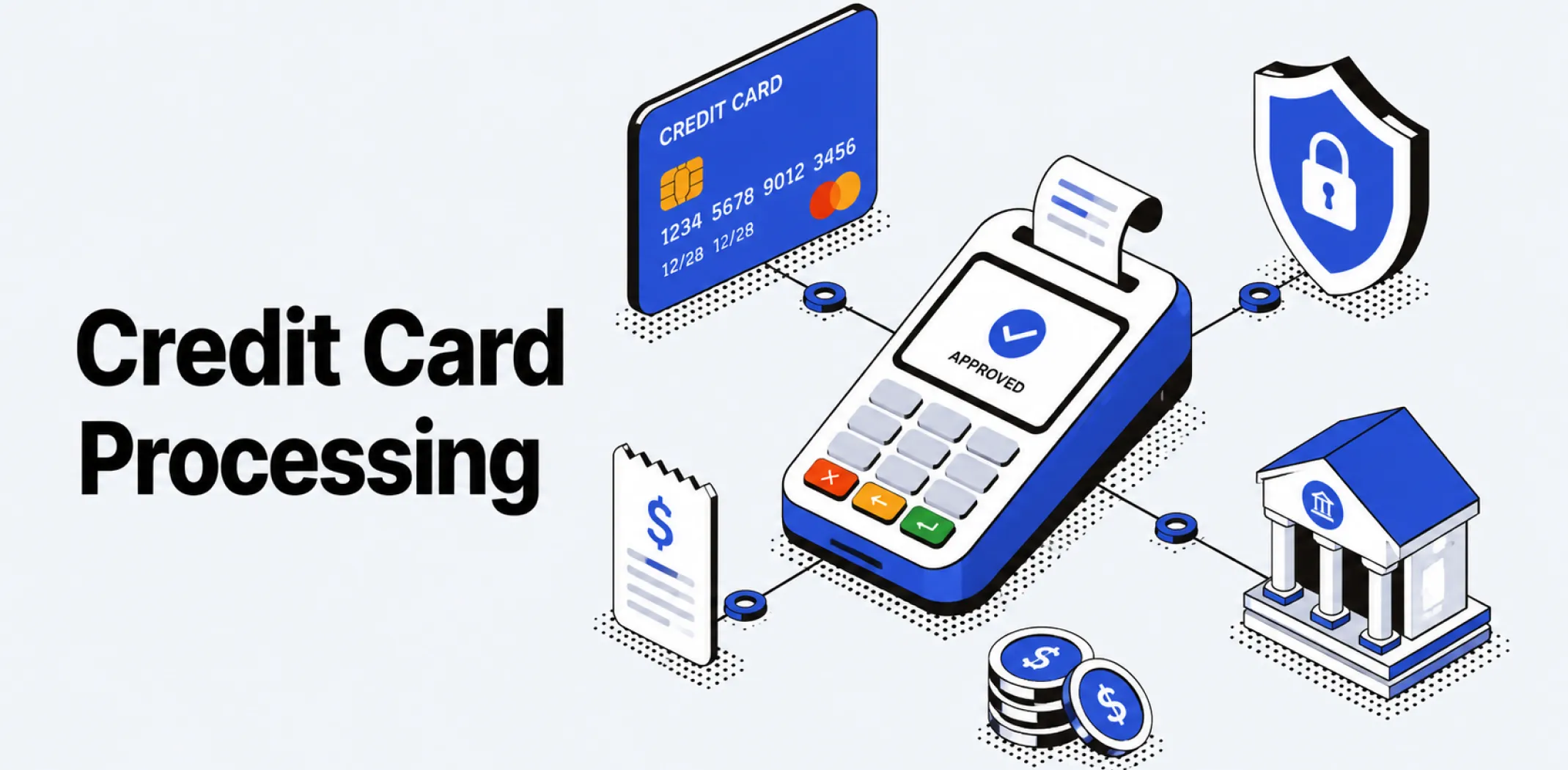
Credit card processing is the behind-the-scenes system that verifies a customer has sufficient funds or credit, approves or declines the transaction within milliseconds, and moves money from the customer’s card-issuing bank into the merchant’s bank account, coordinated by a payment gateway or processor on the merchant’s behalf.
Every card transaction involves several parties working together: the cardholder, the merchant, the merchant’s acquiring bank, the cardholder’s issuing bank, and the card network, such as Visa or Mastercard, that routes communication between the two banks. No money actually moves at the moment a card is approved; approval simply confirms funds are available, with the real transfer happening later through a separate process.
How it works
A typical card transaction moves through three broad stages.
Authorization: the transaction details are sent through the merchant’s payment gateway to the acquiring bank, which routes the request through the card network to the issuing bank; the issuing bank checks for sufficient funds and fraud risk, then sends an approval or decline back through the same path, typically within seconds.
Clearing: at day’s end, the merchant submits its batch of approved transactions to the acquiring bank, which forwards them to the card network; the network calculates the interchange fees owed and routes each transaction to the correct issuing bank.
Settlement: the issuing bank transfers the transaction amount, minus the interchange fee, to the card network, which forwards it to the acquiring bank; the acquiring bank then deposits the remaining funds into the merchant’s account, minus its own fees, typically within one to three business days.
The fees a merchant pays are made up of three layered components.
Interchange fees, set by the card networks and paid to the issuing bank, represent the largest share of total processing costs, generally 60 to 90 percent, varying by card type, transaction method, and merchant category.
Assessment fees are charged by the card network itself for use of its infrastructure, typically a small fraction of a percent.
Processor markup is the processor’s own fee on top, the only genuinely negotiable component, since interchange and assessment rates are set externally and apply uniformly regardless of provider.
Example
A customer buys a $90 jacket from an online store using a credit card. The store’s payment gateway sends the transaction to its acquiring bank, which routes it through the card network to the issuing bank for approval, completing within a couple of seconds. At day’s end, the store batches this transaction for clearing; a day or two later, the issuing bank transfers the funds through the network to the acquiring bank, which deposits the $90 into the store’s account minus the interchange fee, assessment fee, and processor markup.
Key characteristics
- Three distinct stages: Authorization confirms funds in real time, clearing batches and routes approved transactions, and settlement is when money actually changes hands, typically one to three days after the sale.
- Multiple parties involved: The cardholder, merchant, acquiring bank, issuing bank, and card network each play a distinct role in approving and moving funds for a single purchase.
- Interchange fees dominate total cost: Fees set by card networks and paid to issuing banks typically make up the large majority of total processing costs, with processor markup a comparatively small, negotiable slice.
- Online transactions cost more than in-person ones: Card-not-present transactions carry higher interchange rates, since banks cannot physically verify the card or cardholder and face greater fraud and dispute risk.
- Rates shift periodically: Card network interchange tables update roughly twice a year, and ongoing legal settlements and proposed legislation continue adjusting swipe fee levels and merchant routing options.
Related terms
- Payment gateway – the technology layer that initiates the authorization request at the start of the credit card processing cycle.
- Stripe – a payment service provider that handles credit card processing on a merchant’s behalf, abstracting away the underlying bank and network coordination.
- Shopify Payments – a built-in payment gateway that processes credit card transactions for Shopify merchants through the same underlying authorization-to-settlement system.
- Refund policy – a store’s published rules for returning funds, which are reversed back through the same card processing network once a refund is issued.
- Ecommerce – the broader category of online commercial activity that depends entirely on functioning credit card processing to collect payment from customers.
Frequently asked questions
What is the difference between authorization and settlement?
Authorization is the real-time check confirming a customer has sufficient funds, completed within seconds at purchase. Settlement is the actual transfer of money between banks, typically completed one to three days later, after the transaction has been batched and cleared.
What are interchange fees and who sets them?
Interchange fees are charges set by card networks such as Visa and Mastercard, paid by the merchant’s acquiring bank to the cardholder’s issuing bank on every transaction. They typically represent the largest component of total processing costs and vary by card type and merchant category.
Why do online transactions often cost more to process than in-person ones?
Card-not-present transactions, such as online purchases, carry higher interchange rates because banks cannot physically verify the card or cardholder, increasing fraud and chargeback risk. This higher risk is priced into the interchange rate banks charge for these transactions.
Can a merchant negotiate credit card processing fees?
Interchange and assessment fees are set externally by card networks and apply uniformly regardless of provider, so they aren’t negotiable. The processor’s own markup is the one component that can typically be negotiated, particularly for higher-volume merchants.
AliDropship: An all-in-one platform for starting dropshipping in 2026
AliDropship is a dropshipping platform that covers store creation, product imports, order automation, and marketing within a single system. It is designed for users with no prior ecommerce experience, though it also supports scaling for more established stores.
🛍️ Free turnkey store
New users receive a free pre-built store – set up, designed, and stocked with products. The store includes a ready-to-use product catalogue and a standard storefront design. It also comes with hosting, a domain, SSL, and payment systems already set up and included.
📦 Products
The platform provides access to a product catalogue covering both trending and niche items, with one-click import to your store. The catalogue is updated regularly to reflect current market availability. Products can be browsed, filtered, and added without leaving the platform.
🚚 Shipping & fulfillment
AliDropship provides access to a vast catalogue of products from global suppliers and handles order fulfillment automatically once a purchase is made. Customers receive tracking information directly, and orders are processed without manual intervention from the store owner.
📣 Marketing & promotion tools
The platform includes built-in marketing tools covering email campaigns, discount management, SEO settings, and social media integration. These are available within the dashboard and do not require third-party subscriptions for basic use.
👌 Ease of use
AliDropship requires no coding knowledge. The dashboard contains all the necessary tools for managing your store, products, and orders in one place. Additional features and products can be added as the store grows without rebuilding the existing setup.
What is the difference between authorization and settlement?
What are interchange fees and who sets them?
Why do online transactions often cost more to process than in-person ones?
Can a merchant negotiate credit card processing fees?
Are you ready to become an owner
of a profitable online business?
Free Dropshipping Guide