

Shopify Payments

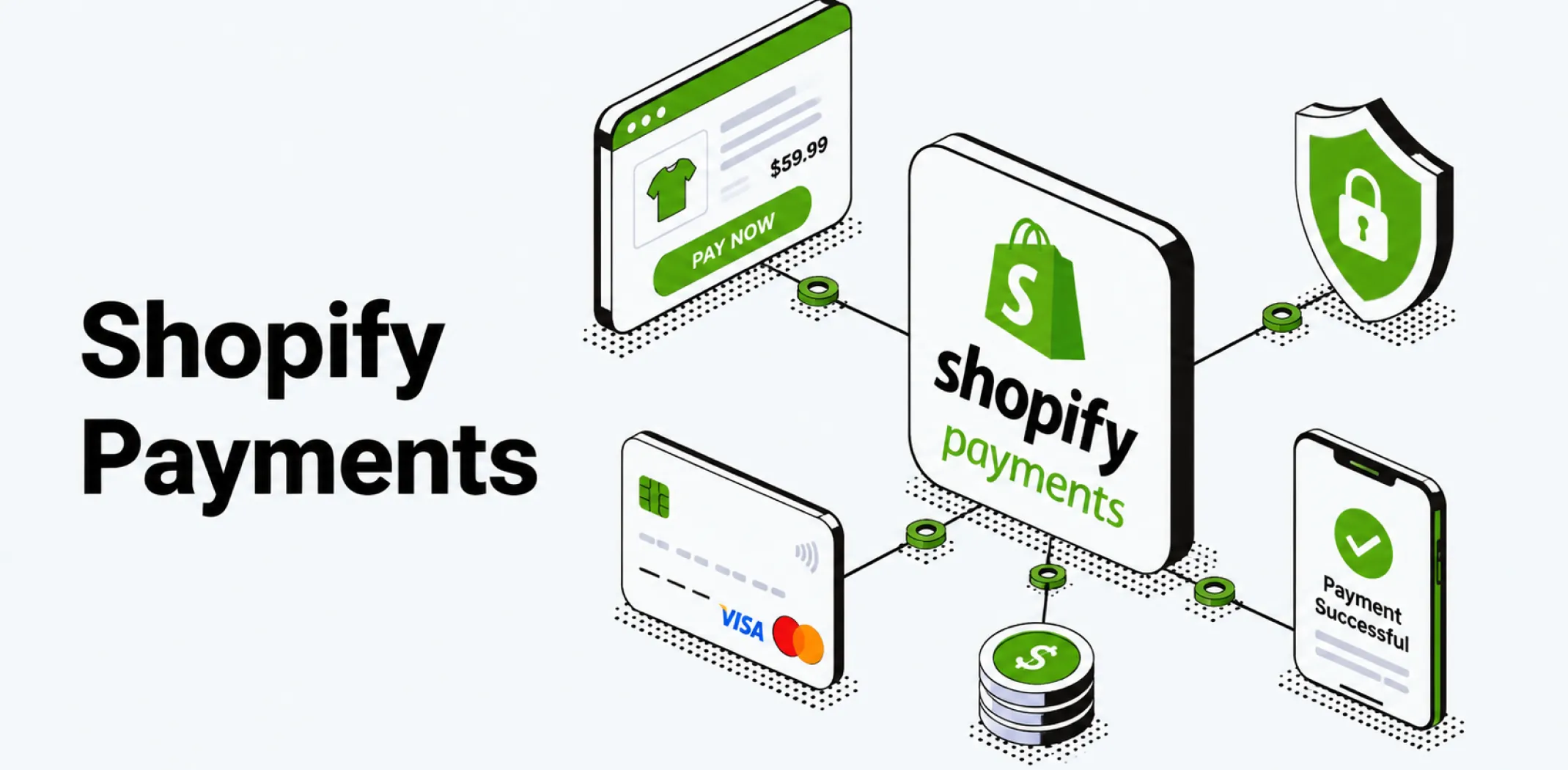
Shopify Payments is Shopify’s own built-in payment gateway, letting merchants accept credit and debit cards, Apple Pay, Google Pay, and Shop Pay directly through the Shopify admin without creating or managing a separate account with an external payment provider.
Technically, Shopify Payments runs on top of Stripe’s underlying payment infrastructure, but it operates as Shopify’s own first-party product rather than a connection to a separate Stripe account, meaning a merchant cannot run Shopify Payments and a standalone Stripe integration side by side; enabling one typically requires deactivating the other.
As of 2026, around 1.85 million merchants use Shopify Payments, with funds typically deposited into a connected bank account within a few business days of a sale.
The most consequential difference between Shopify Payments and any external gateway is Shopify’s third-party gateway fee: merchants who choose to process cards through an outside provider such as Stripe or PayPal, rather than Shopify Payments, are charged an additional surcharge on top of whatever fee that outside provider already charges, ranging from roughly 2% on the Basic plan down to as low as 0.2% on Shopify Plus.
This means a merchant routing payments through Stripe instead of Shopify Payments can end up paying a meaningfully higher effective rate overall, even though Stripe’s own published rate may look comparable or lower in isolation.
Because of this surcharge structure, Shopify Payments is the default, lowest-cost option for the large majority of merchants operating in one of its supported countries, with third-party gateways remaining relevant mainly for businesses in unsupported regions, certain high-risk industries Shopify Payments does not service, or those needing a specific feature, such as advanced subscription billing, that an outside provider offers more directly.
Example
A new dropshipping store on Shopify’s Basic plan enables Shopify Payments during setup, entering business and bank details directly in the Shopify admin without creating any separate account. When a customer checks out with a credit card, the transaction is processed at Shopify Payments’ standard rate with no additional surcharge. Had the merchant instead connected a standalone Stripe account, the same transaction would have incurred Stripe’s own processing fee plus an extra 2% third-party gateway fee charged by Shopify on top, resulting in a noticeably higher total cost for an equivalent sale.
Key characteristics
- Built into the Shopify admin: Setup happens entirely within Shopify’s settings, requiring only business and bank account details rather than a separate signup process with an outside provider.
- Powered by Stripe, but first-party: Shopify Payments runs on Stripe’s processing infrastructure underneath, but functions as Shopify’s own product, meaning it cannot be used alongside a separate, standalone Stripe integration.
- Avoids the third-party gateway surcharge: Using any outside payment processor instead of Shopify Payments triggers an additional fee, ranging from roughly 2% on Basic to 0.2% on Plus, on top of that processor’s own rate.
- Limited geographic availability: Shopify Payments is only available in a defined set of countries; merchants outside that list must use a third-party gateway by default.
- Tied to other Shopify features: Enabling Shopify Payments unlocks related tools such as Shop Pay’s accelerated checkout and chargeback protection on eligible Shop Pay transactions, benefits not extended to orders processed through outside gateways.
Related terms
- Shopify – the hosted ecommerce platform that Shopify Payments is built into as its native, first-party payment option.
- Payment gateway – the broader technology category that Shopify Payments belongs to, alongside third-party alternatives such as Stripe and PayPal.
- Stripe – the underlying processing infrastructure Shopify Payments runs on, while also remaining available to Shopify merchants as a separate, surcharged third-party option.
- PayPal – a commonly used third-party alternative to Shopify Payments, automatically provisioned for new Shopify stores but subject to the same gateway surcharge unless Shopify Payments is also enabled.
- Refund policy – a store’s published rules for returning funds, processed back to the customer through whichever gateway, including Shopify Payments, handled the original transaction.
Frequently asked questions
Can I use Shopify Payments and Stripe at the same time?
No, since Shopify Payments runs on Stripe’s infrastructure as Shopify’s own first-party product, a merchant cannot run a separate, standalone Stripe integration alongside it. Enabling Shopify Payments typically requires deactivating any existing third-party Stripe connection first.
What happens if I use Stripe or PayPal instead of Shopify Payments?
Shopify charges an additional third-party gateway fee on every transaction processed through an outside provider, ranging from roughly 2% on the Basic plan down to 0.2% on Plus, on top of whatever fee that outside provider charges. This often makes routing payments through an external gateway more expensive overall than using Shopify Payments directly.
Is Shopify Payments available in every country?
No, Shopify Payments is only available in a defined set of supported countries. Merchants based outside that list must rely on a third-party gateway by default, since Shopify Payments cannot be enabled for their account.
Does Shopify Payments offer any features outside payments do not?
Yes, enabling Shopify Payments unlocks related benefits such as Shop Pay’s accelerated checkout and chargeback protection on eligible Shop Pay transactions, neither of which is extended to orders processed through a separate, third-party gateway.
AliDropship: An all-in-one platform for starting dropshipping in 2026
AliDropship is a dropshipping platform that covers store creation, product imports, order automation, and marketing within a single system. It is designed for users with no prior ecommerce experience, though it also supports scaling for more established stores.
🛍️ Free turnkey store
New users receive a free pre-built store – set up, designed, and stocked with products. The store includes a ready-to-use product catalogue and a standard storefront design. It also comes with hosting, a domain, SSL, and payment systems already set up and included.
📦 Products
The platform provides access to a product catalogue covering both trending and niche items, with one-click import to your store. The catalogue is updated regularly to reflect current market availability. Products can be browsed, filtered, and added without leaving the platform.
🚚 Shipping & fulfillment
AliDropship provides access to a vast catalogue of products from global suppliers and handles order fulfillment automatically once a purchase is made. Customers receive tracking information directly, and orders are processed without manual intervention from the store owner.
📣 Marketing & promotion tools
The platform includes built-in marketing tools covering email campaigns, discount management, SEO settings, and social media integration. These are available within the dashboard and do not require third-party subscriptions for basic use.
👌 Ease of use
AliDropship requires no coding knowledge. The dashboard contains all the necessary tools for managing your store, products, and orders in one place. Additional features and products can be added as the store grows without rebuilding the existing setup.
Can I use Shopify Payments and Stripe at the same time?
What happens if I use Stripe or PayPal instead of Shopify Payments?
Is Shopify Payments available in every country?
Does Shopify Payments offer any features outside payments do not?
Are you ready to become an owner
of a profitable online business?
Free Dropshipping Guide