

Lookalike Audience

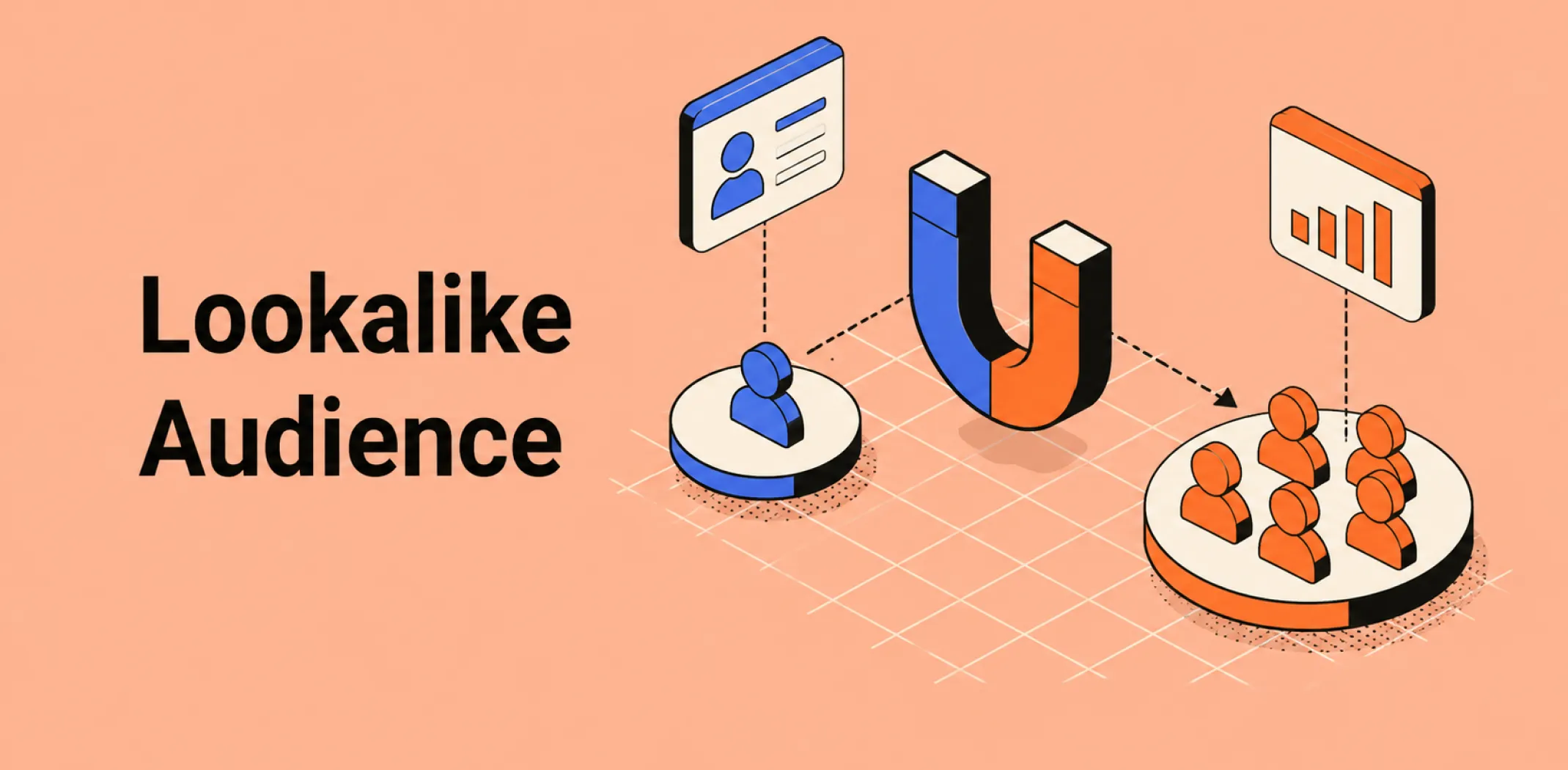
A lookalike audience is a targeting segment built by an advertising platform that identifies new users sharing characteristics with an existing source audience, such as past customers or website visitors, with the goal of reaching new people likely to behave similarly to that source group.
To build a lookalike audience, an advertiser uploads or selects a source audience, sometimes called a seed audience, such as a customer list or website visitor data. The platform’s algorithm then analyzes signals like purchase behavior, content engagement, and demographic patterns across that seed group, and searches its broader user base for people who match those patterns.
Meta popularized the term lookalike audience and remains the most well-known implementation, with audience size configurable between 1 and 10 percent, where a lower percentage means higher similarity to the source.
TikTok Ads offers a similar feature with Narrow, Balanced, and Broad size presets and a minimum source audience of 1,000 users. Google Ads previously offered an equivalent feature called Similar Audiences, but officially discontinued it in 2023 due to changes in available data, shifting instead toward Optimized Targeting and Customer Match as alternatives.
For dropshipping and ecommerce sellers, lookalike audiences are commonly built from past purchaser lists, since seeding from actual buyers generally produces stronger matches than seeding from general website traffic.
Key characteristics
- Built from a source audience: A lookalike audience requires an existing seed group, such as a customer list or website visitor data, to base its matching on.
- Sized by similarity level: Smaller size percentages or narrower presets prioritize closer similarity to the source, while larger sizes prioritize broader reach with less precise matching.
- Quality depends on source data: A lookalike built from high-value purchasers generally outperforms one built from a broad or low-intent source list.
- Availability varies by platform: Not every platform offers an identical lookalike feature; some have discontinued or renamed equivalent tools as data availability has changed.
Example
A dropshipping store uploads a list of its top 500 customers by total spend to build a Meta lookalike audience. Setting the audience size to 1 percent prioritizes close similarity to those top customers, while a 5 percent setting would reach a larger but less precisely matched group. The store tests both sizes in separate ad sets to compare which produces a lower cost per acquisition before committing most of its budget to the better-performing option.
Related terms
- Ad set – the layer of campaign structure where lookalike audience targeting is typically applied.
- CPA – a metric commonly used to evaluate whether a lookalike audience is performing efficiently.
- TikTok Ads – a platform offering its own lookalike audience feature with preset size options.
- Conversion funnel – the customer journey that lookalike-targeted traffic enters after a click.
Frequently asked questions
What is a source audience in lookalike targeting?
A source audience, sometimes called a seed audience, is the existing group of users, such as customers or website visitors, that a platform analyzes to build a lookalike audience. The quality of this source data directly affects how well the resulting lookalike audience performs.
Does Google Ads still offer lookalike audiences?
Google Ads previously offered a similar feature called Similar Audiences but officially discontinued it in 2023 due to changes in available data. Advertisers on Google Ads now generally use Optimized Targeting or Customer Match as alternatives for reaching similar users.
What size lookalike audience should an advertiser choose?
Smaller size percentages or narrower presets generally prioritize closer similarity to the source audience, while larger sizes prioritize broader reach with somewhat less precise matching. Many advertisers test multiple sizes to determine which balance of similarity and scale performs best for their specific goal.
Why do lookalike audiences sometimes underperform?
Lookalike audiences commonly underperform when built from a low-quality or overly broad source list, since the resulting matches reflect whatever patterns exist in that source data. Using a more specific, high-value source, such as past purchasers rather than general visitors, typically improves results.
AliDropship: An all-in-one platform for starting dropshipping in 2026
AliDropship is a dropshipping platform that covers store creation, product imports, order automation, and marketing within a single system. It is designed for users with no prior ecommerce experience, though it also supports scaling for more established stores.
🛍️ Free turnkey store
New users receive a free pre-built store – set up, designed, and stocked with products. The store includes a ready-to-use product catalogue and a standard storefront design. It also comes with hosting, a domain, SSL, and payment systems already set up and included.
📦 Products
The platform provides access to a product catalogue covering both trending and niche items, with one-click import to your store. The catalogue is updated regularly to reflect current market availability. Products can be browsed, filtered, and added without leaving the platform.
🚚 Shipping & fulfillment
AliDropship provides access to a vast catalogue of products from global suppliers and handles order fulfillment automatically once a purchase is made. Customers receive tracking information directly, and orders are processed without manual intervention from the store owner.
📣 Marketing & promotion tools
The platform includes built-in marketing tools covering email campaigns, discount management, SEO settings, and social media integration. These are available within the dashboard and do not require third-party subscriptions for basic use.
👌 Ease of use
AliDropship requires no coding knowledge. The dashboard contains all the necessary tools for managing your store, products, and orders in one place. Additional features and products can be added as the store grows without rebuilding the existing setup.
What is a source audience in lookalike targeting?
Does Google Ads still offer lookalike audiences?
Google Ads previously offered a similar feature called Similar Audiences but officially discontinued it in 2023 due to changes in available data. Advertisers on Google Ads now generally use Optimized Targeting or Customer Match as alternatives for reaching similar users. This shift reflects a broader industry trend away from traditional lookalike modeling as privacy related data restrictions increase. Sellers running campaigns across multiple platforms should expect some variation in available targeting tools.
What size lookalike audience should an advertiser choose?
Smaller size percentages or narrower presets generally prioritize closer similarity to the source audience, while larger sizes prioritize broader reach with somewhat less precise matching. A 1 percent lookalike on Meta targets a smaller, more closely matched group than a 5 or 10 percent lookalike. Many advertisers test multiple sizes in separate ad sets to determine which balance of similarity and scale performs best. The right choice often depends on whether the campaign goal is precision or volume.
Why do lookalike audiences sometimes underperform?
Lookalike audiences commonly underperform when built from a low quality or overly broad source list, since the resulting matches reflect whatever patterns exist in that source data. A source built from random website visitors tends to produce weaker results than 1 built from confirmed purchasers. Stale source data that has not been refreshed in many months can also reduce match quality over time. Using a more specific, high value source typically improves results compared to a broad, low intent one.
How large does a source audience need to be?
Minimum source audience requirements vary by platform, with some allowing as few as 100 users and others requiring 1000 or more before a lookalike can be created. Even when a platform technical minimum is lower, most advertisers see noticeably stronger results with larger source audiences, often 1000 or more, due to better statistical matching. Smaller source audiences tend to produce less reliable lookalike performance. Building toward a larger, higher quality source list over time generally improves long term targeting results.
Are you ready to become an owner
of a profitable online business?
Free Dropshipping Guide