

First-Touch Attribution

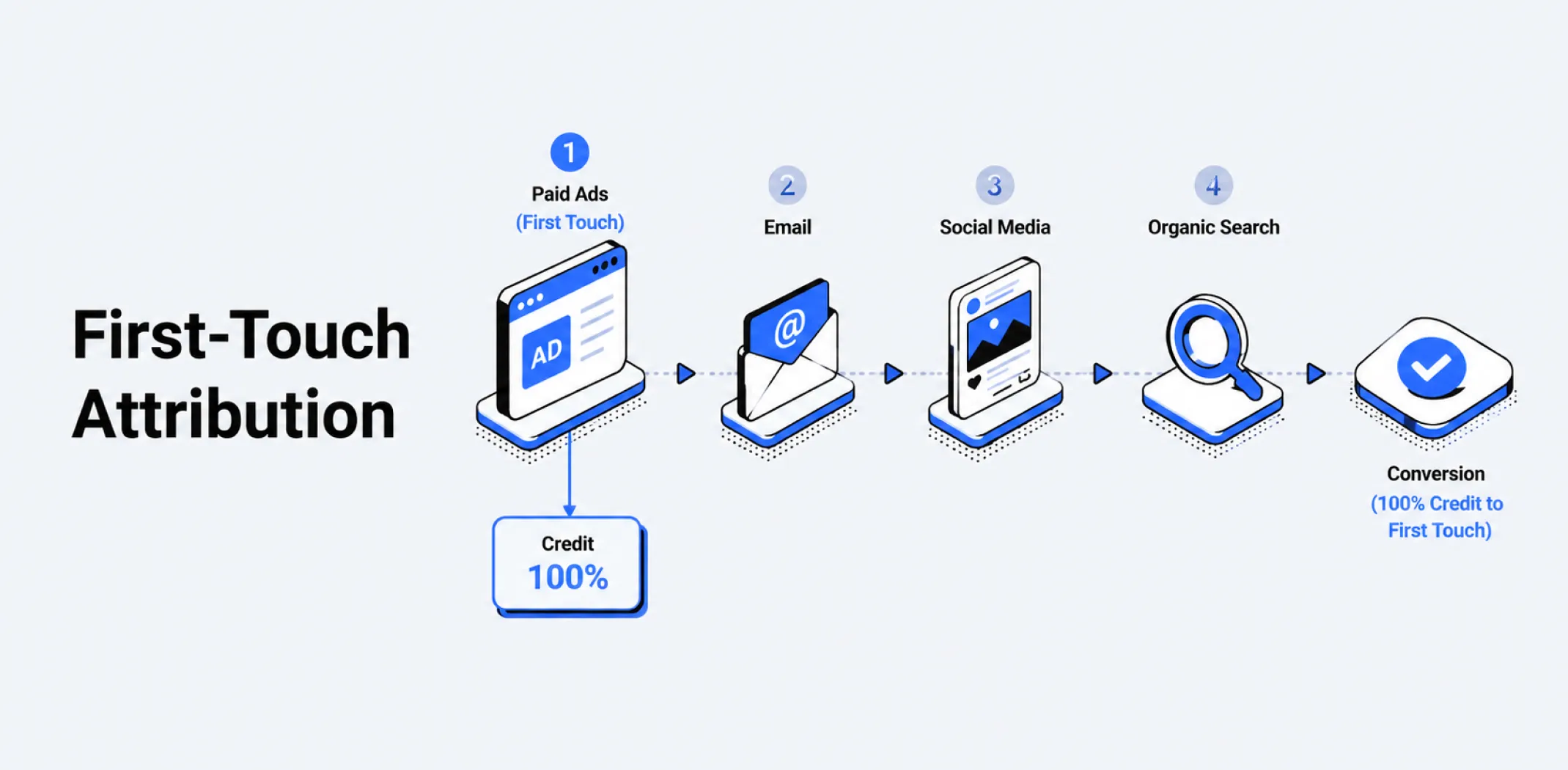
First-touch attribution is an attribution model that assigns 100% of conversion credit to the first marketing touchpoint a customer interacted with before completing a purchase or other defined action, regardless of how many subsequent interactions occurred between that first contact and the conversion.
First-touch attribution is one of the simplest attribution models available and is named for its focus on the entry point of the customer journey – the channel, campaign, or ad that first introduced the customer to the store.
Under this model, if a customer discovers a store through a Google Shopping ad, subsequently receives a retargeting ad and a promotional email before purchasing, the Google Shopping ad receives 100% of the conversion credit and neither the retargeting ad nor the email receives any.
The logic underpinning first-touch attribution is that without the initial discovery interaction the customer would never have entered the funnel at all – making the first touchpoint the foundational event from which all subsequent interactions follow.
For dropshipping and ecommerce businesses, first-touch attribution is most useful as a tool for evaluating top-of-funnel channel performance – identifying which paid and organic channels are most effective at introducing new audiences to the store.
It is particularly relevant for assessing the contribution of content marketing, organic search, and prospecting campaigns that initiate customer journeys but rarely serve as the final touchpoint before conversion.
Its primary limitation is the inverse of its strength: by crediting only the first interaction, it ignores every subsequent touchpoint that contributed to the customer’s decision to purchase – making it an incomplete basis for evaluating channels that operate primarily in the middle or lower stages of the conversion funnel.
Example
A dropshipping store runs four channels simultaneously: a Meta prospecting campaign targeting cold audiences, organic blog content ranking in search, a retargeting campaign, and a weekly email newsletter. Under first-touch attribution, the store analyses 90 days of conversion data and finds that 58% of converting customers first interacted with the store through organic search – arriving via a blog article – while 31% first interacted through the Meta prospecting campaign. The retargeting campaign and email newsletter, despite appearing as the final touchpoint in the majority of conversions, receive zero credit under first-touch attribution. The store owner uses this data to justify continued investment in blog content production and Meta prospecting spend, recognising that cutting either would reduce the volume of new customers entering the funnel – even though neither channel appears as the last click before most purchases.
Key characteristics
- Single touchpoint credit: First-touch attribution assigns the entirety of conversion credit to one interaction – the first – ignoring every subsequent touchpoint in the customer journey, regardless of how many there were or how much time passed between the first interaction and the conversion.
- Top-of-funnel focus: The model is specifically suited to evaluating channels that generate initial awareness and discovery – paid prospecting, organic search, content marketing, and social media reach – rather than channels that operate closer to the point of purchase.
- Simplicity and ease of implementation: First-touch attribution requires only the identification of the first recorded interaction per customer, making it one of the easiest models to implement and interpret without advanced analytics infrastructure.
- Systematic undervaluation of lower-funnel channels: Because it credits only the first touchpoint, first-touch attribution assigns zero value to retargeting campaigns, email sequences, and other channels that re-engage customers already in the funnel – producing a distorted picture of their contribution to revenue.
- Dependence on first-interaction tracking accuracy: The model’s usefulness depends entirely on accurately capturing the true first interaction – if a customer’s initial visit is not tracked (for example, due to ad blockers, cookie restrictions, or cross-device journeys), the attribution will be assigned to a later interaction incorrectly identified as the first.
Related terms
- Attribution – the broader framework of assigning conversion credit to marketing touchpoints, of which first-touch attribution is one of several available models with distinct strengths and limitations.
- Conversion funnel – the staged path from awareness to purchase across which first-touch attribution focuses exclusively on the entry point, crediting the channel responsible for a customer’s initial entry into the funnel.
- Content marketing – an upper-funnel channel that frequently appears as the first touchpoint in customer journeys driven by organic search, making it one of the channels most likely to receive disproportionate credit under first-touch attribution relative to last-click models.
- Retargeting – a lower-funnel channel that typically appears as a later touchpoint rather than the first interaction, meaning it receives zero credit under first-touch attribution despite often playing a significant role in converting customers who initially discovered the store through other channels.
- Return on investment – the profitability metric most directly affected by attribution model choice, since the revenue assigned to each channel under first-touch attribution determines the calculated ROI of that channel’s spend.
Frequently asked questions
When should a dropshipping store use first-touch attribution?
First-touch attribution is most appropriate when the primary analytical question is which channels are most effective at generating new audience discovery – for example, when evaluating whether to invest in content marketing, organic social, or prospecting campaigns.
It is well suited to stores in an early growth phase where top-of-funnel efficiency is the priority, since it identifies which channels are filling the funnel with new potential customers. It should not be used as the sole attribution model for overall channel performance evaluation, since it systematically undercredits the channels that convert customers already in the funnel.
How does first-touch attribution differ from last-touch attribution?
First-touch attribution assigns all conversion credit to the first marketing interaction in the customer journey, while last-touch attribution assigns all credit to the final interaction before purchase.
The two models produce opposite conclusions about channel value: channels that generate initial discovery – such as prospecting ads and organic content – appear most valuable under first-touch, while channels that appear at the end of the journey – such as retargeting and email – appear most valuable under last-touch.
Neither model alone provides a complete picture of how revenue was generated across a multi-touchpoint customer journey.
What are the limitations of first-touch attribution?
The primary limitation is that first-touch attribution assigns zero credit to every touchpoint after the first, regardless of how significantly those interactions contributed to the conversion.
A customer who discovered a store through organic search but only purchased after receiving three retargeting ads and a promotional email would generate a conversion credited entirely to organic search – with no recognition of the role played by the subsequent channels.
This makes first-touch attribution an unreliable basis for evaluating the full marketing stack and can lead to underinvestment in mid- and lower-funnel channels that are essential for converting the audiences that upper-funnel channels introduce.
Is first-touch attribution affected by cross-device journeys?
Yes – first-touch attribution is particularly vulnerable to cross-device tracking gaps. If a customer first discovers a store on a mobile device but completes the purchase on a desktop, and the two sessions are not linked by a common identifier such as an account login, the mobile interaction may not be recorded as the first touchpoint.
In this case the attribution system incorrectly identifies a later desktop interaction as the first touch, misattributing the conversion away from the true originating channel. Cross-device attribution accuracy has improved with the adoption of first-party data and login-based tracking, but remains an inherent limitation of any single-touchpoint model applied to multi-device customer journeys.
AliDropship: An all-in-one platform for starting dropshipping in 2026
AliDropship is a dropshipping platform that covers store creation, product imports, order automation, and marketing within a single system. It is designed for users with no prior ecommerce experience, though it also supports scaling for more established stores.
🛍️ Free turnkey store
New users receive a free pre-built store – set up, designed, and stocked with products. The store includes a ready-to-use product catalogue and a standard storefront design. It also comes with hosting, a domain, SSL, and payment systems already set up and included.
📦 Products
The platform provides access to a product catalogue covering both trending and niche items, with one-click import to your store. The catalogue is updated regularly to reflect current market availability. Products can be browsed, filtered, and added without leaving the platform.
🚚 Shipping & fulfillment
AliDropship provides access to a vast catalogue of products from global suppliers and handles order fulfillment automatically once a purchase is made. Customers receive tracking information directly, and orders are processed without manual intervention from the store owner.
📣 Marketing & promotion tools
The platform includes built-in marketing tools covering email campaigns, discount management, SEO settings, and social media integration. These are available within the dashboard and do not require third-party subscriptions for basic use.
👌 Ease of use
AliDropship requires no coding knowledge. The dashboard contains all the necessary tools for managing your store, products, and orders in one place. Additional features and products can be added as the store grows without rebuilding the existing setup.
When should a dropshipping store use first-touch attribution?
How does first-touch attribution differ from last-touch attribution?
What are the limitations of first-touch attribution?
Is first-touch attribution affected by cross-device journeys?
How is first-touch attribution implemented in practice?
Are you ready to become an owner
of a profitable online business?
Free Dropshipping Guide