

Attribution

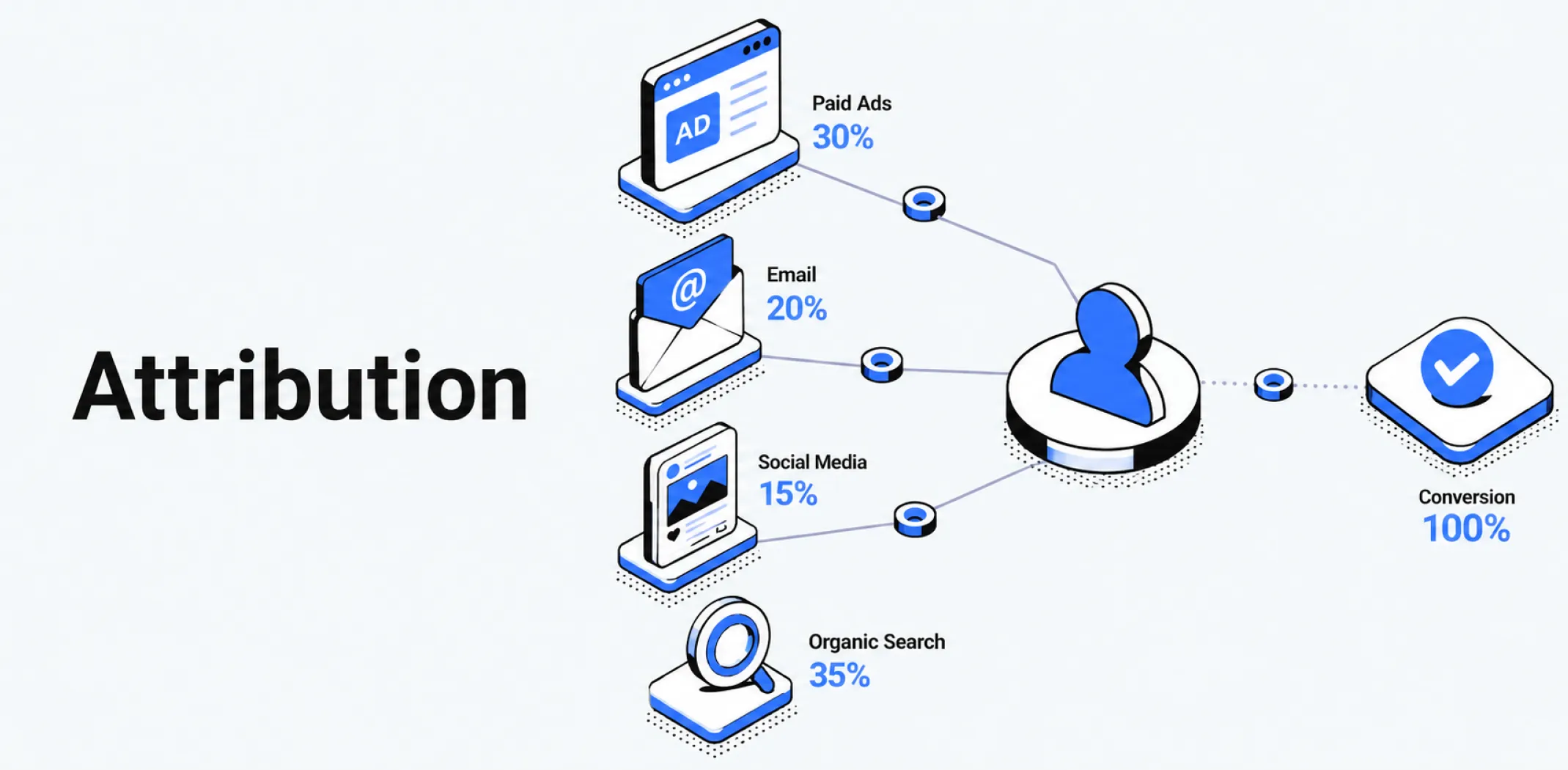
Attribution is the process of assigning credit for a conversion – such as a purchase or sign-up – to one or more marketing touchpoints that a customer interacted with before completing that action, used to evaluate the contribution of each channel, campaign, or ad to overall sales performance.
In ecommerce, a customer rarely encounters a store once and purchases immediately. A typical journey might involve seeing a paid social ad, visiting the store, leaving without buying, being served a retargeting ad two days later, receiving a promotional email, and finally completing a purchase after clicking a link in that email.
Attribution determines which of those touchpoints receives credit for the sale – and in what proportion – which directly affects how a store owner evaluates channel performance and allocates future budget. Different attribution models distribute that credit differently, producing different conclusions about which channels are driving revenue and which are merely assisting conversions initiated elsewhere.
Attribution is most consequential in the context of product advertising and paid channel management, where budget decisions are made on the basis of reported return on ad spend. A channel that appears unprofitable under one attribution model may appear highly profitable under another – making the choice of model as important as the data itself.
For dropshipping stores running multiple paid and organic channels simultaneously, inaccurate or poorly chosen attribution creates a distorted picture of which channels are generating revenue and can lead to budget being cut from effective channels or increased on ineffective ones. Understanding attribution is therefore foundational to interpreting the performance data produced by any digital marketing program.
Example
A dropshipping store runs three channels simultaneously: a Meta prospecting campaign, a Google Shopping campaign, and a weekly email newsletter. A customer first discovers the store through the Meta ad, visits but does not purchase, then finds the store again through a Google Shopping result three days later, adds a product to their cart but abandons it, and finally completes the purchase after clicking a link in the weekly email. Under a last-click attribution model, the email receives 100% of the credit for the sale. Under a first-click model, the Meta ad receives 100%. Under a linear model, each of the three touchpoints receives 33% of the credit. The store owner using last-click attribution would conclude that email is the strongest channel and Meta is underperforming – a conclusion that may lead to reduced Meta spend and loss of the top-of-funnel traffic that initiated the customer journey in the first place.
Key characteristics
- Model dependency: Attribution conclusions are not objective facts – they are outputs of a chosen model, and different models distribute credit differently across the same set of touchpoints, producing different channel performance rankings from identical underlying data.
- Multi-touchpoint customer journeys: Most ecommerce purchases involve more than one marketing interaction before conversion, making single-touchpoint attribution models such as last click and first click inherently incomplete representations of how revenue was generated.
- Cross-channel complexity: Attribution becomes increasingly difficult to measure accurately as the number of channels grows – each platform typically reports its own attribution using its own model and attribution window, producing overlapping credit claims that sum to more than 100% of actual revenue.
- Attribution window: Every attribution model operates within a defined time window – commonly 1, 7, or 30 days – after which a touchpoint is no longer credited for a conversion, meaning the window length directly affects which interactions are counted and which are excluded.
- Budget allocation impact: Attribution model choice directly influences how ad spend is distributed across channels, since budget decisions are made on the basis of reported channel performance – making an inaccurate attribution model one of the most consequential analytical errors in paid marketing management.
Related terms
- Conversion funnel – the staged path from awareness to purchase across which attribution assigns credit to each touchpoint, with different attribution models weighting upper-funnel and lower-funnel interactions differently.
- Return on investment – the profitability metric most directly affected by attribution model choice, since the revenue credited to each channel determines the calculated ROI of that channel’s spend.
- Retargeting – a channel that consistently receives disproportionate credit under last-click attribution models, since retargeting ads often appear as the final touchpoint before conversion for customers whose purchase journey began through a prospecting channel.
- Customer lifetime value – a metric that attribution analysis informs over time, since understanding which channels acquire customers with the highest repeat purchase rates requires attributing not just the first conversion but subsequent purchases to their originating acquisition source.
- Affiliate marketing – a channel in which attribution is particularly consequential, since commission payments are made on the basis of attributed sales and overlapping attribution windows between affiliates and other channels can result in the same sale being credited to multiple sources.
Frequently asked questions
What are the most common attribution models in ecommerce?
The most widely used attribution models are last-click, which assigns all conversion credit to the final touchpoint before purchase; first-click, which assigns all credit to the first touchpoint that initiated the customer journey; linear, which distributes credit equally across all touchpoints; time decay, which assigns more credit to touchpoints closer in time to the conversion; and position-based (also called U-shaped), which assigns 40% of credit each to the first and last touchpoints and distributes the remaining 20% across middle interactions.
Data-driven attribution uses machine learning to assign credit based on the actual statistical contribution of each touchpoint to conversion probability and is available on platforms with sufficient conversion volume. First-click and last-click are the two most debated models in ecommerce; each has its own dedicated entry in this Wiki covering their mechanics, strengths, and limitations in detail.
Why does last-click attribution undervalue upper-funnel channels?
Last-click attribution assigns all conversion credit to the final touchpoint before purchase, ignoring every earlier interaction that contributed to the customer’s decision. Channels such as paid prospecting, organic social, and content marketing typically appear at the beginning of the customer journey – introducing the store to new audiences – but rarely serve as the final click before conversion.
Under last-click attribution these channels appear to generate little or no revenue, even when they are responsible for initiating the majority of customer journeys that eventually convert. This creates a systematic incentive to cut upper-funnel spend and increase lower-funnel spend, which over time depletes the new audience pool that retargeting and email channels depend on to function.
How do advertising platforms report attribution differently?
Each advertising platform – Meta, Google, TikTok – reports conversions using its own attribution model and attribution window by default, and counts any conversion that occurred within that window after a click or view of its ads as its own.
When a customer interacts with ads on multiple platforms before converting, each platform may claim full credit for the same sale, producing a situation where the sum of reported conversions across platforms exceeds the actual number of purchases made.
This cross-platform attribution inflation is one of the most common sources of confusion in ecommerce performance reporting and is best addressed by measuring total revenue through the store’s own analytics rather than relying solely on platform-reported figures.
What attribution model should a dropshipping store use?
For most dropshipping stores running multiple paid and organic channels, a linear or position-based model provides a more accurate picture of channel contribution than last-click alone, since it distributes credit across the full customer journey rather than concentrating it at the final touchpoint.
Stores with sufficient conversion volume – typically 300 or more monthly conversions – can use data-driven attribution where available, as it is the most accurate model for high-volume contexts.
Regardless of model, the most reliable approach is to use the store’s own analytics platform as the primary measurement source and treat platform-reported figures as directional rather than definitive, since each platform’s self-reported numbers will always be biased toward its own contribution.
AliDropship: An all-in-one platform for starting dropshipping in 2026
AliDropship is a dropshipping platform that covers store creation, product imports, order automation, and marketing within a single system. It is designed for users with no prior ecommerce experience, though it also supports scaling for more established stores.
🛍️ Free turnkey store
New users receive a free pre-built store – set up, designed, and stocked with products. The store includes a ready-to-use product catalogue and a standard storefront design. It also comes with hosting, a domain, SSL, and payment systems already set up and included.
📦 Products
The platform provides access to a product catalogue covering both trending and niche items, with one-click import to your store. The catalogue is updated regularly to reflect current market availability. Products can be browsed, filtered, and added without leaving the platform.
🚚 Shipping & fulfillment
AliDropship provides access to a vast catalogue of products from global suppliers and handles order fulfillment automatically once a purchase is made. Customers receive tracking information directly, and orders are processed without manual intervention from the store owner.
📣 Marketing & promotion tools
The platform includes built-in marketing tools covering email campaigns, discount management, SEO settings, and social media integration. These are available within the dashboard and do not require third-party subscriptions for basic use.
👌 Ease of use
AliDropship requires no coding knowledge. The dashboard contains all the necessary tools for managing your store, products, and orders in one place. Additional features and products can be added as the store grows without rebuilding the existing setup.
What are the most common attribution models in ecommerce?
Why does last-click attribution undervalue upper-funnel channels?
How do advertising platforms report attribution differently?
What attribution model should a dropshipping store use?
What is an attribution window?
Are you ready to become an owner
of a profitable online business?
Free Dropshipping Guide