

Retargeting

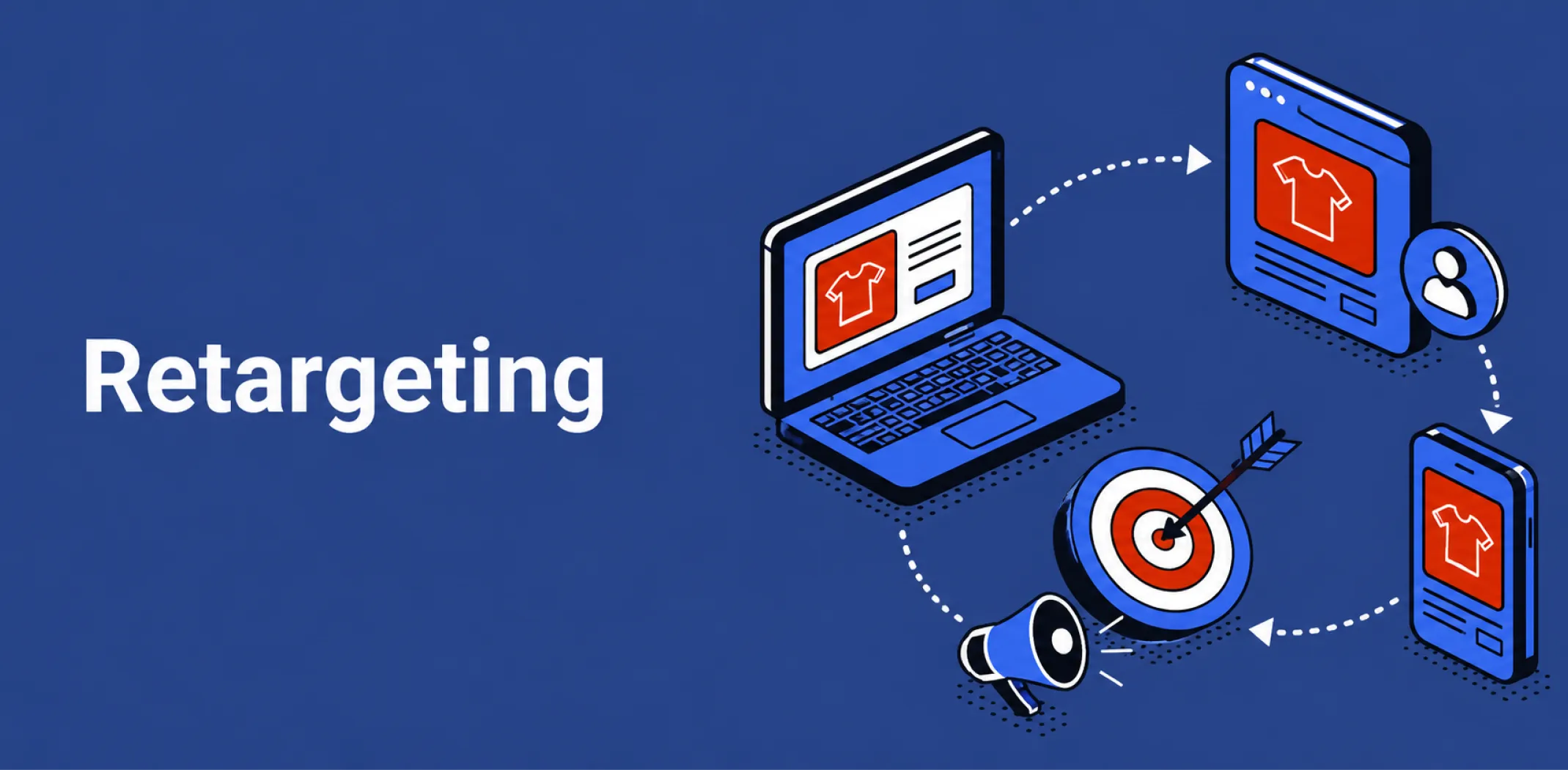
Retargeting is a paid advertising technique that serves promotional messages to users who have previously visited a website, viewed a product, or interacted with a brand, using tracking technology to identify and re-engage audiences who did not convert during their initial visit.
Retargeting operates through a small piece of code – commonly called a pixel – installed on a store’s website that records visitor behavior and passes that data to an advertising platform such as Meta, Google, or TikTok. When a tracked visitor subsequently uses that platform, the store’s ads are served to them specifically, targeting an audience already familiar with the brand rather than a cold audience encountering it for the first time.
This prior familiarity is the defining advantage of retargeting: conversion rates on retargeted audiences are consistently higher than on cold prospecting campaigns, and cost per acquisition is typically lower, because the audience has already demonstrated interest by visiting the store or engaging with a product page.
Retargeting is distinct from prospecting campaigns, which target new audiences with no prior brand interaction, and sits within the broader category of outbound marketing since ad placement is purchased rather than earned.
For dropshipping and ecommerce businesses, retargeting is most commonly applied to three high-value audience segments: product page viewers who browsed without adding to cart, cart abandoners who added a product but did not complete checkout, and past purchasers who are targeted with complementary products to drive repeat orders.
Each segment represents a different level of purchase intent, and ad creative is typically tailored accordingly – a cart abandoner may receive a reminder ad featuring the specific product they left behind, while a past purchaser may see an ad for a related item.
This segmentation approach, combined with the lower cost per acquisition relative to cold campaigns, makes retargeting one of the highest-returning paid channels available to an established ecommerce store. Accurate retargeting depends on the conversion funnel being instrumented correctly so that each audience segment is defined and tracked with precision.
Example
A dropshipping store selling yoga equipment runs a Meta retargeting campaign targeting visitors who viewed a specific yoga mat product page in the previous 14 days but did not add it to their cart. The campaign serves a carousel ad featuring the mat alongside two complementary products – a yoga block and a carry strap – with a limited-time 10% discount applied to orders over $50. The retargeting campaign generates a cost per acquisition of $5.80 against an average order value of $68, compared to $19.40 per acquisition from the store’s cold prospecting campaign targeting new audiences. The retargeting audience, though smaller in size, converts at 4.3 times the rate of the cold audience because every person in it has already expressed interest in the product.
Key characteristics
- Pixel-based audience tracking: Retargeting relies on a tracking pixel installed on the store’s website that records visitor behavior – pages viewed, products added to cart, purchases completed – and passes that data to the advertising platform to define retargeting audience segments.
- Warm audience targeting: Unlike prospecting campaigns that reach cold audiences with no prior brand exposure, retargeting reaches users who have already interacted with the store, producing higher baseline conversion rates and lower cost per acquisition.
- Segment-specific creative: Effective retargeting uses different ad creative for different audience segments – cart abandoners, product viewers, and past purchasers each receive messaging relevant to their specific level of purchase intent rather than a generic brand advertisement.
- Recency-dependent effectiveness: Retargeting audiences are most responsive shortly after their initial store visit, with conversion rates declining as time passes; most campaigns define audience windows of 7 to 30 days to focus spend on the most recently engaged visitors.
- Cross-platform reach: A visitor tracked on a store’s website can be retargeted across multiple platforms – Meta, Google Display Network, TikTok, Pinterest – allowing the store to re-engage the same audience across the platforms they use most frequently.
Related terms
- Conversion funnel – the staged path from awareness to purchase that retargeting addresses at the middle and lower stages, re-engaging visitors who entered the funnel but did not progress to a completed transaction.
- Landing page – the destination page to which retargeting ads direct traffic, typically a product page or cart recovery page optimized to convert visitors already familiar with the product being advertised.
- Customer segmentation – the practice of dividing an audience by behavior or characteristics, which is fundamental to retargeting since different audience segments – cart abandoners, product viewers, past buyers – require distinct ad creative and messaging.
- Average order value – a metric used in retargeting campaign design, since minimum spend incentives and product bundle ads served to retargeted audiences are a standard method for increasing the value of recovered transactions.
- Return on investment – the primary metric against which retargeting spend is evaluated, with retargeting campaigns typically producing higher ROI than cold prospecting campaigns due to the warmer audience and lower cost per acquisition.
Frequently asked questions
How does retargeting work technically?
A retargeting pixel – a short snippet of JavaScript code provided by an advertising platform – is installed on the store’s website. When a visitor loads a page, the pixel fires and records the visit, adding the user to a retargeting audience on the platform.
When that user subsequently visits the platform – browsing Instagram, watching YouTube, or scrolling TikTok – the store’s retargeting ads are eligible to be served to them specifically. The process is automated and operates continuously without manual intervention once the pixel is installed and the campaign is configured.
What is the difference between retargeting and remarketing?
Retargeting and remarketing are related but distinct re-engagement techniques. Retargeting uses pixel-based tracking to serve paid ads to past website visitors across external platforms – Meta, Google Display, TikTok – reaching them while they are browsing elsewhere.
Remarketing re-engages past visitors or customers through owned channels, primarily email – an abandoned cart email or a post-purchase win-back sequence are both forms of remarketing. The practical distinction is channel: retargeting operates through paid placements on third-party platforms, while remarketing operates through direct communication channels the business already owns.
How large does a retargeting audience need to be to run a campaign?
Most advertising platforms require a minimum audience size before a retargeting campaign can be activated – Meta typically requires a minimum of 1,000 matched users in an audience before ads can be served, while Google’s requirements vary by campaign type.
For new or low-traffic stores, retargeting audiences may be too small to run efficiently, making it necessary to build website traffic through prospecting campaigns first. A store receiving fewer than 500 to 1,000 unique visitors per month will generally find retargeting audiences too small to generate meaningful campaign volume.
Should retargeting ads offer a discount to recover abandoned carts?
Offering a discount in cart abandonment retargeting ads is effective at increasing recovery rates but carries two trade-offs: it reduces the margin on recovered orders, and it can train customers to abandon carts deliberately in anticipation of a discount.
A common approach is to run the first retargeting touchpoint without a discount – a simple reminder of the product – and introduce a time-limited offer only in a second or third ad served to users who have not yet converted after the initial reminder. This sequence preserves margin on customers who would have returned without an incentive while still recovering price-sensitive abandoners.
AliDropship: An all-in-one platform for starting dropshipping in 2026
AliDropship is a dropshipping platform that covers store creation, product imports, order automation, and marketing within a single system. It is designed for users with no prior ecommerce experience, though it also supports scaling for more established stores.
🛍️ Free turnkey store
New users receive a free pre-built store – set up, designed, and stocked with products. The store includes a ready-to-use product catalogue and a standard storefront design. It also comes with hosting, a domain, SSL, and payment systems already set up and included.
📦 Products
The platform provides access to a product catalogue covering both trending and niche items, with one-click import to your store. The catalogue is updated regularly to reflect current market availability. Products can be browsed, filtered, and added without leaving the platform.
🚚 Shipping & fulfillment
AliDropship provides access to a vast catalogue of products from global suppliers and handles order fulfillment automatically once a purchase is made. Customers receive tracking information directly, and orders are processed without manual intervention from the store owner.
📣 Marketing & promotion tools
The platform includes built-in marketing tools covering email campaigns, discount management, SEO settings, and social media integration. These are available within the dashboard and do not require third-party subscriptions for basic use.
👌 Ease of use
AliDropship requires no coding knowledge. The dashboard contains all the necessary tools for managing your store, products, and orders in one place. Additional features and products can be added as the store grows without rebuilding the existing setup.
How does retargeting work technically?
What is the difference between retargeting and remarketing?
How large does a retargeting audience need to be to run a campaign?
Should retargeting ads offer a discount to recover abandoned carts?
What metrics should a store track to measure retargeting performance?
Are you ready to become an owner
of a profitable online business?
Free Dropshipping Guide