

Affiliate Marketing

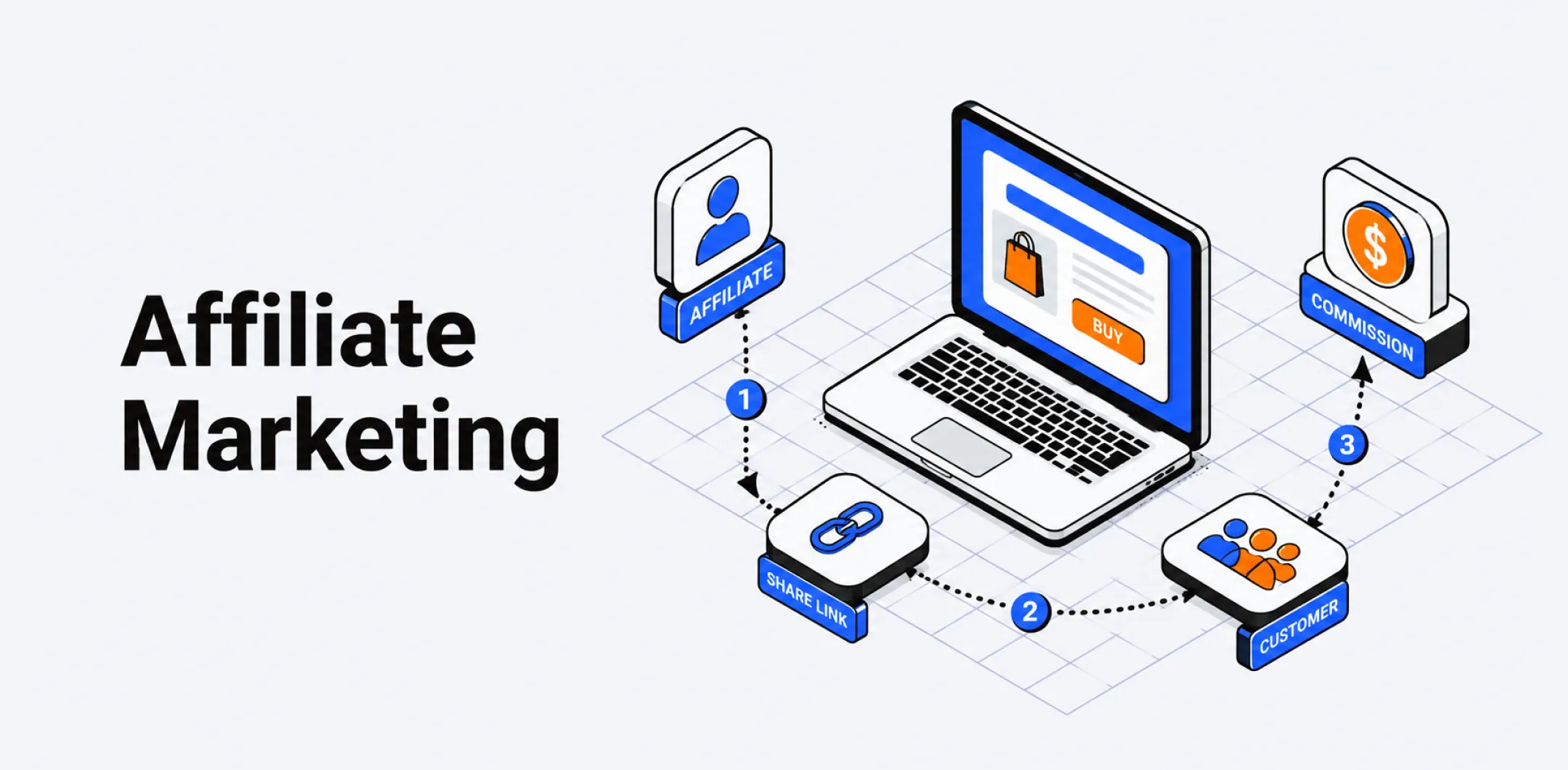
Affiliate marketing is a performance-based marketing arrangement in which a business pays an external promoter – the affiliate – a commission for each sale, lead, or other defined action generated through the affiliate’s unique tracking link, with no payment made unless the target action is completed.
The affiliate marketing model involves three parties: the merchant (the business selling the product), the affiliate (the promoter who drives traffic to the merchant), and the customer (who completes the purchase or action). Affiliates may be bloggers, content creators, comparison websites, email publishers, social media accounts, or any other party capable of directing relevant traffic to a product page.
Each affiliate is assigned a unique tracking link; when a customer clicks that link and completes the target action within a defined attribution window – typically 30 to 90 days – the affiliate earns the agreed commission. Because payment is contingent on results, affiliate marketing sits firmly within the product advertising category of performance marketing and carries no upfront cost risk for the merchant beyond program administration.
For dropshipping and ecommerce businesses, affiliate marketing provides a scalable acquisition channel that expands reach without requiring the merchant to produce additional advertising content. A store running an affiliate program effectively outsources audience development to a distributed network of promoters, each of whom is incentivized to generate sales rather than merely impressions.
The channel is particularly well suited to stores in content-rich niches – such as health, home, fitness, or pet products – where bloggers and creators already produce content that their audiences consult before purchasing. Commission rates in ecommerce affiliate programs typically range from 5% to 30% of the sale value depending on the product margin, niche, and competitive landscape.
Stores using platforms such as WooCommerce can integrate affiliate tracking directly into their existing store infrastructure.
Example
A dropshipping store selling home fitness equipment launches an affiliate program offering a 12% commission per sale. A fitness blogger with a monthly readership of 45,000 joins the program and publishes a product review article featuring the store’s resistance band set, linking to the product page through their unique affiliate URL. Over the following three months the article generates 94 sales totaling $6,580 in revenue, earning the blogger $789.60 in commissions. The store acquires 94 customers at an effective cost per acquisition of $8.40 – with no upfront ad spend, no creative production cost, and no payment made until each sale was confirmed.
Key characteristics
- Commission-only payment structure: The merchant pays only when a defined result – typically a completed sale – is delivered, transferring the cost risk of promotion from the merchant to the affiliate who invests time and audience reach without guaranteed compensation.
- Unique tracking links: Each affiliate is assigned a distinct URL that records clicks, attributing any resulting sales to the correct affiliate within the program’s defined attribution window, typically 30 to 90 days after the initial click.
- Scalable reach: An affiliate program can grow without proportional effort from the merchant – each new affiliate added to the program extends reach into a new audience segment at no additional fixed cost.
- Promoter diversity: Affiliates span a wide range of content formats and platforms – blogs, YouTube channels, email newsletters, social media accounts, and comparison sites – giving merchants access to audiences they could not reach efficiently through a single owned channel.
- Attribution window dependency: The accuracy of affiliate attribution depends on the tracking window and cookie duration set by the program; customers who purchase after the window expires do not generate a commission even if the affiliate’s content influenced the decision.
Related terms
- Influencer – a content creator whose affiliate partnerships are structured around their social audience, commonly using unique discount codes or tracking links embedded in posts or videos to attribute sales.
- Conversion funnel – the staged path from awareness to purchase that affiliate content addresses at the top and middle stages, where product reviews, comparisons, and recommendations introduce potential buyers to a store before they are ready to purchase.
- Return on investment – the profitability metric used to evaluate affiliate program performance, calculated by comparing revenue generated through affiliate sales against total commission payments and program administration costs.
- Customer lifetime value – a metric relevant to affiliate program design, since a higher customer lifetime value justifies a higher commission rate by increasing the total revenue attributable to each affiliate-acquired customer beyond the initial sale.
- Niche market – the defined audience segment around which affiliate recruitment is targeted, with the most effective affiliates being those whose existing content and readership closely match the store’s ideal customer profile.
Frequently asked questions
How does affiliate marketing differ from influencer marketing?
Affiliate marketing is defined by its commission-based payment structure – the promoter is paid only when a sale or defined action is completed, regardless of their platform or content format. Influencer marketing specifically involves social media creators and may be structured as flat fees, gifting arrangements, or commissions.
All commission-based influencer partnerships are technically a form of affiliate marketing, but affiliate marketing also encompasses non-social promoters such as bloggers, comparison sites, and email publishers who operate outside social platforms entirely.
What commission rate should a dropshipping store offer affiliates?
Commission rates in ecommerce affiliate programs typically range from 5% to 30% of the sale value, with the appropriate rate determined by the product margin, niche competitiveness, and the quality of affiliates the store wants to attract.
A store with a 40% gross margin on each product can afford a higher commission rate than one operating on 20% without becoming unprofitable per acquisition. Rates should be set high enough to motivate active promotion – affiliates with multiple program options will prioritize those offering the best return for their promotional effort.
How do stores track affiliate sales?
Affiliate sales are tracked through unique URLs assigned to each affiliate, which record the source of each click and attribute any resulting purchase to the correct affiliate within the program’s attribution window. Most ecommerce platforms support affiliate tracking natively or through third-party plugins.
Discount codes unique to each affiliate provide a supplementary attribution method for social media promoters whose audiences may not click a link directly – the code used at checkout identifies which affiliate drove the sale regardless of how the customer arrived at the store.
Is affiliate marketing suitable for new dropshipping stores?
Affiliate marketing is most effective for stores that already have a functional product catalogue, competitive pricing, and a converting store – affiliates will not promote a store that does not convert their traffic into sales, since their income depends on completions rather than clicks.
New stores are generally better served by paid outbound channels in early stages to validate product-market fit, then launching an affiliate program once conversion rate and product margin are understood. A program launched too early with an unoptimized store produces poor affiliate results and may discourage quality promoters from returning.
AliDropship: An all-in-one platform for starting dropshipping in 2026
AliDropship is a dropshipping platform that covers store creation, product imports, order automation, and marketing within a single system. It is designed for users with no prior ecommerce experience, though it also supports scaling for more established stores.
🛍️ Free turnkey store
New users receive a free pre-built store – set up, designed, and stocked with products. The store includes a ready-to-use product catalogue and a standard storefront design. It also comes with hosting, a domain, SSL, and payment systems already set up and included.
📦 Products
The platform provides access to a product catalogue covering both trending and niche items, with one-click import to your store. The catalogue is updated regularly to reflect current market availability. Products can be browsed, filtered, and added without leaving the platform.
🚚 Shipping & fulfillment
AliDropship provides access to a vast catalogue of products from global suppliers and handles order fulfillment automatically once a purchase is made. Customers receive tracking information directly, and orders are processed without manual intervention from the store owner.
📣 Marketing & promotion tools
The platform includes built-in marketing tools covering email campaigns, discount management, SEO settings, and social media integration. These are available within the dashboard and do not require third-party subscriptions for basic use.
👌 Ease of use
AliDropship requires no coding knowledge. The dashboard contains all the necessary tools for managing your store, products, and orders in one place. Additional features and products can be added as the store grows without rebuilding the existing setup.
How does affiliate marketing differ from influencer marketing?
What commission rate should a dropshipping store offer affiliates?
How do stores track affiliate sales?
Is affiliate marketing suitable for new dropshipping stores?
What types of affiliates work best for ecommerce stores?
Are you ready to become an owner
of a profitable online business?
Free Dropshipping Guide