

Digital Marketing

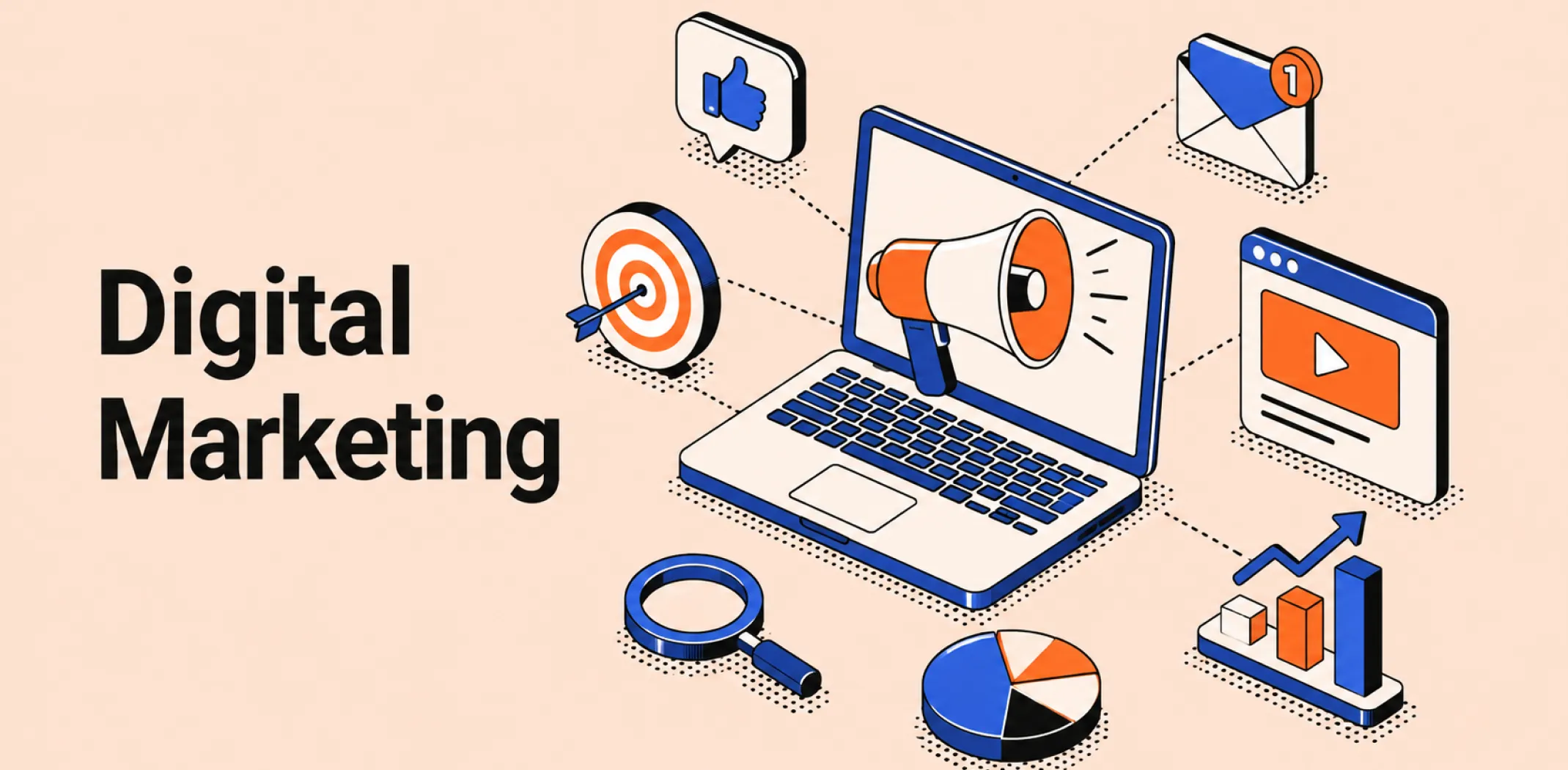
Digital marketing is the promotion of products, services, or brands through internet-based channels and tools, encompassing tactics such as search engine optimization, paid advertising, social media, email marketing, and content marketing to reach and convert online audiences.
Digital marketing differs from traditional marketing in that every channel produces measurable data – clicks, impressions, conversion rates, and cost per acquisition can all be tracked in real time, allowing a business to adjust spend and creative based on performance. For ecommerce and dropshipping businesses, digital marketing is the primary mechanism for driving traffic to a store, since there is no physical retail presence to generate footfall.
The discipline spans both organic channels – where visibility is earned through content, SEO, or social engagement – and paid channels, where placement is purchased directly through advertising platforms. Effective digital marketing requires selecting the right mix of channels for a given niche market and audience, then allocating budget and effort accordingly.
The measurability of digital marketing makes it particularly suited to dropshipping businesses, where margins are often thin and return on ad spend must be monitored closely.
A store running paid social campaigns can calculate the exact cost of acquiring each customer, compare it against the average order value and customer lifetime value, and determine whether the channel is profitable before committing further budget. This feedback loop – spend, measure, adjust – is the operational core of digital marketing practice for product-based online businesses.
Example
A dropshipping store selling home organization products runs three digital marketing channels simultaneously: a Google Shopping campaign targeting buyers searching for specific products, an organic Instagram account posting styling content to build an audience over time, and a weekly email sequence sent to past customers promoting new arrivals. Each channel serves a different stage of the conversion funnel – paid search captures high-intent buyers, social content builds brand awareness, and email re-engages existing customers at near-zero cost per send.
Key characteristics
- Channel diversity: Digital marketing encompasses a wide range of distinct channels – including paid search, paid social, organic social, email, content, and influencer marketing – each suited to different audience types, budget levels, and stages of the buyer journey.
- Measurability: Every digital marketing channel produces trackable performance data, allowing a business to calculate cost per click, cost per acquisition, return on ad spend, and conversion rate with a precision unavailable in offline marketing.
- Scalability: Paid digital channels can be scaled up or down rapidly in response to performance data or budget constraints, making them more flexible than fixed-cost traditional advertising formats.
- Audience targeting: Digital platforms allow sellers to target audiences by demographics, interests, search behavior, and purchase intent – reducing wasted spend compared to broad-reach offline channels.
- Organic and paid distinction: Digital marketing activity splits between paid channels, where visibility is purchased directly, and organic channels, where it is earned through content quality, SEO, or social engagement over time.
Related terms
- Conversion funnel – the sequence of stages a potential customer moves through from first awareness to completed purchase, which digital marketing tactics are designed to address at each step.
- Product advertising – a subset of digital marketing focused specifically on promoting individual products to drive direct purchase intent rather than broad brand awareness.
- Landing page – a destination page designed to convert traffic arriving from a digital marketing campaign, typically optimized for a single action such as a purchase or email sign-up.
- Influencer – an individual with an established online audience who is used as a digital marketing channel to promote products to their followers, typically through social media platforms.
- Customer lifetime value – the projected total revenue from a customer over time, used in digital marketing to determine the maximum viable cost of acquisition across paid channels.
Frequently asked questions
What is the difference between digital marketing and traditional marketing?
Traditional marketing uses offline channels such as print, television, radio, and outdoor advertising to reach audiences. Digital marketing uses internet-based channels – search engines, social media platforms, email, and websites – where audience behavior can be tracked and measured in real time.
The primary practical difference for small businesses is that digital marketing allows precise budget control and performance measurement that traditional channels do not.
Which digital marketing channels work best for dropshipping?
The most commonly used channels for dropshipping stores are paid social advertising (particularly Meta ads), Google Shopping campaigns, organic social media content, and email marketing to past customers.
The most effective combination depends on the product niche, target audience, and available budget. Paid channels produce faster results but require ongoing spend; organic channels take longer to build but generate traffic at lower marginal cost once established.
How much should a dropshipping store spend on digital marketing?
There is no fixed benchmark – spend should be determined by the store’s break-even threshold, target cost per acquisition, and available capital. A common starting approach is to allocate a defined test budget across one or two channels, measure cost per acquisition against the per-unit margin, and scale spend only on channels producing a positive return.
Spending before understanding the margin structure of the store typically results in losses that are difficult to reverse.
What is organic digital marketing?
Organic digital marketing refers to channels where visibility is earned rather than purchased – including search engine optimization, unpaid social media content, and email marketing to an existing subscriber list.
It typically requires a longer time horizon to produce results than paid advertising but generates traffic at lower ongoing cost. Most ecommerce businesses use a combination of organic and paid channels, with organic activity building a long-term audience while paid campaigns drive immediate traffic and sales.
AliDropship: An all-in-one platform for starting dropshipping in 2026
AliDropship is a dropshipping platform that covers store creation, product imports, order automation, and marketing within a single system. It is designed for users with no prior ecommerce experience, though it also supports scaling for more established stores.
🛍️ Free turnkey store
New users receive a free pre-built store – set up, designed, and stocked with products. The store includes a ready-to-use product catalogue and a standard storefront design. It also comes with hosting, a domain, SSL, and payment systems already set up and included.
📦 Products
The platform provides access to a product catalogue covering both trending and niche items, with one-click import to your store. The catalogue is updated regularly to reflect current market availability. Products can be browsed, filtered, and added without leaving the platform.
🚚 Shipping & fulfillment
AliDropship provides access to a vast catalogue of products from global suppliers and handles order fulfillment automatically once a purchase is made. Customers receive tracking information directly, and orders are processed without manual intervention from the store owner.
📣 Marketing & promotion tools
The platform includes built-in marketing tools covering email campaigns, discount management, SEO settings, and social media integration. These are available within the dashboard and do not require third-party subscriptions for basic use.
👌 Ease of use
AliDropship requires no coding knowledge. The dashboard contains all the necessary tools for managing your store, products, and orders in one place. Additional features and products can be added as the store grows without rebuilding the existing setup.
What is the difference between digital marketing and traditional marketing?
Which digital marketing channels work best for dropshipping?
How much should a dropshipping store spend on digital marketing?
What is organic digital marketing?
What metrics should a dropshipping store track in digital marketing?
Are you ready to become an owner
of a profitable online business?
Free Dropshipping Guide