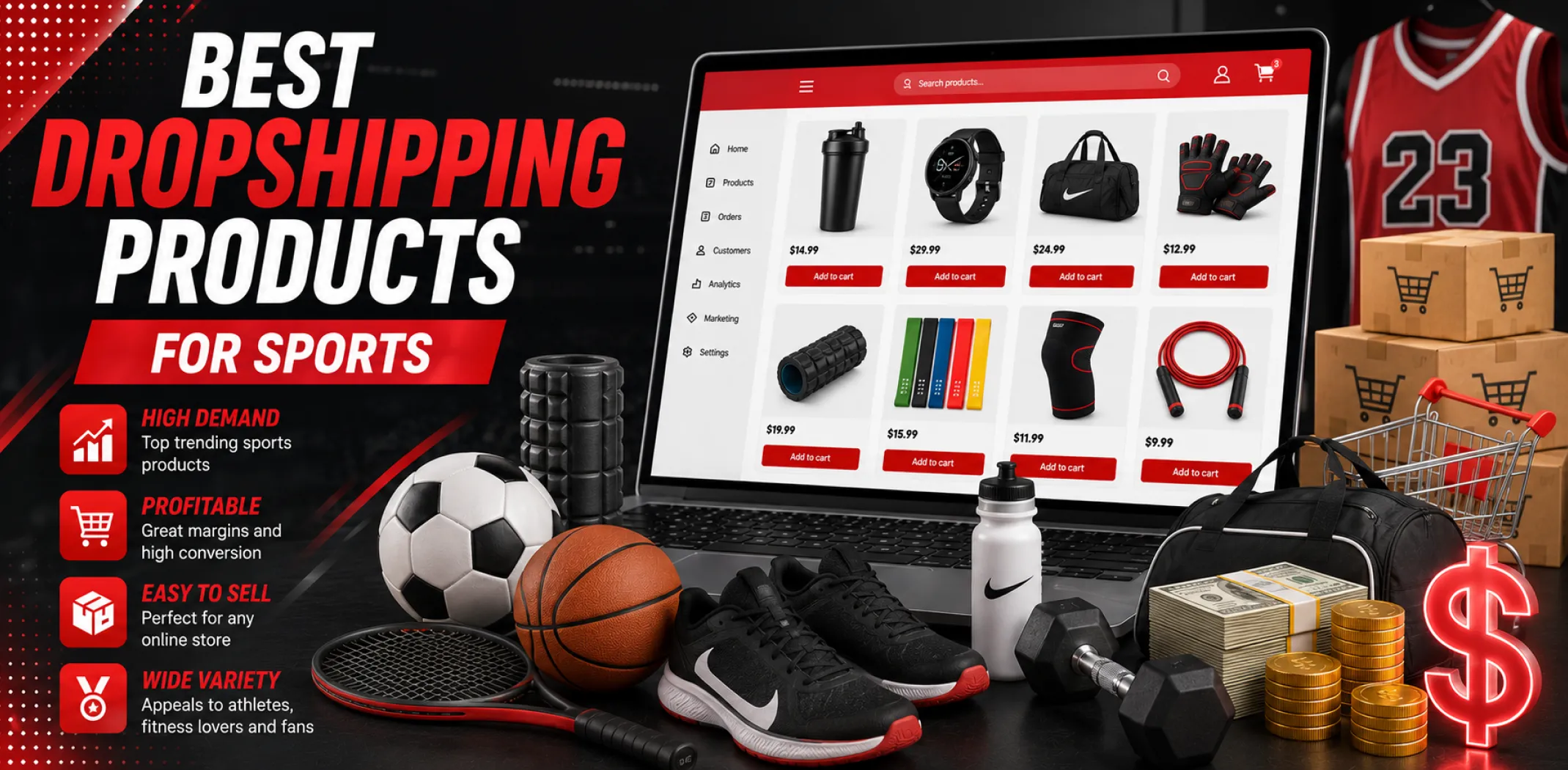
Best Dropshipping Products For Sports: Fitness Gear And Training Tools

There are 184 million gym members globally – a number that grows every year as fitness shifts from a seasonal resolution to a permanent lifestyle priority. Americans alone are expected to spend approximately $60 billion on health and fitness in 2026, and the global sports and leisure equipment market was valued at $511 billion that same year.
Behind every one of those members is a consistent need: the right tools to train harder, recover faster, and reach their goals without spending a fortune on equipment or gym memberships.
That need is exactly what makes the best dropshipping products for sports such a reliable commercial opportunity. This is not a niche driven by impulse or aesthetics – it is driven by genuine physical goals and a buyer who is actively motivated to solve a problem. Someone who has committed to getting fit at home, improving their marathon time, or recovering from a tough week of training is not casually browsing.
They are ready to buy the product that helps them do it. Sports and outdoor products also carry the highest best-seller rate of any dropshipping category, with 14.5% of listed products earning bestseller status – more than kitchen, baby, or electronics.
Quick Answer: The best dropshipping products for sports in 2026 are resistance bands, yoga and fitness mats, percussion massage guns, smart jump ropes, and foam roller recovery kits. These categories combine year-round demand, multiple seasonal peaks, 40–70% profit margins at the $22–$90 retail price point, and viral content potential on fitness platforms.
Why sports products are one of the strongest dropshipping niches in 2026
The global fitness market was valued at $45.17 billion in 2026 and is growing at 5.5% annually toward $73 billion by 2035. The fitness equipment market specifically stands at $13.89 billion in 2026, growing at 5.3% CAGR through 2033.
These numbers reflect a structural behavioral shift that started during the pandemic and has now become permanent: the home workout is mainstream, and the people who built home gyms or discovered bodyweight training are now continuous, recurring buyers of the accessories and tools that keep their routine going.
The recovery side of sports is growing just as fast – and arguably faster in terms of dropshipping opportunity. There is heightened interest in recovery tools – massage devices, foam rollers, and compression therapy – driven by a broader wellness mindset that now treats recovery as a deliberate part of athletic performance rather than an afterthought.
This recovery category is less price-sensitive than training equipment, generates strong margins, and has broad appeal across age groups from serious athletes to people managing everyday desk-job muscle tension. Online fitness equipment sales have increased by 170% since 2020, and that trajectory has not reversed.
What sets sports products apart commercially is the combination of strong year-round demand with predictable and disproportionate seasonal peaks. New Year’s resolution buying runs from late December through mid-February. Pre-summer body goal buying spikes in April and May. Back-to-school fitness surges in September.
Each of these windows can deliver 2–3x a store’s normal monthly sales volume with the right product and the right campaign timing. And crucially, the fitness buyer does not just buy once – they upgrade equipment as their fitness improves, replace worn consumables like bands and mats, and add recovery tools as their practice deepens. The lifetime value of a converted fitness customer is among the highest in consumer dropshipping.
How dropshipping sports products works
The model is the same as any other dropshipping category. You list sports and fitness products in your store at retail price, a customer orders, and your supplier ships directly to them. No inventory, no packing, no warehouse. Your job is to pick the right products, build compelling listings, and run targeted traffic to a buyer who is already motivated to purchase.
One of the genuine advantages of sports products for dropshipping is their content-friendliness. A resistance band workout takes 30 seconds to film on a phone. A massage gun demo on sore shoulders is compelling in 15 seconds. A jump rope calorie-counter display is immediately visual.
Fitness content is among the most organically shared content on TikTok, Instagram Reels, and YouTube Shorts – and it drives genuine product discovery purchases. Dropshippers who create or commission basic exercise demonstration content for their products consistently see lower effective acquisition costs because organic traffic supplements paid campaigns in a way few other niches can match.
Training equipment vs. recovery tools: Where is the bigger opportunity?
The sports dropshipping market divides into two commercially distinct segments – training equipment (the things people use to exercise) and recovery tools (the things they use to feel better after exercising). Both are excellent for dropshipping, but they serve different buyer motivations and create different repeat purchase dynamics.
The strongest sports dropshipping stores carry both segments – using training gear bundles as the high-volume entry point and recovery tools as the high-margin anchor. A customer who buys a resistance band set and mat is a natural follow-on buyer for a foam roller or massage gun within 30–60 days, once their training frequency reaches the point where recovery starts to matter.
That natural upsell pathway is one of the clearest repeat-purchase structures in the entire dropshipping landscape.
The best sports products to dropship in 2026
The sports category contains hundreds of products, but a subset consistently delivers the strongest combination of search volume, margin, content performance, and seasonal reliability for dropshippers. Below are the four sub-categories with the clearest commercial case for 2026.
Real results from sports product dropshippers
Sports dropshipping rewards sellers who understand what motivates a fitness buyer – not product features, but the goal behind the purchase. The examples below show what happens when product selection, creative angle, and seasonal timing come together correctly. Results vary based on product, ad spend, and execution, and are not typical for every seller.
4 strategies that work for sports product dropshipping in 2026
Sports buyers are goal-driven, results-oriented, and community-connected. They respond to content that speaks directly to their training goal, their fitness level, and their timeline. The strategies below are built around those characteristics – and around the seasonal patterns that make sports one of the most plannable niches in dropshipping.
Sell the goal, not the gear
Fitness buyers do not purchase a resistance band – they purchase the ability to get stronger at home without a gym membership. They do not buy a massage gun – they buy the ability to recover faster and train harder tomorrow. Framing your ad creative and product listings around the outcome rather than the product feature is the most reliable conversion lever in sports dropshipping. “Replace your $60/month gym membership with this” outperforms “5 resistance levels, includes carrying bag” every time, because it speaks to the buyer’s actual motivation before introducing any product information.
Plan your entire year around seasonal peaks
Sports dropshipping has four clearly documented revenue peaks: the January resolution window (December 28 through mid-February), the pre-summer body goal spike (April through May), back-to-school fitness (September), and Christmas gifting for recovery tools (November through December). Planning ad creative and budget increases 3–4 weeks before each peak, and increasing spend by 50–80% during the peak period, is the single highest-leverage calendar action in this niche. Stores that flat-spend year-round leave a disproportionate amount of peak-period revenue on the table compared to those with a proactive seasonal plan.
Bundle training and recovery together
The natural lifecycle of a fitness buyer moves from training tools (bands, mats, jump ropes) in the early commitment phase to recovery tools (foam rollers, massage guns, compression) as their training frequency increases and soreness becomes a real issue. A store that stocks both segments – and positions recovery products as the natural next step after training gear – captures this lifecycle expansion without requiring paid re-acquisition of the customer. A post-purchase email at day 21 to band and mat buyers asking “working out consistently now? your muscles will thank you” and recommending a foam roller converts at 18–24% to a second order with no additional ad spend required.
Use workout demos as your primary content format
Fitness content is the most organically shared category on TikTok and Instagram Reels – a 30-second workout demo using your resistance band set or a before/after massage gun shoulder recovery clip generates genuine organic reach in communities that are already primed to discover and purchase fitness products. This is not aspirational content for fitness influencers only: basic, unpolished demonstration content shot on a phone by a real person in a real apartment performs strongly and consistently outperforms studio product photography in conversion for this category. Even one piece of workout content per week compounds into meaningful organic traffic within 60–90 days.
A free store and a free Amazon business – launched in under 60 seconds
Sign up once and walk away with two complete income streams: a done-for-you store loaded with 100+ digital products, and an Amazon Seller Kit with listings already formatted and ready to go live. Keep 50–70% of every sale, with no inventory, no shipping, and no logistics on your end.
What determines your results in sports dropshipping?
Sports dropshipping has the highest best-seller rate of any consumer category, which means more products succeed here than elsewhere. But not every store does. The variables below are what distinguish the stores compounding past $3,000/month from those that plateau or burn through ad spend on products that do not convert.
Product quality and sampling before listing
Fitness buyers use their products under real physical stress – a resistance band that snaps during a workout, a yoga mat that slides on wood floors, or a massage gun with inadequate motor power generates not just a return but a detailed, specific negative review that stays on your listing permanently. The sports category has the highest review engagement of almost any niche: buyers leave feedback after testing products in actual workouts and they are detailed about failures. Sampling every product, testing it through actual exercise use, and only listing products that perform as described is the minimum standard for building a sports store that scales. A supplier that costs 15–20% more per unit but produces consistent quality is almost always the better commercial decision when you factor in return rates and review damage from cheap alternatives.
Seasonal timing and advance campaign preparation
Sports dropshipping has documented seasonal peaks that are highly predictable and disproportionately large. The January window alone can deliver 2–3x monthly normal sales volume if you are ready for it – but “ready” means campaigns live, creative tested, and review base established before December 28, not on January 2 when ad CPMs have already spiked as every competitor enters the market simultaneously. The stores generating $4,000–$6,000 in January are those that launched in October or November, built their review base, tested creative angles in low-CPM periods, and then scaled aggressively into the peak with a proven product and a proven ad. Preparing 6–8 weeks ahead of each seasonal window is the single highest-leverage timing decision available in this niche.
Goal-framing in ad creative and listing copy
The sports buyer is uniquely motivated by a specific, personal outcome: losing a specific amount of weight, running a specific distance, building visible muscle, or recovering from an injury. Ads that speak directly to one of these goals – rather than describing product features – consistently outperform feature-led creative in this niche. “Train like an athlete at home” is more motivating than “includes 5 resistance levels.” “Wake up without shoulder pain” converts better than “5 interchangeable massage heads.” Connecting every ad, every headline, and every product description to the physical outcome the buyer is seeking is not just better messaging – it is a conversion rate difference of 2–3x in most head-to-head tests in the fitness category.
Catalog design for training-to-recovery upsell
A fitness buyer who starts with training gear almost inevitably reaches a point – usually within 3–6 weeks of consistent training – where soreness and recovery become daily concerns. That is the natural moment to introduce recovery products. Stores that carry both training and recovery, and that email buyers at day 21 with “training hard? here’s what professional athletes use to recover faster” see 18–24% repeat purchase rates from this single automated email. The training-to-recovery arc is one of the clearest and most reliable product expansion pathways in all of dropshipping – and each repeat order it generates requires zero additional ad spend per order acquired.
Retail price point and bundle margin management
Individual resistance bands at $8–$12 retail and individual yoga mats at $18 retail are too thin in margin to support paid advertising as a primary acquisition channel. The sports dropshipping opportunity is in the bundle: a 5-band set with a mat and jump rope at $42–$55 retail, a recovery kit with a foam roller and massage ball at $35–$50 retail, or a complete home gym starter package at $48–$65 retail. Bundles create the margin headroom needed to absorb $12–$18 cost per acquisition and still net $20–$35 per order. They also reduce price comparison behavior – a shopper comparing individual resistance band prices on Amazon can easily find a $9 alternative, but comparing a “complete home gym bundle” is much harder, which is why bundles convert at higher rates than individual products at equivalent price points.
Why AliDropship is the best way to launch your sports dropshipping store in 2026
AliDropship is an ecommerce platform built specifically for people starting their first online business – no coding required, no inventory to manage, no supplier logistics to navigate. If you want to sell sports and fitness products without spending weeks on technical setup, this is the most direct path from your first product idea to your first order arriving at a customer’s door.
Free turnkey store – built, designed, and filled with products
Your store arrives professionally designed, pre-loaded with 50 bestselling products, and fully optimized to convert. No setup fees, no coding, no design time. You start at the product-testing stage – not the store-building stage. Hosting, SSL, and payment gateway are all included.
Winning products, one-click import
Browse trending and niche items from AliDropship’s catalog – including brand-name and digital products – and import them to your store in one click. The catalog updates regularly so your store always has fresh, competitive inventory without manual research.
Automated fulfillment and real-time tracking
Orders are processed automatically through global supplier connections. Customers receive real-time tracking updates – building trust and reducing support volume. You don’t touch the shipping logistics; the platform handles it end-to-end.
Built-in marketing and promotion tools
Email campaigns, discount management, abandoned-cart recovery, live countdown timers, and social media integration are all included or available as add-ons. No prior marketing experience required – the tools guide you through each campaign type.
Beginner-friendly – no coding, no learning curve
An intuitive dashboard walks you through every step. Adding products, running campaigns, and scaling your catalog require no technical knowledge. As your business grows, the platform scales with you – adding features without adding complexity.
AliExpress integration – one-click imports, synced inventory
AliDropship connects directly to AliExpress for one-click product imports, automated order processing, and synced tracking. Inventory stays current with the latest products and prices. Combined with the turnkey store and automated fulfillment, this integration makes the entire operation manageable for one person.
What are the best dropshipping products for sports in 2026?
How much can you make dropshipping sports and fitness products?
Earnings in sports dropshipping vary based on product selection, bundle structure, seasonal timing, and how effectively you set up upsells from training gear to recovery tools – results are not typical and will differ for each seller. Dropshippers running mid-range bundles at 35 to 65 dollars retail, with 15 to 25 dollars per day in ad spend and strong seasonal campaign timing, have reported monthly profits of 1,200 to 4,500 dollars after reaching consistent campaign performance in months 2 to 5. The January resolution window alone can 2 to 3 times normal monthly sales volume for stores that launch campaigns before December 28 rather than on January 2 when ad costs have already spiked.
When is the best time to sell sports products dropshipping?
The sports dropshipping calendar has four clearly documented revenue peaks. The January window (December 28 through mid-February) is the largest, driven by New Year resolution buyers looking to start a home workout routine. The pre-summer window (April through May) is the second peak, driven by body goal motivation ahead of warm weather. Back-to-school fitness (September) creates a third surge. Christmas gifting for recovery tools like massage guns drives the fourth peak in November and December. The key to maximizing each window is starting campaigns 3 to 4 weeks before the peak begins – ad costs rise sharply once every competitor enters the market simultaneously at the peak itself. Stores prepared in advance consistently outperform late entrants at significantly lower acquisition costs.
What is the difference between dropshipping training gear and recovery tools?
Training gear and recovery tools are complementary segments that target the same buyer at different stages of their fitness journey. Training gear – resistance bands, yoga mats, jump ropes, and weights – appeals to buyers beginning or maintaining a workout routine. These products have high volume, lighter margins on individual items, and strong seasonal demand around resolution and summer periods. Recovery tools – percussion massage guns, foam rollers, and compression accessories – appeal to more active buyers who are training consistently enough to experience soreness and injury risk. Recovery products typically carry higher retail prices (55 to 140 dollars), stronger per-unit margins (30 to 90 dollars before ad spend), and strong gifting demand at Christmas and birthdays. The most profitable sports stores carry both: using training gear bundles as the high-volume entry point and recovery tools as the high-margin expansion and gift product.
What is the best price range for dropshipping sports accessories?
The best retail price range for paid-traffic dropshipping of sports accessories is 30 to 65 dollars for training gear bundles, and 55 to 120 dollars for recovery tools. Individual accessories below 20 dollars retail have margins too thin for paid advertising as the primary acquisition channel – resistance bands, jump ropes, and individual mat purchases are best sold as components of bundles rather than standalone paid-traffic lead products. The 30 to 65 dollar bundle range provides 15 to 38 dollars per unit before ad spend – enough to absorb a 12 to 18 dollar cost per acquisition and still net meaningful profit during the testing phase. Recovery tools at 55 to 120 dollars deliver the strongest absolute margins in the category and convert well as both personal purchases and gifts.