
AI Dropshipping vs Traditional Dropshipping: What Actually Changes?

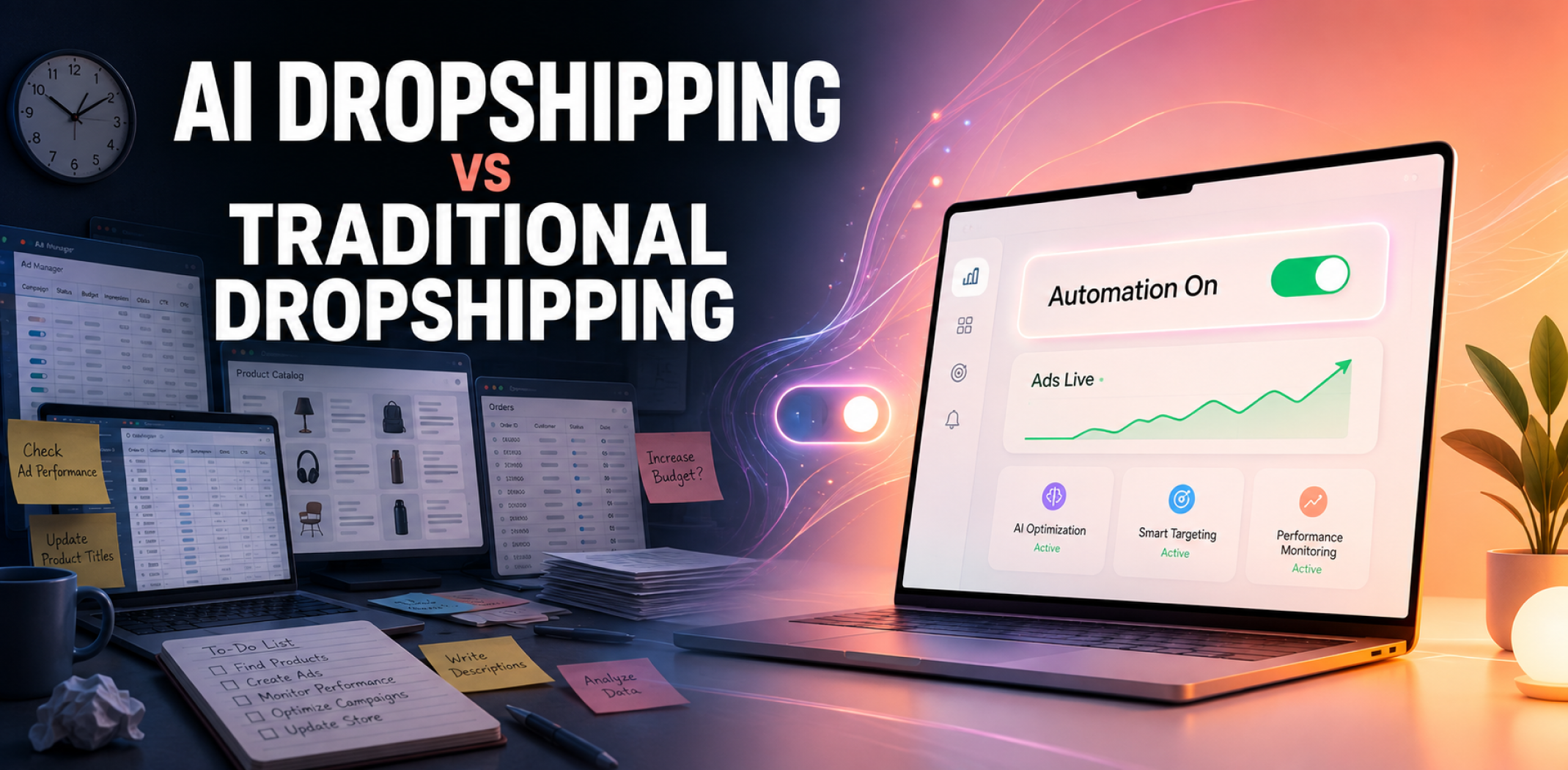
Type “AI dropshipping” into Google next to “traditional dropshipping” and you will find dozens of articles using the two terms almost interchangeably. That is a problem, because they describe genuinely different workflows. One still asks a store owner to do most of the setup, research, and ad management by hand. The other hands that work to automation, and increasingly, to a fully digital, no-inventory version of the model.
This guide breaks down what actually changes when AI enters a dropshipping business: setup time, product research, ad management, and how orders get fulfilled. It also looks at where AI dropshipping stops being just a label and starts being a real operational difference, using AliDropship, a digital-only online business platform, as the working example.
Part of the reason the two terms blur together in search results is timing. Dropshipping as a category has existed since long before AI tools were part of the picture, so most of the how-to content written about it describes the manual version by default, even when it does not say “traditional” anywhere in the text. AI dropshipping is the newer label people reach for once a platform starts handling pieces of that manual work automatically, which means the comparison is less about two competing business models and more about how much of the same underlying model has been automated.
AI dropshipping vs traditional dropshipping: The numbers that actually matter
Before getting into workflow differences, it helps to see what automation actually changes on the ground. Traditional dropshipping and AI dropshipping both start from the same basic model: sell products without holding inventory. What separates them is how much of the setup and daily running gets handed to software instead of the store owner.
Those numbers describe one specific platform, not the whole category. Across AI dropshipping platforms in general, automation usually clusters around four tasks: product research and curation, so a seller is not scrolling supplier catalogs one item at a time; store setup, since a pre-built layout replaces picking a theme and building pages from scratch; ad management, where the platform sets targeting and creative instead of the seller learning ad platforms cold; and order communication, where automated updates replace manually emailing customers about status. Not every AI dropshipping platform automates all four to the same degree, which is exactly why the label covers such a wide range of actual experiences.
Stacked together, those four tasks add up to a meaningful chunk of a work week for someone running a traditional dropshipping store solo. That time cost is not a flaw in the traditional model, it reflects how much of ecommerce used to require a human in the loop for nearly every step. AI dropshipping does not eliminate the work so much as move it from the store owner to the platform, which is exactly why the setup time comparison in the numbers above looks so different from the actual product margins, which tend to land in a similar range either way.
The bigger, category-wide difference between AI dropshipping and traditional dropshipping shows up in daily workflow, which is where the next section picks up.
Where the two models actually diverge
Traditional dropshipping and AI dropshipping both run on the same basic idea, sell products without holding stock, but the day-to-day experience of running one looks very different from running the other. The clearest way to see it is side by side.
Setup time and product research are usually where the difference is most visible. A traditional dropshipping store typically starts from a blank storefront: pick a platform, choose a theme, then spend hours or days searching supplier catalogs for products worth listing. An AI dropshipping store like AliDropship starts from a store that already exists, stocked with a curated catalog, so the first real decision a new owner makes is which of the already-loaded products to feature first rather than where to find products at all.
Ad management and order handling follow a similar pattern. Traditional dropshipping generally means learning an ad platform from scratch, choosing keywords or audiences manually, and tracking performance across separate dashboards. AI dropshipping platforms tend to fold that into one built-in system where a daily budget is the main input and the software handles targeting and creative from there. Order updates work the same way: a traditional setup often means manually forwarding shipment tracking to customers, while an automated, digital-only setup like AliDropship delivers the product instantly and skips shipment tracking entirely.
There is also a hidden cost difference in how many separate tools each model ends up requiring. A traditional dropshipping setup often means stitching together a store builder, a product research tool, a design tool for ad creative, and a separate ad platform login, each with its own learning curve and sometimes its own monthly fee. An AI dropshipping platform that bundles store building, product curation, and advertising into one system removes that stitching step entirely, which is a big part of why the setup time gap in the numbers above is so wide. The tools were not eliminated, they were consolidated.
One thing that does not change much between the two models is what the end customer actually sees. A shopper buying from a traditional dropshipping store and a shopper buying from an AI dropshipping store both land on a normal-looking online store, browse products, and check out the same way. The automation gap is almost entirely on the operator side, in how the store gets built and run, not in the buying experience itself.
The automation side of that comparison is not unique to any one platform; plenty of tools now offer some version of automated dropshipping, from AI-assisted product research to autopilot inventory syncing. What varies a lot more from platform to platform is how much of the automation is actually bundled together versus stitched from separate tools.
What this looks like in practice
Numbers and comparison tables only go so far. Here is what the difference actually looks like for two people starting out around the same time, one running a traditional dropshipping setup and one running a fully automated, digital-only store.
The gap tends to widen rather than close over the following weeks. Devon’s manual workload stays roughly constant every week, since nothing he set up automates itself later. Amara’s daily tasks shrink further once her ad system has enough data to optimize on its own, leaving her with less hands-on work in month two than in week one. That trajectory, flat effort for the manual model versus declining effort for the automated one, is a big part of what people are actually asking about when they search for the difference between the two.
Devon and Amara are composite examples, not real customers, but the pattern they illustrate holds up broadly: the time that traditional dropshipping asks a store owner to spend on research, setup, and ad testing does not disappear with AI dropshipping, it just moves to the platform instead. Whether that trade makes sense depends on what you would rather spend your limited time on: learning the mechanics of ecommerce from scratch, or picking what to sell and how to talk about it.
Is AI dropshipping actually better, or just different?
Faster and less manual is not automatically the same as better for every situation. Traditional dropshipping still appeals to people who want full control over every product decision and do not mind the time cost. AI dropshipping trades some of that hands-on control for speed, consistency, and a much shorter learning curve, which tends to matter more for someone starting their first online business than for someone who already knows the space well.
It is also worth separating two things that get blurred together online: AI dropshipping as an automation category, and digital-only as a specific business model within it. Most stores that show up in an AI dropshipping search are automation-heavy but still sell physical products with all the shipping and supplier logistics that come with them. A smaller group, AliDropship among them, applies that same automation to a fully digital catalog instead. If that distinction matters to you, our breakdown of AI dropshipping vs digital dropshipping goes deeper into where the two labels overlap and where they do not.
Traditional dropshipping still makes sense for a specific kind of seller: someone who already has ecommerce experience, wants direct control over supplier relationships and product sourcing, or is building a store around a very specific niche that a pre-loaded catalog would not cover well. For that person, the manual work is not wasted effort, it is the actual craft of the business. AI dropshipping is the better fit for someone who wants to test whether running an online business is for them without first learning ad platforms, supplier vetting, and store design from scratch.
Automation also does not remove every judgment call. Picking the right products, pricing them sensibly, and staying consistent with ads still shape the outcome, automated or not. That is a fair question to ask before starting with any platform, and it is worth reading a straightforward answer to whether AI dropshipping is legit or a scam before assuming automation alone makes the decision for you.
A fair number of sellers land somewhere in between rather than picking one model outright. Someone running a traditional dropshipping store might bolt on a single AI tool for product descriptions or ad copy without switching platforms, getting a partial automation benefit while keeping full control over sourcing. That hybrid approach is common, and it is worth naming, since most comparisons frame this as an either-or choice when in practice the automation categories described earlier can be adopted piece by piece.
Switching from one model to the other partway through is usually simpler than it sounds, since the two are not opposing philosophies so much as two points on the same automation spectrum. A store owner moving off a manual setup is not abandoning sunk work; product research skills and an eye for what sells still transfer directly, the only thing that changes is which parts of the day-to-day get handled by software instead of by hand.
How AliDropship applies AI dropshipping’s automation
If you want to see AI dropshipping’s automation applied to a fully digital, no-inventory business, AliDropship is one of the most beginner-friendly platforms out there, and a useful starting point if you are exploring how to start an online business for the first time. It brings your store, your products, and your marketing together in one place, so you can launch fast without stitching together separate tools yourself. Over 1,500,000 stores have already been built on AliDropship, and the platform has been featured by Forbes, Entrepreneur, Inc., NBC, Business, and Fox News.
In practical terms, testing that shift starts with a 14-day free trial that includes full access to the store and product catalog, plus a $40 ad coupon that covers the first stretch of automated advertising without touching your own budget. That is enough time to see whether the automated version of dropshipping suits how you want to spend your time, before deciding whether to continue at $39 a month.
None of this means AI dropshipping removes every decision from your plate. You are still the one choosing which products to feature and how to position your store. What changes is which tasks you spend your time on, since the setup, ad management, and order fulfillment run in the background instead of sitting on your to-do list.
The short version: AI dropshipping and traditional dropshipping are not two different businesses, they are two different amounts of manual work layered onto the same underlying model. If the busywork of research, setup, and ad testing is the part holding you back from starting, that is exactly the part automation is built to take off your plate.
What is the main difference between AI dropshipping and traditional dropshipping?
Is AI dropshipping certain to produce faster sales than traditional dropshipping?
Is AI dropshipping more expensive to start than traditional dropshipping?
Can I switch from traditional dropshipping to AI dropshipping?







