Get your FREE store + Amazon business!
Side hustle starter pack with a $100 bonus voucher inside
Claim a free store with a head-start voucher today!
Get for free

From $87 In Checking To $1,012 Saved: How To Build An Emergency Fund From Zero


how to build an emergency fund fast

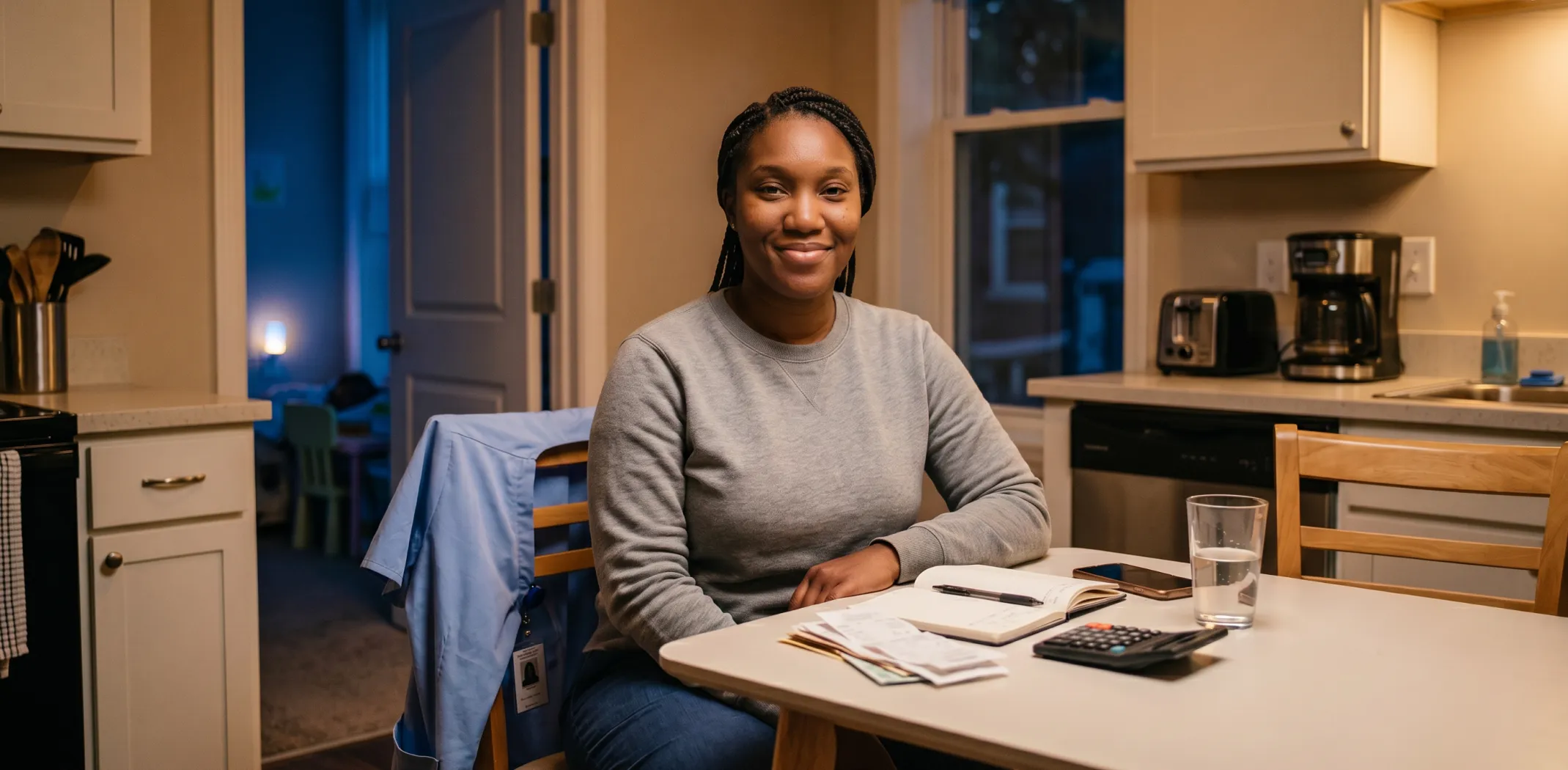
One Tuesday in February cost Yvette $1,245 she didn’t have – Devon’s asthma flare at school plus her car towed from the Norton employee lot. That Friday night she sat at the kitchen table and did the math she’d been avoiding for four years. A $9 tool gave her the 90-day plan. Twelve weeks later there was $1,012 in a savings account that hadn’t existed in March.

Most articles on how to build an emergency fund assume you can spare $200 a month and a quiet weekend to plan. Yvette can’t. She’s a lab tech at Norton Hospital making $46,000 a year and raising 10-year-old Devon alone in Louisville. The plan had to work on a $214 paycheck-end balance – or it didn’t work.

Devon was fine by Wednesday morning. Yvette wasn’t. Three days of looking at her checking app and waiting for the next bad day. Her coworker LaShauna showed up Saturday morning with coffee and a link. Here’s what happened next.

Why building an emergency fund matters more than another finance hack

For four years Yvette had been doing the same Friday-night kitchen-table math. Rent. Daycare credit. Devon’s after-school. Groceries. Car. Capital One minimum. By the 28th of every month checking ran around $214 and one bad day could crack the whole thing open. Then a bad day did.

60%
of Americans can’t cover a $1,000 surprise expense (Bankrate)
39%
have $0 in savings (Federal Reserve)
$400
median savings balance for the bottom 50% of households

Those numbers aren’t doom. They’re Yvette’s situation – not unusual, just underserved by financial advice written for someone with more income, more time, or more cushion.

Expert tips:
Most people fail at building an emergency fund because they aim too high too fast. Six months of expenses on a $46K salary is $13,800 – impossible to feel. Emergency Fund Builder sets a $1,000 starter target first – a number you can actually hit in 90 days, that covers 80% of real emergencies, and proves to you that saving is possible.

It wasn’t a crisis until it was. The bills got paid – usually. The rent went out on the 1st – usually. But there was zero room for a tire to blow, an ER co-pay to land, or a tow-truck fee to drop in on the same morning.

$1000 emergency fund 90 days plan

Yvette is 32. She drives a 2016 Hyundai Elantra with 119,000 miles. She wears Norton Hospital scrubs Monday through Friday and pulls one Saturday a month for the overtime differential. Her son Devon is 10, in fourth grade at Cochran Elementary, mild asthma that flares with cold air. Yvette’s mother Carolyn lives 15 minutes east and watches Devon after school until 4:30pm – Yvette helps her with $100 a month for utilities because Carolyn’s on a fixed disability check.

Like a lot of working single moms, Yvette wasn’t looking for how to build an emergency fund in some Pinterest-board way. She was looking for a thousand dollars to sit in a separate account so the next bad Tuesday didn’t crack her open.

What Yvette tried before the $9 tool worked

Here’s what Yvette had tried in the four years before the bad Tuesday:

Dave Ramsey’s envelope system (from a coworker’s recommendation)

She tried it for six weeks. Cash in envelopes for groceries, gas, kid stuff. By Week 7 she’d had to pull from three envelopes to cover one bill and the system collapsed.

r/povertyfinance threads at 2 a.m.

Tons of advice. None of it ranked. None of it told her which thing to do first when she had $87 in checking and no time to read 40 comment threads.

Acorns round-ups

Eight months in, she’d saved $41 in round-ups and paid $3/month in fees. The math worked out to less than $5 a month of actual savings.

Every system assumed she was someone she wasn’t. The envelope thing assumed predictable income. The Reddit threads assumed time to research. The round-ups assumed savings would compound at a rate the fees didn’t eat. None said: given your $46K salary and your $214 month-end checking, here’s the one thing to do this week.

emergency fund on low income working class

That’s the gap Yvette walked into Saturday morning at her kitchen table when LaShauna handed her a phone and said: the right tool for building a first emergency fund is nine dollars.

Nine dollars when I had eighty-seven dollars total in the world felt insane. I sat there for ten minutes before I clicked. LaShauna texted me ‘just do it.’ I did it. The questions were six. The whole thing took me twenty-two minutes including a bathroom break for Devon.

Yvette closed her eyes, tapped Apple Pay, and watched her checking drop to seventy-eight. The tool didn’t open with a sales page. It opened with six questions about her actual life – monthly essentials, current savings, monthly income, job stability, dependents, biggest obstacle – and twenty-two minutes later it gave her back five sections built on her exact numbers. Not “build a 6-month fund” generic advice. A target. A money finder. A 90-day plan. A full fund strategy. Protection rules for what counts as an emergency.

The 5 sections the tool returned for Yvette

Twenty-two minutes later, Yvette had a plan. Five sections. Not “save more” – a starter target with the math, a money finder with the exact charges, a 90-day plan with weekly dollar amounts, a full-fund strategy beyond the starter, and the protection rules that decide what counts as an emergency.

EMERGENCY FUND BUILDER · 5 SECTIONS FOR YVETTE
22 MIN · PERSONALIZED
Inputs: $2,950/mo income · $87 savings · stable Norton job · one dependent (Devon)
5
🎯 YOUR TARGET
$1,000 → $6,540

Section 1 · Starter goal $1,000, full goal $6,540 (3 months essentials)

$1,000 covers 80% of working-class emergencies (tow, ER co-pay, brake job). Full fund = 3 months essentials for a stable-income household with one dependent. Don’t aim for 6 months until $1,000 is hit.

🔍 MONEY FINDER
$185/mo found

Section 2 · 5 specific subscriptions and recurring charges Yvette had forgotten

Hulu, Showtime, pet insurance for a dog she lost in 2022, a Twitch sub, cloud storage she didn’t know which service. $185/month redirect – before adding a dollar of new money.

📅 90-DAY PLAN
$50/wk auto + $185 redirect

Section 3 · Week-by-week targets, Marcus Goldman high-interest savings account + auto-deposit

Open a a savings account that pays you good interest at a separate bank. Set $50/week auto-deposit from Norton paycheck. Cancel subscriptions weekend one. Track once a week, not daily.

🏦 FULL FUND STRATEGY
~14 months to $6,540

Section 4 · What happens after the $1,000 line is crossed

Keep the $50/week auto-deposit running. Setback rule: if Yvette dips into the fund, the next paycheck doubles the auto-deposit until refilled. Stop building, start investing, after $6,540 is hit and held for 60 days.

🛡 PROTECTION RULES
What counts · What doesn’t

Section 5 · The criteria that decide if the fund moves

Counts: unexpected medical, car repair >$500, urgent home, lost income. Doesn’t: clothes, “I deserve this,” gifts, anything Yvette can pay over 3 paychecks. Kept at a separate bank so it’s 2 taps away – not 0.

It pulled up the recurring charges from my Capital One statement. Five subscriptions. One was for a dog who’d been gone since 2022. I’d been paying twenty-six dollars a month for pet insurance for a memory. Twenty-six dollars covered Devon’s whole school lunch for a week.

Emergency Fund Builder
$1,000 stands between you and a crisis. 60% of households can’t cover a $1,000 surprise. Start today, even with $20.

39% of Americans have $0 in savings. What about you?

Type in what you spend each month. Type in what you have saved now. Type in the one thing that holds you back. The tool gives you five things back: your goal, the money you can find right now, a plan for the next 90 days, a plan past that, and rules for what counts as an emergency. About 22 minutes.

A financial planner charges $200+/hr

$9

Build My Fund Now →

One-time · Instant access · 30-day refund, no questions · Private

Saturday afternoon Yvette opened a Marcus Goldman high-interest savings account on her phone (the tool linked to three options – she picked the one with the highest APY at the time). Took 11 minutes. Cancelled the five subscriptions Sunday morning. Set up the $50/week auto-deposit Monday morning from her Norton paycheck.

From $87 to $1,012 in 90 days: Yvette’s 12-week timeline

Saturday morning Yvette had $87 in checking and $0 in savings. The tool’s 90-day plan said: open the high-interest savings account today, cancel the five subscriptions this weekend, set up $50/week direct deposit Monday morning, and let the system do the work. Don’t check the balance more than once a week.

Day 9: first $50 deposit. Fifty dollars. Not a lot. But the savings number had moved up for the first time since Yvette opened her first checking account at 18.

Week 4 I checked the Marcus app at the lab on my break. Three hundred and eighty-five dollars. I almost didn’t believe the screen. I’d been watching my checking balance my whole adult life – never a savings number that went up four weeks in a row.

12-Week Timeline
Week 1
high-interest savings account opened. 5 subscriptions cancelled. Auto-deposit set up. $0 saved yet.
Week 2
First $50 deposit hit Day 9. $50. First subscription refund landed too – $14.
Week 3
All subscription refunds processed. Second $50 deposit. $164 total.
Week 4
Subscription savings now redirecting monthly. $385 total.
Week 6
Caught one subscription that wasn’t fully cancelled. Fixed it. $585 total.
Week 8
Devon’s school asked for a $45 spring-fundraiser donation. Yvette paid in cash without thinking twice. $785 total.
Week 10
$895 total.
Week 12
Crossed the line. Total: $1,012.

Not life-changing money. But it bought back the room to breathe. Devon’s next asthma flare doesn’t crack the budget. A tow doesn’t end the month. And – maybe the part that mattered most – Yvette stopped flinching every time her phone buzzed at 3pm on a school day.

Two weeks ago Devon’s school asked for forty-five dollars for the spring fundraiser. I wrote the check the same day. I didn’t call my mom. I didn’t lose sleep. I didn’t tell Devon it might be a maybe. I just paid it. That’s what one thousand dollars buys you.

Why most working families never build an emergency fund – and how to break the pattern

There’s a reason 60% of households can’t cover a $1,000 surprise. It’s not laziness. It’s not bad math. It’s that the advice is written for someone who already has more cushion than they’re trying to build.

Dave Ramsey assumes you have predictable expenses. Reddit assumes you have time to research. Acorns assumes the round-ups will outpace the fees. Every option whispers the same lie: you need to be more like someone you’re not before saving works.

Option
Cost
Time
Works at $46K
Financial planner
$200+/hr
Days–weeks
Yes, but unaffordable
Dave Ramsey envelope system
Free
Weeks
Assumes predictable bills
Reddit + YouTube research
Free
Many hours
No – generic
Emergency Fund Builder
$9
~22 minutes
✔ Yes, personalized

The free options aren’t bad. They’re just built for someone with predictable income, predictable expenses, or unlimited research time – not someone whose Tuesday afternoon can disappear into an ER waiting room.

🤔

What if I don’t have $50 a week to save?

The tool starts with what you already have. If you have $0 left over each month, it finds the cheap leaks first. Usually 2 to 5 bills you forgot you were paying. Yvette’s tool found $185 a month before she added one dollar of her own. If your tool only finds $40, the plan adjusts. You don’t need to bring money to start. The tool finds it for you.

That’s the part most generic advice skips – the money finder. Subscriptions, charges you forgot, things that quietly renewed. The average working-class household has $87–$240 a month in recurring charges they no longer use.

What other readers built with the same approach

Yvette isn’t unusual. Working-class households are quietly building first emergency funds by starting with the money finder, not the savings target.

WEBP-renee-testimonial-1.webp

★★★★★

“I tried Dave Ramsey, I tried YNAB, I tried a budget binder. The thing that worked was the tool finding $94/month I didn’t know I was paying – including a gym I hadn’t walked into since 2023. $640 saved in 60 days.

Renee W. · single mom, Sacramento CA

WEBP-malik-testimonial-1.webp

★★★★★

“My wife and I had two emergencies in six months that put us back $1,800 on the credit card. The tool walked us through the protection rules – what counts as an emergency, what doesn’t. $1,100 saved in 14 weeks. First emergency fund we’ve ever had.

Malik R. · warehouse supervisor, Cleveland OH

ALSO INCLUDED

Beyond the starter plan – Emergency Fund Builder also includes the Quick Money Finder (for when you need to redirect a specific dollar amount fast), a protection-rules card for what counts as a real emergency, and unlimited reruns when your situation changes.

Whether your situation looks like Yvette’s, Renee’s, Malik’s, or nothing like any of them, the same approach applies. You bring what you have. The tool finds the rest.

How to start building an emergency fund this week – the 5-step playbook

If you’re where Yvette was three months ago – $87 in checking, $0 in savings, one bad Tuesday away from cracking – here’s the 5-step playbook the tool walks you through:

1

Aim for $1,000 first, not 6 months of expenses

$1,000 covers 80% of working-class emergencies. Hit it before you think about the bigger number.

2

Find the leak before you add new money

Pull your credit-card and bank statements from the last 90 days. List every recurring charge. Cancel anything you forgot existed. This usually finds $50–$240/month.

3

Open a separate a savings account that pays you good interest

Not your regular checking bank – a different one so you don’t accidentally see the balance and spend it. Marcus Goldman, Ally, SoFi all work. The tool ranks the current best rates.

4

Automate it. Don’t rely on willpower.

Direct deposit a fixed amount per paycheck into the high-interest savings account before it hits your checking. Yvette did $50/week. Even $20 works if that’s what fits.

5

Decide what counts as an emergency before the emergency

Unexpected medical, car repair >$500, urgent home, lost income. NOT clothes. NOT impulse. NOT “I deserve this.” Write the rule before you need it.

Yvette didn’t have any of the typical advantages – no extra cushion, no second income, no quiet weekend to research. She had what she had, 22 minutes, and the willingness to actually do the five steps in order. The same is true for almost everyone reading this.

Once the fund is rolling, the next move is feeding it faster – a small weekly side income that goes straight to the high-interest savings account. That’s a different tool, built for the same kind of working-class schedule.

⚠ Most readers find their first leak in under 30 minutes

Tired of one bad Tuesday cracking your budget?

Build the buffer instead.

Answer six short questions. Get your goal. See the money you can find right now. Get a 90-day plan that does not depend on you trying harder. About 22 minutes.

A financial planner charges $200+/hr

$9

Build My Fund Now →

One-time payment · Unlimited re-runs · Instant access · No subscription

✔ 30-day money-back guarantee

Build your own first emergency fund – the same 22-minute tool Yvette used to find $185/month she didn’t know was leaking and build $1,012 in 90 days.

PLAN MY EMERGENCY

FAQ

How to build an emergency fund fast?

Find money you already pay but don’t use. Most people pay $100 to $250 a month for things they forgot – gym, streaming, pet stuff, old apps. Cancel them. Put that same money into a savings account at a different bank from your checking. Set it to move the day after each paycheck. Most people hit their first $1,000 in 90 days. Without earning one new dollar. The tool finds the money.

How to set up an emergency fund step by step?

Five steps in order. (1) Open a savings account at a different bank than your checking. Pick one that pays you good interest – Marcus, Ally, SoFi, or Capital One 360. (2) Your first goal is $1,000. Not six months of pay. Six months is too far away to feel real. (3) Pull your last three months of bank and card bills. Circle every charge you don’t use. (4) Cancel those charges. Send that money to the new account every payday. (5) Write down what counts as an emergency before you need to use it.

How to start building an emergency fund from zero?

Start with the money you already pay – not the money you wish you had. Most people pay $100 to $250 a month for things they forgot. Pet insurance for a pet that’s gone. Gym from 2022. Three streaming apps stacked. Cancel those. Send that exact money to the new savings account. After the first month works, then add more. Trying to save through willpower from zero fails. Starting with money you already pay works.

How to build an emergency fund on a tight budget?

The tool works even if you have $0 left over each month. The Money Finder finds 5 to 10 charges most people can cancel and never miss. The pet insurance for a pet that passed. The gym from two years ago. Three streaming apps stacked. The savings come from money you were already losing – not new money.

How long does it take to build an emergency fund?

The first $1,000 takes 60 to 120 days for most people. Yvette hit $1,012 in 12 weeks while earning $46K a year. The full three months of bills saved takes 12 to 18 months. The big variable is how much money you find in old charges in the first month. The more you find, the faster you finish.

How to start an emergency fund with no money?

Start with the money-finder, not with willpower. Pull your last three months of bank and card bills. Highlight every charge you don’t use. Most people find $100 to $250 a month they can cancel right now without changing how they live. That is your seed money. The first deposit to the new savings account comes from the cancel list – not from your normal budget.
avatar
By Anna V.
They say you can't do too many tasks at once and achieve great results. But they most likely don't know Ann! She's, first of all, a mother and a wife, then, a marketing expert, and... a proud creator of multiple 6-figure stores. Can you keep up? Learn from her experience and you'll achieve success!
×