Google Trends Products: What Is Selling Right Now In 2026


If you have ever wondered how some online sellers always seem to stock the right products at exactly the right time, the answer is usually the same: they use Google Trends. Right now, in 2026, real-time search data is one of the most powerful – and most underused – tools available to ecommerce entrepreneurs. While your competition is guessing, you can be reading actual consumer demand signals and stocking your store accordingly.
Quick Answer: Google Trends products are items whose search interest is measurably rising on Google, signaling growing consumer demand. In 2026, top trending categories include wellness gadgets, sustainable accessories, beauty tools, smart home devices, and portable tech – all backed by consistent or sharply rising search volume.
This article covers the best products trending on Google Trends right now, what makes each one worth selling, and how to act on that data before the market gets crowded.

What are Google Trends products?
Google Trends is a free tool from Google that tracks how often specific search terms are entered into its search engine over time. It scores relative search interest on a scale from 0 to 100, where 100 represents the peak popularity for a given period. For ecommerce sellers, this translates into something very practical: a live pulse on what people actually want to buy.
When a product’s search interest rises steadily over 12 months or spikes sharply after going viral on social media, that is a signal that demand is real and growing – not manufactured by a marketing report. Google Trends products are simply items whose search momentum makes them worth adding to your store before the market becomes saturated.
The tool lets you filter by country, region, time range, and even search category, which means you can get granular. Want to know if sauna blankets are trending specifically in the United States this quarter? You can check that in under 60 seconds. That kind of data specificity gives independent sellers a genuine competitive edge.
What makes Google Trends especially useful in 2026 is the pace at which trends now form and spread. A single TikTok video can push a product from zero to 100 on the interest scale within days. Sellers who are watching the data can catch that wave early. Those who are not will see the same product everywhere a week later – by which point margins have already thinned.
How much can you realistically earn selling Google Trends products?
Earnings from selling trending products vary widely depending on how early you catch a trend, your marketing approach, your niche, and the platform you sell on. Here is a realistic overview of what different effort levels typically produce:
These ranges assume consistent effort over 60–90 days to build traffic and optimize product pages. The $15,000+ ceiling typically requires paid advertising, strong brand positioning, and multiple trending products running simultaneously.
One note on these figures: High-end monthly numbers reflect established stores with real ad budgets and refined operations – not first-month results. Most new sellers see their first meaningful sales within 30–60 days and scale from there. The key is picking products early, before peak search interest arrives.
The sellers who consistently profit from trending products are not necessarily the ones with the biggest budgets. They are the ones who check Google Trends regularly, understand what a healthy trend curve looks like – a steady upward climb rather than a sharp spike and immediate crash – and move fast when the data lines up.
Best Google Trends products to sell in 2026
The following products are not guesses or recycled lists. Each one reflects real, measurable Google Trends data from 2025 into 2026 – showing either a sustained upward climb or a sharp recent breakout that signals early viral traction. They are grouped by category to help you identify which niche fits your store best.
Health and wellness products
Sauna blankets
Sauna blankets use infrared heat to replicate the experience of a traditional sauna at home, without the cost or space requirements. Google Trends data shows a sharp climb in interest beginning in late 2024 with sustained high search volume carrying into 2026. The appeal is straightforward: consumers want the alleged health benefits of heat therapy – relaxation, improved circulation, post-workout recovery – on their own terms and on a budget accessible to most households.
For dropshippers, sauna blankets sit in a high-perceived-value category, which means margins are strong. A unit sourced for $30–$60 typically retails between $100 and $200. The wellness framing also works well with content marketing – YouTube reviews, before-and-after posts, and influencer partnerships all convert reliably in this niche.
Earning potential: $40–$140 per sale depending on model and positioning, with repeat purchases from buyers upgrading or gifting.
Hydrogen water bottles
These bottles use electrolysis to infuse water with hydrogen, and the health-conscious consumer market has responded. Search interest has grown steadily through 2025 and into 2026, driven by a broader trend toward science-backed hydration products. The 1.5-liter portable format is particularly popular, appealing to gym-goers, remote workers, and wellness enthusiasts who want a functional health upgrade they can carry anywhere.
The product photographs well, explains easily in short-form video, and carries strong margins – typically sourced between $15 and $35, with retail prices ranging from $50 to $90. The technical angle (hydrogen-rich alkaline water) also gives your product pages something specific and credible to talk about, which improves both SEO and conversion.
Earning potential: $30–$60 per unit, with bundle potential when paired with other hydration or wellness accessories.
Blue light therapy devices
Red light therapy became a saturated market quickly. Blue light therapy is following the same growth curve but has not yet caught up in competition. Search data shows blue light therapy queries are growing at a rate comparable to red light – but from a much lower base, which means the opportunity window is still open. The product addresses a specific, verifiable problem: acne and skin damage. That credibility makes it easier to market honestly without overpromising.
Handheld blue light therapy devices source for $10–$25 and retail comfortably at $50–$120 depending on features and branding. Pairing them with before-and-after user content builds trust and drives organic social traffic without heavy ad spend.
Earning potential: $30–$90 per unit, with strong upsell potential into broader skincare tool sets.
Beauty and personal care products
Flat back earrings
Traditional earring backs are bulky, uncomfortable during sleep, and increasingly impractical as multiple-piercing styles become mainstream. Flat back earrings – also called safety back earrings – solve this directly. Google Trends shows consistent upward search interest, driven by the curated ear stacking trend, rising piercing rates among younger consumers, and growing demand from parents looking for safe options for children with newly pierced ears.
The market is broad and the product is low-cost to source: typical wholesale pricing is $1–$5 per piece with retail prices ranging from $8 to $30 depending on design and material. Offering sets and variety packs significantly increases average order value. This is an evergreen niche with a trend boost – a reliable combination for long-term store performance.
Earning potential: $8–$25 per unit, higher with curated sets. Repeat buyer rate is strong in the jewelry niche.
Hair repair masks
Deep-conditioning hair repair masks have been climbing steadily on Google Trends alongside the broader consumer shift toward investing in hair health. The trend is closely connected to the sleep bonnet movement – both reflect growing awareness of hair damage from daily habits, and together they signal a niche with real staying power. Hair masks are accessible products: they are consumable (driving repeat purchases), easy to ship, and visually appealing on product pages and in social content.
Sourcing cost typically ranges from $3 to $12 per unit, with retail pricing between $15 and $40. Subscription or bundle formats work particularly well here because the consumable nature means customers who enjoy the product will return regularly.
Earning potential: $10–$30 per unit, with strong subscription or bundle revenue potential over time.
PDRN skincare products
PDRN – polydeoxyribonucleotide – is a medical-grade skincare ingredient that originated in Asian aesthetic medicine and is now expanding globally. Google Trends data shows a synchronized upward curve across PDRN creams, toners, and masks, with demand highest in South Korea, Singapore, and Hong Kong but measurable growth across Western markets. This is not a flash trend – the sustained, multi-product interest pattern signals an ingredient-driven movement with years of runway.
For dropshippers, this represents a premium positioning opportunity. PDRN products carry strong margins because consumers are willing to pay for science-backed, clinical-grade skincare. Sourcing from reputable Korean or Chinese manufacturers and building educational product pages around the ingredient will separate your store from generic competitors.
Earning potential: $20–$60 per unit, with premium bundles reaching $80–$120 for sets.
Tech and smart home products
Portable POV cameras
Search interest in portable POV (point-of-view) cameras has climbed steadily over the past several years, driven by the explosion of short-form video content on TikTok and Instagram Reels. The product sells itself visually: a 30-second clip of someone using a hands-free camera while cycling, cooking, or hiking is all the marketing most sellers need. Demand is global, and the format appeals to a wide audience – from outdoor sports enthusiasts to content creators to parents documenting family life.
Entry-level POV cameras source for $25–$60 and retail between $80 and $150 depending on quality and bundling. The strong visual payoff makes this product particularly well-suited to organic social marketing, which lowers customer acquisition cost compared to purely paid traffic strategies.
Earning potential: $40–$90 per unit, with accessory upsells (mounts, cases, memory cards) increasing average order value significantly.
Smart door knobs
Smart home adoption continues to expand, and smart door knobs represent one of the most accessible entry points. They offer keyless entry, multiple unlocking methods (PIN, app, fingerprint), and a direct upgrade to household security – a need that resonates with homeowners, renters, and property managers alike. Google Trends interest in smart door knobs has been climbing consistently, riding the broader smart home wave without being as saturated as smart speakers or smart lighting.
The product appeals to a practical, purchase-ready audience. Someone searching for a smart door knob is not casually browsing – they have a specific problem and are ready to solve it. That high purchase intent translates into strong conversion rates when your product pages clearly demonstrate the installation simplicity and security benefits.
Earning potential: $30–$70 per unit, with higher-end smart lock bundles reaching $100–$150.
Wireless charging desk lamps
The combination of two useful functions – ambient lighting and wireless device charging – has driven search interest in wireless charging desk lamps steadily upward since mid-2024, with notable spikes during back-to-school and Black Friday periods. This is a product that fits naturally into the home office and student niche, both of which remain robust buying categories in 2026. The dual-function angle also makes it easy to justify the price point to potential buyers.
These lamps typically source for $15–$30 and retail between $40 and $80, giving sellers comfortable room for paid advertising while maintaining healthy margins. The product also has a strong gifting angle, which makes Q4 and Valentine’s Day natural high-volume sales windows.
Earning potential: $20–$50 per unit, with seasonal spikes providing predictable revenue boosts.
Sustainable and lifestyle products
Glass straws
Glass straws have shown a clear and consistent upward trend on Google Trends, with over 125,000 monthly searches globally. The growth is tied directly to increasing consumer awareness around single-use plastic and a preference for reusable, BPA-free alternatives. Health-conscious buyers also appreciate that glass straws do not leach flavors or chemicals the way some plastic versions do, and the visual appeal – many come in attractive colors or artistic designs – makes them popular in the lifestyle and kitchen accessories space.
Offering sets with cleaning brushes and protective cases significantly increases perceived value and average order value. The eco-friendly angle also lends itself well to brand storytelling that resonates with a values-driven audience, which tends to be more loyal and more likely to share purchases on social media.
Earning potential: $8–$25 per set depending on size and presentation. Repeat purchases are common as customers buy extras for gifts.
Portable espresso makers
Home coffee culture exploded during the pandemic years and has not slowed down. Portable espresso makers tap into this by offering a premium coffee experience anywhere – camping, travel, office, or commute. Google Trends data shows steady growth over the past 12 months with noticeable spikes in Q4 2024 and Q1 2025 continuing into 2026. The product appeals to coffee enthusiasts and casual drinkers alike, which keeps the addressable audience wide.
Lightweight manual pump models are the strongest sellers in this category. Source for $10–$25 and retail between $35 and $80 depending on design and branding. Including branded packaging and positioning the product around the “cafe-quality coffee anywhere” story gives you a strong differentiator from generic listings.
Earning potential: $20–$55 per unit, with accessory bundles (travel cases, coffee pods, cleaning kits) pushing average order value higher.
How to use Google Trends to validate any product
Spotting a product name in a “trending products” article is a starting point, not a verdict. Before adding anything to your store, spend five minutes validating the actual search data yourself. Here is what to look for.
Read the trend shape, not just the score
A score of 80 on Google Trends means nothing on its own. What matters is the shape of the curve over time. A product showing a gradual, sustained upward climb over 12 months is a far safer bet than one that spiked to 100 for two weeks and immediately crashed. The steady climbers indicate genuine growing consumer interest. The spike-and-crash pattern usually signals viral hype that fades fast – the kind of product that floods supplier channels and tanks margins by the time most sellers stock it.
Conversely, a flat line with no movement suggests low, stable demand – fine for evergreen catalog products but not exciting enough to build a trend-driven campaign around. You are looking for that middle ground: consistent upward movement, ideally with seasonal peaks that are predictable and recurring.
Check regional demand patterns
Google Trends shows you where search interest is concentrated by country, state, or city. This is valuable in two directions. First, it tells you which markets to target with paid advertising – no point spending budget on audiences in regions where no one is searching for your product. Second, it can reveal geographic arbitrage opportunities: a product trending heavily in one country but barely visible in another may be an early-entry opportunity in that second market before local competition catches up.
Compare related search terms
Google Trends also shows “related queries” – the search terms that people use alongside your main keyword. This is a goldmine for SEO and product page optimization. If you are researching sauna blankets and the related queries show strong interest in “infrared sauna blanket for weight loss” or “sauna blanket for back pain,” you now know exactly what language to use in your product descriptions and which pain points to lead with in your ad copy.
Cross-reference with social signals
A Google Trends spike that coincides with high TikTok or Instagram engagement is a stronger signal than either platform alone. When you see a product climbing on Google Trends, search for it on TikTok and check the most recent video view counts. If you find recent content (within the last 30 days) getting hundreds of thousands of views, that social momentum is actively feeding the search trend – meaning demand is likely to continue rather than plateau. The combination of rising search data and active social content is the clearest green light for trend-driven product selection.
What to avoid when selling trending products
Selling trending products is genuinely profitable when done right. It is also one of the fastest ways to burn through ad budget or damage your store’s reputation when done carelessly. Here are the most common mistakes to avoid.
Jumping on trends too late
By the time a product is featured in every major dropshipping blog, covered in YouTube videos, and appearing across Facebook ads, the profitable window has often already closed. Competition drives up ad costs, margins compress, and the platform algorithms start favoring established sellers with review histories. The point of using Google Trends is to get ahead of that curve – which means checking data regularly and acting within days of spotting a rising signal, not weeks.
Key principle: The best time to enter a trending product niche is when search interest is climbing but has not yet peaked – typically when a score moves from 20 to 50, not after it has already hit 90.
Choosing suppliers without vetting quality
Trending products attract a flood of low-quality suppliers who cut corners to meet sudden demand. Inconsistent product quality leads directly to refunds, returns, and negative reviews – all of which hurt your store’s long-term performance far more than any short-term revenue gain is worth. Always order samples before committing to volume. Check AliExpress reviews carefully and favor suppliers with consistent five-star feedback over long periods, not just recent activity. A single wave of bad reviews during a trending product’s peak moment can permanently damage your store’s standing.
Ignoring shipping timelines
Shipping expectations have shifted significantly. Customers in 2026 expect faster delivery than they did five years ago, and delayed orders during a trending product’s peak sales window are a direct threat to your reviews and repeat purchase rate. When evaluating suppliers, prioritize those with reliable shipping times to your target markets. Consider using suppliers who warehouse product in the destination country for your top-selling trending items. The short-term savings from slower, cheaper shipping almost never outweigh the customer experience cost.
How to build a Google Trends product strategy for your store
Chasing individual trending products one at a time is exhausting and inconsistent. A smarter approach is to build a store with a clear product strategy that uses Google Trends as an ongoing tool rather than a one-time lookup.
For complete beginners
If you are just starting out, pick one niche from the categories covered in this article – wellness, beauty, tech accessories, or sustainable lifestyle – and build your first store around it. Choose two to three products with clear, sustained upward Google Trends curves, write product pages that address specific buyer pain points, and focus your marketing energy on one or two social channels where your target audience is active. A single niche done well will outperform five niches done halfway.
For intermediate sellers (part-time to growing)
If you have an existing store and a basic traffic foundation, the next step is building a systematic product rotation process. Set a calendar reminder to check Google Trends for your niche every two to three weeks. When a product in your category shows a sustained climb over four to six weeks, test it with a small paid traffic budget before committing to heavy inventory promotion. This data-driven approach to product expansion reduces risk and keeps your catalog fresh without requiring constant manual research.
For advanced or full-time ecommerce goals
At a higher level, Google Trends becomes one layer of a broader product intelligence system. Serious sellers combine Google Trends data with TikTok analytics, AliExpress bestseller lists, and supplier activity signals to build a predictive picture of what will trend next. If you are aiming for $5,000+ per month, the goal is not just to sell trending products – it is to build brand equity in a niche so that your store benefits from each new trend wave rather than having to start over each time. That means consistent store design, cohesive branding, and an email list that you own independently of any algorithm.
AliDropship: Your complete all-in-one solution for starting dropshipping in 2026
If you want the simplest possible way to start dropshipping – especially if you’re brand new – AliDropship remains one of the most beginner-friendly tools available in 2026. It brings together store creation, product imports, automation, and marketing into a single streamlined system designed to help you launch quickly and grow confidently.
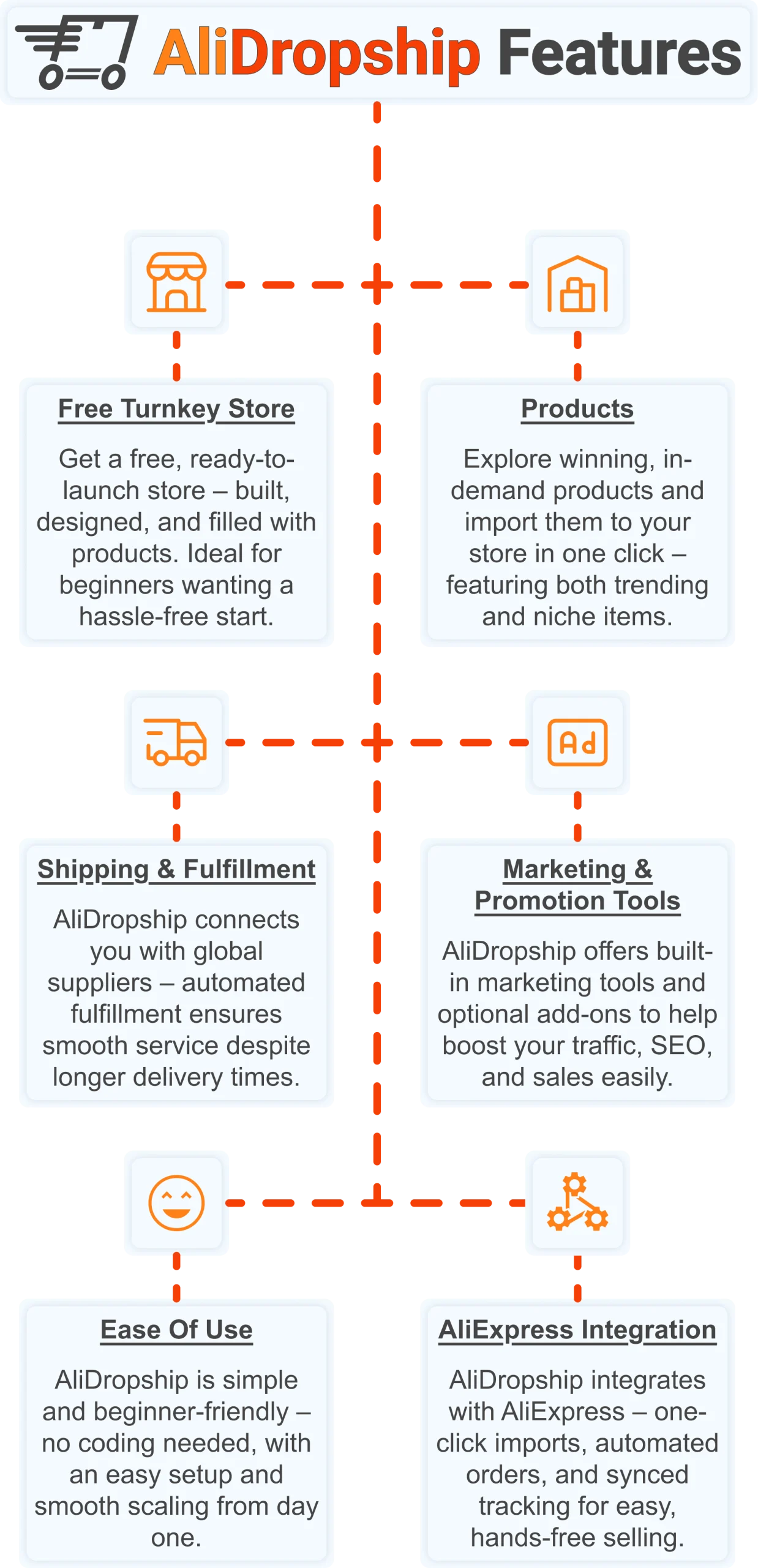
Free turnkey store 🛍️
Get a free turnkey store – built, designed, and filled with products. Ideal for beginners wanting a hassle-free start, the store comes fully optimized to attract customers right away, saving you time on setup. Plus, it includes professional design elements to give your business a polished, trustworthy look from day one. This ready-made foundation makes it easy to move seamlessly into product selection.
Products 📦
Once your store is set up, you can explore winning, in-demand products and import them in one click – featuring both trending and niche items. This wide selection lets you cater to diverse customer interests and test what works best. Regular updates ensure you always have fresh products, keeping your store competitive and relevant. With great products in place, smooth shipping becomes the next essential step.
Shipping & fulfillment 🚚
AliDropship connects you with global suppliers, and automated fulfillment ensures seamless order processing despite international delivery times. Customers receive real-time tracking updates, which builds confidence and trust in your store. Once shipping is handled reliably, you can focus on promoting your store and attracting traffic.
Marketing & promotion tools 📣
To maximize sales, AliDropship offers built-in marketing tools and optional add-ons that help boost traffic, SEO, and conversions. From email campaigns and discounts to social media integration, these tools empower you to reach and retain customers without needing prior marketing experience. With promotion strategies in place, managing your business becomes simpler and more efficient.
Ease of use 👌
AliDropship is beginner-friendly – no coding needed, with an intuitive dashboard that guides you through every step. Easy setup and smooth scaling let you expand your store without stress. As your business grows, adding new features, products, and marketing campaigns remains hassle-free, giving you more time to focus on sales.
AliExpress integration 🛒
Finally, AliDropship integrates seamlessly with AliExpress, enabling one-click imports, automated orders, and synced tracking. Your inventory stays up-to-date with the latest products and prices, while automated order processing frees you from manual tasks. Combined with the turnkey setup, reliable shipping, and built-in marketing tools, this integration ensures your dropshipping business is fully equipped for growth and success.
Google Trends tells you what people want to buy – AliDropship gives you the store to sell it to them. Get your free turnkey dropshipping store today and start selling the products people are already searching for.
What are the best Google Trends products to sell right now?
How do you find trending products on Google Trends?
Are Google Trends products worth selling for dropshipping?
How often do Google Trends products change?
What is the difference between a trending product and an evergreen product?