

Abandoned Cart Email

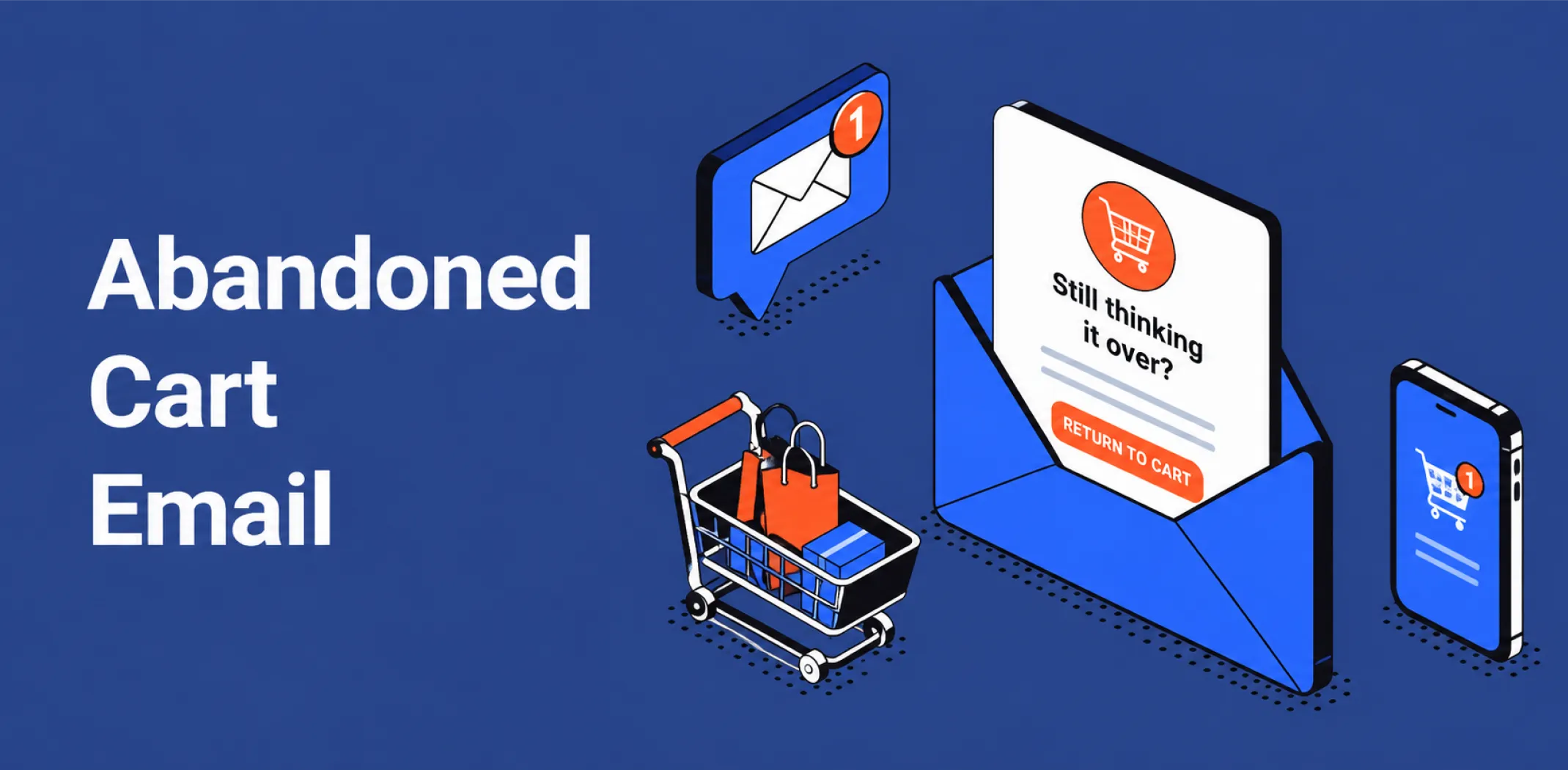
An abandoned cart email is an automated message sent to a shopper who added one or more products to an online store’s cart but left without completing the purchase, triggered by the cart abandonment event and designed to return the shopper to the store to complete their transaction.
Abandoned cart emails are a specific application of remarketing – behavioral re-engagement through owned channels – and are among the most commercially effective automated email formats available to ecommerce stores.
Unlike broadcast promotional emails sent to an entire subscriber list, abandoned cart emails are triggered by a specific action and sent to an individual whose purchase intent has already been demonstrated by the act of adding a product to their cart. This behavioral targeting produces open rates and conversion rates significantly above those of standard promotional campaigns.
The format is distinct from a general win-back or promotional email in that its content is anchored to the specific products the shopper left behind, using dynamic product insertion to display the abandoned items directly within the email body.
A critical prerequisite for abandoned cart emails is that the store must have the shopper’s email address before the abandonment occurs. This is achieved either through a prior purchase or account registration, through a pre-checkout email capture step that asks for an email address at the start of the checkout flow, or through an on-site pop-up that collects email addresses before the shopper reaches the cart.
Shoppers who abandon without having provided their email address cannot be reached through this channel – a gap that retargeting ads address by reaching anonymous abandoners through pixel-based paid placements instead.
Example
A dropshipping store selling kitchen appliances captures email addresses at the first step of its checkout flow. When a shopper adds a stand mixer to their cart and exits without purchasing, the store’s email platform triggers a 3-email sequence automatically. The first email – sent one hour after abandonment – shows an image of the mixer, its price, and a single call-to-action button linking directly to the pre-filled cart. It generates a 42% open rate and recovers 6% of recipients on its own. The second email, sent 24 hours later, features a 5-star customer review of the mixer alongside the product image, recovering a further 3% of the original abandoning cohort. The third email, sent 72 hours after abandonment with a 10% discount valid for 24 hours, recovers an additional 2%. Combined, the sequence recovers 11% of all abandoning shoppers who provided their email address – at a total cost of the platform subscription fee and the discount value on third-email recoveries.
Key characteristics
- Behavioral trigger: Abandoned cart emails are sent in response to a specific customer action – leaving a cart without purchasing – rather than on a scheduled broadcast basis, producing higher relevance and engagement than untargeted promotional sends.
- Dynamic product content: The email body displays the specific products the shopper left behind, pulled dynamically from the cart data at the time of abandonment, making the message personally relevant to each recipient without manual content creation per send.
- Sequence structure: Abandoned cart programs typically deploy 2 to 3 emails in a timed sequence – an initial reminder, a social proof or benefit-focused follow-up, and a final incentive email – with each message serving a distinct persuasive purpose and the sequence stopping automatically when the recipient converts.
- Email capture dependency: The channel only reaches shoppers who have provided their email address before abandoning; stores that do not capture email early in the checkout flow or via on-site pop-ups reach a significantly smaller proportion of abandoning visitors.
- Consent requirement: Abandoned cart emails may only be sent to contacts who have opted in to marketing communications or who have an existing customer relationship with the store, depending on the applicable data privacy regulations in the store’s operating jurisdiction.
Related terms
- Remarketing – the broader owned-channel re-engagement strategy of which abandoned cart emails are the most widely used and highest-returning specific application in ecommerce.
- Retargeting – the paid advertising counterpart to abandoned cart emails, used to re-engage cart abandoners who did not provide their email address through pixel-tracked ads served on social and display platforms.
- Conversion funnel – the staged path from awareness to purchase in which abandoned cart emails intervene at the final stage, recovering shoppers who reached the highest point of demonstrated purchase intent but did not convert.
- Average order value – a metric relevant to abandoned cart email design, since product recommendation blocks and minimum spend incentives included in recovery emails are a standard method for increasing the value of recovered transactions above the original abandoned cart total.
- Customer lifetime value – a metric extended by successful cart recovery, since each recovered abandoner becomes or remains an active customer whose subsequent purchase behavior contributes to long-term store revenue.
Frequently asked questions
How soon after abandonment should the first cart recovery email be sent?
The first email in an abandoned cart sequence should be sent within one hour of the abandonment event. This timing captures the shopper while the product is still fresh in their memory and before they have made a purchase decision elsewhere.
Open rates and recovery rates for the first email decline significantly when the send is delayed beyond two to three hours. The first email in a sequence consistently generates the highest open rate and recovery rate of any email in the sequence and should be treated as the primary recovery touchpoint.
Should abandoned cart emails offer a discount?
Not necessarily in the first email – a simple product reminder without an incentive recovers a meaningful proportion of abandoners at no discount cost, and offering a discount immediately trains shoppers to abandon carts deliberately to receive one.
The standard approach is to reserve the discount for the third email in the sequence, presented as a time-limited offer to create urgency, applied only to shoppers who have not converted after the first two reminders. This preserves margin on recoveries driven by the first two emails while still addressing price-sensitive abandoners in the final touchpoint.
What should an abandoned cart email contain?
An effective abandoned cart email contains a clear subject line referencing the abandoned product or cart, a dynamic image and name of the specific product or products left behind, the price and a direct link back to the pre-filled cart, and a single prominent call-to-action button.
Social proof elements – a customer review or star rating for the abandoned product – are commonly added to the second email in the sequence to address hesitation. The email should be concise: the goal is to return the shopper to their cart, not to provide extensive product information they can find on the product page itself.
What open and recovery rates should an abandoned cart sequence achieve?
Abandoned cart emails typically achieve open rates of 40% to 50% for the first email in the sequence – significantly above the 20% to 35% average for standard promotional emails – reflecting the high relevance of a message triggered by the recipient’s own recent behavior.
Full sequence recovery rates – the proportion of triggered sequences that result in a completed purchase – typically range from 5% to 15% of abandoning shoppers who provided their email address. Recovery rates at the lower end of this range are common for stores without an incentive in the sequence; rates toward the upper end typically involve a discount in the final email.
AliDropship: An all-in-one platform for starting dropshipping in 2026
AliDropship is a dropshipping platform that covers store creation, product imports, order automation, and marketing within a single system. It is designed for users with no prior ecommerce experience, though it also supports scaling for more established stores.
🛍️ Free turnkey store
New users receive a free pre-built store – set up, designed, and stocked with products. The store includes a ready-to-use product catalogue and a standard storefront design. It also comes with hosting, a domain, SSL, and payment systems already set up and included.
📦 Products
The platform provides access to a product catalogue covering both trending and niche items, with one-click import to your store. The catalogue is updated regularly to reflect current market availability. Products can be browsed, filtered, and added without leaving the platform.
🚚 Shipping & fulfillment
AliDropship provides access to a vast catalogue of products from global suppliers and handles order fulfillment automatically once a purchase is made. Customers receive tracking information directly, and orders are processed without manual intervention from the store owner.
📣 Marketing & promotion tools
The platform includes built-in marketing tools covering email campaigns, discount management, SEO settings, and social media integration. These are available within the dashboard and do not require third-party subscriptions for basic use.
👌 Ease of use
AliDropship requires no coding knowledge. The dashboard contains all the necessary tools for managing your store, products, and orders in one place. Additional features and products can be added as the store grows without rebuilding the existing setup.
How soon after abandonment should the first cart recovery email be sent?
Should abandoned cart emails offer a discount?
What should an abandoned cart email contain?
What open and recovery rates should an abandoned cart sequence achieve?
Can abandoned cart emails be sent to all store visitors?
Are you ready to become an owner
of a profitable online business?
Free Dropshipping Guide