Can AI Automatically Build An Online Store For You?

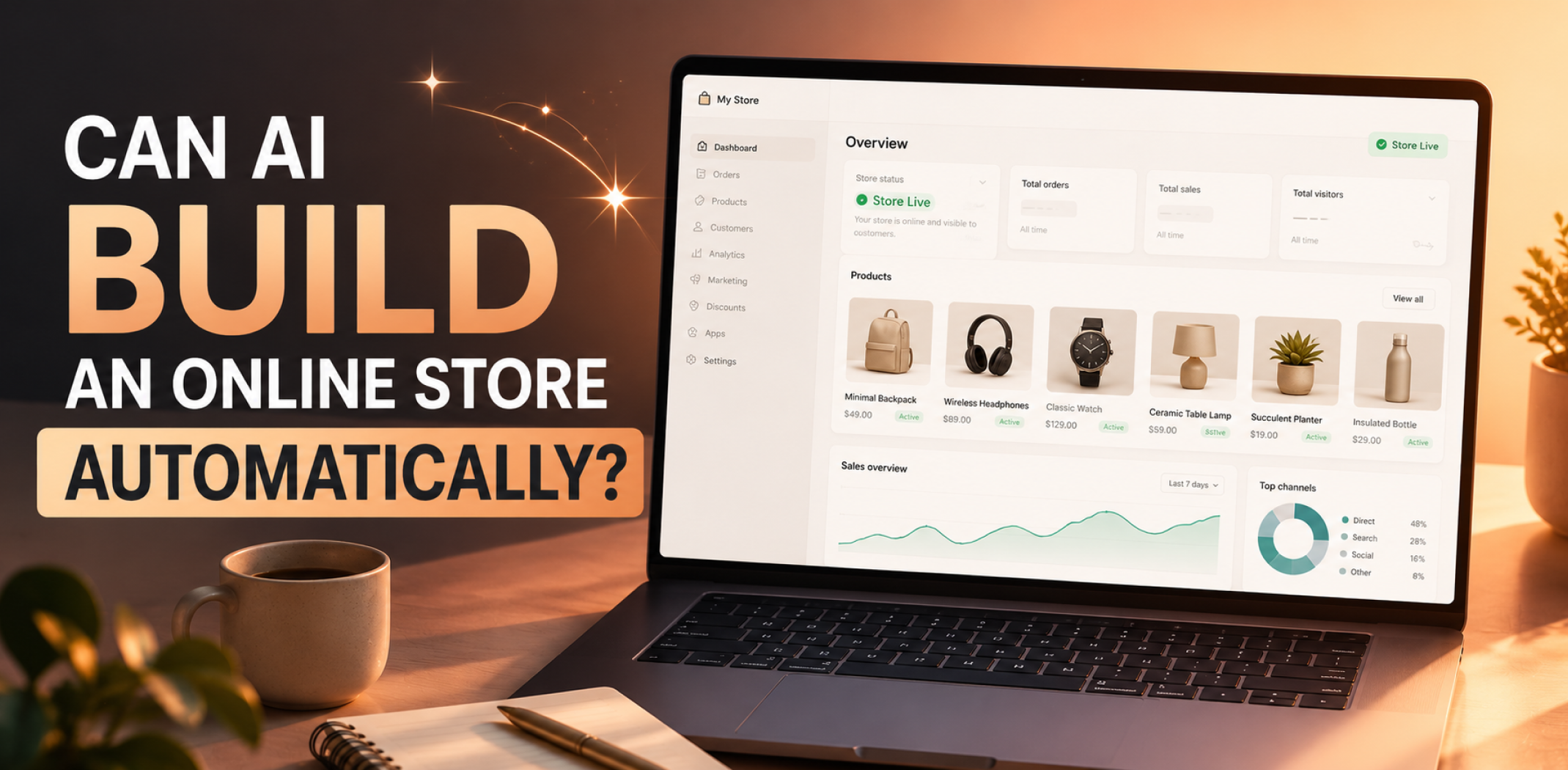
Search anything about starting an online business in 2026 and it will not take long to find bold claims about artificial intelligence. Type a few words into an AI tool, the pitch goes, and a finished online store appears, built, styled, and ready to sell. For anyone without a coding background and with limited time to spare, that promise is genuinely appealing.
The honest answer sits between hype and reality. AI can genuinely speed up parts of the process, but a store that can actually accept an order still takes real setup work that most tools do not finish for you. This guide breaks down what AI store builders can and cannot do on their own, then looks at a different option: a store that skips the building process altogether because it is already finished before anyone opens an AI tool.
Interest in this question has grown alongside a wave of new AI-powered website builders, logo generators, and product-description tools that market themselves as complete store-building solutions. Understanding where these tools genuinely deliver, and where they quietly hand the work back to you, makes it much easier to judge whether starting with an AI tool or a ready-made store is the better fit for your situation.
How AI store builders actually work
AI website builders have improved a great deal over the past few years, and search interest in whether they can fully automate a store has grown right along with them. Before comparing specific tools, it helps to separate an AI tool that assists with parts of the setup from a platform that removes the setup step altogether, since marketing pages for both often use nearly identical language. If you are weighing AI tools against a more established approach, it also helps to understand how this AI-driven online selling model is usually defined, since that broader concept and a general AI store builder get used loosely, and sometimes interchangeably, in marketing copy.
Search engines and AI chat assistants increasingly answer questions about starting an online business by pointing to AI website builders, no-code store platforms, and print-on-demand generators, since all three categories have leaned heavily into automatic-build messaging over the past two years. That messaging is not wrong, exactly; it is just describing the first stage of a longer process rather than the whole thing.
Most tools that promise to build a store automatically follow a similar three-stage pattern behind the scenes, and each stage hands off a different share of the work between the person and the AI. Understanding where that handoff actually happens is the fastest way to judge whether a specific tool will genuinely save time, or whether it will just move the work around without removing very much of it.
Some of these tools focus narrowly on layout and design, using AI to arrange sections and pick color palettes based on a short description. Others go further and attempt to write full product catalogs or generate images automatically. The more ambitious a tool’s automatic claims are, the more manual review its output usually needs before anything looks trustworthy enough to publish.
That third stage, the one where a person still has to add products, connect payments, and fix mistakes, is where the automatic promise usually breaks down. It is not that the AI did nothing useful; it is that what it produced still needs a human to finish before a customer can actually buy something. That gap between a generated draft and a working, order-taking store is the real difference worth comparing, and it is bigger than most AI store builder marketing lets on.
This pattern is not unique to online stores. AI resume builders, AI logo generators, and AI landing page tools all follow a similar shape: a strong first draft in minutes, followed by a cleanup phase that can stretch into days depending on how particular the result needs to be. Online stores are simply one more category where that pattern shows up, just with higher stakes, since a broken checkout costs a sale rather than just looking unpolished.
Part of the reason that gap exists is not really about the AI at all. Verifying a payment processor, deciding which specific products to sell, and setting up an advertising account are steps that involve real decisions and real-world verification, not just content generation. An AI model can draft text and layouts almost instantly, but it cannot verify your business details with a payment provider or decide which products will actually resonate with your specific audience.
The comparison below lays out what that gap tends to look like in practice for a typical AI website builder, set next to a completely different approach. On one side is a tool you prompt and then finish yourself over the following days. On the other is a store with no draft stage at all, because it was already built, stocked with products, and connected to an advertising system before you ever opened a tool.
AI store builders vs. a store that is already built
A payment processor, for example, typically needs a business bank account, a tax setup, and a short verification review before it can accept real transactions. None of that can be skipped by a better AI prompt, no matter how capable the underlying model is. Advertising follows a similar pattern: an AI tool might suggest ad copy or a target audience, but actually launching a campaign still means creating an ad account, entering payment details, and monitoring performance day to day.
For someone with a full-time job or limited free time, this gap is not a minor inconvenience. Hours spent sourcing products, testing payment setups, or troubleshooting a template are hours that could otherwise go toward learning how to run ads or talk to customers. That trade-off is really what is worth weighing before choosing a starting point, more than which tool produces the prettier first draft.
This question comes up alongside a related one many beginners ask: do you even need a separate website if an AI tool can build one, or does the store itself already work as your site. For most people starting out, the answer matters less than which option gets them to a working, order-taking store the fastest, with the least amount of manual cleanup left over afterward.
Numbers on a comparison chart only tell part of the story, though. Seeing how these two paths actually played out for two different people trying to start an online business in 2026 makes the practical difference easier to picture, especially the parts that never make it onto an AI tool’s marketing page or into a builder’s demo video.
What this looked like for two different store owners
The following examples are illustrative composites built from the kinds of experiences store owners commonly describe, not specific named individuals. They are meant to show how the two approaches tend to play out in practice, not to promise any particular result.
Neither story is meant to suggest that AI tools are without value. They can be a genuinely useful way to explore ideas or draft rough copy. The difference shows up specifically at the point where a draft needs to become a real, working store, which is exactly the step AliDropship removes rather than automates.
Marcus’s experience lines up with how AliDropship’s own turnkey store built around digital products is designed to work from the first day of the free trial. Instead of trying to make an AI tool build a store faster, the entire building step gets removed from the equation, which is a different kind of shortcut than a quicker AI prompt.
That difference is worth walking through in more detail, since it changes what the first day of running a store actually looks like, and why AliDropship approaches the automatic-building question differently than most AI store builders on the market right now, which are built to help you build faster rather than to remove the building step altogether.
Why AliDropship skips the AI-building step entirely
No AI prompt is needed here. AliDropship removes the building step completely by giving every new customer a store that is already finished, stocked with digital products, and connected to a working advertising system from the moment the free trial begins. Over 1,500,000 stores have launched this way already, and AliDropship has been featured by Forbes, Entrepreneur, Inc., NBC, Business, and Fox News.
Part of what makes this possible is the shift toward digital products. Guides, courses, checklists, and AI-powered toolkits deliver themselves automatically the moment someone buys, which removes the sourcing and shipping decisions that usually slow down a DIY AI-built store. AliDropship’s AI Toolkits, for example, generate a tailored plan or guide for the buyer on the spot, based on their own answers to a few quick questions, rather than shipping a static file.
That scale is worth mentioning because trust is part of what AI store builder marketing still has to earn on its own, usually with no track record beyond a demo video. AliDropship’s 4.7-star average on Trustpilot and recognition from outlets including Forbes and Entrepreneur reflect years of stores actually launching and running, not just a generated preview.
None of this requires prompting an AI tool, reviewing a generated draft, or fixing a broken template by hand. The products, the store design, and the advertising system are already connected before the 14-day free trial even begins, which is the main reason this approach removes the automatic-building question rather than trying to answer it with a faster AI. It simply is not a question that applies once the store is already built for you.
The same logic applies to advertising. Rather than asking a customer to write ad copy or guess a daily budget, AliDropship’s built-in system handles targeting, creatives, and optimization once a daily budget between $10 and $50 is chosen, which is the other half of the automatic-store question that most AI tools leave untouched.
This matters most for someone who has never run a website before. Troubleshooting an AI-generated template, however capable the underlying model is, still assumes a baseline comfort with settings, plugins, and error messages that many first-time store owners simply do not have yet. Removing that requirement, rather than trying to simplify it, is the more beginner-friendly path.
The bottom line is straightforward. AI can help with parts of building a store, but it has not eliminated the setup work most tools still leave behind. A ready-made store sidesteps that work entirely rather than trying to out-automate it, which is the more direct answer to whether a store can really build itself.
If you are still deciding whether an online business is the right move before picking a specific tool or platform, our complete guide on how to start an online business covers the fundamentals in more depth, including what it actually costs to get started and what a realistic first month looks like.
Can AI build an online store automatically?
What can AI actually do when building an online store?
Do AI store builders still need manual setup?
Is there a way to get a store without building it yourself?