Top Cheap Dropshipping Products Under $20 To Sell Now

Somewhere between $3 and $19.99 lives a goldmine that most beginner dropshippers walk straight past. Products in that price range sell faster, get fewer returns, and require almost no convincing – buyers just click. The challenge is knowing which products in that bracket are actually worth your time, and how to price them so you keep real profit after costs.
This guide breaks down the best dropshipping products under 20 dollars across the hottest niches in 2026 – with specific examples, margin data, and the strategies that experienced sellers actually use. Whether you are browsing for your first product or refreshing a slow catalog, you will find actionable picks here.
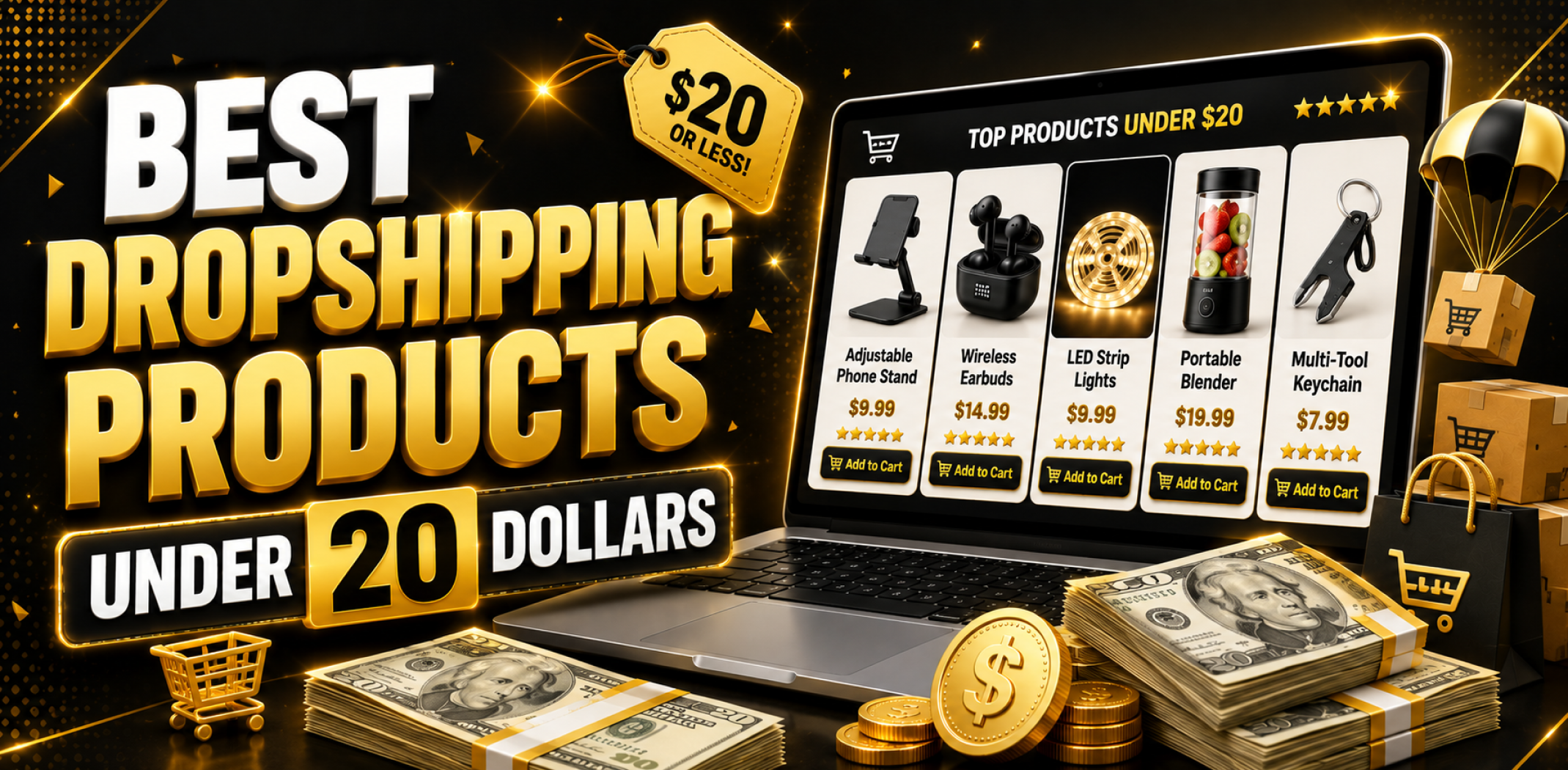
Quick Answer: The best dropshipping products under 20 dollars include phone accessories, beauty tools, kitchen gadgets, and pet supplies. These categories consistently convert well, cost $3–$10 from suppliers, and can be priced at $12–$19.99 for margins of 40–65% per order.
Why cheap dropshipping products can earn serious money
The logic sounds backwards at first. If each product only sells for $15, how do you build a real income? The answer is volume, repeat purchases, and impulse buying psychology. Products under $20 hit the sweet spot where a shopper does not need to think for long – there is no buyer hesitation, no comparison shopping, no waiting for payday. They just buy.
Experienced sellers know that a $14 phone grip sold 80 times a month returns more predictable revenue than a $200 item sold four times. Low price points also mean lower return rates – when something costs $12, most customers do not bother with a return request. That cuts your support overhead dramatically.
The volume model works especially well with a ready-made store because you are not manually processing every order. When fulfillment is automated and your store already has traffic from built-in ads, those 80 small sales happen while you are doing other things. That is the actual mechanism behind the numbers you see in dropshipping success stories.
How dropshipping under $20 actually works
If you are new to dropshipping, here is the model in plain language. You list products in your store at your chosen retail price. A customer buys. The supplier ships directly to that customer. You keep the difference between what the customer paid and what you paid the supplier. You never handle the product, hold inventory, or deal with shipping logistics.
The key variable with cheap products is your pricing strategy. Too low and you cut your own margin. Too high and you lose the impulse-buy advantage. Most experienced sellers price at 2.5–3× supplier cost for items in this range, landing retail prices between $12 and $19.99 – high enough to earn real money, low enough to convert cold traffic.
Best niches for dropshipping products under $20
Not every cheap product is worth selling. The categories below consistently produce high order volumes, low return rates, and repeat buyers – the three factors that make a low-ticket dropshipping niche actually profitable.
Real sellers, real results with low-ticket products
It is one thing to list popular categories – it is another to see how actual store owners have made them work. Here are two examples of sellers who built consistent monthly income around cheap dropshipping products without any prior experience.
Strategies that make low-ticket dropshipping actually profitable
Finding the right products is only half the equation. How you position, price, and promote them determines whether your margins hold up or get eaten by ad costs. These four strategies are what separate the stores that make money from the ones that break even.
Price at 2.5–3× supplier cost
The golden rule for sub-$20 products is a 2.5× to 3× markup on supplier cost. This keeps your retail price inside the impulse-buy zone while leaving enough room to cover order fees and still earn real profit. Going higher risks losing the low-ticket conversion advantage entirely.
Create simple product bundles
Bundling two complementary cheap items together lifts your average order value without losing the impulse-buy feel. A single item at $9.99 becomes a bundle at $17.99 – still well under $20, still an easy purchase decision, but your per-order earnings go up significantly without extra ad spend.
Stack repeat-purchase niches
The most profitable sub-$20 stores focus on niches where customers come back naturally – beauty consumables, pet accessories, seasonal kitchen items. One converted customer can return 3–5 times per year at zero additional ad cost. This flips the unit economics dramatically: your customer acquisition cost gets spread across multiple orders instead of just one.
Use social proof on product pages
At sub-$20 price points, social proof on the product page can lift conversion rates by 15–25%. Even a handful of genuine customer reviews or a “bestseller” badge triggers trust faster than any copywriting technique. AliDropship stores come with product review tools built in – use them from your first week.
Your store can be selling under $20 products today
AliDropship gives you a prebuilt store loaded with 50 products, automated supplier fulfillment, and a built-in ad system – all included in a 14-day free trial. You do not need to find products, build a website, or figure out advertising from scratch.
What affects your results with cheap dropshipping products
Two people can sell the same $14 phone grip and get completely different outcomes. The variables below are what actually determine whether your low-ticket store earns $300 or $3,000 per month – and most of them are within your control from day one.
Product page quality
A well-written product description with clear images can double conversion rates on low-ticket items compared to a generic page. At $15, buyers still want to know exactly what they are getting – size, material, and what problem it solves. Stores that invest 20 minutes in each product page consistently outperform those using default catalog copy, often seeing conversion rates of 3–5% vs 1.5–2% for thin pages.
Ad budget and spend timing
The AliDropship one-click ad system starts delivering results from $10 per day, but the timing of that spend matters. Starting ads at $15–$20 per day for the first 7–10 days generates enough data for the system to optimise. Sellers who start too low (under $8/day) often see slow initial traction and give up before the algorithm has enough signal to perform. After the first two weeks, many drop back to $10–$12 daily once the winning audience is locked in.
Niche consistency across the catalog
Stores that focus their catalog on one niche – say, pet accessories or kitchen gadgets – build a clearer brand identity, earn more repeat buyers, and get better ad targeting results than stores stocking random items. A focused niche also makes email marketing far more effective: a customer who bought a dog treat dispenser is very likely to buy a matching dog bowl. Mixed catalogs dilute all three of these advantages.
Supplier shipping times
At under $20, buyers are more forgiving about wait times than they would be for a $150 purchase – but not infinitely so. Products with 7–14 day delivery windows perform much better than those with 3–5 week timelines. When browsing the catalog, prioritise suppliers with warehouses in or near your primary market. AliDropship’s vetted supplier network includes options with US and EU stock for faster fulfilment on the most popular item categories.
Seasonal timing and trend awareness
Low-ticket products follow seasonal patterns sharply. Kitchen gadgets spike in October–December. Beauty tools peak around Valentine’s Day and summer. Phone accessories follow new phone release cycles in September–November. Sellers who plan catalog additions 4–6 weeks ahead of peak seasons consistently outperform those reacting in real time – the ads need 1–2 weeks to warm up before the peak hits. Building a 12-month seasonal calendar for your niche is one of the highest-return 2-hour investments you can make in your store.
How AliDropship helps you sell cheap dropshipping products from day one
Finding winning products under $20 is only the first step – you still need a store, a supplier network, and a way to get traffic without burning your budget on trial and error. AliDropship handles all three. Here is what the platform includes from the moment you sign up.
Free turnkey store – built, designed, and filled with products
Your store arrives professionally designed, pre-loaded with 50 bestselling products, and fully optimized to convert. No setup fees, no coding, no design time. You start at the product-testing stage – not the store-building stage. Hosting, SSL, and payment gateway are all included.
Winning products, one-click import
Browse trending and niche items from AliDropship’s catalog – including brand-name and digital products – and import them to your store in one click. The catalog updates regularly so your store always has fresh, competitive inventory without manual research.
Automated fulfillment and real-time tracking
Orders are processed automatically through global supplier connections. Customers receive real-time tracking updates – building trust and reducing support volume. You don’t touch the shipping logistics; the platform handles it end-to-end.
Built-in marketing and promotion tools
Email campaigns, discount management, abandoned-cart recovery, live countdown timers, and social media integration are all included or available as add-ons. No prior marketing experience required – the tools guide you through each campaign type.
Beginner-friendly – no coding, no learning curve
An intuitive dashboard walks you through every step. Adding products, running campaigns, and scaling your catalog require no technical knowledge. As your business grows, the platform scales with you – adding features without adding complexity.
AliExpress integration – one-click imports, synced inventory
AliDropship connects directly to AliExpress for one-click product imports, automated order processing, and synced tracking. Inventory stays current with the latest products and prices. Combined with the turnkey store and automated fulfillment, this integration makes the entire operation manageable for one person.
What are the best dropshipping products under 20 dollars?
What profit margin can I expect on cheap dropshipping products?
Is it worth dropshipping low-ticket items under 20 dollars?
How do I find winning dropshipping products priced under 20 dollars?
Can I start a dropshipping store with no money and sell budget products?