Best Dropshipping Products For Vitamins And Supplements

The global vitamins and supplements market is worth over $200 billion, and a significant slice of that spending happens online. Whether someone is chasing better sleep, faster recovery after the gym, or just trying to fill in nutritional gaps, they are buying products that can ship directly from a supplier to their door – which makes health and wellness one of the most rewarding spaces for dropshipping.
The question most beginners ask is simple: which specific products are actually worth selling?
The best dropshipping products for vitamins and supplements share a few traits. They solve a clear, everyday problem. They have strong repeat purchase behavior – people who run out of their magnesium or protein powder come back and buy again. And they sit at a price point where you can mark them up comfortably while staying competitive with what buyers see on Amazon or at their local pharmacy.
This article breaks down which supplement categories perform best, how the margins stack up, and how you can get a store in this niche running without sourcing a single product yourself.
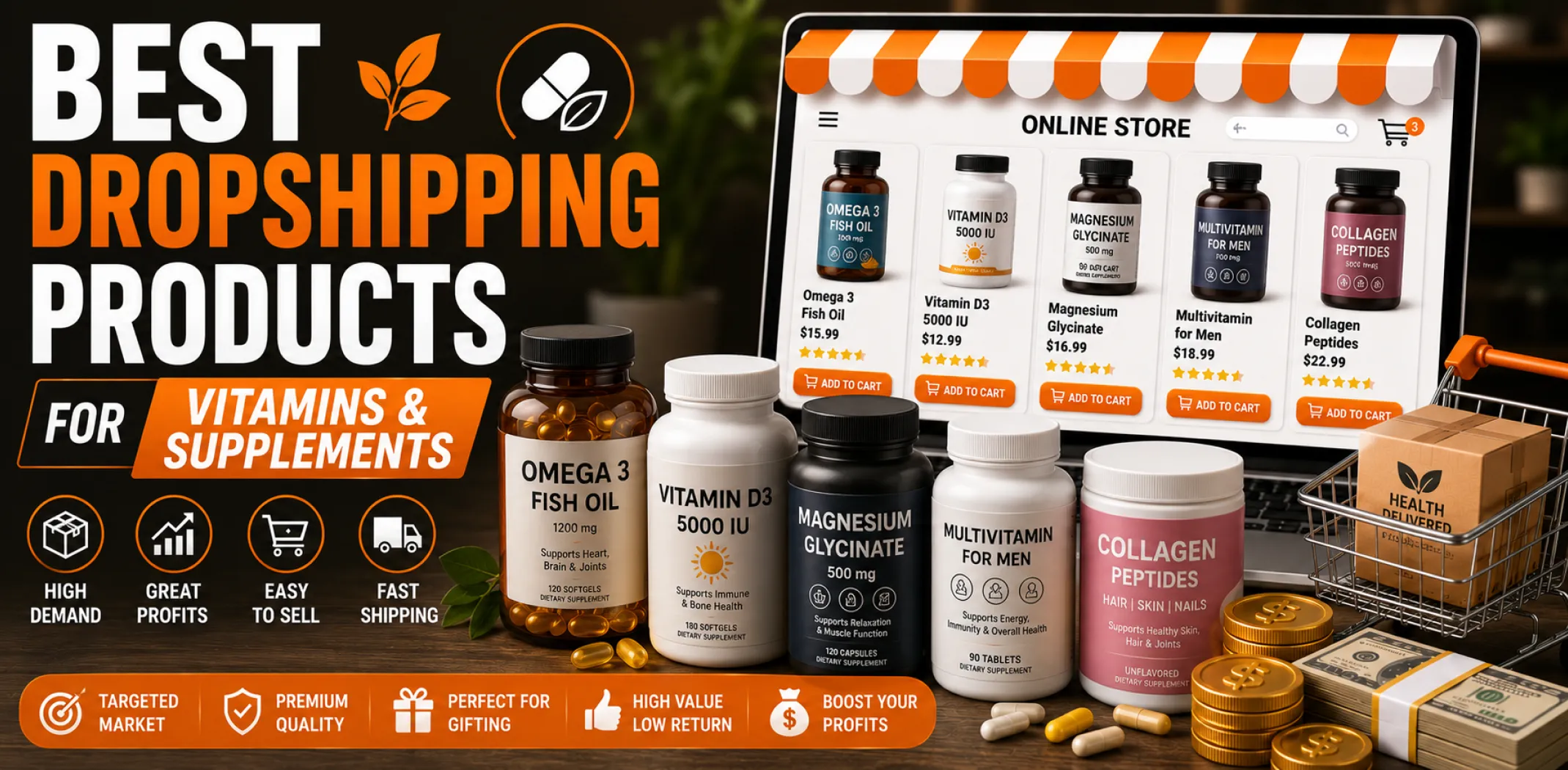
Quick Answer: The top-performing dropshipping products in the vitamins and supplements space include omega-3 fish oil, magnesium glycinate, vitamin D3, collagen peptides, protein powder, probiotics, and pre-workout formulas. These categories combine high search volume, strong repurchase rates, and margins that typically run between 40% and 70% depending on how you price them.
How big is the supplement dropshipping market right now?
Vitamins and supplements have moved from niche health-store shelves to mainstream online shopping carts. According to market research, the global dietary supplements industry is projected to exceed $350 billion by 2030, with e-commerce accounting for a fast-growing share of that total.
More than half of adults in the US now report taking at least one supplement daily, and the trend is even stronger among the 25–44 age group – exactly the demographic that shops online most actively. That combination of mass adoption and digital buying behavior makes health and wellness dropshipping one of the most scalable niches available to beginners right now.
What makes this niche especially attractive for dropshippers is that customers do not buy once and stop. A person who loves a particular magnesium supplement or protein powder will reorder every 30 to 60 days almost automatically. That repeat behavior turns a single customer acquisition into multiple sales – which is exactly the kind of economics you want when you are building an online store from scratch.
How supplement dropshipping actually works
Supplement dropshipping follows the same model as any other dropshipping niche, but with a few practical advantages. The products are lightweight, shelf-stable, and straightforward to describe in product listings. You never touch the inventory. Here is the basic flow from signup to sale.
The key to success in this niche is product selection. Not every supplement category is equally easy to sell. Some are dominated by heavily branded players – think protein powder from major gym brands – while others have a wide-open field of buyers searching for reliable quality at a fair price. The sections below break down the best performing categories and which specific products to consider stocking first.
Physical supplements vs digital health products: which should you sell?
When you set up a health and wellness dropshipping store, you have a choice to make: should you sell physical supplement products, digital health and nutrition guides, or both? Each has a distinct earning profile, and understanding the difference will help you decide where to focus your early energy.
The smart move for most beginners is to sell both. Physical supplements bring in customers who have an urgent, recurring need. Digital health products – like a 30-day clean eating guide or a supplement stacking plan – sit alongside those physical purchases as natural add-ons that cost you nothing to fulfill. The combination maximizes your average order value without adding any operational complexity.
The best dropshipping products for vitamins and supplements by category
Not every vitamin or supplement sells equally well online. The products below have proven track records – strong search demand, clear benefits that buyers understand immediately, and the kind of repurchase behavior that makes a health and wellness dropshipping store worth building. Think of these as your starting catalog.
Beyond these three headline categories, other supplement products that consistently perform well for online sellers include vitamin D3 (especially in markets with limited sun exposure), probiotics, pre-workout formulas, and B-complex vitamins. Each of these has a clear, well-understood benefit that makes the buying decision straightforward – which matters enormously when you are selling to someone who has never bought from your store before.
Real stories from supplement and health product sellers
Numbers and categories only tell part of the story. What actually happens when a regular person launches a health and wellness store from scratch? The two sellers below are representative of the kind of results that are achievable – with the caveat that results vary widely depending on product selection, ad spend, and consistency. Neither story involves overnight wealth, but both show what focused effort in this niche can produce.
What both of these stories share is patience and a willingness to let the niche work over a 60–90 day period rather than expecting instant results. The supplement buyer is health-conscious and a little skeptical by nature – they read labels, check reviews, and research brands. Once they find a store they trust, though, they come back reliably. Building that trust through good product selection and honest copy is the real work.
Four strategies that work for selling vitamins and supplements online
Picking the right products is only half the equation. How you position and sell those products determines whether a visitor buys from you or bounces to a competitor. These four strategies are proven to work specifically in the health and wellness niche – and none of them require a marketing degree or a big budget to execute.
Go deep into one sub-niche
Instead of stocking every supplement category, pick one well-defined audience – say, sleep optimization or women’s hormonal health – and build your store around it. Focused stores convert better because the buyer feels the store was built specifically for them, not for everyone.
Bundle physical with digital
Pair every physical supplement with a relevant digital product – a meal plan, a dosing guide, a workout program. Digital products carry 50–70% margins and deliver instantly, so adding one as an upsell costs you nothing in fulfillment but meaningfully increases your average order value.
Activate the repurchase cycle
Most supplements run out in 30 to 60 days. Set up automated email follow-ups timed to that cycle – a gentle “time to restock?” message at day 25 can recover a significant percentage of buyers who would have otherwise drifted to Amazon or a local store.
Use one-click ads to test fast
Rather than guessing which product will perform best, use a small daily ad budget – as low as 10 to 15 dollars per day – to test 3 or 4 products simultaneously. Let the data tell you which category resonates with your target audience before doubling down on inventory expansion.
These four approaches work together rather than in isolation. A focused sub-niche store that bundles digital products, activates repurchase emails, and uses data-driven ad testing is working all four levers at once – and that compounding effect is what separates supplement stores that plateau at a few hundred dollars a month from those that grow steadily over time.
One signup. Two income streams. Zero upfront cost.
AliDropship builds your ecommerce store and gives you a complete Amazon Seller Kit – product listings ready to upload, a step-by-step guide, and access to 300 million buyers on a $514 billion marketplace. Your $40 ad coupon covers your first campaign, and the 14-day free trial means you risk nothing to get started.
What affects how much you earn selling supplements online?
Two stores in the same supplement niche with identical product catalogs can produce very different results. The variables below are what separate sellers who see traction within 60 days from those who spend months testing without a clear direction. Understanding them before you launch helps you make smarter decisions from day one.
Product specificity
Broad supplement categories like “vitamins” are harder to convert than specific solutions like “magnesium glycinate for better sleep.” The more precisely your listing speaks to a particular problem, the higher your conversion rate. In A/B tests across health stores, specific benefit-led headlines outperform generic category titles by 30–50% in click-through rate.
Supplier reliability
Supplement buyers are sensitive to shipping delays and inconsistent product quality more than buyers in most other categories – because they are consuming what you sell. A shipment that takes 21 days to arrive or a product that looks different from the listing photo can hurt your review score severely. Vetting supplier delivery times and requesting product samples before listing is worth the extra week of setup time.
Ad budget consistency
Supplement buyers often need 2 to 3 touchpoints before they purchase – they see an ad, think about it, then look up reviews before returning to buy. Inconsistent ad spending breaks that cycle and resets your audience learning. Sellers who run 10 to 20 dollars per day every day for 60 days almost always see better results than those who spend 100 dollars one week and nothing the next.
Trust signals on your store
Health product buyers are cautious. They look for reviews, clear return policies, and professional product photography before handing over payment details. Stores with at least 10 visible product reviews and a clearly stated satisfaction policy see conversion rates 2× higher than stores with identical product catalogs but no social proof. Collecting early reviews – even by following up personally with first-time buyers – pays outsized dividends early on.
Seasonal and trend awareness
Supplement demand spikes predictably around New Year’s fitness resolutions (January), pre-summer body goals (April–May), and cold-and-flu season (October–November). Sellers who plan product launches and ad budgets around these windows typically see 30–60% higher revenue during peak months than those who keep the same budget year-round. Vitamin D3 and immunity supplements peak in autumn; protein and pre-workout peak in January and April.
Important: Supplement sales claims on your product pages must stay factual and measured. Avoid absolute health outcome language – focus on the established, well-documented benefits (support, promote, contribute) rather than cure or treatment claims. This keeps you compliant and credible.
The single most controllable factor across all five of these variables is how you set up your store from the start. A well-structured store with clear product pages, built-in promotion tools, and automated fulfillment removes the operational friction that causes most beginner sellers to quit before their first 90 days are up. That is exactly what AliDropship is designed to provide.
Why AliDropship is the fastest way to launch your supplement store
AliDropship is an online business platform built specifically for people starting from scratch. In the context of selling vitamins and supplements, it removes every technical barrier that would otherwise slow you down – store design, product sourcing, payment setup, order fulfillment, and marketing automation are all handled for you. Here is what the platform includes.
Free turnkey store – built, designed, and filled with products
Your store arrives professionally designed, pre-loaded with 50 bestselling products, and fully optimized to convert. No setup fees, no coding, no design time. You start at the product-testing stage – not the store-building stage. Hosting, SSL, and payment gateway are all included.
Winning products, one-click import
Browse trending and niche items from AliDropship’s catalog – including brand-name and digital products – and import them to your store in one click. The catalog updates regularly so your store always has fresh, competitive inventory without manual research.
Automated fulfillment and real-time tracking
Orders are processed automatically through global supplier connections. Customers receive real-time tracking updates – building trust and reducing support volume. You don’t touch the shipping logistics; the platform handles it end-to-end.
Built-in marketing and promotion tools
Email campaigns, discount management, abandoned-cart recovery, live countdown timers, and social media integration are all included or available as add-ons. No prior marketing experience required – the tools guide you through each campaign type.
Beginner-friendly – no coding, no learning curve
An intuitive dashboard walks you through every step. Adding products, running campaigns, and scaling your catalog require no technical knowledge. As your business grows, the platform scales with you – adding features without adding complexity.
AliExpress integration – one-click imports, synced inventory
AliDropship connects directly to AliExpress for one-click product imports, automated order processing, and synced tracking. Inventory stays current with the latest products and prices. Combined with the turnkey store and automated fulfillment, this integration makes the entire operation manageable for one person.
What are the best dropshipping products for vitamins and supplements?
Is supplement dropshipping profitable in 2026?
Health and wellness dropshipping can be profitable in 2026, with typical margins running between 40 and 70 percent depending on product type and pricing strategy. Physical supplements generally allow a markup of 2 to 3 times supplier cost, while digital health products like nutrition guides and meal plans deliver 50 to 70 percent margins with no shipping costs at all. Sellers who consistently run small daily ad budgets – 10 to 20 dollars per day – and focus on building repeat customers typically begin seeing consistent revenue within 60 to 90 days. Individual results vary widely based on effort, market conditions, and product selection.
Do you need a license to sell supplements online through dropshipping?
Requirements for selling supplements online vary by country and platform, but in the United States, selling pre-made branded supplements through dropshipping does not typically require a manufacturing license since you are acting as a retailer, not a producer. However, you are responsible for ensuring the products you list are compliant with FTC advertising guidelines – meaning no unsubstantiated health claims in your product copy. It is advisable to review the FTC guidelines for health products and consult a legal professional if you are uncertain. Platforms like Amazon have additional category approval requirements for health and wellness products that apply to all sellers.
How do you find reliable suppliers for health and wellness dropshipping?
Finding reliable suppliers for health and wellness dropshipping starts with platforms that vet their supplier networks rather than sourcing directly from unknown sellers. Look for suppliers that provide certificates of analysis from third-party testing labs, offer consistent delivery windows of 7 to 14 days, and have strong review histories from other sellers. Ordering product samples before listing is one of the most reliable ways to confirm quality. Platforms like AliDropship give sellers access to a curated supplier catalog that updates regularly, removing the need to manually source and vet each supplier individually.
Can you sell supplements on Amazon as a dropshipper?
Yes, you can sell supplements on Amazon as a dropshipper, but Amazon has specific category requirements for health and wellness products that you will need to meet before your listings go live. These include submitting documentation about your supplier and ensuring product listings comply with Amazons guidelines around health claims. An Amazon Seller Kit – like the one included free with AliDropship – provides an import file with listings already formatted and a step-by-step guide to help beginners navigate the approval process. Selling on both your own store and Amazon simultaneously allows you to reach two separate audiences without doubling your workload.