Best Dropshipping Products For Security: Cameras, Locks And More

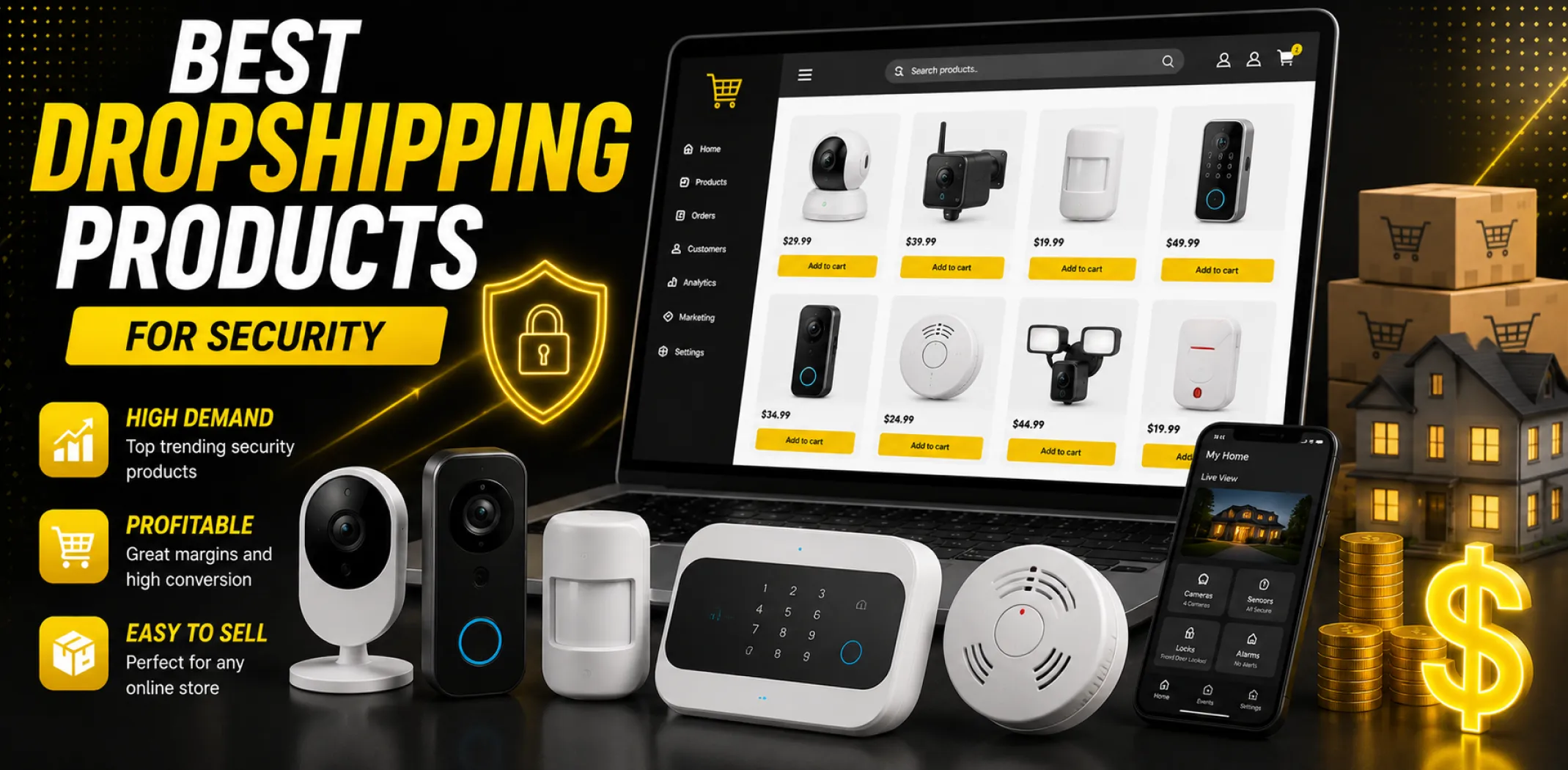
Home security has crossed over from a luxury into a household staple. In 2026, 61% of U.S. households have at least one security camera – up from 52% just two years ago. Video doorbells sit on 58.9 million American homes. Smart locks are moving from early adopters into mainstream retrofits. This is not a niche trend. It is a category that has permanently entered everyday life, and it is still growing fast.
That combination of mass adoption and sustained growth is exactly why the best dropshipping products for security represent such a strong opportunity right now. Buyers are actively searching, purchase intent is high, and the product range spans from affordable entry-level items at $35–$60 to mid-range smart systems at $80–$150 – a price spread that works across multiple ad channels and customer types.
Whether your buyer is a homeowner, a renter, a parent, or someone who has just experienced a package theft, the motivation is real and the conversion window is short.
Quick Answer: The best dropshipping products for security in 2026 are wireless security cameras, video doorbells, smart door locks, and motion sensor alarm kits. These four categories combine high consumer demand, repeat purchase potential through multi-camera expansion, and 2–3x markup over supplier cost at the mid-range price point.
The home security market in 2026: A dropshipper’s opportunity
The numbers behind this market are hard to ignore. The global smart home security market was valued at 46.56 billion dollars in 2026 and is projected to reach 163 billion dollars by 2035, growing at nearly 15% per year. The smart home security camera segment alone is expanding at 22.1% CAGR through 2033. The smart door lock market is growing at 19.7% annually.
These growth rates reflect genuine behavioral change: consumers are not just buying security products once – they are building out layered systems over time, adding cameras, sensors, and smart locks progressively as their comfort with the technology grows.
Package theft is one of the clearest demand drivers. A 2023 study by Security.org found that porch pirates stole $8 billion worth of goods in a single year, and 44% of Americans have experienced package theft at some point. Video doorbells and outdoor cameras are the direct consumer response – and the doorbell camera segment is growing at a 15.84% CAGR to 2031.
Separately, the rise of renters as a security audience has opened up a strong market for wireless, no-drill, renter-friendly products – smart padlocks, battery-powered cameras, and retrofit smart locks that do not require professional installation and can move with the tenant.
What makes security especially well-suited to dropshipping is the customer expansion dynamic. A buyer who purchases one outdoor camera often returns for a second, a third, and eventually a video doorbell or smart lock. The initial transaction is not the ceiling – it is the opening. That built-in upsell and repeat purchase pathway is something few other product categories offer as naturally as home security.
How dropshipping security products works
The model is the same as any other dropshipping category. You list security products in your store at retail price, a customer places an order, and your supplier ships directly to them. You never hold stock, pack boxes, or handle logistics. Your job is product selection, store presentation, and driving traffic – everything else runs automatically through your supplier network.
The security niche has one important characteristic that sets it apart from most other dropshipping categories: buyer intent is emotionally driven. Someone who has just seen a neighbor’s package stolen, noticed an unfamiliar car on their street, or moved into a new home is not casually browsing – they are ready to buy right now.
That urgency shortens the conversion window considerably, which means well-targeted ads in this niche often convert faster than in more aspirational product categories. The emotional hook is already there. Your ad just needs to show up at the right moment with the right product.
DIY vs. professional-grade: Which security tier works best for dropshipping?
The home security market splits into two very distinct customer segments. Professional-grade systems – those requiring installation, monitoring contracts, and proprietary hardware – are not suitable for dropshipping.
The opportunity is entirely in the DIY, plug-and-play tier: wireless cameras, battery-powered doorbells, keypad and fingerprint smart locks, and standalone motion sensor alarms that anyone can set up in under 30 minutes with no professional help. This is also the segment growing fastest, because consumers increasingly want security without contracts or complexity.
Within the DIY security tier, the sweet spot for dropshipping sits at $55–$120 retail. Products here have enough margin to absorb paid ad spend and still net $30–$65 per unit, they photograph well for product listings, and they sit below the price threshold where buyers start demanding professional installation or warranty contracts. That is the window to build around.
The best security product types to dropship in 2026
The security niche covers a wide range of products, but four sub-categories stand out for their demand signals, margin profiles, and suitability for paid advertising in 2026. Each targets a slightly different buyer and works best with a different creative angle.
Real results from security product dropshippers
Security is a niche that rewards specificity and patience. The stores doing well here are not trying to serve every possible buyer – they are picking one audience, dialing in their creative, and building repeat purchase value over time. The examples below show what that can look like in practice. Results vary based on product selection, ad spend, and how quickly you find a winning creative angle.
4 strategies that work for security dropshipping in 2026
Security is one of the most emotionally resonant niches in all of consumer electronics. The products solve a fear that every homeowner and renter shares. Getting the strategy right means matching that emotion to the right audience, the right creative, and the right price point – and then building a catalog that grows with each customer over time.
Lead with a specific fear, not a generic product
Security buyers are motivated by a specific concern: package theft, neighborhood break-ins, an unfamiliar car spotted outside, a new home with an unknown key history. Ads that speak to one of these specific fears outperform generic “protect your home” creative by a wide margin. The more precisely your ad matches the buyer’s actual anxiety, the faster they move from click to purchase – because you have removed the work of self-identification from their side.
Target renters as a distinct audience
Renters represent 43% of U.S. households and are a systematically underserved audience in home security marketing. Most brands talk to homeowners. A store that explicitly targets renters – using language like “no drilling,” “no landlord permission,” “moves with you” – taps into a large audience with fewer direct competitors. Battery-powered cameras, wireless doorbells, and retrofit keypad locks are all naturally renter-friendly. This positioning alone can cut your cost per click by narrowing to a less contested ad audience.
Design your catalog for expansion orders
Security is one of the few dropshipping niches where the first purchase naturally creates demand for subsequent ones. A customer who buys one outdoor camera will want a second for a different entry point. A video doorbell buyer will eventually look at a smart lock for the same door. Building your catalog so that compatible products are easy to find – and emailing past buyers when you add a compatible model – captures this expansion revenue without any additional ad spend. Set up a post-purchase email sequence that goes out at 30 and 60 days with relevant add-on suggestions.
Use installation demos as your primary creative
The biggest objection buyers have to DIY security products is “I don’t know how to install it.” A 30–45 second installation video – showing a real person setting up a camera or smart lock from unboxing to fully functional – addresses that objection directly and removes the last barrier to purchase. These videos also perform well organically on TikTok and YouTube Shorts, generating free traffic alongside paid campaigns. Security product demos with a clear start-to-finish format consistently outperform lifestyle-only ad creative in this niche.
A free store and a free Amazon business – launched in under 60 seconds
Sign up once and walk away with two complete income streams: a done-for-you store loaded with 100+ digital products, and an Amazon Seller Kit with listings already formatted and ready to go live. Keep 50–70% of every sale, with no inventory, no shipping, and no logistics on your end.
What determines your results in security dropshipping?
Two security dropshippers running the same ad budget in the same niche can produce very different results. The variables below are what separate consistent profitability from months of flat performance. Understanding them before you start saves both money and time.
App quality and smart home compatibility
In 2026, 72% of homeowners prefer integrated security systems that connect to their existing smart home setup. A security camera or smart lock that works with Alexa and Google Home converts significantly better than one that requires a standalone app with no integrations. This has become the single most frequently cited feature in buyer reviews across Amazon, Reddit, and Trustpilot for security products. Before listing any security product, confirm its smart home compatibility and include that information prominently in your product listing – it will directly improve your conversion rate and reduce your pre-purchase support volume.
Retail price point and margin structure
Security products have a wider viable price range than most consumer electronics niches – from $45 for a basic indoor camera to $140 for a fingerprint smart lock – but the sweet spot for paid advertising profitability is $65–$120 retail. Products here generate $35–$75 per unit before ad spend, which comfortably covers a target of $15–$25 cost per acquisition while leaving meaningful net margin. Products below $45 retail are better used as upsell add-ons or bundle components rather than paid-traffic lead products. At $65–$120 your margin survives a learning phase, which matters especially in a niche where it takes 2–3 weeks of ad testing to identify the best creative angle.
How specifically you define your buyer
Generic security advertising – “protect your home,” “stay safe” – is crowded and expensive because every major brand is running it. The stores consistently achieving 3–4% conversion rates in this niche are talking to a specific person in a specific situation: a renter in an apartment building who cannot drill, a parent who wants to monitor a front door while school-age kids are home alone, or a homeowner who had a porch theft last month. Each of these audiences has different copy, different creative, and different buying triggers. Identifying one and speaking to it exclusively in your initial campaigns is almost always more profitable than broad targeting – and your cost per click will be lower because the competition is thinner.
Supplier reliability and product quality
Security products carry higher buyer expectations than most consumer electronics because their entire purpose is reliability – a camera that stops connecting to Wi-Fi or a smart lock that fails to unlock is not an inconvenience, it is a safety concern. Return rates from unreliable suppliers in this category can reach 20–25%, which eliminates the margin on otherwise profitable campaigns. Prioritize suppliers with verified product testing, strong review histories, and a demonstrated QA process. Always order samples before listing at scale, test night vision and app connectivity specifically, and confirm that the physical build quality matches the product photos. A supplier who costs 10% more per unit but produces 15% returns instead of 25% is always the better financial choice.
Post-purchase strategy and repeat order capture
Security is one of the most repeat-purchase-friendly niches in consumer electronics, and most dropshippers underutilize this. A buyer who orders one camera and has a positive experience is primed to buy a second within 30–90 days. A smart lock buyer will likely want a compatible video doorbell within a few months. Setting up a post-purchase email sequence that promotes compatible add-ons at 30 and 60 days – without requiring any additional ad spend – can add 20–30% to your monthly revenue from customers you have already paid to acquire. This is one of the highest-leverage growth levers available in this niche, and most new dropshippers skip it entirely.
Why AliDropship is the best platform to launch your security dropshipping store in 2026
AliDropship is an ecommerce platform built specifically for people starting their first online business – no coding, no product sourcing, no logistics. If you want to build a security products store without spending weeks on setup and supplier research, this is the most direct path from decision to your first sale.
Free turnkey store – built, designed, and filled with products
Your store arrives professionally designed, pre-loaded with 50 bestselling products, and fully optimized to convert. No setup fees, no coding, no design time. You start at the product-testing stage – not the store-building stage. Hosting, SSL, and payment gateway are all included.
Winning products, one-click import
Browse trending and niche items from AliDropship’s catalog – including brand-name and digital products – and import them to your store in one click. The catalog updates regularly so your store always has fresh, competitive inventory without manual research.
Automated fulfillment and real-time tracking
Orders are processed automatically through global supplier connections. Customers receive real-time tracking updates – building trust and reducing support volume. You don’t touch the shipping logistics; the platform handles it end-to-end.
Built-in marketing and promotion tools
Email campaigns, discount management, abandoned-cart recovery, live countdown timers, and social media integration are all included or available as add-ons. No prior marketing experience required – the tools guide you through each campaign type.
Beginner-friendly – no coding, no learning curve
An intuitive dashboard walks you through every step. Adding products, running campaigns, and scaling your catalog require no technical knowledge. As your business grows, the platform scales with you – adding features without adding complexity.
AliExpress integration – one-click imports, synced inventory
AliDropship connects directly to AliExpress for one-click product imports, automated order processing, and synced tracking. Inventory stays current with the latest products and prices. Combined with the turnkey store and automated fulfillment, this integration makes the entire operation manageable for one person.
What are the best dropshipping products for security in 2026?
How much can you make dropshipping security products?
Earnings from dropshipping security products vary by product selection, ad spend, and how precisely you target a specific buyer audience – results are not typical and will differ for every seller. Dropshippers running mid-range security products priced at 65 to 120 dollars at retail, with 15 to 25 dollars per day in ad spend, have reported monthly profits ranging from 900 to 3,500 dollars after reaching consistent campaign performance in months 2 to 5. Wireless cameras and smart locks at the 80 to 130 dollar retail tier generate 40 to 60 dollars per unit before ad spend. Digital products through AliDropship carry 50 to 70 percent margins with no shipping or inventory costs.
Is the home security niche too competitive to dropship?
The security niche is competitive at the generic level but far less so at the sub-audience level. Broad ads targeting "homeowners who want security" face high CPMs and established brand competition. Ads targeting a specific person – a renter who cannot drill, a parent monitoring a home with school-age kids, or someone who experienced a porch theft – face much lower competition and convert at significantly higher rates. Dropshippers who narrow to one specific buyer persona consistently see conversion rates of 3 to 4% versus 1 to 2% for broad campaigns at the same budget. The security buying cycle is also fast because purchase intent is emotionally urgent.
What security products work best for renters?
The best security dropshipping products for renters are battery-powered wireless cameras, battery-powered video doorbells, and retrofit keypad or fingerprint smart locks that install over existing deadbolts without any drilling or permanent modification. Renters represent 43% of U.S. households and are systematically underserved by most home security marketing, which typically targets homeowners. Positioning your store explicitly around renter-friendly features – no drilling, no wiring, moves with you – addresses a large audience with fewer direct competitors and typically delivers lower cost per click and higher conversion rates.
What is the best price range for dropshipping home security products?
The best retail price range for paid-traffic dropshipping of security products is 65 to 120 dollars. Products in this range deliver 35 to 75 dollars per unit before ad spend – enough to absorb a 15 to 25 dollar cost per acquisition and still net meaningful profit during the testing phase. Products below 45 dollars are better used as bundle add-ons or upsell items rather than paid-traffic lead products, as margins are too thin to survive the learning period. Multi-feature products – cameras with color night vision and AI detection, or smart locks with fingerprint and keypad access – command the higher end of this range and tend to justify it with lower return rates and stronger buyer satisfaction.