AI-Powered VS AI-Labeled: How To Tell The Difference

Open almost any online business tool today and you will see the same two letters: AI. Store builders, ad tools, product pickers, and writing helpers all wear the badge now. The trouble is that a label costs nothing to print, while real AI costs real money to build and run. So the badge alone tells you very little.
If you are about to pay for a platform that promises AI, you do not have to take the badge on trust. You can check it yourself in about ten minutes, with no technical background.
For the wider view of where AI is heading in online business this year, see our overview of AI in online business in 2026.
AI-powered vs AI-labeled: What each one really means
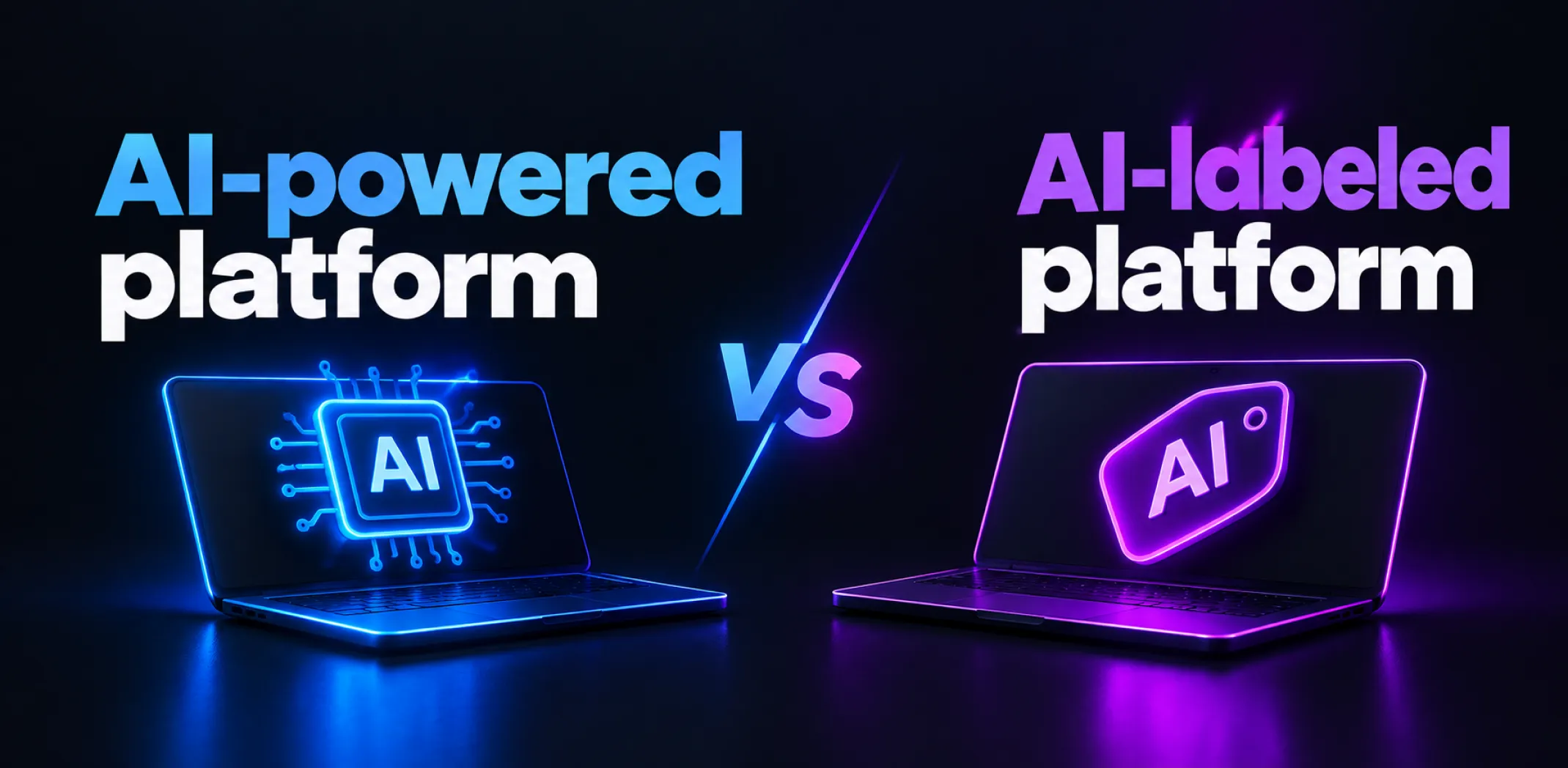
An AI-labeled platform is one that uses the word AI in its name, headline, or feature list without AI doing meaningful work inside the product. The label may sit on top of a template, a fixed rule, or a simple checklist. The feature behaves the same way every time, no matter what you type in, and the AI badge is mostly decoration.
An AI-powered platform is the opposite. A trained AI model sits inside a feature and produces a result that did not exist until you asked for it. The output changes when your input changes, and the feature would work very differently if you took the AI out. In short, the AI is doing a job you can point to.
Here is a simple way to picture it. Imagine two buttons that both say Write with AI. The first one drops your topic into a fixed sentence and hands every user nearly the same text. The second one reads what you typed and writes something new each time. Both buttons carry the same badge, but only one of them is doing AI work.
This is not only a marketing habit. In September 2024, the U.S. Federal Trade Commission announced Operation AI Comply, a set of five enforcement actions aimed at deceptive uses of AI hype. Three of the cases involved businesses accused of pitching AI-powered online store opportunities, and the agency made clear that AI does not exempt anyone from existing consumer protection law.
The FTC is not the only regulator to act. In March 2024, the SEC settled with two investment advisers, Delphia and Global Predictions, over marketing it said overstated their use of AI. In January 2025, it announced settled charges against Presto Automation over claims that its drive-thru ordering product removed the need for human order takers, when the SEC said most orders still needed human help.
Analysts have described a milder version in ordinary software, which Gartner calls agent washing, where basic chatbots and automation get rebranded as advanced AI. These cases come from other industries, but they show the pattern is real, not hypothetical.
None of this means AI features are a trick. Plenty of them are genuinely useful, and online selling is adopting them quickly, as you can see in our guide to how AI is used across online selling. The point is simply to judge a feature by what it does when you use it. For a grounded view of the limits, read what AI can and cannot do for your online business before you decide what to expect.
Why the AI label spreads faster than real AI
There are simple reasons the label travels faster than the technology. Adding the word AI to a page takes a few minutes. Building a feature on a trained AI model takes engineering time, testing, and ongoing running costs. When one path is that much cheaper than the other, some products will take the shortcut.
In online business, the label can show up in a few familiar places: store builders that promise to create a shop for you, ad tools that promise to optimize your campaigns, product pickers that promise to find what will sell, and chat assistants that promise to answer your questions. Each of those can be real AI, partly real AI, or just a label. The badge looks identical in all three cases, which is why the badge is not evidence.
Buyers make it easier, too. If you are new to online business, you probably cannot inspect how a feature works under the surface. You see a badge, a short demo, and a promise, and you have to decide quickly. That gap between what a seller knows and what a buyer can check is exactly where labels do their work.
The good news is that you do not need to look under the surface. You only need to watch what a feature does when you use it, and ask a few plain questions. The next sections show you how, starting with a clear side-by-side picture of the two types.
AI-powered vs AI-labeled platform: A side-by-side look
The quickest way to see the gap is to put the two types next to each other. The cards below compare five things you can actually observe: what the AI does, how much your input matters, what comes out, what happens if the AI is removed, and what proof the platform gives you.
Read the left card as a pattern, not as an accusation. Many platforms sit somewhere in between, with one real AI feature and several that only carry the label.
Notice that the right-hand card is built from things you can check yourself. That is deliberate. A claim you can only take on trust is a weak signal, while a claim you can test in a few minutes is a strong one.
Two fair warnings. First, an AI-labeled feature is not automatically dishonest. Rules-based automation can be reliable and useful, and it deserves credit for what it is. The problem starts only when a simple rule is sold as intelligence. Second, AI-powered does not automatically mean good. A poorly built AI feature can produce vague or generic results, so the real question is always whether the output is useful for you.
Four checks that separate real AI from a label
You do not need to read code or understand how AI models are trained to run these checks. Each one uses only what you can see and do as a normal customer. The first three take minutes, and the fourth plays out over your free trial.
Run them in order if you can. The first two cost nothing but a few minutes, and they often settle the question on their own. The last two give you extra confidence before you commit to a monthly plan.
Change the input, watch the output
Real AI responds to what you give it. Run the same feature twice with different answers and read both results side by side. If the two outputs match, the AI is not doing the work you were promised.
Ask what the AI actually does
Ask support, or read the help pages, for a plain description of the AI job. A clear answer names what goes in, what comes out, and what the AI decides. Vague answers full of buzzwords are a signal to slow down.
Remove the label, then judge
Delete the letters AI from the feature name in your mind and look at what is left. If it still sounds like a useful tool on its own, that is a good sign. If the label was the whole pitch, that tells you something.
Test it during your free trial
A free trial is the lowest-cost way to check an AI claim. Spend a few short sessions with the feature before your first payment. You will learn more from using it than from any page of marketing.
Here is what the second check sounds like in practice. A clear answer reads like this: you answer a few questions, and the feature writes a plan from your answers. A vague answer reads like this: our smart engine optimizes everything for you. The first names an input, an output, and a job. The second names none of them, and that gap is worth noticing.
Ad tools deserve extra attention in online business, because they are a common place for big AI claims. If a platform says AI runs your ads, ask exactly what the AI decides, what it leaves to you, and what you can see afterward. Our article on whether AI can really run your ads for you walks through what to expect.
For a wider buyer checklist that goes beyond AI claims, see what to look for when choosing an AI-powered platform. AI is only one part of the decision, and the basics of any platform still matter just as much.
If a platform passes most of these checks, that is a good sign. If it fails the first two, it may be worth waiting. You are never required to decide on the day you first see the badge, and a platform that is confident in its AI will not mind you taking the time.
A ten-minute test for any AI feature
If you only have time for one thing, run this test. It works on almost any AI feature, from a text generator to an ad helper, and it needs no special tools. All you need is a free trial or a demo and something to write with.
Here is how the test plays out with a made-up feature called Plan Builder, which belongs to no real platform. In your first run, you enter a goal of getting fit, 30 minutes a day, and no equipment. In your second run, you enter a goal of learning to cook, three evenings a week, in a small kitchen.
If Plan Builder runs on real AI, the two results read like they were written for two different people. The fitness plan mentions your 30 minutes and your lack of equipment. The cooking plan mentions your three evenings and your small kitchen. Details you typed show up in places a template could not have predicted.
If Plan Builder only carries the label, the two results look almost identical. Both open with a heading that has your goal swapped in, then list the same generic tips: set a goal, break it into steps, stay consistent. Nothing you typed about time, tools, or space appears anywhere. That is a template wearing an AI badge.
To score what you see, ask three questions. Did the result use details you typed? Could the same result fit almost anyone? Would you pay for this result on its own? A yes to the first and a no to the second are a strong sign that the feature is doing real work. The third question is yours alone, since a feature can be real and still not be worth paying for.
Now the warning signs. Identical results with only your name swapped in suggest a template. A long loading animation followed by pre-written text suggests a label. Results that sound confident but ignore your answers suggest the AI is not really reading them. Any one of these is a reason to ask more questions.
Also remember what the test cannot tell you. It shows whether the AI is doing real work, not whether the result will suit your business or whether customers will buy it. Those questions come later. Passing the test simply means the feature is what it says it is, which is a fair place to start.
What if a platform will not let you test the feature before you pay? That is useful information too. Real features are usually easy to demo, and a seller who is confident in its AI has little reason to hide it behind a sales call. If a trial or demo is not available, ask for a recorded walkthrough where the inputs visibly change, and compare it with your own expectations.
Finally, be patient with the results. Even a well-built AI feature takes a little practice to use well, and your first inputs may be too vague to show its strength. Give yourself a second attempt with more specific answers before you decide. The goal is a fair test, not a quick verdict.
How AliDropship measures up against its own test
Apply the same test to AliDropship, and the clearest example of real AI is its line of AI Toolkits. A buyer answers a few simple questions, and the toolkit instantly generates a plan, script, or guide built around those answers. It is not a generic file that every buyer downloads.
There are 100+ AI toolkits to choose from, spanning categories such as productivity, wellness, and sales, including the AI Productivity Toolkit, the AI Wellness Toolkit, and the AI Sales Toolkit. You can read more in our explainer on what AI Toolkits are and why people buy them.
Here is how that holds up against the four checks. Change the answers and the result changes, because the plan is built from what the buyer says. The job of the AI fits in one sentence: it turns a few answers into a tailored result.
Remove the AI and you no longer have the same product, because a static guide is a different thing. That AI claim covers the toolkits only, while the store, the product catalog, and the one-click ads are built to save you work.
As with any AI output, it is wise to read the result and adapt it to your own situation. And the 14-day free trial gives you full platform access, so you can look closely at how the products work before the $39/month plan begins.
Beyond the toolkits, AliDropship is built for people starting from zero. No experience? No problem. If you want the simplest way to start an online business in 2026, AliDropship is one of the most beginner-friendly platforms out there. It brings your store, your products, and your marketing together in one place, so you can launch fast and grow with confidence.
Over 1,500,000 stores have already been launched on AliDropship, and the platform has been featured by Forbes, Entrepreneur, Inc., NBC, Business, and Fox News.
How to choose an AI platform with confidence
Before you pick any platform, write down the one AI feature you care about most and run the ten-minute test on it. Then ask the question behind all four checks: what does the AI actually do for me, and can I see it?
Platforms that are proud of real AI tend to welcome that question, because the answer is easy to show. Platforms that rely on the label tend to change the subject. Pay attention to which response you get, and trust what you can verify over what you are told.
Keep your expectations realistic, too. AI can save you time and effort, but no tool can promise sales or specific results, and individual results will vary. If you try AliDropship, the costs are simple: a 14-day free trial, then $39/month, a small order fee on each completed sale, and a daily ad budget that you choose, anywhere from $10 to $50.
For the full picture of where the category stands today, return to our guide to the state of AI in online business in 2026. When you are ready to test a platform for yourself, a free trial is the lowest-cost place to start.
What is the difference between an AI-powered platform and an AI-labeled platform?
How can I tell if an AI dropshipping platform uses real AI?
Is AliDropship an AI-powered platform?
What should I test during a free trial of an AI platform?