AI Dropshipping In Slovakia: How To Start And Get Paid


Yes, you can run an AI-powered dropshipping business from Slovakia. You get paid through PayPal, which works cleanly here with no restrictions on receiving or withdrawing euros. Getting started costs nothing during the 14-day free trial, then $39 a month (about 34 euros at today’s rate) once it ends.
Slovakia has real advantages for this kind of business: PayPal, card billing, and ad funding all clear without complication, and self-employment income up to 100,000 euros a year is taxed at a flat 15%, well below the country’s regular income tax brackets.
The one thing to plan for is Slovakia’s own compulsory health and social insurance system, which now starts billing faster than it used to under a 2026 reform. Last verified: September 24, 2026.
Who your customers will be
Selling digital products means your customers are wherever your ads run – typically the US, UK, Canada, and Australia, not necessarily Slovakia. Slovakia’s own market size, payment habits, and ecommerce maturity do not limit this business.
For a Slovakia-based seller, that split matters in a few concrete ways. Slovakia runs on Central European Time, one hour ahead of the UK and roughly six hours ahead of the US East Coast, the same manageable gap as most of the EU pages in this series.
English proficiency here scored 606 out of 800 in the 2025 EF EPI, in the very high band and 10th out of 123 countries surveyed, up 22 places from the year before and comfortably ahead of neighboring Czechia, so reviewing AI-generated ad copy should need very little extra attention.
Can you run AI dropshipping from Slovakia?
All six gate items clear cleanly here, similar to Lithuania and most of the EU pages in this series. Here is the full breakdown:
The real story is what happens after you register. Slovakia now bills mandatory health and social insurance faster than it used to, under a reform that took effect at the start of 2026. The tax and legal section below has the specifics.
How you get paid in Slovakia
PayPal is the straightforward answer here. Slovakia is a full Eurozone member, and PayPal treats Slovak accounts the same way it treats any other Eurozone account: no restrictions on receiving USD-denominated payouts, converting them to euros, or withdrawing to a Slovak bank account.
Payoneer and Wise both work here too if you want a second option, but most sellers in this series stick with PayPal when it is unrestricted, and Slovakia is one of those cases.
Withdrawals to a Slovak bank account typically clear within one to three business days. PayPal’s currency conversion carries a markup over the mid-market exchange rate, commonly in the 3 to 4 percent range for a EUR/USD conversion, on top of PayPal’s standard processing fee for commercial payments, roughly 3.5 percent plus a small fixed fee.
There is no capital control or withdrawal limit to plan around – the euro moves freely in and out of Slovak accounts, and you do not need a dedicated business bank account to receive payments; a personal account works fine at this stage.
Here is the math on a single sale. A $39 digital product sale at a 60% margin leaves $23.40 in margin before any fees. PayPal’s processing fee and its currency conversion markup together take a real bite out of that: on a $39 digital product sale at a 60% margin, a seller in Slovakia receives approximately 18 euros after payout and conversion fees, using the September 24, 2026 rate of roughly 1 euro to 1.14 dollars.
How AI dropshipping works
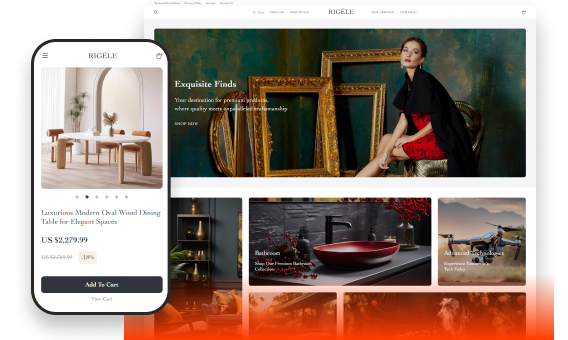
AI handles three layers of this business, and each one looks slightly different from Slovakia specifically. It configures the store, picks which of the 60+ digital products to feature based on what is already selling, and writes and launches ad campaigns across Google, Instagram, TikTok, and Amazon.
For a Slovakia-based seller, the catalog itself needs no local adjustment, since your customers are in the US, UK, Canada, and Australia rather than in Slovakia, and every ad platform in the lineup, Meta, TikTok, and Google, is fully fundable with a Slovak card or PayPal balance. Read more about how the full system works on the AI Dropshipping hub.
Because the products are digital, there is no shipping from Slovakia, no customs, no stock, and no failed deliveries. Orders are fulfilled the moment they are placed, wherever the customer is.
What it costs to start in Slovakia
Here is the real month-one breakdown, converted at the September 24, 2026 rate of roughly 1 euro to 1.14 dollars. The line that surprises most people is health insurance, since it starts immediately, not after a grace period:
Tax and legal requirements in Slovakia
Foreign-earned online income in Slovakia is taxed as self-employment profit. As long as your self-employment income stays under 100,000 euros a year, a flat 15% rate applies instead of Slovakia’s regular progressive scale, which was expanded in 2026 to four brackets running from 19% up to 35% for other income types.
A personal allowance of 5,966.73 euros a year comes off your taxable base first, and you can deduct either your actual documented business expenses or a flat 60% of your taxable income with no receipts required, as long as you are not a VAT payer for the full year.
Health insurance is the one bill that starts immediately, with no grace period at all. Once you register your zivnost, you owe a monthly advance payment to a health insurer, 16% of an assessment base with a 2026 minimum of 762 euros a month, working out to a minimum payment of about 121.92 euros a month, due by the 8th of the following month.
This applies from your very first month of trading, regardless of how little you have actually earned.
Social insurance works differently, and a January 2026 reform changed it in a way that matters here. Previously, new self-employed people got a genuine break, often 18 months or more, before social insurance kicked in at all. That break is now cut to just five months: mandatory social insurance starts from the first day of the sixth calendar month after you start trading, no matter how much you have earned by then.
From that point, if your self-employment income stays under roughly 9,144 euros a year, you owe a flat minimum of about 131.34 euros a month; above that threshold, the standard minimum of about 303.11 euros a month applies instead, calculated as 33.15% of a 914.40 euro base.
Registration itself stays simple. The zivnost, a trade licence under the Trade Licensing Act, is filed through the jednotne kontaktne miesto, a single contact point at your district office, or electronically through slovensko.sk, which also notifies the tax office and the relevant insurers on your behalf.
It carries a small administrative fee, typically around 5 to 7 euros per trade activity, though filing electronically often waives it, and takes effect within days.
On VAT: Slovakia raised its standard rate to 23% in 2026, and mandatory registration is triggered by crossing 50,000 euros in the prior calendar year or 62,500 euros within the current one, the second of which gives you only five days to register once you cross it.
Selling digital products to consumers in other EU countries is a separate matter, governed by the EU-wide 10,000 euro cross-border threshold: below it you can apply Slovak VAT treatment to those sales, above it you register for the EU’s One-Stop Shop and charge each buyer’s own country rate instead. Sales to the UK sit outside both of these: post-Brexit, UK VAT applies from your very first sale to a UK consumer, with no threshold at all.
This is general information, not tax advice, and Slovak tax and insurance rules do change, as the 2026 reform above shows. Confirm your specific obligations with the Financial Administration of Slovakia or a local accountant before relying on any of it.
What AI does and does not solve for Slovakia sellers
AI handles the parts that scale: it configures your store, decides which of the 60+ digital products to feature, writes and tests ad creative, and keeps optimizing campaigns across platforms without you touching a keyboard. What it does not handle is the parts that are genuinely yours to own.
Registering your zivnost, filing your annual tax return, and paying your monthly health and social insurance is paperwork only you or an accountant can do; no AI tool files with the Financial Administration, your health insurer, or the Social Insurance Agency on your behalf. Deciding when you have crossed the 10,000 euro EU cross-border threshold or the UK’s nil-threshold VAT trigger is a compliance call that needs a real decision, not automation.
And the roughly 122 euros a month Slovakia bills for health insurance from day one is a fixed cost of doing business here; no amount of campaign optimization makes that bill disappear.
Getting started from Slovakia
Step 1: Register your zivnost. File the trade licence online through slovensko.sk or in person at your district trade office before you make your first sale. It carries a small fee, often waived electronically, and takes effect within days.
Step 2: Set up your free AI-configured store. During the 14-day trial, the store arrives already stocked with 60+ digital products across several niches, so there is nothing to build from scratch.
Step 3: Turn on the ad credit. The $40 AI-managed ad credit writes, launches, and optimizes your first campaigns across Google, Instagram, TikTok, and Amazon automatically; keep in mind that health insurance starts billing from your first month, regardless of when your first sale lands.
That is the whole path: register, set up, turn on ads. None of it requires you to hold inventory, ship anything from Slovakia, or speak to a single supplier – the entire operation runs through slovensko.sk, PayPal, and the AI platform itself. From here, it is mostly a matter of budgeting for health insurance from month one and social insurance from month six, and letting the store do what it was built to do.
If you are weighing Central Europe as a base, Poland and Czechia share the same EU mechanics with their own registration and insurance rules.
Can I do AI dropshipping from Slovakia?
How do I get paid as a dropshipper in Slovakia?
Do I need to register a business in Slovakia to sell digital products?
Do I pay tax on digital product sales in Slovakia?
Can I sell to customers outside Slovakia?


Recommended for You