AI Dropshipping In The UAE: How To Start And Get Paid

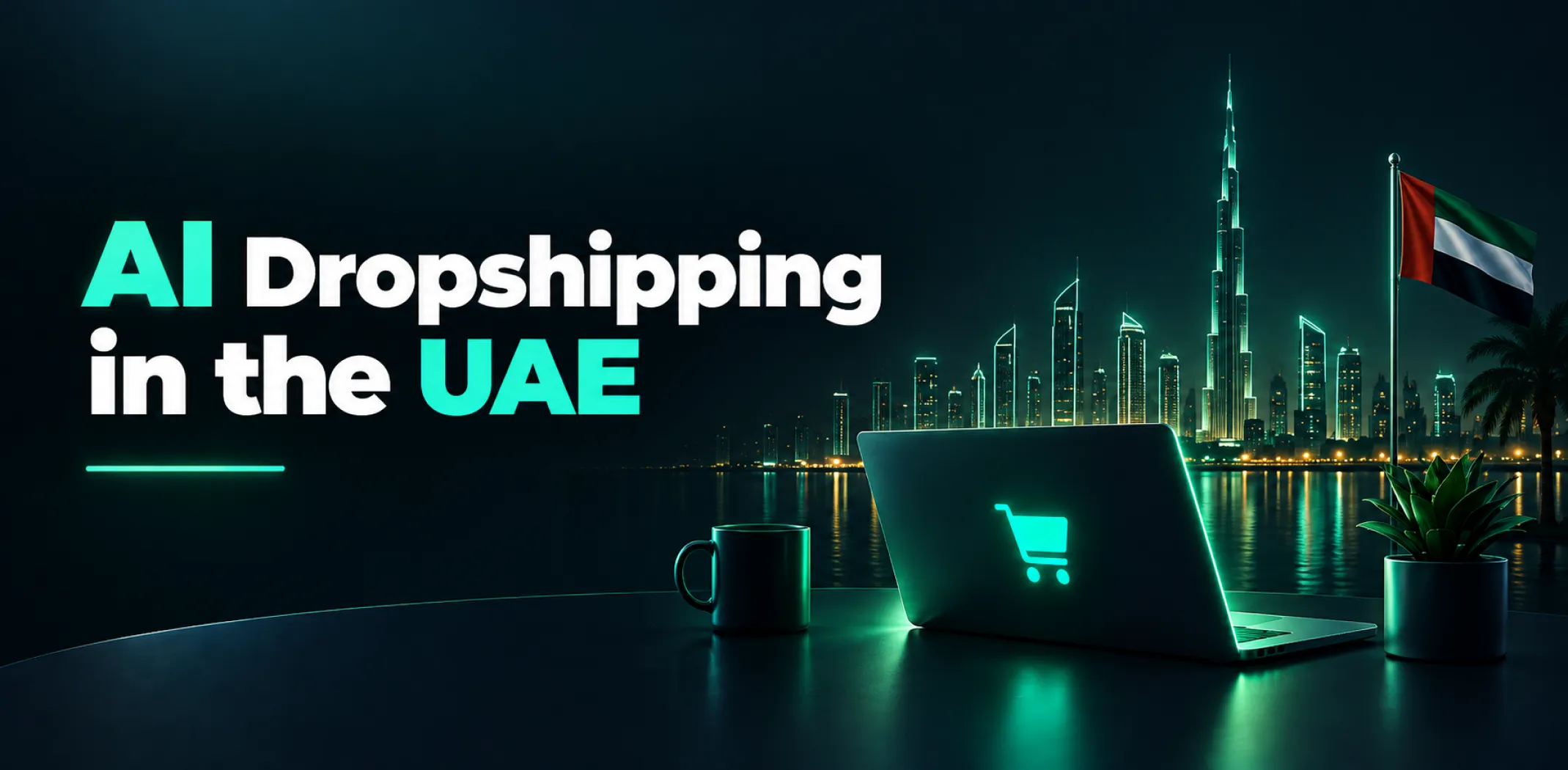
Yes – you can run an AI dropshipping business from the UAE, though there is a real cost most other markets in this series don’t have: you need a trade or freelance license to legally sell online here, starting from about AED 1,070 a year.
You get paid through PayPal, Stripe, or Wise, all of which deposit directly into a UAE bank account, and since the dirham is pegged to the US dollar, currency swings are not something you need to worry about here. Startup cost beyond the license is close to zero: the platform is free for 14 days, then runs about AED 143 a month, with no personal income tax on what you earn.
Who your customers will be
Selling digital products means your customers are wherever your ads run – typically the US, UK, Canada, and Australia, not necessarily the UAE itself. The UAE’s own market size, payment habits, and ecommerce maturity do not limit this business.
For a UAE-based seller, the pattern is close to Australia’s or Malaysia’s: your primary customers sit many hours away in the US and UK time zones, so campaigns and customer messages mostly run on their own rather than in real time.
English is widely used in UAE business and ecommerce, and because the dirham is pegged to the US dollar at a fixed rate, your revenue does not lose value to currency swings the way it can in a market with a floating currency.
Can you run AI dropshipping from the UAE?
Run every requirement through the checklist below before committing any time or ad budget. The UAE clears the five operational gates without a single caveat. Business registration is the exception – it is required up front here, not after a revenue threshold, and it is the one row worth budgeting for.
How you get paid in the UAE
Three payout providers work cleanly from the UAE: PayPal, Stripe, and Wise. All three connect directly to a UAE bank account and settle in AED, typically within a few business days of a payout request.
Because the UAE dirham is pegged to the US dollar at a fixed rate of 3.6725 AED per USD, you do not face the currency swings that affect sellers in markets with a floating exchange rate. Standard payout and conversion fees of roughly 2 to 3 percent still apply, since AliDropship bills and pays out in US dollars, but the underlying rate itself does not move.
On a $39 digital product sale at a 60% margin, a seller in the UAE receives approximately AED 84 after payout and conversion fees, based on the fixed rate of 1 USD to 3.6725 AED.
No separate business bank account is strictly required to receive PayPal or Wise payouts, though your trade or freelance license application may ask for one depending on the structure you choose.
How AI dropshipping works
AI dropshipping through AliDropship runs on three layers working together. AI configures the store – layout, pages, and checkout are set up automatically, so there is no template shopping or plugin troubleshooting on your end. AI stocks it with digital products – 60+ tested items are pre-loaded across several niches at launch, all fitting the same US, UK, Canadian, and Australian audiences your ads will actually reach.
AI runs the ads – campaigns launch and optimize across Google, Instagram, TikTok, and Amazon, and since Meta, TikTok, and Google Ads all bill UAE cards without restriction, nothing about running this from the UAE slows that process down; the same automation is also what absorbs the time zone gap noted earlier, since campaigns keep optimizing overnight without you at the keyboard.
Because the products are digital, there is no shipping from the UAE, no customs, no stock, and no failed deliveries. Orders are fulfilled the moment they are placed, wherever the customer is. See the full breakdown of how AI dropshipping works for more on each layer.
What it costs to start in the UAE
Every cost below is stated in US dollars first, since that is how AliDropship bills, with the dirham equivalent alongside it at the fixed rate of 1 USD to 3.6725 AED. UAE-issued cards handle the recurring USD billing without any special setup.
Tax and legal requirements in the UAE
This is general information, not tax advice, and UAE rules can change – confirm anything time-sensitive with your emirate’s Department of Economy, a free zone authority, or a registered tax consultant before you commit.
The UAE has no personal income tax, so whatever you earn from this business is yours in full at the individual level – a genuine rarity among the countries covered in this series.
What the UAE does require, ahead of anything else, is a trade, e-commerce, or freelance license before you can legally sell online.
Dubai’s E-Trader license is the cheapest route for individuals selling through an existing online store or social channels, at around AED 1,070 a year; free zones such as SHAMS or RAKEZ offer similar freelance permits valid across the UAE, typically running AED 5,000 to 15,000 a year depending on the zone and package.
Two further thresholds sit above the license itself. If your income from this business is treated as freelance activity by a natural person rather than through a company, UAE Corporate Tax only becomes relevant once your annual turnover from that activity passes AED 1 million – a notably higher bar than the AED 375,000 profit threshold that applies to registered companies.
VAT registration is separate again, and only becomes mandatory once taxable turnover passes AED 375,000 in a rolling 12-month period.
The point most sellers miss: if any of your customers are in the European Union or the United Kingdom, VAT applies from your very first sale to them, with no threshold at all.
A UAE seller with even one EU customer is expected to register for the EU’s non-union VAT OSS scheme (one registration covers all 27 member states) and charge that customer’s local VAT rate; UK sales carry the same first-sale obligation at the UK’s standard 20 percent rate.
What AI does and does not solve for UAE sellers
AI handles the parts of this business that used to take the most time: store setup, product selection from the catalog, ad copy and creative, campaign optimization, product descriptions, and follow-up email.
It does not handle three things that stay on you as a UAE-based seller. It will not apply for your trade, e-commerce, or freelance license before you start – that step has to happen first, and only you can complete it.
It will not track whether you are approaching the AED 1 million corporate tax threshold or the AED 375,000 VAT threshold. And it will not register you for the EU’s VAT OSS scheme if European customers start buying – that decision and paperwork are yours as well.
Getting started from the UAE
1. Apply for your trade or freelance license first. Go through your emirate’s Department of Economy or a free zone such as SHAMS or RAKEZ; most licenses are issued within one to two weeks.
2. Claim your 14-day free trial. Your store, catalog, and checkout are configured automatically once your license is in hand.
3. Turn on ads and connect your payout method. Link PayPal, Stripe, or Wise so sales settle straight into your UAE bank account, and let the $40 ad credit cover your first campaigns across Meta, TikTok, or Google.
Getting started from the UAE puts one real cost up front that most other markets in this series skip – the trade or freelance license – but nothing past that point is genuinely harder.
The parts worth real attention are the ones covered above: the license itself, the fact that a floating currency is not a concern here, the AED 1 million and AED 375,000 tax thresholds, and the nil-threshold VAT obligation the moment a European or UK customer buys something. None of those are blockers. They are just the things worth budgeting for before you turn ads on.
Can I do AI dropshipping from the UAE?
How do I get paid as a dropshipper in the UAE?
Do I need to register a business in the UAE to sell digital products?
Do I pay tax on digital product sales in the UAE?
Can I sell to customers outside the UAE?


Recommended for You