AI Dropshipping In Slovenia: How To Start And Get Paid


Yes, you can run an AI-powered dropshipping business from Slovenia. You get paid through PayPal, which withdraws to a Slovenian euro bank account, and Wise or Stripe work as alternatives. Starting costs about €34 for the first month of the platform subscription, plus €0 to register as a sole trader (s.p.) and a small test ad budget.
Because the products are digital, there is no shipping, no customs, and no stock to manage, wherever you live in the country. Slovenia does add a few local rules: social contributions start the day you register, and ad platforms add 22% VAT to your ad bill unless you hold a VAT number. This page walks through each one.
Last verified: 29 September 2026
Everything below is written for someone living in Slovenia, whether you are a Slovenian citizen, an EU national, or a resident with the right to work. Each section answers one question in order: who buys, what works from Slovenia, how money reaches your account, what it costs, and which taxes apply. Where a rule changed in 2026 or is still being debated, the page says so directly instead of smoothing it over.
Who your customers will be
Selling digital products means your customers are wherever your ads run, typically the US, UK, Canada, and Australia, not necessarily Slovenia. The size of the Slovenian market, local payment habits, and local ecommerce maturity do not limit this business.
For a seller in Slovenia, three things matter. The first is timezone: Slovenia runs on Central European Time, one hour ahead of London and six hours ahead of New York. Your working day covers the UK and Europe live, and the first US East Coast orders of the day reach you around mid-afternoon. The second is language: you will run the store, the ads, and customer support in English.
The EF English Proficiency Index does not list Slovenia in its 2025 edition, but older editions placed it in the Very High band (9th in 2018). The third is location: Slovenia is inside the euro area and the EU single market, which makes banking and card payments routine.
Can you run AI dropshipping from Slovenia?
Yes. Every requirement clears for a seller in Slovenia, and the one real local step is registering as a sole trader (s.p.).
How you get paid in Slovenia
Three payout routes work from Slovenia. PayPal is the simplest: Slovenia is a fully supported PayPal market, and a business account can withdraw to a Slovenian bank account in euros with no withdrawal fee when no currency conversion is involved. Stripe supports Slovenian businesses directly, and Wise is a common lower-cost option for converting dollars to euros. Bank withdrawals typically take a few working days, depending on your bank.
The fee that matters most is currency conversion. When a US buyer pays your PayPal business account, PayPal charges 3.4% plus 1.99% for an international payment, plus a fixed $0.30. Converting the balance to euros then costs 3% above the base exchange rate.
At the mid-market rate on 21 September 2026 (1 USD = 0.8712 EUR), a $100 payment from a US buyer is worth €87.12 but arrives as about €79.70 after the PayPal receiving and conversion fees.
Here is the same math on a single product sale. On a $39 digital product sale at a 60% margin, a seller in Slovenia receives approximately €17.75 after payout and conversion fees. The margin is $23.40, PayPal charges about $2.40 on the $39 payment, and the 3% conversion takes about $0.63 more. That is one sale, not a forecast: real figures depend on the product, where the buyer lives, and the exchange rate on the day.
Slovenia has no capital controls, so nothing stops money moving in or out of your account. The friction is elsewhere. New PayPal business accounts can face review limits and temporary holds until they build a history, and every s.p. must hold a Slovenian transaction account with a bank. FURS accepts a personal or a business account type, although some banks expect a business account, which usually costs more.
How AI dropshipping works
AI dropshipping means AI handles the three jobs that usually stop beginners: building the store, filling it with products, and running the ads. You do not need experience or technical skills to start. The full explanation lives on the AI dropshipping hub, so this section only covers what changes for a seller in Slovenia.
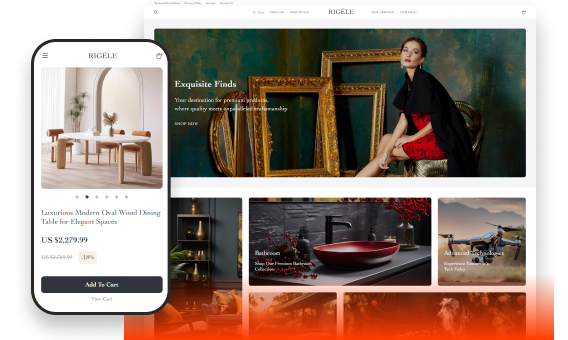
AI configures the store. The store arrives set up. Checkout runs on PayPal and Stripe, and both are available to Slovenian businesses.
AI stocks it with digital products. The store comes with 60+ tested digital products across several niches, with seller margins of 50–70% per sale. The catalog is the same everywhere, so living in Slovenia does not limit what you can sell.
AI runs the ads. AI writes, launches, and optimizes campaigns across Google, Instagram, TikTok, and Amazon. From Slovenia you can fund Meta, TikTok, and Google accounts with a local card, keeping in mind the 22% VAT on the ad bill when no VAT number is on the account.
Because the products are digital, there is no shipping from Slovenia, no customs, no stock, and no failed deliveries. Orders are fulfilled the moment they are placed, wherever the customer is.
What it costs to start in Slovenia
The table shows a realistic first month in dollars and euros, using 1 USD = 0.8712 EUR (mid-market rate, 21 September 2026). The total assumes the subscription starts on day 15 after the free trial, plus 14 days of ads at the $10 per day minimum after the $40 credit ($100), plus 22% VAT on that ad spend ($22).
It leaves out payout fees, which come out of sales, and social contributions, which are covered in the tax section. Slovenian cards generally accept recurring dollar billing, though your bank may add its own foreign-currency fee.
Tax and legal requirements in Slovenia
Slovenian residents are taxed on worldwide income, so profit from your store counts no matter where your customers live. As an s.p. you choose between two ways of calculating income tax.
The flat-rate method, called normirani, replaces your real expenses with a fixed percentage. In 2026 a full-time s.p. treats 80% of the first €60,000 of revenue as expenses, with nothing extra above that, and pays a final income tax of 20% on the rest (35% on the part of the tax base above €72,000).
On that first €60,000 of revenue, the effective rate is 4%. You can enter it if last year’s revenue was no more than €120,000. A part-time s.p., meaning someone already fully insured through a job, has tighter limits: 80% deemed expenses on the first €12,500, 40% up to €30,000, and a €50,000 entry ceiling. The regular method lets you deduct real costs and taxes the profit on a progressive scale of 16% to 50%.
These rules were rewritten at the start of 2026. A further law meant to ease them (ZIURS) passed parliament in May but has not taken effect, because a referendum process is still under way. Ask an accountant which version applies when you file.
Social contributions are separate from income tax and apply under either method. A full-time s.p. pays about €651 a month at the minimum base, reduced to about €464 in the first year and €541 in the second by a beginner relief on the pension part. A part-time s.p. pays a flat €113.01 a month. You must register for social insurance within 8 days of starting.
Slovenian VAT is 22%, and you only have to register once taxable turnover passes €60,000 in 12 months. Digital sales to consumers abroad follow different rules. If your digital sales to consumers in other EU countries pass €10,000 a year, VAT is due at each buyer’s country rate and is reported through the EU One Stop Shop (OSS).
For UK consumers, a foreign seller must charge UK VAT from the first sale, because there is no threshold. Sales to US buyers carry no EU VAT.
The Financial Administration of the Republic of Slovenia (FURS) publishes the official rules at fu.gov.si. This is general information, not tax advice, and rules change.
What AI does and does not solve for Slovenian sellers
AI handles the parts that slow beginners down: store setup, product selection, ad copy and creative, campaign optimization, product descriptions, and email. It does not handle three things that are specific to running this from Slovenia.
Tax registration and filing. AI cannot register your s.p., choose between the flat-rate and regular methods, or file your annual return. That choice affects your bill every year, so make it with an accountant before your first sale.
Banking. Every s.p. needs a Slovenian transaction account, and if you also use a foreign account, such as a Wise account with a non-Slovenian IBAN, you have to report it to FURS through eDavki. AI cannot open accounts or file that report.
VAT on ads and cross-border sales. AI can run the campaigns, but it cannot add a VAT number to your ad accounts, register you for OSS, or file UK VAT returns. Without a valid VAT number, the ad platforms charge Slovenian VAT of 22% on your ad spend.
Getting started from Slovenia
Three steps take you from nothing to a running store.
Step 1. Register as an s.p. Apply through the SPOT portal with a digital certificate, or in person at a SPOT point. You need your ID, a Slovenian tax number, your EMŠO personal number, and a business address. Registration is free and usually takes one or two working days. Then register for social insurance (form M-1) and confirm your Slovenian bank account. The SPOT guide lists each form.
Step 2. Set up payouts. Open a PayPal business account and link your Slovenian IBAN. Add Wise or Stripe if you want lower conversion costs.
Step 3. Start the free trial. Start the 14-day trial, let AI configure the store, and set your ad budget. If you have a VAT number, enter it in each ad account before you spend.
Most of the work in Slovenia is paperwork rather than technology: one free registration, one fixed monthly contribution, and a choice of tax method. Once those are in place, the business itself is the same one sellers run from anywhere. If you are comparing markets, the neighboring countries have their own guides, including Austria, Croatia, and Italy. Results may vary from seller to seller, and no page can tell you what you will earn.
Can I do AI dropshipping from Slovenia?
How do I get paid as a dropshipper in Slovenia?
Do I need to register a business in Slovenia to sell digital products?
Do I pay tax on digital product sales in Slovenia?
Can I sell to customers outside Slovenia?


Recommended for You