Sellvia VS Teachable: Full 2026 Pricing Comparison

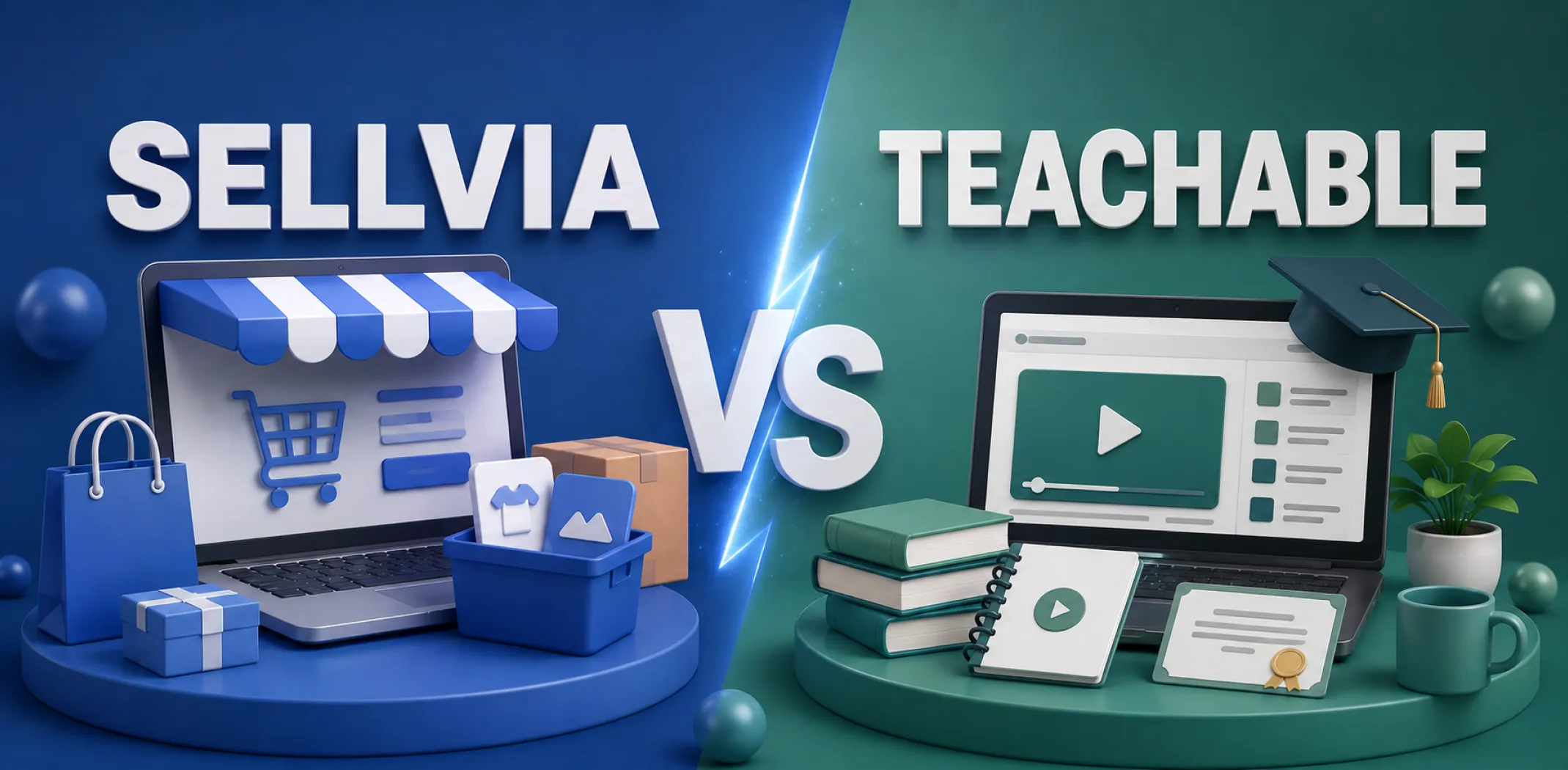
Teachable and Sellvia both promise a way to make money from digital products, but they start from almost opposite assumptions about what you already have. Teachable assumes you have expertise, something you actually know how to teach, and it gives you the tools to package that knowledge into a course: video hosting, quizzes, certificates, and a structured curriculum builder.
Sellvia assumes you do not need to create anything at all, and hands over a store already stocked with a digital products catalog instead. As of 2026, that difference matters more than either platform’s monthly price, though the pricing has its own story worth telling too, especially once Teachable’s transaction fees enter the picture.
This guide breaks down what Teachable actually charges once fees are counted, where it genuinely earns its reputation among course creators, and what a realistic first year costs on each platform.
Key takeaways
What is Teachable and how does it work?
Teachable is an online course and coaching platform founded in 2013, headquartered in New York, and now owned by Hotmart. It gives creators the tools to build a structured learning experience: video lesson hosting, quizzes and graded assignments, completion certificates, a native mobile app for students, and a built-in affiliate marketing program on its higher tiers.
Everything a Teachable school sells, whether a video course, a coaching package, or a downloadable resource, is content the creator has to produce themselves. There is no pre-made catalog, and Teachable is best understood as infrastructure for turning your own expertise into a product, not a source of products to sell.
*Teachable’s Trustpilot reviews are notably polarized: roughly a third of reviewers give 5 stars while a large share give 1 star, with recurring complaints centering on repeated price increases and slow-moving support tickets rather than the core course-building tools themselves.
Where Teachable actually wins
For someone who genuinely has expertise to teach, Teachable’s specialized tooling is hard to replicate on a general platform. Graded quizzes and assignments, completion certificates, a native iOS and Android app so students can learn on the go, and a built-in affiliate program on the Builder plan and above all exist specifically to support a structured learning experience rather than a simple product sale.
Teachable also handles US sales tax and global VAT automatically, which removes a genuinely tedious compliance job from a solo creator’s plate. For someone building a real course brand around their own knowledge, that combination of course-specific features is a legitimate reason to choose a platform built for teaching over a general digital storefront.
Now put Sellvia next to that same picture. Founded in 2016 and based in Irvine, California, Sellvia solves a different problem than Teachable does. Instead of giving you a curriculum builder and asking you to fill it with your own expertise, it hands over a store that already exists: built, styled, and pre-loaded with a catalog of digital products, guides, courses, checklists, and AI-generated toolkits, that deliver instantly with no shipping involved.
Where Teachable is infrastructure for turning knowledge you already have into a product, Sellvia is built for someone who wants to start selling without producing original content first, backed by a built-in ad system Teachable does not include at any tier.
How does Sellvia compare to Teachable?
Both platforms land close to the same headline price for their entry tier, but Teachable’s fee structure changes the picture as soon as real sales start coming in.
The transaction fee row is the one to sit with. Teachable’s Starter plan looks like it matches Sellvia’s price exactly, until the first sale comes in and the platform keeps 7.5 percent of it before payment processing is even counted.
Year-1 cost breakdown: Which is actually cheaper?
Take a seller doing a modest but real volume: 30 sales a year at an average of 100 dollars each, a realistic price point for a course, or 3,000 dollars in total sales across the year, on Teachable’s Starter plan billed monthly.
The subscription itself is 468 dollars for the year, identical to Sellvia. Teachable’s 7.5 percent transaction fee on 3,000 dollars in sales adds 225 dollars. Card processing at 2.9 percent plus 30 cents per order adds roughly 96 dollars across 30 orders.
All in, Starter lands around 789 dollars for the year. Switching to the Builder plan removes the transaction fee entirely, but the subscription itself jumps to 828 dollars a year on annual billing, or 1,068 dollars a year billed monthly, plus the same 96 dollars in card processing, landing between about 924 and 1,164 dollars depending on billing cycle.
Either way on Teachable, the realistic total sits meaningfully above the subscription’s own sticker price.
Sellvia’s total for the same year is the flat 468 dollar subscription, with no transaction fee at any tier and the ad system already included rather than purchased at a higher plan.
*Estimates built from Teachable’s published 2026 pricing and standard card processing rates; your own total depends on your average sale price, sales volume, and which plan and billing cycle you choose.
At this volume, Teachable costs meaningfully more than Sellvia on every plan and billing combination, and that gap widens further at higher sales volumes on the Starter plan specifically, since its transaction fee scales with revenue while Sellvia’s flat fee does not.
What real users say: Teachable vs Sellvia
Numbers only tell half the story, so here are two composite examples built from patterns that show up repeatedly across creator forums and review sites, illustrating how the tradeoff actually plays out a few months in.
Which platform is right for you?
Neither platform is the wrong choice in the abstract. The right pick depends mostly on whether you have genuine expertise you want to package into a course, or whether you would rather sell without creating original content first.
Best for genuine subject-matter experts
If you have real expertise you already know how to teach, Teachable’s quizzes, certificates, and structured curriculum tools help package that knowledge professionally.
Best for starting without content to create
If you do not have a specific course topic ready to produce, a store with a digital products catalog already built removes that entire step.
Best for a learning-focused student experience
If a native mobile app, completion certificates, and graded assignments matter to how your audience learns, Teachable’s course-specific design supports that experience directly.
Best for predictable costs with marketing included
If you want one flat fee with no transaction cut and a marketing system already bundled in, Sellvia removes both the fee-percentage question and the separate ad-account setup.
Notice the deciding factor here is less about price and more about whether you have expertise ready to teach or would rather start selling without producing that content yourself.
What factors should you weigh before choosing?
Beyond the subscription price, five practical questions tend to settle which platform actually fits.
Do you have a specific skill or topic ready to teach?
Teachable rewards someone who already knows what they want to teach and how to structure it. If you are still deciding what to sell, a pre-loaded catalog removes that decision entirely.
How close is your sales volume to Teachable’s fee break-even point?
Teachable’s own guidance suggests upgrading from Starter once monthly sales pass roughly 533 to 667 dollars, since the 7.5 percent fee costs more than the price gap to Builder past that point.
How much time can you dedicate to producing content?
Recording, editing, and structuring a real course typically takes several weeks of work before a single sale is possible. A pre-loaded digital products catalog skips that timeline entirely.
How do you plan to reach students or buyers?
Teachable leaves marketing entirely up to you, whether through an existing audience or your own paid ads. Sellvia includes a built-in ad system with a 10 to 50 dollar daily budget as part of the same flat fee.
How much do you want to try before committing?
Teachable offers a 7-day free trial with no free plan afterward. Sellvia offers a 14-day free trial, twice as long, plus a 40 dollar ad coupon included, so you can test both the store and the ad system before paying anything.
Run your own answers through those five questions honestly, and the choice between Teachable and Sellvia usually comes down to whether you have real expertise ready to teach or would rather skip that production step altogether.
Whichever way you are leaning, it is worth actually seeing what a done-for-you store looks like before ruling it out, and that is exactly what a free trial is for.
How does Sellvia compare to Teachable?
Which is cheaper, Sellvia or Teachable?
Is Sellvia better than Teachable for beginners?
What does Teachable do better than Sellvia?
Can I switch from Teachable to Sellvia?