Sellvia VS Shopify For Digital Products: 2026 Guide

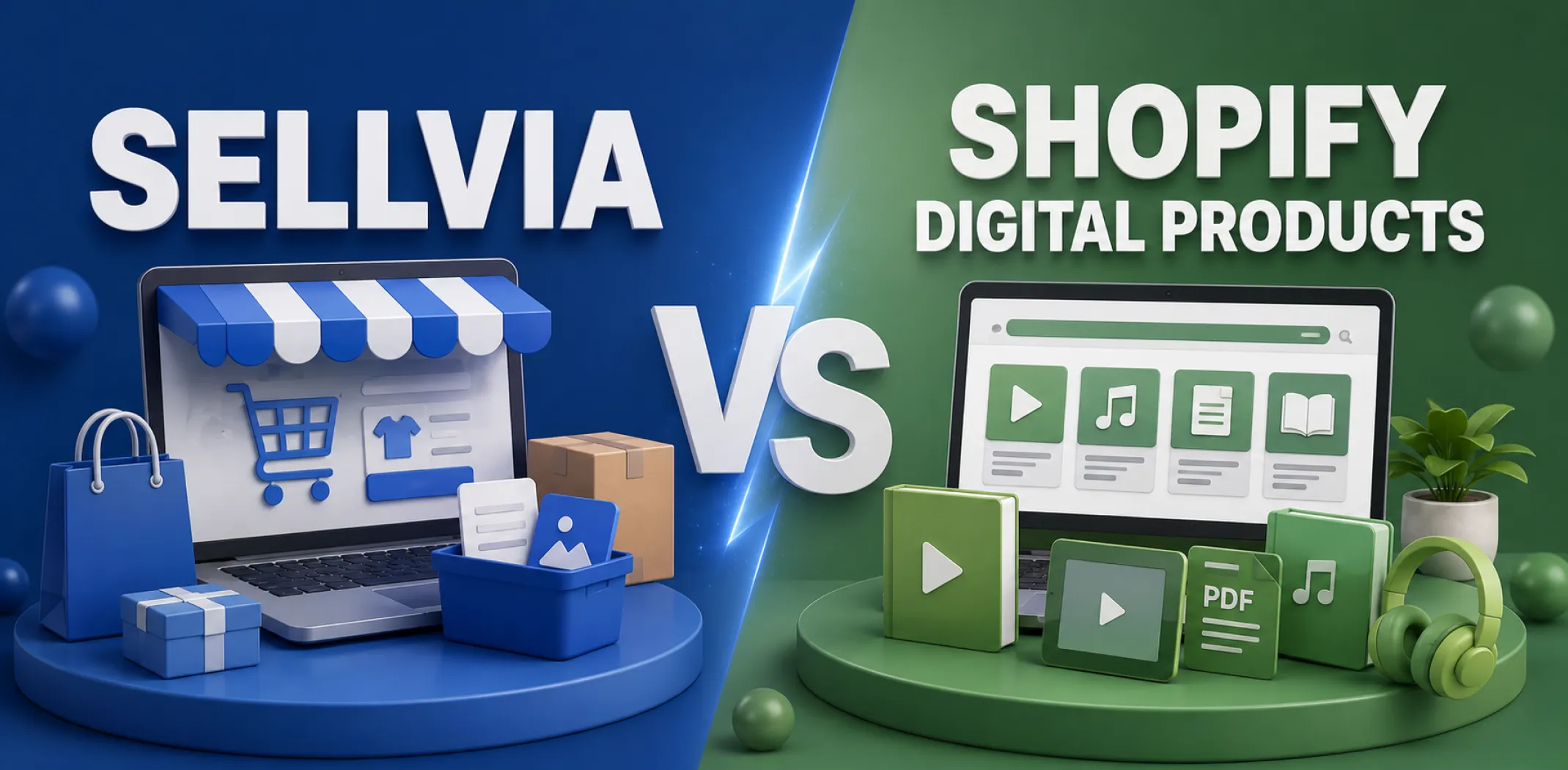
Shopify was built first and foremost as a physical-goods ecommerce platform, and its ability to sell digital downloads is a feature bolted onto that foundation rather than the core design. Sellvia was built the other way around: digital products, guides, courses, checklists, and AI-generated toolkits, are the entire catalog, with nothing physical involved at all.
As of 2026, that difference in starting point shapes almost everything else in this comparison, more than the two platforms’ headline prices do, and it is worth understanding before comparing either one on price alone.
This guide looks specifically at how each platform handles selling digital products: what Shopify actually gives you out of the box, what it takes to get a fully-featured digital delivery setup running on it, and what a realistic first year costs once app fees are added to the subscription.
Key takeaways
How does Shopify actually handle digital products?
Shopify does not treat digital products as a first-class citizen the way a marketplace-style storefront does. Out of the box, Shopify’s product catalog assumes something physical: a SKU, a weight, a shipping profile.
Selling a digital file means either using Shopify’s own free Digital Products app, which lets you attach a file or a link to a product and automatically emails a download link after purchase, or installing one of dozens of third-party apps built specifically for digital delivery.
The free app covers the basics: file uploads up to 5 gigabytes, automatic delivery, and support for links from a short list of approved providers like Google Drive, Dropbox, and Notion. What it does not include is license key generation, PDF stamping or watermarking, download-limit enforcement beyond the basics, or the kind of branded delivery experience many digital sellers want.
That gap is exactly why a large market of paid Shopify apps exists specifically to fill it.
Where Shopify actually wins for digital products
Shopify’s real edge shows up for sellers who want digital products as part of a broader storefront rather than the entire business. Because Shopify’s product catalog treats digital and physical items the same way underneath, a single store can sell an ebook alongside a printed companion workbook, or a course alongside branded merch, without needing two separate platforms.
The app ecosystem also means you can pick specialized tools for exactly what you sell: license key generation for software, PDF stamping for ebooks, subscription billing for recurring digital content, each available as its own app rather than a one-size-fits-all bundle. For a seller who already has a specific digital delivery need and the patience to research and configure the right app, that flexibility is real.
Now put Sellvia next to that same picture. Founded in 2016 and based in Irvine, California, Sellvia does not treat digital products as an add-on to a physical-goods platform, because there is no physical side to begin with.
Every store comes pre-loaded with a catalog of digital products, guides, courses, checklists, and AI-generated toolkits, that deliver instantly the moment a customer buys, with no file-size cap to worry about and no separate app to research, install, and pay for. The built-in ad system is part of the same package, so getting traffic flowing does not depend on adding yet another tool to the stack.
How does Sellvia compare to Shopify for digital products specifically?
Both platforms land at the same 39 dollar headline price for their entry tier, which makes the comparison less about the subscription and more about what else you have to add to get a real digital delivery setup running.
The row that matters most for this specific comparison is the first one. Every other difference on this table is really a downstream consequence of the fact that Shopify treats digital delivery as an optional layer, while Sellvia treats it as the whole point.
Year-1 cost breakdown: Which is actually cheaper?
Take a seller doing a modest but real volume: 10 digital sales a month at an average of 25 dollars each, or 3,000 dollars in total sales across the year, on Shopify’s Basic plan billed monthly.
The subscription itself is 468 dollars for the year, identical to Sellvia. Card processing through Shopify Payments at 2.9 percent plus 30 cents per order adds roughly 123 dollars across 120 orders. If this seller sticks with Shopify’s free Digital Products app and accepts its file-size and feature limits, that is the whole bill: about 591 dollars for the year.
But a seller who needs license keys, PDF stamping, larger file support, or a more branded delivery experience, which describes most sellers of software, paid courses, or premium ebooks, typically adds a paid digital delivery app in the 18 to 99 dollar a month range. At a modest 25 dollars a month for a mid-tier app, that adds 300 dollars for the year, pushing the realistic total to around 891 dollars.
Sellvia’s total for the same year is the flat 468 dollar subscription, with the digital delivery system and the ad system both already included rather than purchased separately.
*Estimates built from Shopify’s published Basic plan pricing, standard Shopify Payments processing rates, and typical published digital delivery app price ranges as of 2026; your own total depends on which specific app you choose and how much of its feature set you actually need.
Even in the best case, using the free native app with no added tools, Shopify still lands above Sellvia’s flat fee once processing costs are counted, and the gap widens meaningfully the moment a paid app becomes necessary.
What real users say: Shopify digital products vs Sellvia
Numbers only tell half the story, so here are two composite examples built from patterns that show up repeatedly across ecommerce forums and app review sections, illustrating how the tradeoff actually plays out a few months in.
Which platform is right for you?
Neither platform is wrong for digital products specifically, but they solve for two different starting points.
Best for mixing digital and physical products
If your catalog genuinely needs both digital downloads and shippable goods under one brand, Shopify’s shared product structure and app ecosystem handle that combination better than a digital-only platform can.
Best for going digital-only without app research
If digital products are the entire plan, skipping the step of researching and paying for a delivery app gets you to a working store faster.
Best for software or license-key products
If your specific digital product needs license key generation or DRM-style protection, Shopify’s specialized apps built for exactly that use case fill a gap Sellvia’s general digital catalog does not target.
Best for someone who wants marketing bundled in
If you do not want to also research and set up a separate ads solution on top of a digital delivery app, a platform where the ad system is already part of the fee removes that third moving piece.
Notice the pattern: every scenario where Shopify pulls ahead involves a specific need that justifies researching and paying for an extra app, while every scenario where Sellvia pulls ahead involves wanting that research step removed entirely.
What factors should you weigh before choosing?
Beyond the headline subscription price, five practical questions tend to settle which platform actually fits a digital products business specifically.
Do you also need to sell physical products?
Shopify handles a mixed digital-and-physical catalog well, since both product types live in the same system. Sellvia is digital-only, so a genuine need for physical inventory points toward Shopify.
Do your digital files exceed 5 gigabytes or need license keys?
Shopify’s free Digital Products app caps out at 5 gigabytes and has no license key support, which pushes many sellers toward a paid app. Sellvia’s built-in catalog does not carry that specific limitation for its own product types.
How comfortable are you researching and configuring apps?
Getting a fully-featured digital delivery setup on Shopify means comparing several third-party apps and configuring the one you choose. Sellvia’s delivery system comes pre-configured with the store itself.
How do you plan to market your digital products?
Shopify leaves marketing entirely up to you, on top of whatever digital delivery app you choose. Sellvia includes a built-in ad system with a 10 to 50 dollar daily budget as part of the same flat fee.
How much do you want to try before committing?
Shopify’s free trial runs 3 days before dropping to a low-cost introductory rate, and any digital delivery app usually needs its own separate trial. Sellvia offers one 14-day free trial covering the store, catalog, and ad system together.
Run your own answers through those five questions honestly, and the choice usually comes down to whether your digital product has a specific technical requirement Shopify’s app ecosystem is built to solve, or whether you would rather skip that research step entirely.
Whichever way you are leaning, it is worth actually seeing what a digital-first store looks like before ruling it out based on Shopify’s broader name recognition alone, and that is exactly what a free trial is for.
How does Sellvia compare to Shopify for digital products?
Which is cheaper, Sellvia or Shopify, for selling digital products?
Is Sellvia better than Shopify digital products for beginners?
What does Shopify do better than Sellvia for digital products?
Can I switch from Shopify to Sellvia?