Sellvia VS Sellfy: Complete 2026 Comparison Guide

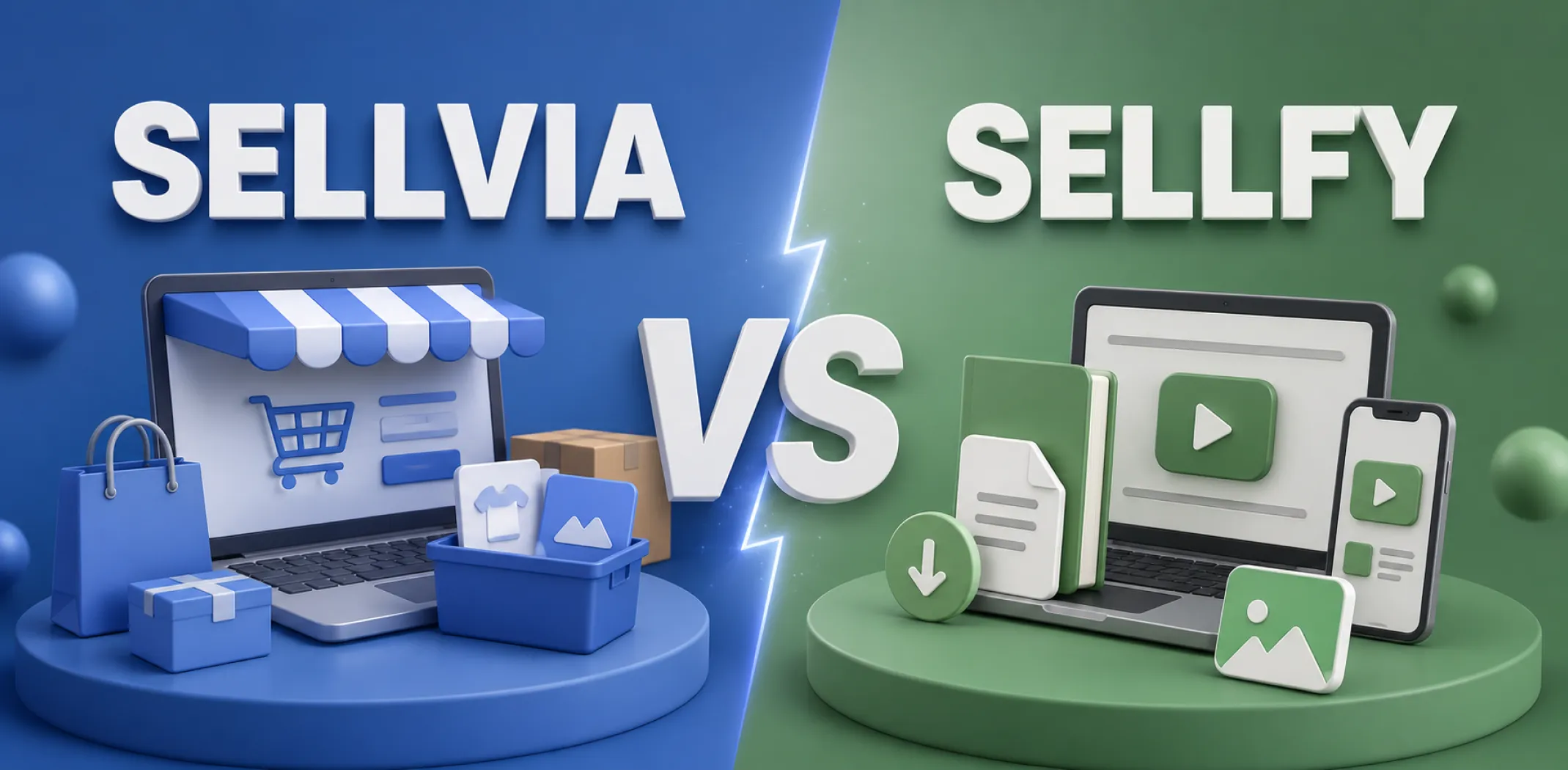
Sellvia and Sellfy get confused for each other constantly, partly because the names are one letter apart and partly because both are flat-fee platforms built for selling digital products without the overhead of a general-purpose store builder. But past the name, they solve two different problems.
Sellfy is a store-building tool: it gives you the storefront, checkout, and delivery system, and you bring your own products. Sellvia is a done-for-you shop: it gives you the storefront and a pre-loaded catalog of digital products to sell from day one.
As of 2026, that distinction matters more than the pricing does, though the pricing tells its own story too.
This guide runs through what Sellfy actually offers, where it genuinely has the edge over Sellvia, and what a full first year costs on each platform once subscription fees and payment processing are added up.
Key takeaways
What is Sellfy and how does it work?
Sellfy is a creator-focused ecommerce platform founded in 2011 and headquartered in Riga, Latvia. It gives independent sellers a storefront, checkout, and delivery system for digital downloads, subscriptions, print-on-demand merchandise, and physical products, all built specifically so a creator with no coding background can launch a store in under 15 minutes.
Unlike a marketplace, Sellfy is not a shared shopping destination: your store lives on its own Sellfy subdomain or a custom domain, and there is no built-in shopper traffic the way a marketplace like Etsy provides. You bring the products, the audience, and, in most cases, your own marketing.
*Sellfy’s Trustpilot page has historically carried a fairly small number of reviews relative to larger platforms, and ratings have ranged from roughly 4.1 to 4.4 out of 5 across different snapshots, generally landing in the Great to Excellent bands. A smaller sample size means each individual review carries more weight than it would on a platform with thousands of ratings.
Where Sellfy actually wins
Sellfy’s core pitch holds up under scrutiny: zero transaction fees on any plan, a genuinely fast setup that most reviewers clock at under 15 minutes, and a bundle of built-in tools, email marketing, discount codes, upselling, and subscription billing, that would otherwise require several separate apps on a more general platform.
For a creator who already has an audience and a product to sell, whether that is an ebook, a course, or a print-on-demand merch line, Sellfy removes the need to assemble a tech stack from scratch. Its entry price is also lower than Sellvia’s on paper, especially with annual billing, which matters to someone testing an idea before committing to a bigger monthly number.
Now put Sellvia next to that same picture. Founded in 2016 and based in Irvine, California, Sellvia solves a step earlier in the process than Sellfy does. Instead of giving you a storefront and asking you to supply the products, it hands over a store that already exists: built, styled, and pre-loaded with a catalog of digital products such as guides, courses, checklists, and AI-generated toolkits that deliver instantly with no shipping involved.
Where Sellfy assumes you already have something to sell and an audience to sell it to, Sellvia is built for someone who has neither yet and wants both handled, including a built-in ad system that Sellfy simply does not include.
How does Sellvia compare to Sellfy?
Both platforms avoid the percentage-of-every-sale model that marketplaces use, which already puts them closer together than either is to Etsy or Shopify. The real difference is what each fee actually buys.
The sales cap row is easy to skim past, but it is arguably the most consequential difference on this table. Sellfy’s Starter plan looks cheaper right up until a shop crosses 10,000 dollars in a year, at which point an upgrade or a 2 percent overage fee becomes part of the real cost, something Sellvia’s flat fee never has to account for.
Year-1 cost breakdown: Which is actually cheaper?
Take a seller doing a modest but real volume: 10 sales a month at an average of 25 dollars each, no shipping charge, or 3,000 dollars in total sales across the year, comfortably under Sellfy’s 10,000 dollar Starter plan cap.
On Sellfy’s annual billing, the Starter plan costs 22 dollars a month, or 264 dollars for the year. Stripe or PayPal processing at roughly 2.9 percent plus 30 cents per order adds about 123 dollars across 120 orders. That totals close to 387 dollars for the year.
On monthly billing instead of annual, the Starter plan runs 29 dollars a month, or 348 dollars for the year, plus the same 123 dollars in processing, for a total closer to 471 dollars. Sellvia’s cost for the same year is the flat 468 dollar subscription, with the ad system and product catalog already included rather than purchased separately.
At this volume, Sellfy on annual billing is genuinely the cheaper option by about 80 dollars across the year. Choose monthly billing instead, and the two platforms land within a few dollars of each other, at which point the deciding factor stops being price and starts being whether you already have a product and a marketing plan, since Sellfy includes neither.
*Estimates built from Sellfy’s published pricing and standard Stripe/PayPal processing rates as of 2026; neither figure includes the cost of sourcing products or running your own ad campaigns, both of which are separate expenses on Sellfy but already bundled into Sellvia’s flat fee. Your own total will move with which billing cycle you choose and how much you end up spending to market the store yourself.
What real users say: Sellfy vs Sellvia
Numbers only tell half the story, so here are two composite examples built from patterns that show up repeatedly across creator forums and review sites, illustrating how the tradeoff actually plays out a few months in.
Which platform is right for you?
Neither platform is the wrong choice in the abstract. The right pick depends mostly on whether you already have something to sell and a way to reach buyers, or whether you need both of those handled for you.
Best for creators with an existing audience
If you already have a following and your own products to sell, Sellfy’s low entry price and zero transaction fees let you keep more of every sale without needing a catalog handed to you.
Best for starting with no product and no audience
If you do not yet have a product or a way to reach buyers, a store with both already provided closes that gap in a single signup instead of two separate projects.
Best for a shop expecting to grow past 10,000 a year
If your sales are likely to grow past Sellfy’s Starter plan cap, a flat fee with no sales ceiling avoids the upgrade decision, and the overage fee, entirely.
Best for skipping the product-sourcing step
If figuring out what to sell has been the actual barrier to starting, choosing from a ready-made digital products catalog removes that decision entirely.
Notice the deciding line here is less about price and more about which two problems, product and traffic, you have already solved and which ones you still need a platform to solve for you.
What factors should you weigh before choosing?
Beyond the subscription price, five practical questions tend to settle which platform actually fits.
Do you already have a product ready to sell?
Sellfy rewards someone who already has a digital product finished and ready to upload. If you are still deciding what to sell, a pre-loaded catalog removes that step entirely.
How will you drive traffic to the store?
Sellfy leaves traffic generation entirely up to you, whether through an existing audience or your own paid ads. Sellvia includes a built-in ad system with a 10 to 50 dollar daily budget, so no existing audience is required.
How close is your expected volume to Sellfy’s sales cap?
Sellfy’s Starter plan caps out at 10,000 dollars a year in sales before an upgrade or overage fee applies. Sellvia’s flat fee has no such ceiling at any sales volume.
What product types do you want to offer?
Sellfy supports digital, physical, subscription, and print-on-demand products, all self-sourced. Sellvia sells digital products only, delivered instantly with a 50 to 70 percent margin and no shipping involved.
How much do you want to try before committing?
Sellfy offers a 14-day free trial with no credit card required. Sellvia also offers a 14-day free trial, plus a 40 dollar ad coupon included, so you can test the built-in ad system as well as the store before paying anything.
Run your own answers through those five questions honestly, and the choice between Sellfy and Sellvia usually comes down to whether you are further along on the product-and-audience side or the store-and-traffic side of getting started.
Whichever way you are leaning, it is worth actually seeing what a done-for-you store looks like before ruling it out based on the entry price alone, and that is exactly what a free trial is for.
How does Sellvia compare to Sellfy?
Which is cheaper, Sellvia or Sellfy?
Is Sellvia better than Sellfy for beginners?
What does Sellfy do better than Sellvia?
Can I switch from Sellfy to Sellvia?