Side hustle starter pack with a $100 welcome gift inside
Claim a free store with a head-start gift today!
Get for free

Sellvia VS Printful: Complete 2026 Cost Comparison

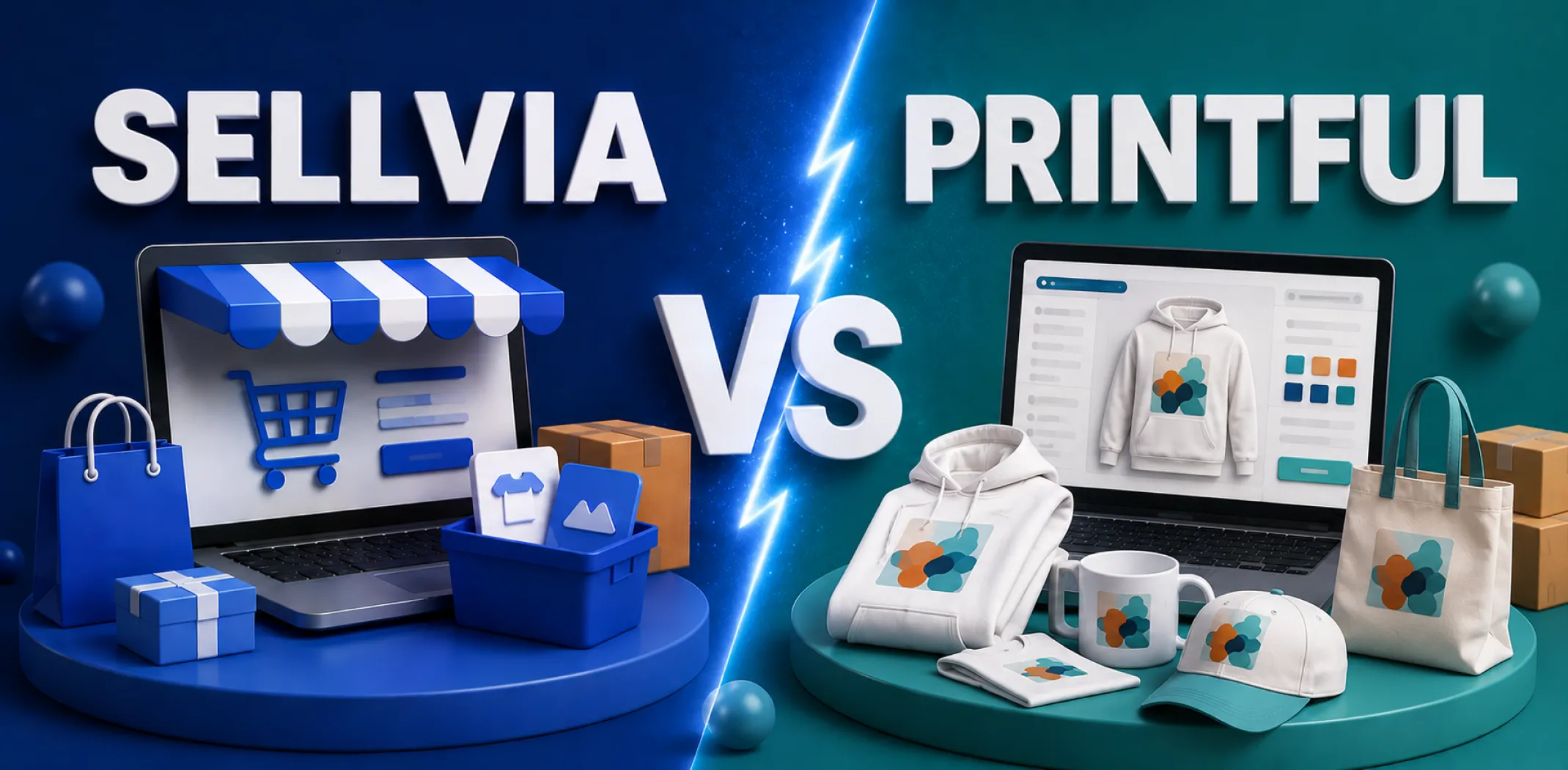
Featured image for a competitive breakdown of Sellvia vs Printful

Printful takes the opposite approach to the same problem Printify solves with a marketplace of competing providers: instead of connecting you to dozens of third-party printers, Printful runs a large share of its own orders through its own production facilities, in Barcelona, Riga, Birmingham, Toronto, Charlotte, Dallas, and Tijuana, backed by a three-step quality check and a free reprint or refund if a manufacturing error slips through.

That single-company model means more consistent quality and one point of accountability, at the cost of a smaller catalog and, by most accounts, a slightly higher base price than shopping around a marketplace would get you.

🛍️
📦
📣
See a store that’s already the whole package
14-day free trial • Cancel anytime • $39/month after trial

Claim My Free Store ⤻

🛍️
See a store that’s already the whole package
14-day trial • Cancel anytime • $39/mo after

As of 2026, Printful and Printify are technically under the same corporate umbrella after a November 2024 merger, though the two platforms still operate separately with genuinely different philosophies.

This guide breaks down what Printful actually charges, where its in-house production and consistency genuinely earn their reputation, and what a realistic total setup costs once the storefront it depends on is added back into the picture.

Quick Answer
Printful’s free plan charges no commission, only the base product cost plus shipping, and its Growth plan at 24.99 dollars a month unlocks up to 33 percent off products, becoming free for a year once trailing annual sales hit 12,000 dollars. Like other fulfillment backends, Printful is not a storefront, so it requires a separate ecommerce platform, typically Shopify at around 39 dollars a month on its own. Sellvia is 39 dollars a month flat and includes the store, a pre-loaded digital products catalog, and a built-in ad system all in one, with no production or quality control to manage at all.

Key takeaways

 ✓

Printful charges no commission at any tier, only the base product cost plus shipping, and its Growth plan becomes free for a year once trailing annual sales reach 12,000 dollars.

 ✓

Printful runs a large share of orders through its own in-house production facilities rather than a marketplace of third-party providers, giving more consistent quality control than Printify’s model.

 ✓

Printful is a fulfillment backend, not a storefront, and requires a separate ecommerce platform like Shopify, Etsy, or WooCommerce underneath it.

 ✓

Sellvia is 39 dollars a month after a 14-day free trial, and includes the store itself, a pre-loaded digital products catalog, and a built-in ad system, with nothing else to purchase separately.

 ✓

Printful makes the most sense for someone who already runs a store and wants consistent, single-source quality control over price shopping; Sellvia makes more sense for someone who wants the entire setup, store and traffic included, from a single signup.

What is Printful, and how is its production model different from Printify’s?

Printful is a print-on-demand company founded in 2013 in Riga, Latvia, and now headquartered in Charlotte, North Carolina, having processed well over 100 million items to date.

Where a marketplace-style competitor connects sellers to dozens of independent print providers, Printful runs a large share of its own orders through its own production facilities across North America, Europe, and partner sites in Australia and Japan, applying the same three-step quality check to every order regardless of which facility fulfills it. If a manufacturing error does slip through, Printful covers a free reprint or refund.

That single-source model trades away some of the catalog breadth and price flexibility a marketplace offers in exchange for a more predictable, consistent product every time. Like the other fulfillment tools in this series, Printful itself has no storefront; it connects to a store you build separately on Shopify, Etsy, WooCommerce, Squarespace, or Amazon.

Platform · Quick facts
Printful — At a glance
Founded2013
HeadquartersCharlotte, North Carolina
Trustpilot ratingAround 4.3 to 4.6 out of 5, from over 7,000 reviews
Free plan$0/month, no commission, 450+ products
Growth plan24.99 dollars a month, free for a year past $12k in annual sales
Requires a separate storeYes, Shopify, Etsy, WooCommerce, and more
Product type450+ apparel, accessory, and home items, self-designed

Where Printful actually wins

Printful’s consistency is a genuine, structural advantage over a marketplace of competing providers. Because a large share of orders route through Printful’s own facilities rather than dozens of independent partners, a seller does not have to sample and vet different print providers to find one that produces reliable quality, the same standard applies across the catalog.

🛍️
📦
📣
Your free store is one click away
14-day free trial • Cancel anytime • $39/month after trial

Start My Free Store ⤻

🛍️
Your free store is one click away
14-day trial • Cancel anytime • $39/mo after

Its 4.3 to 4.6 out of 5 Trustpilot rating, from over 7,000 reviews, reflects that reliability, and reviewers consistently single out product quality and ease of use as strengths even when they flag pricing as a concern.

The Growth plan’s 12,000 dollar annual sales threshold for a free year of the subscription is also a genuinely unusual perk among print-on-demand platforms, rewarding sellers specifically for scaling with Printful rather than shopping elsewhere.

Platform · In-house production fulfillment
Printful
Since 2013
Quality consistencyVery high, single-source production
Standalone readinessLow, requires a separate store
0% commission
In-house production, 3-step QC
Free at $12k/year sales

Printful’s in-house production model trades marketplace-style price flexibility for something a lot of sellers value more once they have real customers relying on them: predictable, repeatable quality. The tradeoff is a smaller catalog than a provider marketplace offers, and base product costs that reviewers frequently describe as running a bit higher than budget-focused competitors.

⚠️

Caution: A February 2026 price adjustment raised base costs and shipping on specific product lines like Cotton Heritage apparel and phone cases by small amounts, while leaving core products like Bella + Canvas and Gildan apparel unaffected, so check current catalog prices for your specific products before finalizing your pricing.

Now put Sellvia next to that same picture. Founded in 2016 and based in Irvine, California, Sellvia removes the quality-control question entirely, since there is no physical production to manage in the first place.

Instead of a fulfillment tool that assumes a separate storefront is already built and paid for, it hands over a complete store that already exists: built, styled, and pre-loaded with a catalog of digital products, guides, courses, checklists, and AI-generated toolkits, that deliver instantly with no printing, shipping, or manufacturing quality check involved at any point.

🛍️
📦
📣
See the setup with nothing to quality-check
14-day free trial • Cancel anytime • $39/month after trial

See My Free Store ⤻

🛍️
See the setup with nothing to quality-check
14-day trial • Cancel anytime • $39/mo after

Where Printful solves the production-consistency half of a physical-goods business and leaves the store, traffic, and marketing to you, Sellvia is the whole business, including a built-in ad system Printful does not include at any tier.

How does Sellvia compare to Printful?

This comparison only makes sense once Printful’s real total cost, the storefront it depends on plus its own product pricing, is counted alongside Sellvia’s single flat fee.

Feature Sellvia ✦ Printful
Store included ✓ Yes, built for you ✗ No, needs Shopify/Etsy/etc.
Products pre-loaded ✓ Digital catalog ready ✗ You design it yourself
Built-in ad system ✓ One-click ✗ Not included
Quality control Not applicable, digital delivery In-house, 3-step check on every order
Monthly cost $39/month, all-inclusive $0–$24.99, plus a separate store subscription
Time to first listing Minutes Hours, after a store is already set up

The quality control row is where Printful’s approach stands out most clearly against both Printify’s marketplace model and Sellvia’s digital-only model. It is a real, meaningful strength if physical product consistency matters to your brand, and simply not a variable at all for a store that never ships anything physical to begin with.

🛍️
📦
📣
Compare the real total costs for yourself
14-day free trial • Cancel anytime • $39/month after trial

See My Free Store ⤻

🛍️
Compare the real total costs for yourself
14-day trial • Cancel anytime • $39/mo after

Year-1 cost breakdown: Which is actually cheaper?

Take a seller doing a modest but real volume: 10 sales a month at an average of 25 dollars each, or 3,000 dollars in total sales across the year, running Printful’s free plan connected to a Shopify Basic store.

The Shopify subscription itself runs 468 dollars for the year on monthly billing. On the free plan, a Bella + Canvas t-shirt runs around 11.50 dollars wholesale before shipping, a touch higher than some marketplace-style competitors, leaving a margin closer to 54 percent on a 25 dollar retail price with no percentage fee on top. On 3,000 dollars in sales, that works out to roughly 1,620 dollars in gross margin across the year.

Are you ready to skip the second platform?
One path needs a store built somewhere else first, the other already includes it.

Start My Free Store

14-day free trial · Cancel anytime · $39/month after trial
Are you ready to skip the second platform?
One path needs a store built somewhere else first, the other already includes it.

Start My Free Store

14-day free trial · Cancel anytime · $39/month after trial

Subtracting the 468 dollar Shopify subscription and standard card processing fees, roughly 123 dollars, leaves a realistic net profit around 1,029 dollars, before any separate advertising spend.

Upgrading to Growth at this volume sits close to the break-even point commonly cited around 10 to 15 orders a month, and since this example’s 3,000 dollars in annual sales sits well under the 12,000 dollar threshold, the free-Growth-plan perk would not kick in yet either.

Sellvia’s total for the same year is the flat 468 dollar subscription, with no separate storefront to pay for, no quality control to manage, and a built-in ad system already included rather than a separate expense to budget for.

Sellvia, year 1
$468
A flat 39 dollars a month, store, catalog, and ads all included.
Printful Free + Shopify, subscription*
$468
The Shopify Basic plan alone; Printful’s free tier itself adds no subscription fee.
Printful Free + Shopify, net profit*
~$1,029
After product cost, Shopify subscription, and processing, before any ad spend.

*Estimates built from Printful’s published fee structure and Bella + Canvas base cost example, plus Shopify’s published Basic plan cost, as of 2026; your own totals will vary by product type, order volume, and print method. Printful’s slightly higher base costs compared to a shop-around marketplace are a real, documented tradeoff for the quality consistency and single point of accountability its in-house model provides.

P.S. Consistent physical product quality only matters if you are shipping something physical in the first place, so a store with nothing to print, pack, or quality-check is ready to go in minutes.
14-day free trial · Cancel anytime · $39/month after trial

What real users say: Printful vs Sellvia

Numbers only tell half the story, so here are two composite examples built from patterns that show up repeatedly across ecommerce forums and app review sections, illustrating how the tradeoff actually plays out a few months in.

👕
Talia, Oregon
Shopify + Printful · Store live 2025

Talia chose Printful specifically because she had been burned by inconsistent print quality on a previous marketplace-style platform, and she wanted one company she could hold accountable if something went wrong. She never had to sample multiple providers, since every order came from the same production standard, and a rare manufacturing defect was replaced without a fight. What she noticed over time was that her per-unit costs ran a bit higher than a friend’s shop using a cheaper marketplace competitor, which she decided was worth it for the peace of mind.

Her takeaway: paying slightly more for one consistent quality standard felt like the right trade for a brand she wanted customers to trust.

💻
Marcus, Texas
Sellvia · Store live in 2026

Marcus briefly looked at Printful but did not have a Shopify or Etsy store to connect it to, and the idea of managing a physical product’s quality, even a consistently good one, felt like more than he wanted to take on right away. He signed up for Sellvia’s 14-day trial instead, and his store arrived already built and stocked with digital guides, with no production quality to worry about at all. He turned on the built-in ad system with a 15 dollar daily budget the same afternoon he signed up, and his first sale came in four days later.

His takeaway: not having a physical product to manufacture or worry about quality-wise, at all, was worth more to him than any comparison of production standards.

*Individual results vary and depend on the time you put in.

Which platform is right for you?

Neither is the wrong choice for what it actually is, but they answer different questions: Printful assumes you already have a store and value consistency over shopping around, Sellvia assumes neither.

🏪

Best for an existing store prioritizing consistency

If you already run a store and want one dependable production standard instead of comparing providers for every product, Printful’s in-house model is built exactly for that.

Example: Building a brand where every order, regardless of product, comes from the same quality standard.

Best for starting with no store already built

If you do not have a store on any of Printful’s supported platforms yet, a platform that already includes the store, catalog, and ad system removes an entire separate setup project.

Example: Going from signup to a live storefront with products listed in under an hour, no second platform required.
📈

Best for scaling past the free-Growth threshold

If your sales are on track to clear 12,000 dollars a year through Printful specifically, the Growth plan not only pays for itself but eventually becomes free for a full year.

Example: Tracking trailing annual sales toward the 12,000 dollar mark to unlock a free year of Growth benefits.
🎯

Best for skipping production entirely

If quality control, print methods, and manufacturing standards are not something you want to think about at all, a digital-only store removes that entire category of decision.

Example: Delivering a digital product instantly with no physical production step anywhere in the process.

Notice the deciding factor here is less about which platform is objectively better, since Printful’s consistency is genuinely a real strength, and more about whether managing physical product quality is a job you actually want or one you would rather skip entirely.

No production to manage. Just $39.
50–70% margin
14-day free trial • Cancel anytime • $39/month after trial
GET MY STORE
ON

No production to manage.
Just $39.
50–70%
margin
14-day free trial • Cancel anytime •
$39/month after trial

Get My Store ON

What factors should you weigh before choosing?

Beyond the production model itself, five practical questions tend to settle which path actually fits.

01

Do you already have a Shopify, Etsy, or WooCommerce store running?

Printful only makes sense once that store already exists and is paid for. If you would be starting a store specifically to use Printful, that separate subscription cost belongs in your real comparison.

02

How much does consistent quality matter to your brand?

Printful’s in-house production and quality guarantee are a real advantage if you cannot afford variability across orders. If price flexibility matters more, a marketplace-style competitor may be worth comparing too.

03

What is your realistic monthly and annual sales volume?

Under roughly 10 to 15 orders a month, Printful’s free plan beats Growth on total cost. Cross 12,000 dollars in annual sales through Printful specifically, and the Growth subscription becomes free for a year.

04

How do you plan to drive traffic to whichever store you use?

Printful includes no marketing tools at all, since it is purely a fulfillment backend. Sellvia includes a built-in ad system with a 10 to 50 dollar daily budget as part of the same flat fee.

05

How much do you want to try before committing?

Printful’s Growth plan offers a 14-day free trial of its own, but only on the paid tier. Sellvia offers a full 14-day free trial of the entire setup, store, catalog, and ad system, with no separate tier to navigate.

Run your own answers through those five questions honestly, and the choice between Printful and Sellvia usually comes down to whether you already have half the setup in place and value production consistency, or would rather get the whole thing in one step with nothing physical to manage.

Whichever way you are leaning, it is worth actually seeing what a single all-in-one setup looks like before building a store and managing a physical production standard yourself, and that is exactly what a free trial is for.

No inventory · No setup fees · Built for you

Skip the setup.
Start selling today.

Store setup usually costs $299+
FREE
Get My Free Store →

Your store arrives built, stocked, and ready for orders, with automated fulfillment handling the rest.

14-day free trial
$39/month after
Cancel anytime
$40 ad coupon included
✓ Store built for you
✓ No inventory
✓ Automated fulfillment
FAQ

How does Sellvia compare to Printful?

Printful charges no commission on sales, only the base product cost plus shipping, but it is a print-on-demand fulfillment tool that requires a separate ecommerce platform like Shopify, typically around 39 dollars a month on its own. Sellvia is 39 dollars a month flat and includes the store, a pre-loaded digital products catalog, and a built-in ad system all in one price.

Which is cheaper, Sellvia or Printful?

Once Printful real dependency on a paid storefront like Shopify is counted, the two land close on subscription cost. The difference is what that fee includes: Sellvia bundles the store, catalog, and ad system into that price, while Printful plus Shopify still requires designing products and paying separately for advertising, even though Printful itself charges no commission.

Is Sellvia better than Printful for beginners?

For beginners without an existing online store, Sellvia is generally easier to start with because the store, products, and advertising are already set up in one place. Printful works well for a beginner who already runs a Shopify, Etsy, or WooCommerce store and specifically values consistent, single-source product quality.

What does Printful do better than Sellvia?

Printful runs a large share of its own orders through in-house production facilities with a three-step quality check and a free reprint or refund guarantee, giving more consistent quality than a marketplace of competing providers. Sellvia does not offer physical product fulfillment at all, since it focuses on instantly delivered digital products instead.

Can I switch from Printful to Sellvia?

Yes. Since Sellvia is a separate platform with its own store and product catalog, you can start a Sellvia store alongside or instead of an existing Printful and Shopify setup. There is no requirement to close an existing Printful integration before starting a 14-day free trial with Sellvia.
avatar
By Agnes Kazaryan
Agnes is an SEO copywriter with a background in digital marketing. Every piece she creates is crafted with care – to connect with people, not just search engines.
×