Is The YouTube Partner Program Legit? An Honest 2026 Review

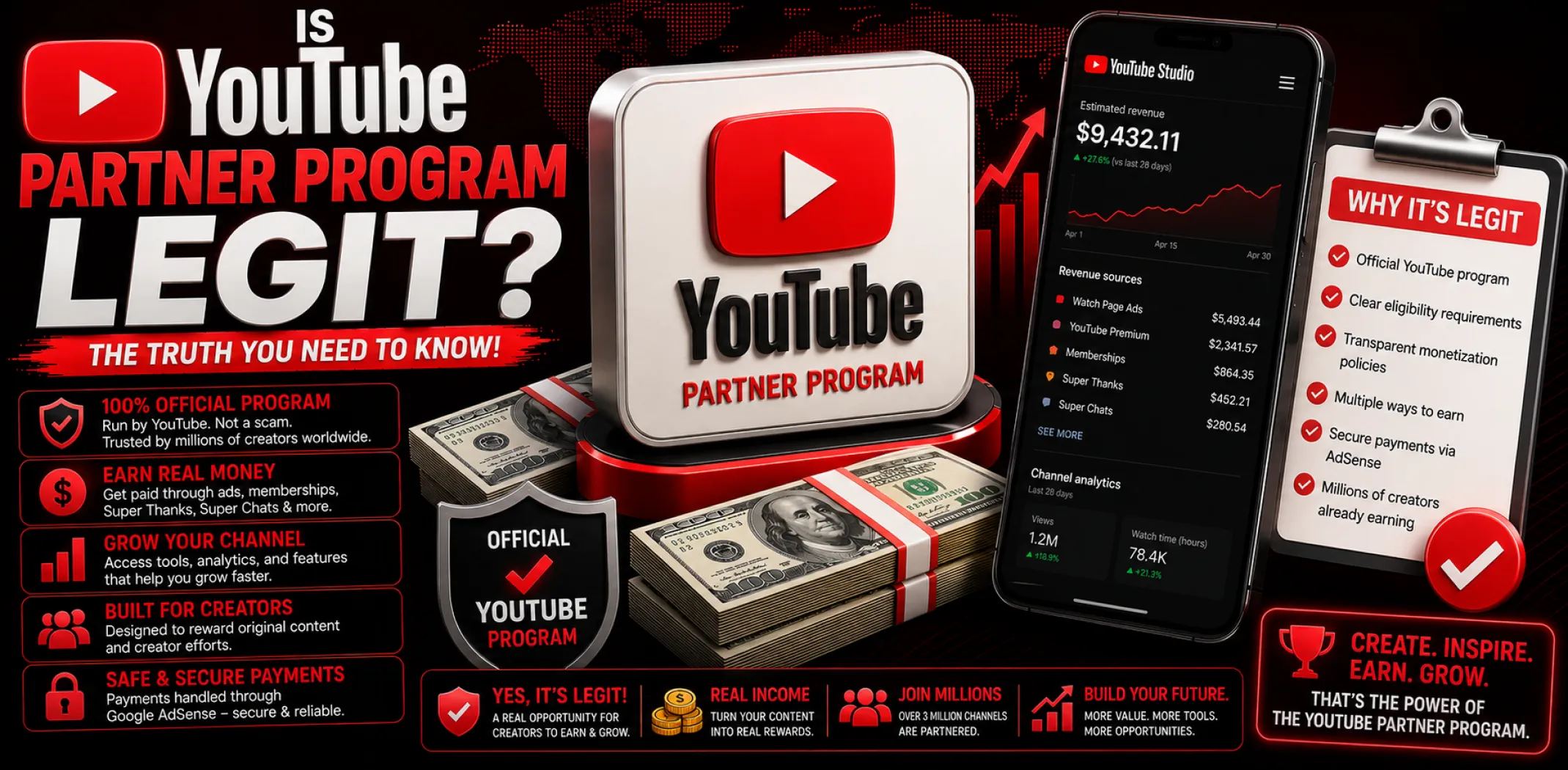
The YouTube Partner Program is the largest creator monetization fund in digital video. In 2025, YouTube distributed over $20 billion annually to creators and paid out more than $70 billion through its Partner Program in 2024 alone – a cumulative payout figure that dwarfs every competing platform combined.
With $40.4 billion in advertising revenue and a 55/45 split that puts $22 billion of that directly in the creator pool, the YPP is, by any measurable scale, a real and functioning income infrastructure for content creators.
So yes – the YouTube Partner Program is legitimate. But whether it is the right path to meaningful income for you depends on factors that are worth understanding clearly before you invest 6 to 18 months building toward the eligibility thresholds.
The income is real. The niche dependency is real. The time-to-money curve is steep. And the 2026 demonetization enforcement wave has caught legitimate creators in its net alongside the channels it was designed to remove. This review covers all of it.
Quick verdict
The YouTube Partner Program is legitimate – definitively. It is owned by Alphabet (Google), distributed over $20 billion to creators in 2025, and operates with a transparent and consistently applied 55/45 ad revenue split. Its honest limitations are about income reality rather than trustworthiness: RPM varies by up to 50x across niches, the path to meaningful income typically takes 6 to 18 months, Shorts RPM is very low, and automated demonetization enforcement has produced false positives for legitimate channels. It is the best-evidenced creator ad revenue program in existence.
Key takeaways
- The YPP is owned by Alphabet (Google), publicly listed and audited. YouTube generated $60 billion in total revenue in 2025 – more than Netflix – with $40.4 billion from advertising.
- The revenue split is 55% to creators on long-form ad revenue, 45% on Shorts, and 70% on channel memberships, Super Chat, and Super Thanks.
- RPM varies by up to 50x across niches: finance earns $12–$35 RPM while gaming earns $3–$7 RPM and entertainment earns $2–$5 RPM.
- Reaching Tier 2 eligibility (1,000 subscribers and 4,000 watch hours) takes most new creators 6 to 18 months of consistent output.
- Automated demonetization enforcement in 2026 has increased strict enforcement against reused and AI-generated content – legitimate channels with original content can trigger false positives and should understand the appeal process.
What is the YouTube Partner Program and how does it work?
YouTube launched in 2005, was acquired by Google in 2006 for $1.65 billion, and introduced ad revenue sharing for creators in 2007 – making it the first major platform to share advertising revenue directly with the people creating the content that attracted the audiences.
The YouTube Partner Program formalized this in 2012, establishing the eligibility requirements and transparent revenue sharing structure that underpins how creators earn today. In 2026, the YPP has expanded its reach with an Early Access tier, giving creators at 500 subscribers access to some monetization tools before the full 1,000-subscriber threshold.
The program operates through Google AdSense: advertisers bid to place ads on videos through an auction system, Google and YouTube take 45% of the winning bid, and the creator keeps 55%. This split is the same for every partner on the platform and is documented in YouTube’s publicly available partner terms.
For memberships, Super Chat, Super Stickers, and Super Thanks, creators keep 70%, with YouTube taking 30%. For Shorts, creators keep 45% of revenue allocated to their content from the Shorts Creator Pool based on their share of views.
The two-tier eligibility structure introduced in 2023 and expanded through 2025 means creators now have two paths. The Early Access Tier (500 subscribers, 3,000 watch hours or 3M Shorts views in 90 days, plus 3 uploads in 90 days) unlocks channel memberships, Super Chat, and merchandise shelf.
The Standard Tier (1,000 subscribers, 4,000 watch hours or 10M Shorts views in 90 days) unlocks ad revenue – the primary income source for most YPP creators. Hitting the Apply button is not automatic approval; YouTube manually reviews every application against its monetization policies, with the review typically taking 1 to 4 weeks.
Beyond ad revenue, YPP unlocks multiple income streams that successful creators stack strategically. Channel memberships let subscribers pay a monthly fee for exclusive content. Super Chat and Super Thanks let viewers send paid messages during live streams or on regular videos. The merchandise shelf integrates with YouTube Shopping to sell products.
And YPP membership makes a channel significantly more attractive to brand sponsors, who typically require YPP status as a baseline. Successful creators in 2026 typically generate 40% to 60% of their total income from YouTube ad revenue and the remaining 40% to 60% from sponsorships, affiliate marketing, digital products, and courses.
Is the YouTube Partner Program legitimate? What the evidence shows
The evidence for the YPP’s legitimacy is stronger than for any other creator monetization program reviewed in this article cluster. YouTube’s ad revenue figures are disclosed in Alphabet’s quarterly SEC filings – the same public documents that institutional investors, regulators, and auditors scrutinize.
The $40.4 billion in 2025 ad revenue is not a marketing claim; it is an audited public company financial disclosure. At the 55/45 split, the creator pool from ad revenue alone exceeded $22 billion in 2025. That is not a platform that is skimming creator earnings or hiding the mechanism.
The revenue split transparency is worth underscoring specifically. YouTube’s official help documentation states the creator’s share explicitly: 55% of Watch Page ad revenue, 45% of Shorts ad revenue from the Creator Pool, 70% of channel memberships and Super Chat. These figures have been publicly available since the program launched and have not changed significantly in years.
There is no mechanism by which YouTube hides a different fee – all revenue flows through Google AdSense, which creators can audit independently through their linked AdSense accounts.
Comparing YouTube to the other platforms in this space makes its relative standing clear. Patreon’s 1.2-star Trustpilot score reflects documented billing problems and a 0% negative review response rate. Buy Me a Coffee’s payout suspensions have been a consistent complaint across multiple review platforms. Twitch’s January 2026 payout redirect hack was a verified security failure.
YouTube is a different category of platform – a publicly listed, SEC-reporting business whose creator payout mechanisms are audited as part of its financial disclosures.
What are the real limitations of the YouTube Partner Program?
The YPP’s legitimacy is not in question – but its income reality contains specific caveats that every creator should understand before investing significant time building toward it.
Common misconception: Many new creators approach the YouTube Partner Program assuming that reaching the eligibility threshold is the hard part and that income will follow naturally. In practice, the eligibility threshold is just the entry point. The income reality that follows depends almost entirely on niche CPM rates and consistent content output – and in low-CPM niches like gaming or entertainment, a beginning creator can invest 15 hours producing a video that earns $15 at a $3 RPM. Understanding the niche-to-RPM relationship before committing to a content direction is one of the most practically useful decisions a new YouTube creator can make.
Niche determines income more than almost anything else. The RPM variance on YouTube is staggering. Finance channels earn $12 to $35 RPM because financial services companies – banks, brokerages, fintech apps – pay $25 to $65 CPM to reach audiences actively researching money decisions. A new brokerage customer might be worth $5,000 to $50,000 in lifetime revenue to the advertiser, justifying premium ad spending.
Gaming channels earn $3 to $7 RPM. Entertainment channels earn $2 to $5 RPM. The same 100,000 views generates $1,200 to $3,500 for a finance creator and $200 to $500 for an entertainment creator. Starting a channel without understanding this dynamic – and choosing your niche accordingly – is one of the most common strategic errors new creators make.
Shorts RPM is dramatically lower than long-form. YouTube Shorts generates 70 billion daily views globally and represents 22% of YouTube’s advertising revenue – but because the volume of Shorts is so massive and the CPMs for short-form inventory are lower, creator RPM for Shorts sits at $0.01 to $0.06 per 1,000 views.
A Shorts video reaching 1 million views earns $10 to $60. Shorts are powerful for audience growth and channel discovery, but treating them as a primary revenue source produces deeply disappointing income for almost every creator.
Automated demonetization has become more aggressive in 2026. YouTube significantly tightened enforcement of its reused and AI-generated content policies through 2025 and into 2026, correctly targeting compilation channels, slideshow-over-stock-footage channels, and low-effort AI-narrated content that had been gaming the system.
The problem is that automated detection at scale produces false positives – channels with genuinely original content have been caught in enforcement sweeps, receiving yellow dollar icons or full demonetization notices before human review corrects the error.
The appeal process works in most documented cases, but the timeline can be frustrating and the automated systems can reclassify the same content multiple times. For creators with original content, keeping a strong watch on YouTube Studio notifications and appealing quickly is the most effective response.
The time-to-money curve is steep. Most new creators take 6 to 18 months to reach the 1,000 subscriber and 4,000 watch-hour thresholds. During this entire period, ad revenue is zero regardless of view counts.
A creator who reaches monetization after 12 months and earns $200 per month from a 10,000-subscriber gaming channel has effectively earned $200 divided across 12 months of content production – an investment that only pays off if the channel grows substantially beyond that point.
YouTube income compounds over time as back catalog accumulates and channel authority grows – but the early months are heavily front-loaded effort with near-zero return.
Strategic insight: The creators who earn most efficiently on YouTube choose niches with high CPM rates and produce videos at least 8 minutes long (which unlock mid-roll ads, roughly doubling ad revenue per view). Finance, technology, business, health, and legal content consistently attract the highest advertising rates. A 100,000-subscriber finance channel earning $15 RPM generates $12,000 to $20,000 monthly from ad revenue alone – a dramatically different outcome from an entertainment channel with the same subscriber count.
How much can you realistically earn from the YouTube Partner Program?
YouTube income is highly niche-dependent, but here is the data-verified picture for 2026 earnings across channel sizes and content categories.
What do real YPP creators say about their experience in 2026?
Creator experiences with the YouTube Partner Program divide along the same fault lines as the data: niche selection and audience geography predict income outcomes more reliably than almost any other variable. Here are two representative experiences that illustrate the range.
Is the YouTube Partner Program worth it – honest verdict
The YouTube Partner Program is worth pursuing for creators who are willing to invest in content for the long term, choose their niche strategically, and treat YouTube as a compounding asset rather than a fast-income path.
The back-catalog effect – older videos continuing to rank in search and generate ad revenue years after upload – makes YouTube income fundamentally different from live-dependent platforms like Twitch. A well-built YouTube channel is closer to a business asset than a job: it keeps generating income while you sleep in a way that streaming never can.
The honest constraints are the 6 to 18 month path to monetization, the steep RPM variance by niche that means your content direction is also your income ceiling, and the automated demonetization system that requires active monitoring. None of these are reasons to avoid the platform – they are reasons to go in with clear expectations and a niche strategy rather than a general enthusiasm for making videos.
Legitimate, well-evidenced, and the best ad-revenue sharing program in creator media
The YouTube Partner Program is backed by a publicly listed company, pays out over $20 billion to creators annually, and operates with a transparent 55/45 revenue split disclosed in Alphabet’s SEC filings. Its limitations are about income curve and niche selection, not platform trustworthiness. Creators who choose high-CPM niches, produce videos over 8 minutes, build toward search-intent content, and supplement ad revenue with sponsorships and affiliate deals consistently report the platform as one of the most viable paths to a sustainable creator income in 2026.
A free store and a free Amazon business – launched in under 60 seconds
Sign up once and walk away with two complete income streams: a done-for-you store loaded with 100+ digital products, and an Amazon Seller Kit with listings already formatted and ready to go live. Keep 50–70% of every sale, with no content schedule and no 6-month wait to earn your first dollar.
Who should pursue the YouTube Partner Program – and who needs a different approach?
Based on the evidence, here is a clear-eyed breakdown of when the YPP is the right path and when a different income model makes more sense.
Strong fit: long-term creators in high-CPM niches
If you are genuinely interested in finance, business, technology, education, or health – and are willing to produce search-intent content consistently for 12 to 24 months – the YouTube Partner Program is the most financially rewarding ad revenue program in creator media. The back-catalog compounding makes each video a lasting asset rather than a one-time event. Videos in high-CPM niches can generate income for years.
Approach carefully: entertainment and gaming niches
Gaming and entertainment channels are entirely viable on YouTube – but the $2 to $7 RPM range means ad revenue alone rarely supports a full-time income at moderate subscriber counts. Creators in these niches who earn meaningfully almost always supplement with Patreon memberships, merchandise, sponsorships, and affiliate deals. Build the channel for the audience, but plan the income model around multiple streams from the start.
Poor fit: fast income within the first 6 months
The YouTube Partner Program earns zero during the pre-monetization period. For most creators that is 6 to 18 months of content production with no ad revenue. If you need income within the first few months – or want income that does not require a content production schedule – YouTube is the wrong primary vehicle. The compounding is real but requires a long runway.
Best combination: YouTube + owned ecommerce business
The highest-earning creators on YouTube in 2026 typically use the platform as an audience-building engine and convert that audience to owned revenue streams – courses, digital products, ecommerce. An owned store with pre-loaded products and built-in advertising generates income from day one, running alongside your YouTube build rather than waiting for it to cross monetization thresholds.
Want income that does not require a 6-month content build? Here is how AliDropship works
The YouTube Partner Program is one of the best long-term income programs in creator media – but it earns nothing for the first 6 to 18 months.
AliDropship works on a completely different timeline: a fully built ecommerce store with 100+ products pre-loaded, one-click advertising that generates sales from day one, and a free Amazon Seller Kit that opens 300 million buyers immediately – no content schedule, no pre-monetization wait, and no RPM ceiling based on your niche.
Free turnkey store – built, designed, and filled with products
Your store arrives professionally designed, pre-loaded with 50 bestselling products, and fully optimized to convert. No setup fees, no coding, no design time. You start at the product-testing stage – not the store-building stage. Hosting, SSL, and payment gateway are all included.
Winning products, one-click import
Browse trending and niche items from AliDropship’s catalog – including brand-name and digital products – and import them to your store in one click. The catalog updates regularly so your store always has fresh, competitive inventory without manual research.
Automated fulfillment and real-time tracking
Orders are processed automatically through global supplier connections. Customers receive real-time tracking updates – building trust and reducing support volume. You do not touch the shipping logistics; the platform handles it end-to-end.
Built-in marketing and promotion tools
Email campaigns, discount management, abandoned-cart recovery, live countdown timers, and social media integration are all included or available as add-ons. No prior marketing experience required – the tools guide you through each campaign type.
Beginner-friendly – no coding, no learning curve
An intuitive dashboard walks you through every step. Adding products, running campaigns, and scaling your catalog require no technical knowledge. As your business grows, the platform scales with you – adding features without adding complexity.
AliExpress integration – one-click imports, synced inventory
AliDropship connects directly to AliExpress for one-click product imports, automated order processing, and synced tracking. Inventory stays current with the latest products and prices. Combined with the turnkey store and automated fulfillment, this integration makes the entire operation manageable for one person.
Is the YouTube Partner Program a legitimate way to earn money?
How does the YouTube Partner Program revenue split work?
YouTube revenue sharing depends on the content type. For long-form videos with Watch Page ads enabled, creators keep 55% of net advertising revenue and YouTube keeps 45%. For Shorts, creators keep 45% of the revenue allocated to them from the Shorts Creator Pool based on their share of views. For fan funding features – channel memberships, Super Chat, Super Stickers, and Super Thanks – creators keep 70% and YouTube keeps 30%. All revenue flows through Google AdSense, which creators can audit independently through their linked AdSense accounts. The 55% ad revenue share means roughly 22 billion dollars was available in the creator pool from the YouTube 40.4 billion dollar long-form ad revenue in 2025 alone.
How long does it take to get approved for the YouTube Partner Program?
Reaching the eligibility thresholds – 1,000 subscribers and 4,000 watch hours in the previous 12 months – takes most new creators between 6 and 18 months of consistent content production. After hitting the thresholds and applying, YouTube performs a manual channel review that typically takes 1 to 4 weeks. Roughly 89% of channels that meet the numeric thresholds pass on the first application; the 11% that are rejected typically have content quality issues, active policy violations, misleading metadata, or content deemed insufficiently original. Rejected creators can reapply after 7 days once the identified issues are addressed. Monetization is not automatic upon reaching eligibility – creators must actively apply through YouTube Studio.
Why do some YouTube channels get demonetized after being approved?
YouTube uses automated systems to enforce its monetization policies at scale, and these systems produce false positives – legitimate original-content channels incorrectly flagged for reused content, repetitive format issues, or advertiser-unfriendliness. In 2026, stricter enforcement targeting AI-generated and compilation content increased the frequency of automated demonetization warnings across channels. The most common reasons genuine channels lose monetization after approval are copyright strikes from using commercial music in videos, content that violates the YouTube advertiser-friendly guidelines such as profanity, violence, or controversial topics, repetitive format content that lacks sufficient original commentary, and misleading thumbnails or titles. Automated demonetizations for legitimate channels can usually be resolved through the appeals process in YouTube Studio within 1 to 2 weeks.
What are the best alternatives to the YouTube Partner Program for making money online?
For creators who want income that does not require a 6 to 18 month content build before earning begins, an owned ecommerce store through a platform like AliDropship generates product-based income from day one through built-in advertising – no eligibility thresholds, no pre-monetization wait, and no RPM ceiling based on content niche. For creators who already have an audience and want a direct fan support layer to supplement YouTube ad revenue, Ko-fi charges 0% on tips and pays instantly with no platform holding period. For newsletter writers who prefer a text-based long-form approach instead of video, Substack offers a 10% fee on paid subscriptions with a transparent fee structure and a strong track record for educational and niche content creators.