Is Young Living Legit? An Honest 2026 Review

Quick verdict
Young Living is a legitimate, registered company that has sold essential oils and wellness products since 1993 and generates around $1.8 billion in annual revenue. However, it carries a heavier regulatory and legal record than most MLMs its size: two FDA warning letters (2014, 2022), a $5 million class-action settlement in 2024 that required removing the term “therapeutic-grade” from all marketing, and an Income Disclosure Statement showing 72.1% of U.S. Brand Partners averaged just $24 for the entire year – with a median income of $0.
Key takeaways
- Young Living is a legitimate, operational MLM company founded in 1993 in Utah, with approximately $1.8 billion in annual revenue and a presence across more than 100 countries.
- In 2024, Young Living settled a class-action lawsuit for $5 million over allegations that its “therapeutic-grade” marketing was deceptive; as part of the settlement, the company agreed to remove the term from all product labeling and marketing materials.
- The FDA issued warning letters to Young Living in 2014 and again in 2022, both citing unauthorized drug claims made by the company and its distributors on websites and social media.
- The 2024 U.S. Income Disclosure Statement (covering 2023) shows that 72.1% of Brand Partners – the largest rank tier, Associate – averaged $24 per year, with a median of $0; the overall average across all Brand Partners was $747 per year before expenses.
- Young Living is not BBB-accredited and holds a 1.94 out of 5 star rating from 67 BBB customer reviews, with complaints focused on customer service, billing, and subscription auto-ship issues.
What is Young Living and how does it work?
In 2026, Young Living is one of the largest and most recognized MLM companies in the world – and also one of the most polarizing. The company was founded in 1993 in Riverton, Utah by D. Gary Young, who became interested in essential oils after studying distillation practices in Europe.
Young officially established Young Living in 1993 with a focus on producing and distributing pure essential oils, and built the company around what he called the “Seed to Seal” commitment – a promise that Young Living controls every stage of its oils, from the farms where plants are grown through to the sealed bottle.
Gary Young died in 2018; co-founder Mary Young has served as CEO since. The company is now headquartered in Lehi, Utah.
Young Living operates through a network of independent contractors called Brand Partners, who buy products at a wholesale price and sell them at retail, earning the markup as commission. Brand Partners can also recruit others to become Brand Partners and earn bonuses on their team’s sales volume.
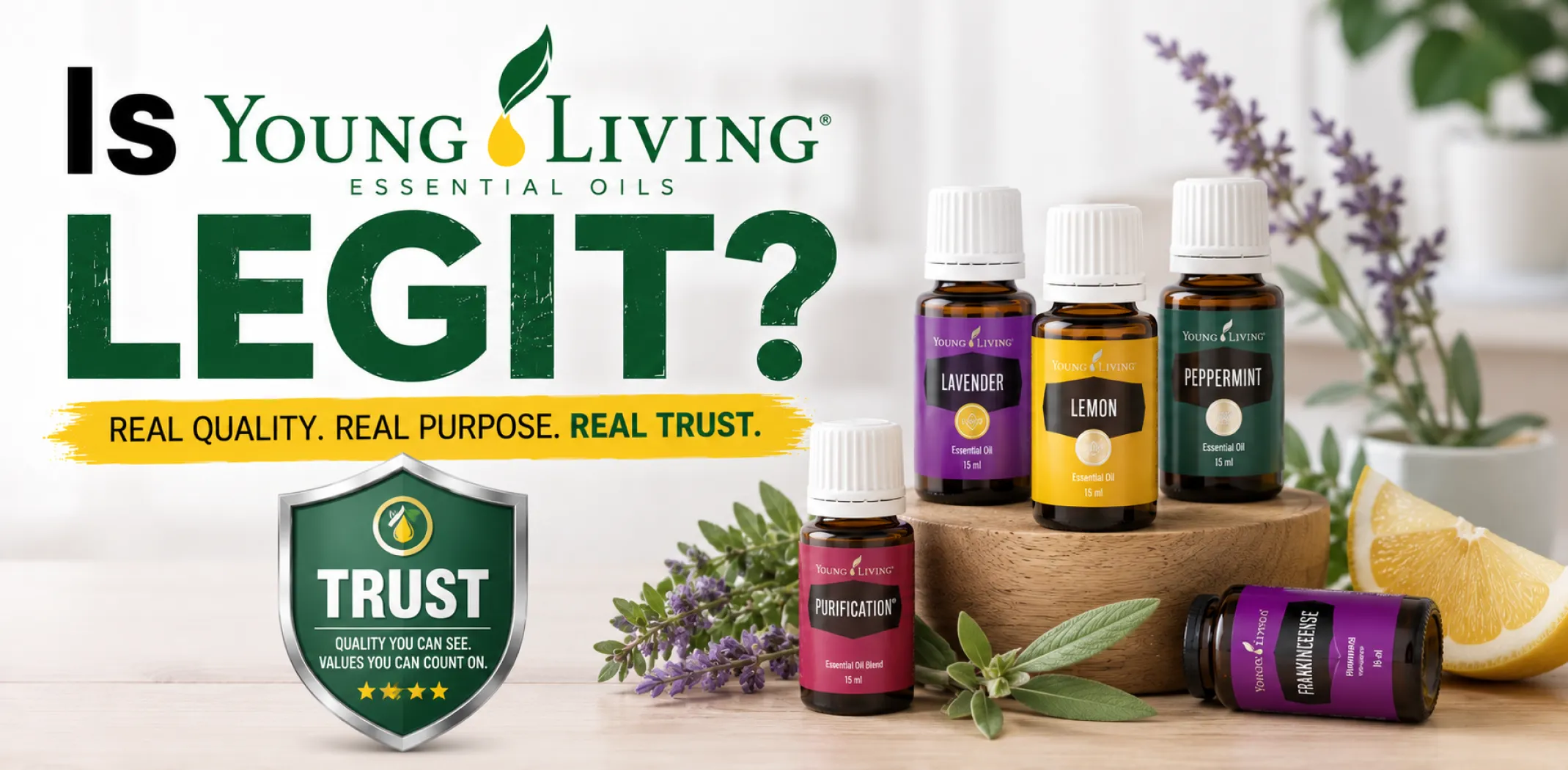
The company’s product catalog spans hundreds of SKUs – single essential oils, proprietary blends (most famously Thieves, Lavender, and Frankincense), supplements, personal care products, home cleaning products, and CBD items. In 2021, the company reportedly had more than six million members worldwide; by 2024, U.S.-based Brand Partners alone numbered in the hundreds of thousands.
To become a Brand Partner, you purchase a starter kit, which gives you access to the compensation plan and wholesale pricing. Brand Partners who want to remain active – and qualify for commissions – are typically expected to maintain a monthly Personal Volume (PV) of purchases, usually around 50 or 100 PV depending on the rank they are targeting.
This auto-ship model, in which a monthly product order processes automatically, is one of the more commonly cited sources of customer and Brand Partner complaints.
Is Young Living legitimate? What the evidence shows
At the scale of $1.8 billion in annual revenue, operating continuously since 1993, and with farms and distilleries across multiple continents, Young Living is unambiguously a real company. The products are real, the compensation is paid, and the essential oils themselves have a genuine and loyal customer base among people who use them for fragrance, aromatherapy, and household purposes.
The Seed to Seal commitment – which positions Young Living as a vertically integrated producer that controls farming, distillation, and testing – is more substantive than typical MLM product positioning and gives the brand a credible quality story.
Where legitimacy becomes more complicated is in the regulatory and legal record. Young Living has received two FDA warning letters – in 2014 and 2022 – both citing unauthorized drug claims made by the company’s websites and distributors.
It settled a $5 million class-action lawsuit in 2024 over its use of the term “therapeutic-grade” in product marketing, agreeing to remove the term entirely as a condition of settlement. And its own published income data for 2023 shows a median Brand Partner income of zero dollars for the full year.
These are not the markers of a scam, but they are meaningful caveats for anyone buying the products based on specific health claims or considering the business opportunity based on income expectations set by a recruiting pitch.
Common concerns and the “therapeutic-grade” question
The most widely shared concern about Young Living – beyond the income question – is whether its product health claims hold up to scrutiny. This matters for buyers who are spending $30–80 per bottle of oil partly because of what they have been told those oils can do.
Common misconception:
✕ “Young Living oils are therapeutic-grade – a clinical standard that proves they can treat health conditions.”
✓ “Therapeutic-grade” is not a recognized standard by any regulatory body, including the FDA, the USP, or any international pharmacopeia. The term was a marketing invention used by essential oil companies including Young Living and doTERRA to imply clinical efficacy. As part of its 2024 class-action settlement, Young Living agreed to remove the term “therapeutic-grade” from all of its product labeling and marketing materials. The settlement did not require the company to admit wrongdoing, but the removal of the term was a material change to how the products had been positioned for years. Essential oils are not drugs, and no essential oil – regardless of purity or grade – is approved by the FDA to treat, cure, or prevent any disease.
The FDA warning letters. Young Living has received two formal warning letters from the U.S. Food and Drug Administration – one in September 2014 and one in June 2022.
Both letters cited the company and its distributors for making unauthorized drug claims: promoting essential oils as effective treatments for specific medical conditions including Ebola (cited in 2014), kidney stones, urinary tract infections, and various other conditions (cited in 2022). The 2022 letter was addressed directly to Mary Young, the CEO, and covered both essential oil products and the company’s CBD line.
In response, Young Living stated it had adhered to all FDA corrective actions and terminated accounts of Brand Partners who continued making prohibited claims. Both warning letters are publicly available on the FDA website.
The auto-ship subscription concern. To remain an active Brand Partner and qualify for the full commission structure, Young Living requires a monthly Personal Volume purchase – typically a minimum monthly auto-ship order processed through the Essential Rewards program.
Brand Partners who are not generating enough retail sales to cover that monthly cost out of commissions effectively pay out-of-pocket each month to maintain their Brand Partner status. The 2023 IDS median income of $0 for all Brand Partners means the typical Brand Partner’s monthly PV purchase represents a net cost, not a business investment with a return.
Customer reviews on the BBB – where Young Living holds 1.94 out of 5 stars – frequently cite difficulty canceling Essential Rewards auto-ship orders and unexpected charges.
Important: If you enroll in Young Living’s Essential Rewards auto-ship program, be aware that canceling requires an explicit opt-out. Multiple BBB complaints cite charges continuing after customers believed they had canceled. Cancel in writing, save the confirmation, and monitor your payment method for at least two billing cycles after cancellation.
What does the income data actually show?
The 2024 Young Living U.S. Income Disclosure Statement – covering calendar year 2023 – is one of the more detailed published by any MLM in the essential oils category. It shows rank-by-rank income data that paints a clear and specific picture of what Brand Partners at different activity levels actually earn.
The data above is drawn directly from the Young Living 2024 U.S. Income Disclosure Statement covering 2023 earnings. Several points stand out. The overall average of $747 per year is heavily distorted by top-rank earners: the median across all Brand Partners is $0, meaning more than half earned nothing at all.
At the Star rank – where 19.1% of Brand Partners sit – the average was $286 for the year, which is less than a typical monthly auto-ship order costs. Reaching the Silver rank, where average earnings first cross $20,000, requires achieving and maintaining a rank that only 0.7% of all Brand Partners reach. These figures are gross income before any business expenses.
What do real users say about Young Living?
Young Living’s user experiences split clearly between product fans and business-opportunity participants. Long-term customers who use the oils for aromatherapy, household cleaning with Thieves products, and personal care often report genuine loyalty and satisfaction with the quality of specific blends.
Brand Partners who joined primarily for income, or customers who were pitched on health benefits that the 2024 settlement found to be unsupported, tend to describe their experience in much more critical terms.
Looking for online income with clearer economics? Essential oil MLM income depends on a large active customer base and consistent recruitment – outcomes that most Brand Partners in the IDS data do not achieve. Our complete guide to making money online covers ecommerce, affiliate marketing, digital products, and more with honest income ranges for each model: How to Make Money Online – The Complete Guide.
Is Young Living worth it – honest verdict
As a product, Young Living sells genuine essential oils with a meaningful quality commitment in the Seed to Seal program. The products are real, the manufacturing infrastructure is substantial, and a loyal customer base spanning decades is not built on nothing.
If you are interested in essential oils for fragrance, aromatherapy, or household cleaning purposes – and you approach the products with expectations calibrated to those uses rather than to health treatment claims – Young Living products can deliver real value. The Thieves line in particular has a strong following for household cleaning.
As a business opportunity, Young Living is harder to recommend than the company’s marketing implies. The 2023 income data is stark: 72.1% of Brand Partners averaged $24 for the year with a median of $0, while a monthly auto-ship requirement typically costs $50 or more.
The $5 million class-action settlement over “therapeutic-grade” marketing, combined with two FDA warning letters and a BBB customer rating of 1.94 out of 5, places Young Living’s regulatory and complaint record significantly below that of most peer MLM companies reviewed here. That is not a case against the products – but it is a meaningful case for approaching the income opportunity with clear-eyed skepticism.
Legitimate company with real products – but a regulatory and income record that demands careful scrutiny
Young Living is a real, operational company with 30-plus years of history, genuine products, and a committed customer base. The products have legitimate uses for fragrance, aromatherapy, and household cleaning. However, two FDA warning letters, a $5 million class-action settlement requiring removal of the “therapeutic-grade” marketing claim, a BBB customer rating of 1.94 out of 5, and IDS data showing a median Brand Partner income of $0 per year put it at the more cautious end of the spectrum among MLM companies reviewed here. The products are worth evaluating on their actual merits – not on health treatment claims that have no regulatory support.
Best for: fragrance and aromatherapy enthusiasts
If you enjoy essential oils for scent, diffusion, and the sensory experience of aromatherapy, Young Living produces genuinely high-quality oils through a vertically integrated supply chain. The Seed to Seal commitment means the quality story is more substantive than many competitors. Buy for those purposes and you are likely to be satisfied – but do not pay a premium based on health treatment claims that the 2024 settlement found unsupported.
Best for: Thieves household cleaning users
The Thieves line – household cleaner, laundry soap, dish soap, and hand sanitizer – has a strong and loyal following among customers who want to reduce synthetic chemical use at home. The products have earned consistent positive reviews for cleaning performance and fragrance, and the positioning around a chemical-reduction mission is meaningful for this audience. The premium price is real, but for buyers specifically seeking this type of product it is often worth it.
Not suitable for: medical or health treatment use
No essential oil – from Young Living or any other brand – is FDA-approved to treat, cure, or prevent any disease. The 2024 class-action settlement required Young Living to stop using “therapeutic-grade” as a marketing term, and the FDA’s 2022 warning letter specifically cited drug claims made for conditions including kidney stones, UTIs, and seasonal allergies. If you or someone you know is considering essential oils as a treatment for a health condition, consult a licensed healthcare provider.
Not suitable for: income seekers at the typical level
The 2023 IDS is explicit: 72.1% of all U.S. Brand Partners averaged $24 for the year before expenses, with a median of $0. The monthly PV auto-ship requirement typically costs more than most Brand Partners earn. Reaching the Silver rank – where average income first exceeds $20,000 – requires achieving and sustaining a rank that 0.7% of all Brand Partners ever reach. Approach this as a business opportunity only with a clear understanding of those numbers.
Want to compare income models with better-documented typical outcomes? Our full guide to making money online covers business models where the typical participant economics are more transparent – including ecommerce, affiliate marketing, and digital products: How to Make Money Online – The Complete Guide.
Is Young Living a legitimate company?
What happened with the Young Living "therapeutic-grade" lawsuit?
In 2024, Young Living agreed to a 5 million dollar class-action settlement in the case MacNaughton et al. v. Young Living Essential Oils. The plaintiffs alleged that Young Living falsely marketed its essential oils as "therapeutic-grade" and capable of providing health-related benefits, claims they argued were deceptive. As part of the settlement, Young Living agreed to remove the term "therapeutic-grade" from all product labeling and marketing materials. The company did not admit wrongdoing under the settlement terms. Consumers who purchased Young Living essential oils for personal use between January 1, 2017 and April 25, 2024 were eligible to file claims for refunds. The settlement received final approval in 2024.
How much do Young Living Brand Partners actually earn?
According to the Young Living 2024 U.S. Income Disclosure Statement covering 2023 calendar year data, the overall average annual income across all U.S. Brand Partners was 747 dollars before expenses. The median across all Brand Partners was 0 dollars. At the Associate rank – which represents 72.1% of all Brand Partners – the average annual income was 24 dollars and the median was 0 dollars. The Star rank (19.1% of Brand Partners) averaged 286 dollars per year. Meaningful income begins at the Senior Star and Executive ranks, which together represent about 8% of all Brand Partners. These figures are gross income before any business expenses including monthly Essential Rewards orders, product samples, and marketing costs.
What is the Young Living Essential Rewards auto-ship and how do I cancel it?
Young Living Essential Rewards is an auto-ship subscription program that processes a monthly product order automatically. Brand Partners are typically required to maintain a minimum monthly Personal Volume through Essential Rewards to qualify for commissions and remain active. To cancel Essential Rewards, you must contact Young Living customer service directly and submit the cancellation request explicitly – it does not cancel automatically if you stop ordering through other channels. Multiple BBB complaints cite charges continuing after customers believed they had canceled. Confirm your cancellation in writing, save the confirmation number or email, and monitor your payment method for at least two billing cycles after cancellation.
What are the best alternatives to Young Living for making money online?
If your goal is building an online income that does not require a monthly product purchase requirement, health-claim-constrained marketing, or recruiting a large downline, there are business models with more transparent economics. Ecommerce, affiliate marketing, digital product sales, and freelancing are all documented paths to income that do not carry the structural constraints of an MLM compensation plan. Our full guide at alidropship.com/how-to-make-money-online covers each option with honest income ranges and startup cost breakdowns for beginners.