Is Webull Legit? An Honest 2026 Review

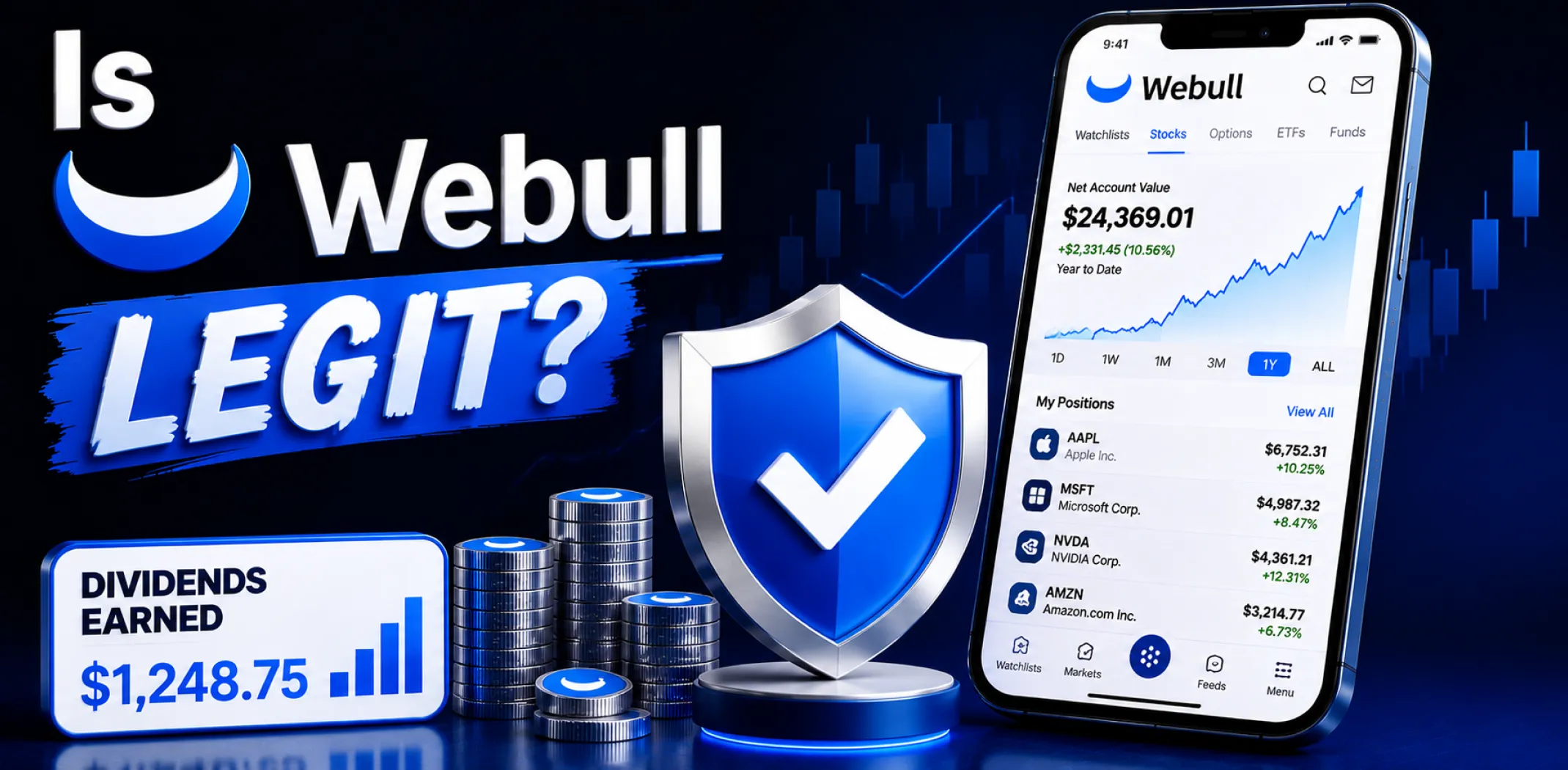
Webull is a legitimate, SEC-registered, FINRA-supervised brokerage – but it carries a more complicated set of caveats than any of the larger legacy platforms. In 2026 it has 25 million registered users, $21.2 billion in customer assets, and is publicly traded on Nasdaq under the ticker BULL.
It has also accumulated over $5 million in FINRA enforcement fines, a documented pattern of withdrawal complaints serious enough to merit SEC and FINRA complaint filings from users, and a bipartisan Congressional letter raising national security concerns about its ties to Chinese entities. Legitimacy here is a more nuanced verdict than it is for Schwab or Fidelity – and this review gives you the full picture.
Quick verdict
Webull is a legitimate, regulated brokerage. Webull Financial LLC is SEC-registered, FINRA-supervised, and SIPC-insured, and its parent company trades on the Nasdaq. However, it has received multiple FINRA enforcement fines since 2023, carries documented withdrawal complaints more serious than those at legacy brokerages, and has been the subject of Congressional scrutiny over its ties to Chinese-connected entities. It is best suited to active and technical traders who understand the platform’s limitations and risks.
Key takeaways
- Webull Financial LLC is SEC-registered, a FINRA and SIPC member, and publicly traded on Nasdaq (BULL) – all verifiable facts that confirm it is a real, regulated entity, not a scam.
- FINRA has fined Webull a total of over $5 million across multiple enforcement actions since 2023, including a $3 million fine for options supervision failures and a $1.6 million fine in May 2025 for influencer marketing violations.
- In November 2024, a bipartisan Congressional committee raised formal concerns about Webull’s ties to Chinese-connected entities, including Fumi Technology and Hunan Weibu – a documented national security question with no equivalent at Schwab, Fidelity, or E*TRADE.
- Withdrawal delays and account restrictions are among the most consistently reported complaints in 2025 and 2026, with some users reporting multi-week holds and filing complaints with the SEC and FINRA.
- Webull’s advanced charting tools, commission-free trading, fractional shares, 3.6% APY on uninvested cash, and extended-hours trading make it genuinely competitive for active and self-directed traders who can manage the caveats.
What is Webull and how does it work?
Webull Financial LLC was founded in 2017 and is headquartered in St. Petersburg, Florida, with its US CEO Anthony Denier based at the firm’s New York address. The parent company, Webull Corporation, went public on the Nasdaq in 2024 via a SPAC merger under the ticker BULL, making it one of the few retail brokerages in its category to file quarterly financial disclosures as a public company.
As of mid-2025, Webull serves more than 25 million registered users globally across 14 markets, with approximately 5 million funded accounts and $21.2 billion in customer assets – an all-time high representing 84% year-over-year growth.
The platform differentiates itself through its data-heavy trading environment.
Where Robinhood was built for simplicity and passive investing, Webull was designed for technically-oriented self-directed traders: institutional-grade charting with over 50 technical indicators, extended-hours trading, real-time streaming market data, paper trading for practice, and a growing product suite that now includes stocks, ETFs, options, futures, fractional shares, and – as of August 2025 – cryptocurrency trading re-integrated directly into the main app with access to over 50 digital assets.
Commission-free trading applies to stocks and ETFs; options trade at $0 per trade plus $0.55 per contract for certain index options.
Is Webull legitimate? What the evidence shows
Webull Financial LLC is a legitimate, regulated broker-dealer. It is verifiable in FINRA’s public BrokerCheck database, registered across all 50 US states, and is a SIPC member providing protection up to $500,000 per account.
Its parent company, Webull Corporation, has been publicly listed on Nasdaq since 2024, which means it files quarterly and annual financial disclosures with the SEC – a level of public accountability that scam operations do not sustain. Its customer assets of $21.2 billion represent real, independently verifiable financial scale.
The legitimacy case is clear. What distinguishes Webull from the other brokerages in this series is that its regulatory record is meaningfully more complicated. Schwab, Fidelity, and E*TRADE carry decades of operation with relatively few enforcement actions relative to their size.
Webull – founded in 2017 – has accumulated over $5 million in FINRA fines in just a few years of operation, covering failures in options supervision, influencer marketing compliance, and internal oversight systems. These are published enforcement actions, not rumors. They do not make Webull a scam – but they are a signal that its compliance infrastructure has not always kept pace with its growth.
Common complaints and red flags – what real users report
The complaints against Webull in 2025 and 2026 are documented on Trustpilot, ConsumerAffairs, and review forums. Some are consistent with the patterns seen at Schwab and E*TRADE – account freezes, slow customer service. Others are specific to Webull and more serious in nature. Four patterns are worth understanding before you open an account.
Pattern 1 – Withdrawal blocks and delays. The most urgent complaint category in 2025 and 2026 involves users being unable to withdraw their funds. Trustpilot reviews from 2025 and 2026 describe users who sold all their positions and then found Webull blocking their withdrawal requests without clear explanation, with customer service citing anti-money laundering compliance as justification while providing no timeline.
One reviewer describes spending two weeks attempting to withdraw funds after selling all positions. Another describes being blocked from withdrawing because the name on their bank account was a shortened version of their legal name – “Jeff” versus “Jeffrey” – despite three years of previous successful transactions with the same account.
Users in this category describe filing formal complaints with the SEC and FINRA. These are qualitatively more serious than the operational friction at Schwab or E*TRADE – the funds eventually appear to be released in documented cases, but the pattern of opaque, prolonged withdrawal holds is a material risk for anyone who may need timely access to their capital.
Pattern 2 – Platform outages affecting live trades. Webull’s reliance on AWS infrastructure without a documented redundant failover system has generated specific complaints when service disruptions occur.
A Trustpilot review from late 2025 describes a situation during an AWS infrastructure outage in which live charting, accurate profit-and-loss display, and account balance visibility all failed simultaneously while trades were still open. The reviewer describes being unable to monitor or exit open positions during a real-time risk management situation and reporting a financial loss directly attributable to the outage.
A Webull platform outage in 2025 was described by one reviewer as a “complete security risk.” These are infrastructure concerns specific to a younger, tech-first platform that has grown very quickly – not fraud, but meaningful operational risk for active traders.
Pattern 3 – Customer service quality. Across Trustpilot, ConsumerAffairs, and BrokerChooser’s community review aggregation from 2026, poor customer service is the most universally cited complaint. Reviews describe wait times measured in days, passive-aggressive representatives, agents unable to resolve basic account questions, and phone support systems described as effectively non-functional.
A user who had been on Schwab for decades and switched to Webull describes the comparison as stark. BrokerChooser’s May 2026 analysis notes that “phone support is poor” and categorizes slow customer support as a structural shortcoming of young US discount brokers in this category.
Pattern 4 – Cryptocurrency transfer restrictions. Webull’s crypto offering, re-launched in August 2025, does not allow users to transfer cryptocurrency to external wallets. Crypto assets held on Webull cannot be moved off-platform – meaning Webull acts as the custodian of your digital assets with no exit route to a personal wallet or another exchange.
This is a meaningful limitation for any user who views self-custody as a security principle, and it is not prominently disclosed at the point of account opening.
Common misconception:
✕ “Webull is just like Robinhood – a simple, safe app for beginners.”
✓ Webull is a significantly more complex platform than Robinhood, built for technically-oriented traders rather than passive investors. It also carries a more complicated risk profile: multiple FINRA enforcement fines, documented withdrawal complaint patterns more serious than those at legacy brokerages, Congressional scrutiny over its ownership structure, and a crypto offering that does not allow off-platform transfers. It is capable of serving experienced self-directed traders well – but it is not a simple, low-risk entry point for investors who are not prepared to navigate those specifics.
The China ownership question – what you need to know
The question of Webull’s ownership and its ties to Chinese entities is the most distinctive caveat in this review – one with no equivalent at Schwab, E*TRADE, Fidelity, or M1 Finance.
In November 2024, a bipartisan letter from the Chairman and Ranking Member of the US House Select Committee on the Chinese Communist Party was sent to Webull CEO Anthony Denier, raising formal concerns about Webull’s ownership structure and its ties to Chinese-connected entities.
Specifically, the letter cited Webull’s connections to Fumi Technology, its parent company, and Hunan Weibu Information Technology, a Changsha-based entity described as having received CCP-backed funding and sharing personnel and technology with Webull.
The committee raised concerns that China’s intelligence and national security laws compel Chinese-connected companies to cooperate with state intelligence activities, potentially compromising US investor data. A coalition of state attorneys general opened a separate data privacy investigation in 2024, and the state of Tennessee banned Webull from all government-issued devices due to security concerns.
Webull has publicly stated that US user data is managed strictly under US law and that American operations maintain independence from Chinese entities. The company moved its headquarters to Florida, and its US CEO Anthony Denier has consistently affirmed operational autonomy.
As of mid-2026, no enforcement action, ban, or sanction against Webull has been imposed by a federal US regulator on data privacy or national security grounds. The concerns are documented and publicly raised – but they remain at the level of investigation and scrutiny rather than confirmed findings. Investors with sensitivity to data privacy or US-China technology policy should factor this into their decision.
How does Webull compare to the alternatives?
Webull occupies a specific niche in the market. Against Robinhood, it wins clearly on platform depth for active traders. Against Fidelity and Schwab, the comparison is more complex – those platforms offer more asset types, more reliable support, and none of the regulatory and ownership baggage. Here is the honest picture.
Is Webull worth it? An honest verdict
Webull is worth it for a specific type of investor: an active, technically-oriented, self-directed trader who uses charting tools intensively, wants the best mobile trading experience in its price range, and values the 3.6% APY on uninvested cash.
For that investor, Webull delivers something no legacy brokerage matches – institutional-grade charting, extended hours, fractional shares, futures, and crypto all in one app at zero commission. The $21.2 billion in customer assets and Nasdaq listing are real signals of institutional credibility.
It is not worth it for investors who might need to withdraw large sums quickly, who are not comfortable navigating a platform with a more complex compliance history, or who have concerns about Chinese ownership of financial technology companies that hold their personal and financial data.
The withdrawal hold pattern is the most serious operational caveat in this review series – more acute than account freezes at Schwab or the inherited account delays at E*TRADE, because it involves blocking access to cash rather than slowing a process. And the China ownership question, while unresolved, is a material open issue that investors should make an informed decision about rather than ignore.
Legitimate platform – but carries more specific risks than legacy brokerages
Webull is a real, SEC-regulated, Nasdaq-listed brokerage with $21.2 billion in verified customer assets. It is not a scam. It is, however, a platform with a more complicated risk profile than Schwab, Fidelity, or E*TRADE: multiple FINRA enforcement actions, documented withdrawal hold complaints, a data privacy investigation, and ongoing Congressional scrutiny of its ownership structure. For active traders who understand these specifics, it is a capable platform. For anyone who prioritizes ease of withdrawal, compliance track record, or data privacy certainty, the legacy brokerages present a more straightforward choice.
A free store and an Amazon business – both yours from day one
Brokerage platforms grow capital you already own. AliDropship lets you generate entirely new income – a fully built ecommerce store and the complete Amazon Seller Kit, both free to start. Your revenue comes directly to you, not through a compliance queue.
Looking for a way to build income that you fully control?
If this search was part of a broader look at how to build financial security online, the distinction between investing platforms and income-generating platforms is worth making clearly. Brokerages like Webull grow capital you already have, with your access to that capital subject to the platform’s compliance processes.
Ecommerce platforms like AliDropship let you create new income from scratch – income that flows to you directly, from customers you serve, with no intermediary holding your funds in a review queue.
Since 2015, AliDropship has helped over 1.5 million stores launch across 150-plus countries, with store owners collectively earning over $1.5 billion. For someone who wants to generate new income rather than manage an existing portfolio, these are genuinely different categories serving different financial goals.
Free turnkey store – built, designed, and filled with products
Your store arrives professionally designed, pre-loaded with 50 bestselling products, and fully optimized to convert. No setup fees, no coding, no design time. You start at the product-testing stage – not the store-building stage. Hosting, SSL, and payment gateway are all included.
Winning products, one-click import
Browse trending and niche items from AliDropship’s catalog – including brand-name and digital products – and import them to your store in one click. The catalog updates regularly so your store always has fresh, competitive inventory without manual research.
Automated fulfillment and real-time tracking
Orders are processed automatically through global supplier connections. Customers receive real-time tracking updates – building trust and reducing support volume. You do not touch the shipping logistics; the platform handles it end-to-end.
Built-in marketing and promotion tools
Email campaigns, discount management, abandoned-cart recovery, live countdown timers, and social media integration are all included or available as add-ons. No prior marketing experience required – the tools guide you through each campaign type.
Beginner-friendly – no coding, no learning curve
An intuitive dashboard walks you through every step. Adding products, running campaigns, and scaling your catalog require no technical knowledge. As your business grows, the platform scales with you – adding features without adding complexity.
AliExpress integration – one-click imports, synced inventory
AliDropship connects directly to AliExpress for one-click product imports, automated order processing, and synced tracking. Inventory stays current with the latest products and prices. Combined with the turnkey store and automated fulfillment, this integration makes the entire operation manageable for one person.
Fully built store. 50 products loaded. Ads ready to activate.
Hosting, SSL, and payment gateway included. Built-in one-click ad system. No inventory. No coding. No compliance queue between you and your revenue.
Access 300M Amazon buyers with an import file ready to upload
The 514 billion dollar Amazon marketplace, with a ready-made product import file. Both tracks come in one free signup.
Is Webull a legitimate and safe brokerage?
What are the FINRA fines against Webull about?
Since 2023, Webull has received multiple FINRA enforcement fines totaling over 5 million dollars. The most notable are a 3 million dollar fine in 2023 for failures in its options trading approval system and inadequate customer complaint handling processes, a 500,000 dollar fine also in 2023 related to having a one-person compliance department insufficient for the scale of the firm, and a 1.6 million dollar fine in May 2025 for failing to properly supervise paid influencers and brand ambassadors who made claims FINRA found to be unfair and exaggerated. These are enforcement actions published in the public FINRA record. They do not make Webull a scam but they are signals of a compliance infrastructure that has not consistently kept pace with the growth of the platform.
Should I be concerned about Webull being Chinese-owned?
The concerns are real and documented but have not resulted in any federal enforcement action against Webull on national security or data privacy grounds as of mid-2026. In November 2024, a bipartisan Congressional letter cited Webull ties to Fumi Technology and Hunan Weibu, Chinese-connected entities, and raised concerns about the potential for US investor data to be accessed under Chinese intelligence laws. A state attorney general coalition opened a data privacy investigation in 2024, and the state of Tennessee banned Webull from government-issued devices. Webull states that US user data is managed strictly under US law and that US operations are independent of Chinese entities. Investors with sensitivity to US-China technology policy or data privacy should factor this open question into their decision.
What are the biggest complaints about Webull in 2026?
The most consistently reported problems in 2025 and 2026 are withdrawal holds and delays – some lasting multiple weeks – during which users are unable to access their cash, with customer service providing no clear timeline and citing compliance review as justification. Platform outages affecting live trading have also been documented, with at least one event in 2025 causing charting and account balance failures during active trading sessions. Customer service quality is universally criticized: slow response times, unhelpful or passive-aggressive agents, and a phone support system that multiple users describe as effectively non-functional. Cryptocurrency transfers off-platform are not permitted, which is a structural limitation for any user who wants self-custody of digital assets.
What are the best alternatives to Webull?
The most commonly recommended alternatives are Fidelity, Charles Schwab, Robinhood, and Interactive Brokers. Fidelity is the strongest all-around choice for most retail investors, with a 78-year track record, no comparable FINRA enforcement history, no ownership concerns, and competitive cash rates. Schwab leads on advanced trading tools through thinkorswim and physical branch access. Robinhood is simpler for beginners and has a significantly shorter compliance complaint record. Interactive Brokers is preferred by highly active or international traders for its lowest margin rates and broadest market access. Each alternative involves trade-offs, and for active technical traders who want Webull-level charting without the ownership and compliance caveats, Schwab thinkorswim is the closest match.