Is Wealthfront Legit? An Honest Review For 2026

Quick verdict
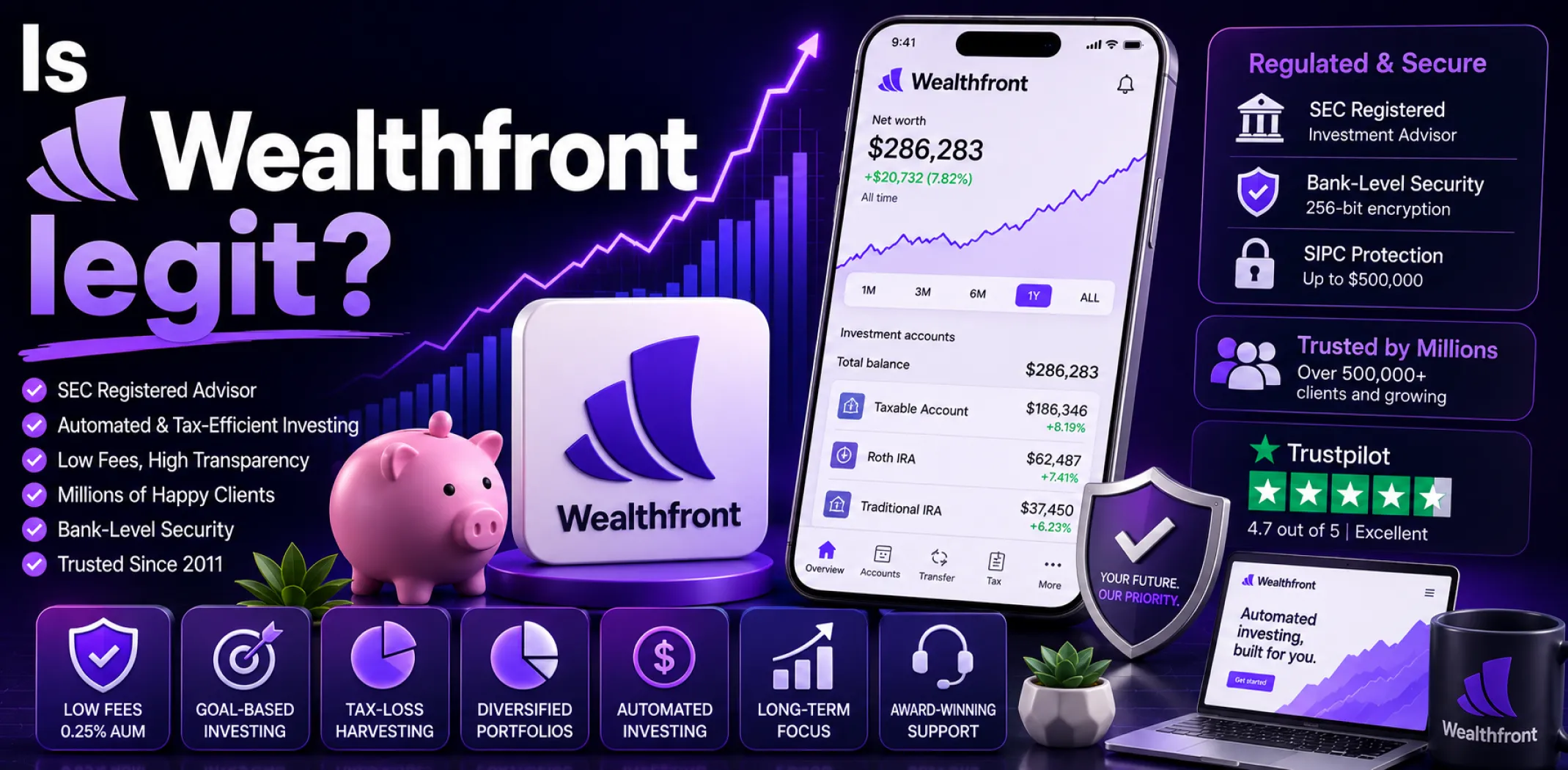
Wealthfront is a legitimate, SEC-registered robo-advisor that went public on Nasdaq in December 2025. It manages over $88 billion for 1.3 million clients. Its BBB F-rating reflects an administrative complaint response issue, not fraud. It is a real and regulated platform with real caveats worth knowing before you sign up.
Key takeaways
- Wealthfront is SEC-registered, SIPC-insured, and publicly traded on Nasdaq under the ticker WLTH since December 2025.
- The platform manages $88+ billion in assets for more than 1.3 million funded clients across investment and cash accounts.
- Its BBB F-rating is an administrative classification, not evidence of fraud or widespread wrongdoing.
- Post-IPO securities investigations concern stock price disclosure timing, not client fund safety or platform legitimacy.
- Wealthfront charges a flat 0.25% annual advisory fee and requires a $500 minimum to start investing.
What is Wealthfront and how does it work?
In 2026, automated investing has gone mainstream – and Wealthfront is one of the platforms that helped make it happen. Founded in 2008 under the name kaChing and relaunched as Wealthfront in 2011, it is now one of the largest independent robo-advisors in the United States, with roughly $88 billion in platform assets and more than 1.3 million funded clients.
In December 2025, the company completed an IPO on the Nasdaq Global Select Market under the ticker WLTH, raising approximately $485 million and cementing its status as a publicly accountable financial institution.
The core idea is straightforward: you answer a short questionnaire about your goals, timeline, and risk tolerance, and Wealthfront builds you a diversified portfolio of low-cost ETFs. The platform then handles rebalancing, tax-loss harvesting, and optimization automatically – no phone calls, no broker, no manual intervention required. It is built for people who want their money working without needing to become investment experts.
Beyond investment accounts, Wealthfront also offers a Cash Account – a high-yield savings alternative that earns interest and provides FDIC coverage up to $8 million through a network of partner banks.
The two products are designed to work together: park your emergency fund in the cash account, invest the rest through the automated portfolio, and let the platform manage both. It is a genuinely integrated approach to personal finance that few competitors match at this price point.
Is Wealthfront legit? What the evidence shows
As of 2026, Wealthfront is one of the most thoroughly regulated consumer investing platforms available in the United States. The short answer to “is Wealthfront legit” is an unambiguous yes – but the evidence is worth laying out clearly, because the platform has several surface-level red flags that mislead people who do not dig deeper.
Here is what the regulatory record actually shows. Wealthfront Advisers LLC is a registered investment adviser under the SEC – meaning it files regular disclosures, is subject to regulatory audits, and operates under binding fiduciary standards. Its brokerage subsidiary, Wealthfront Brokerage LLC, is a FINRA member and SIPC participant.
Investment accounts are covered by SIPC up to $500,000 in the event of broker-dealer failure. Cash accounts receive FDIC coverage up to $8 million through partner banks. These are not marketing claims – they are publicly verifiable regulatory facts.
The December 2025 IPO on Nasdaq added another layer of accountability. As a public company trading under WLTH, Wealthfront now files quarterly and annual reports with the SEC, subjects itself to public market scrutiny, and must disclose material risks to shareholders. Companies that are running scams do not complete $485 million IPOs underwritten by Goldman Sachs, J.P. Morgan, and Citigroup.
The platform has also survived a major acquisition attempt. In 2022, UBS agreed to acquire Wealthfront for $1.4 billion – the deal was ultimately canceled, but the offer itself validates Wealthfront’s standing as a legitimate, valuable financial institution. No major Swiss bank pays $1.4 billion for a fraud scheme.
What are the most common Wealthfront complaints?
Wealthfront is a legitimate platform – and it still generates real complaints. Understanding the nature of those complaints is the honest part of any Wealthfront review. The key question is whether these are red flags that indicate fraud or structural problems, or customer service friction you should weigh against the platform’s strengths.
Common misconception:
✕ Wealthfront has an F from the BBB, which means it is a scam or unsafe to use.
✓ The BBB F-rating reflects a failure to respond to 32 complaints through the BBB portal – not fraud, not regulatory violations, and not evidence of widespread wrongdoing. The BBB rating system is based largely on responsiveness to the BBB itself, not on independent financial safety assessments. Wealthfront is regulated by the SEC, FINRA, and SIPC – agencies with far more authority than the BBB.
The most legitimate complaints from real users fall into a few recurring patterns. Customer support accessibility is the most consistent issue: Wealthfront does not offer a public phone number, and support is primarily email and chat-based.
For users who hit account access problems – locked accounts, canceled withdrawals, or beneficiary documentation issues – this creates real friction at exactly the moments when it matters most. Reviews on ConsumerAffairs reflect this frustration, with several users reporting slow resolution times on account closure and fund transfer requests.
No human advisor access is a structural limitation that catches many users off guard. If you want to speak with a licensed financial planner about your specific situation, Wealthfront cannot help you. The platform is designed for hands-off, algorithm-driven investing. Competitors like Betterment offer human advisor access at higher tiers; Wealthfront does not offer it at any tier as of 2026.
The post-IPO securities investigations deserve specific attention. In January 2026, following Q3 fiscal 2026 results that showed significant net deposit outflows of $208 million (compared to $874 million in inflows the prior year), law firms including Pomerantz LLP and Glancy Prongay & Murray LLP opened investigations on behalf of shareholders.
These concern whether the IPO disclosed sufficient information about deposit flow risks – this is a stock investor concern, not a client fund safety concern. Your invested assets are held separately from company assets and are not at risk from securities litigation against Wealthfront Corporation as a public company.
How does Wealthfront compare to the alternatives?
In 2026, the robo-advisor market has matured considerably. Wealthfront competes directly with Betterment, Schwab Intelligent Portfolios, and Vanguard Digital Advisor – each with different trade-offs. Here is how the key dimensions compare for someone deciding where to start.
The honest summary: Betterment is the better choice if you want human advisor access at some point. Schwab Intelligent Portfolios has no advisory fee (though it keeps a cash allocation that functions as a hidden cost).
Wealthfront wins on tax optimization depth, integration between cash and investment accounts, and flat-fee simplicity. It is the strongest pure-automation option for investors who want sophisticated tax tools without paying extra for them.
Is Wealthfront safe to use? The security picture
As of 2026, Wealthfront uses 256-bit encryption and two-factor authentication to protect accounts. Investment accounts are held in your name at Wealthfront Brokerage LLC, a FINRA member and SIPC participant – meaning they are legally separate from the company’s own assets. If Wealthfront as a company were to go bankrupt, your securities would not be at risk of seizure by creditors.
The Cash Account operates through a cash sweep program: your deposits are swept to a network of FDIC-member partner banks, each providing $250,000 in coverage. By distributing across multiple partner banks, Wealthfront extends effective FDIC coverage up to $8 million per account – significantly above the standard $250,000 limit. This is a legitimate and well-understood structure used by other fintech cash management products.
Important distinction: The post-IPO securities investigations involve potential disclosure issues around Wealthfront as a publicly traded stock (WLTH). They have no bearing on the safety of client funds, the legitimacy of the investing platform, or the security of your individual accounts. These are shareholder concerns, not client concerns.
The one honest caveat: Wealthfront is not a bank. Its Cash Account is not a checking or savings account in the traditional sense – it is a brokerage product with FDIC pass-through coverage via partner banks. Most users will never notice the difference in practice, but it matters if you are comparing it directly to a federally chartered bank account.
Is Wealthfront worth it – honest verdict
In 2026, Wealthfront is one of the best-built automated investing platforms available to US investors. It is not for everyone – but the reasons it might not be right for you have nothing to do with legitimacy or safety, and everything to do with fit.
The platform makes the most sense if you are a hands-off investor who wants sophisticated tax optimization – particularly daily tax-loss harvesting and, at higher balances, direct indexing – without paying a human advisor 1% per year.
The $500 minimum is accessible, the 0.25% flat fee is genuinely competitive, and the integration between the investment account and Cash Account is one of the cleaner personal finance setups available at this price point.
It makes less sense if you need human advice, want crypto exposure through your robo-advisor, or want zero account minimum. It also requires patience around customer support – the lack of a phone number is a real limitation, and the BBB complaint history shows that account-level issues can take weeks to resolve.
Legitimate and well-regulated – with real limitations to know before signing up
Wealthfront is a genuine, SEC-registered investment platform managing $88+ billion for over 1.3 million clients. Its BBB F-rating is an administrative classification, not a fraud indicator. The platform is best suited to hands-off investors who want automated tax-efficient investing at a flat 0.25% annual fee. The key caveat is customer support: when account issues arise, resolution can be slow, and there is no human advisor at any tier.
Wealthfront handles your investments. Your AliDropship store handles your sales.
A 0.25% advisory fee earns you market returns over time. A free turnkey store plus the Amazon Seller Kit gives you active income you can start building today – with no inventory and no experience required. Results vary, but you do not need to choose between the two.
Who is Wealthfront best for?
Not every investor should use Wealthfront – and the platform does not pretend otherwise. Use the profiles below to figure out where you fit before opening an account.
Best for long-term hands-off investors
You have $500 or more to invest, want to set it and let it grow, and do not want to think about rebalancing or tax strategy. The 0.25% fee pays for daily automation you would otherwise have to manage manually.
Best for taxable investors who want to keep more after taxes
If you are investing in a taxable brokerage account and have $100,000 or more, Wealthfront’s direct indexing and daily tax-loss harvesting can produce meaningful after-tax savings over time compared to a simple ETF held elsewhere.
Not ideal for investors who want human guidance
If you want to discuss your portfolio with a licensed CFP, Wealthfront cannot help you. Betterment Premium and Personal Capital both offer human advisor access at higher fee tiers. Wealthfront is a technology product, full stop.
Not ideal for active traders or crypto investors
Wealthfront is not a stock-picking platform or a crypto exchange. It builds diversified index portfolios and manages them for you. If you want to trade individual stocks or hold Bitcoin through your robo-advisor, Betterment or a self-directed brokerage is a better fit.
Your store. Built. Products loaded. Ads ready.
A free turnkey AliDropship store gives you a real ecommerce business from day one. Products are sourced, the ad system is built in, and the Amazon Seller Kit adds a $514B marketplace to your reach. Earning ranges vary – results depend on your niche, ad spend, and effort.
More ways to build income online in 2026
Ecommerce is one path. Our make-money-online guide covers the full range of models that work in 2026 – what each requires, what they realistically return, and how to choose your starting point based on budget and time.
Why AliDropship is a strong complement to passive investing
Passive investing through a platform like Wealthfront grows your money over time – but it requires capital to start and patience to compound. If you are looking to build active income while your investments work in the background, a turnkey ecommerce store gives you a parallel income stream that does not depend on market conditions.
AliDropship has helped launch over 1.5 million stores across 150+ countries, earning its store owners a combined $1.5 billion and a 4.7-star rating on Trustpilot.
Free turnkey store – built, designed, and filled with products
Your store arrives professionally designed, pre-loaded with 50 bestselling products, and fully optimized to convert. No setup fees, no coding, no design time. You start at the product-testing stage – not the store-building stage. Hosting, SSL, and payment gateway are all included.
Winning products, one-click import
Browse trending and niche items from AliDropship’s catalog – including brand-name and digital products – and import them to your store in one click. The catalog updates regularly so your store always has fresh, competitive inventory without manual research.
Automated fulfillment and real-time tracking
Orders are processed automatically through global supplier connections. Customers receive real-time tracking updates – building trust and reducing support volume. You do not touch the shipping logistics; the platform handles it end-to-end.
Built-in marketing and promotion tools
Email campaigns, discount management, abandoned-cart recovery, live countdown timers, and social media integration are all included or available as add-ons. No prior marketing experience required – the tools guide you through each campaign type.
Beginner-friendly – no coding, no learning curve
An intuitive dashboard walks you through every step. Adding products, running campaigns, and scaling your catalog require no technical knowledge. As your business grows, the platform scales with you – adding features without adding complexity.
AliExpress integration – one-click imports, synced inventory
AliDropship connects directly to AliExpress for one-click product imports, automated order processing, and synced tracking. Inventory stays current with the latest products and prices. Combined with the turnkey store and automated fulfillment, this integration makes the entire operation manageable for one person.
Is Wealthfront legit and safe to use?
Is Wealthfront a scam or a real robo-advisor?
Wealthfront is a real and well-established robo-advisor, not a scam. Founded in 2008 and managing over 88 billion dollars in assets, it has survived multiple market cycles including the 2020 crash and the 2022 bear market. In 2022, UBS agreed to acquire the company for 1.4 billion dollars before the deal was later canceled. The post-IPO securities investigations opened in January 2026 concern stock disclosure timing and affect shareholders of WLTH stock, not the safety of client investment accounts.
Does Wealthfront really make money for investors?
Wealthfront does not promise specific investment returns, and all investing involves risk including possible loss of principal. The platform historically delivers returns aligned with diversified index fund portfolios at a given risk score. Its daily tax-loss harvesting can meaningfully improve after-tax returns over time – the S and P 500 Direct indexing portfolio launched in 2024 saved clients over 16 million dollars in taxes in its first year. Past performance does not indicate future results, and returns vary by risk score and market conditions.
What are the main Wealthfront complaints to know about?
The most common Wealthfront complaints involve customer support accessibility, as the platform does not offer a public phone number and resolves issues primarily through email and chat. Account access problems, canceled withdrawals, and slow beneficiary processing have been documented on ConsumerAffairs and the BBB. The platform also does not offer human financial advisor access at any tier, which surprises users who expect a hybrid service. The BBB profile holds an F rating due to 32 unanswered complaints through the BBB portal.
What are the best alternatives to the Wealthfront robo-advisor?
The main alternatives to Wealthfront in 2026 include Betterment, which offers human advisor access at a premium tier and has no account minimum; Schwab Intelligent Portfolios, which charges no advisory fee but requires a 5,000 dollar minimum and holds a cash allocation; and Vanguard Digital Advisor, which is well-suited to investors already using Vanguard funds. For hands-off investors who prioritize tax optimization and do not need human advice, Wealthfront remains the strongest pure-automation option at 0.25 percent annually.