Is Wealthfront a Scam? Here Is What The Evidence Says

Quick verdict
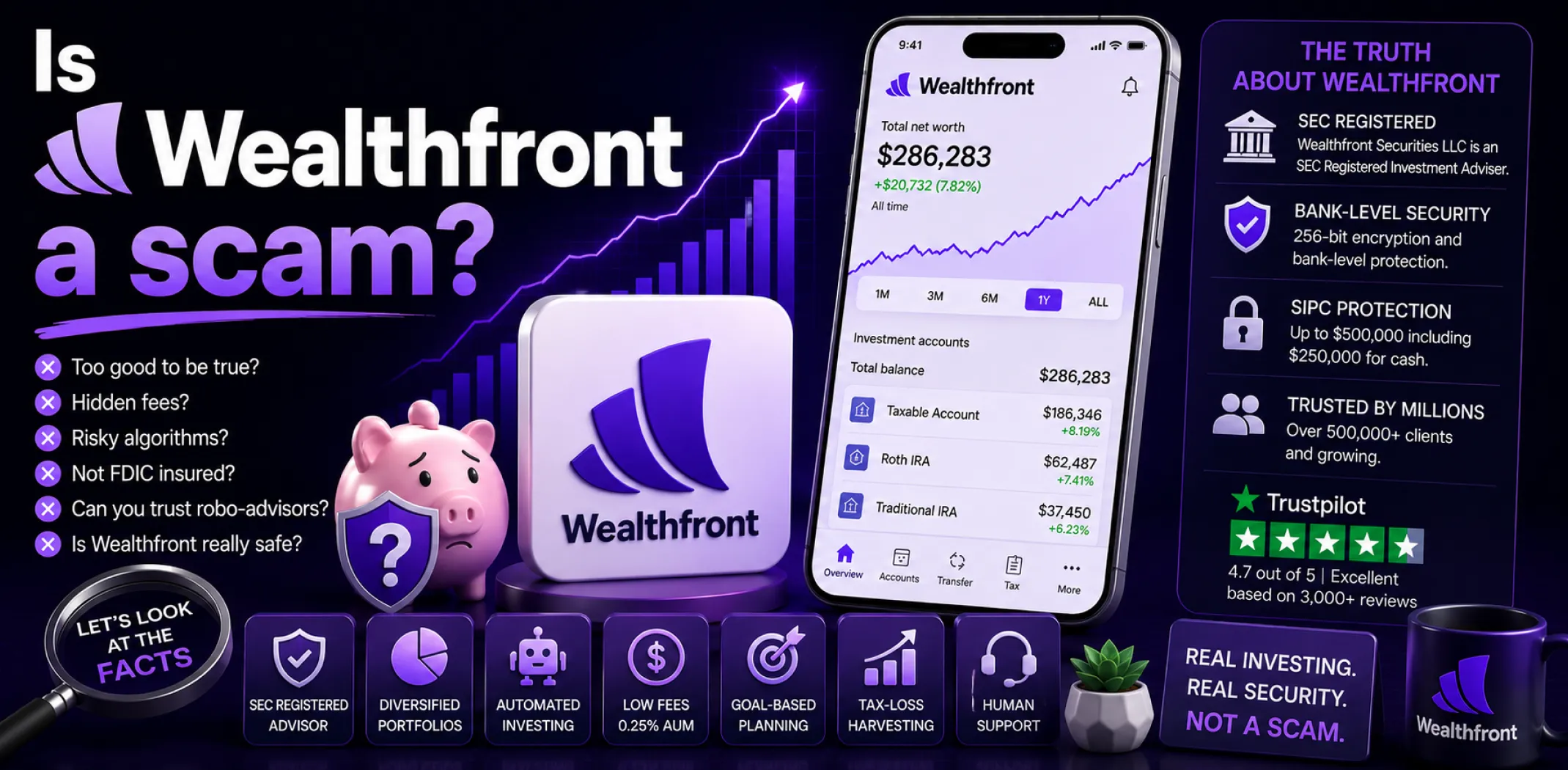
Wealthfront is not a scam. It is an SEC-registered investment adviser, a FINRA and SIPC member, and a publicly traded company on Nasdaq since December 2025. It manages over $88 billion for more than 1.3 million clients. Its red flags – a BBB F-rating and post-IPO securities investigations – have straightforward explanations that do not indicate fraud.
Key takeaways
- Wealthfront is not a scam – it is a regulated, publicly traded financial company with verifiable SEC registration and 15+ years of operation.
- The BBB F-rating means Wealthfront did not respond to 32 BBB complaints – it does not mean the platform is fraudulent or unsafe.
- Post-IPO securities investigations target Wealthfront stock (WLTH) disclosure practices, not the safety of client accounts or assets.
- Real problems include poor customer support access and no human financial advisor at any tier – these are legitimate complaints worth knowing.
- In 2022, UBS offered 1.4 billion dollars to acquire Wealthfront – major acquisitions do not happen if a platform is a scam.
Why people ask if Wealthfront is a scam
In 2026, if you search “is Wealthfront a scam,” you will find consumer complaints, a BBB F-rating, and news headlines about securities investigations. That combination is enough to make any reasonable person pause before depositing money. The concern is understandable – and it deserves a direct, evidence-based answer rather than cheerleading or dismissal.
Wealthfront is not a scam. It is one of the largest independent robo-advisors in the United States, managing over $88 billion in assets for more than 1.3 million funded clients.
It went public on the Nasdaq Global Select Market in December 2025 under the ticker WLTH, completing a $485 million IPO underwritten by Goldman Sachs, J.P. Morgan, and Citigroup. It is regulated by the SEC, FINRA, and SIPC. None of that is consistent with a scam operation.
What is true is that Wealthfront has real weaknesses – particularly around customer support and the absence of human advisors – and that the surface-level signals (BBB rating, securities investigations, ConsumerAffairs complaints) look alarming until you understand what they actually mean. This review breaks each one down so you can decide whether Wealthfront is right for you based on facts rather than fear.
That 95% annual client retention figure – consistent across 11 consecutive years per the company’s own SEC filing – is one of the strongest indicators that Wealthfront is not a scam. Clients who get defrauded do not stick around year after year. They leave, complain, and pursue legal action. A platform retaining 95% of its clients annually for over a decade is one that is delivering something real.
Breaking down each Wealthfront scam concern one by one
Most “is Wealthfront a scam” searches are driven by three specific pieces of information: the BBB F-rating, the post-IPO securities investigations, and negative reviews on consumer complaint sites. Each deserves a precise explanation – not a dismissal, but context that lets you evaluate the real risk accurately.
The BBB F-rating – what it actually means
The BBB gave Wealthfront an F rating because the company did not respond to 32 complaints filed through the BBB portal. The BBB rating methodology rewards responsiveness to the BBB organization, not financial safety or regulatory compliance. Wealthfront is regulated by the SEC and FINRA – two agencies with actual legal authority over investment companies. The BBB has none. Major legitimate firms including Amazon, Google, and various banks have received low BBB ratings for similar administrative reasons. An F from the BBB does not mean a company is a scam.
The post-IPO securities investigations – who is actually at risk
In January 2026, law firms opened investigations into Wealthfront Corporation (WLTH) after the stock dropped 16.8% following an earnings report that showed net deposit outflows of $208 million – a reversal from $874 million in inflows the prior year. The investigations concern whether the IPO prospectus adequately disclosed risks around interest-rate sensitivity and deposit flows. This is a securities disclosure matter that affects investors who bought WLTH shares at or after the IPO. It has nothing to do with the safety of client investment accounts, which are held separately from company assets under SEC rules. If you use Wealthfront to invest money, your funds are not affected by shareholder litigation against the corporate entity.
Negative consumer reviews – real complaints, real context
ConsumerAffairs currently shows a 1.1 out of 5 rating across 36 reviews for Wealthfront – a number that looks alarming in isolation. Consumer review sites like ConsumerAffairs, Yelp, and the BBB are structurally biased toward negative experiences: satisfied customers rarely write reviews, while frustrated ones almost always do. Wealthfront has more than 1.3 million funded clients. Even if every ConsumerAffairs review came from a different person, that represents less than 0.003% of the client base. The complaints themselves are real – poor support response times, account access problems, slow fund returns – but they describe service failures, not fraud.
No public phone number – suspicious or just a design choice?
Wealthfront does not list a public customer service phone number. Support is handled through email and in-app chat. For some users, the absence of a phone number reads as a red flag – legitimate businesses should be reachable by phone. That concern is understandable, but the absence of a phone line is a product decision that many fintech companies have made, not evidence of fraud. Wealthfront does have a support team; the issue is that access is slower than users expect, particularly during account problems. That is a service quality complaint, not a scam indicator.
The failed UBS acquisition – what it tells you
In January 2022, UBS Group agreed to acquire Wealthfront for $1.4 billion. The deal was later canceled when UBS changed its US strategy, but the offer itself is significant. A major Swiss investment bank with its own compliance and due diligence obligations does not sign a $1.4 billion acquisition agreement for a fraudulent or legally questionable operation. The attempted acquisition is perhaps the single most powerful third-party validation that Wealthfront is a legitimate financial institution.
Is Wealthfront trustworthy? What the numbers show
Beyond the individual red flag explanations, the underlying financial and operational data for Wealthfront tells a coherent story of a real, functioning, profitable business. As of 2026, these are the figures that matter for anyone asking whether the platform is trustworthy.
A scam operation does not generate $339 million in annual revenue, report $123 million in net income, and file a transparent S-1 prospectus with the SEC detailing its financials, risks, and business model. Wealthfront’s IPO filings are publicly accessible through the SEC’s EDGAR database – anyone can read them. That level of financial disclosure is the opposite of how fraud works.
Common misconception:
✕ The securities investigations prove Wealthfront defrauded its customers.
✓ The investigations concern whether Wealthfront disclosed enough information to stock market investors about the risks of buying WLTH shares at IPO. They are shareholder litigation matters, not regulatory findings of fraud, and they do not involve client investment accounts. No SEC enforcement action has been announced against Wealthfront as of June 2026.
What real Wealthfront users actually experience
To get a balanced picture of Wealthfront in 2026, it helps to look past the review sites that filter for complaints and look at the full range of documented user experiences – including both the platform’s genuine strengths and the problems that do occur.
How does Wealthfront protect your money?
If you are asking whether Wealthfront is a scam, one of the most important things to understand is how client money is protected – because legitimate protection structures make fraud significantly harder to execute, and Wealthfront has several layers in place.
The key distinction to understand: your invested assets are not Wealthfront’s assets. Under SEC rules, client securities must be held separately from a broker-dealer’s own assets.
Even if Wealthfront Corporation went bankrupt tomorrow, your investment portfolio would not be seized by creditors – it belongs to you, not to Wealthfront. This is the structural fact that separates a regulated broker-dealer from an unregulated scheme where your money genuinely could disappear.
Wealthfront problems that are real – and worth knowing
Being honest about Wealthfront means acknowledging the real problems alongside the regulatory clarity. The platform is not a scam, but it does have documented weaknesses that matter depending on how you plan to use it.
Is Wealthfront a scam – honest verdict
The evidence is clear. Wealthfront is not a scam. It is a 15-year-old, SEC-registered, FINRA and SIPC-member financial company that went public on Nasdaq in December 2025, generates $339 million in annual revenue, reports a 95% annual client retention rate, and has been reviewed and validated by institutions including UBS, Goldman Sachs, and J.P. Morgan.
The things that make it look suspicious online – the BBB F-rating, the securities investigations, the consumer review scores – all have explanations that do not hold up as fraud evidence once you dig into them.
What Wealthfront is not is a perfect platform. Customer support is legitimately poor by fintech standards. Account closures can take weeks when problems arise. And there is no human financial advisor available at any price point. Those are real reasons why Wealthfront might not be the right platform for you – but they are reasons of fit, not reasons of fraud.
Not a scam – a legitimate platform with documented service weaknesses
Wealthfront is SEC-registered, publicly traded, and manages $88 billion for 1.3 million clients with a 95% annual retention rate. The BBB F-rating and post-IPO investigations do not indicate fraud. The platform is best suited to hands-off investors comfortable with fully automated management and no human advisor access. Go in with realistic expectations about support response times and you are unlikely to have a bad experience.
While your investments compound, your store earns.
AliDropship builds you a turnkey ecommerce store and hands you the Amazon Seller Kit – free for 14 days. Products are loaded, the ad system is built in, and fulfillment is automated. Results vary based on niche, effort, and ad spend, but it is a real business you can start today at no upfront cost.
Should you use Wealthfront? Who it is built for
Now that the scam question is settled, the practical question is whether Wealthfront is the right fit for your situation. Here is how to think about it honestly.
Best for set-it-and-forget-it investors
You have at least $500 to invest, a long time horizon, and no desire to actively manage a portfolio. You want the platform to handle rebalancing and tax optimization without input from you. Wealthfront is purpose-built for this profile.
Best for investors with large taxable accounts
At $100,000 or more in a taxable brokerage account, direct indexing and daily tax-loss harvesting can generate real after-tax savings that offset the 0.25% fee many times over. The S and P 500 direct indexing portfolio saved clients over 16 million dollars in taxes in its first year of operation.
Not right for investors who need responsive support
If you expect to be able to call someone when something goes wrong, Wealthfront will frustrate you. There is no public phone number. Account issues are resolved over email and chat. Documented cases of canceled withdrawals and slow account closures show this is a real operational gap, not just a theory.
Not right for people who want to be actively involved
Wealthfront is not a stock-picking platform, a crypto exchange, or a trading account. It builds and manages diversified ETF portfolios based on your risk score. If you want control over individual holdings, options, or alternative assets, you will hit a wall quickly.
Free turnkey store. Amazon Seller Kit. Two income streams.
AliDropship builds your store, loads it with products, and gives you a built-in ad system. The Amazon Seller Kit adds 300 million buyers and a ready-to-upload import file. This is an active income business – results depend on your niche, effort, and ad spend, but you start with a real operational setup, not a blank page.
Explore every legitimate way to earn online in 2026
Ecommerce is one model. Our make-money-online guide covers the full range – freelancing, digital products, affiliate marketing, and more – with honest breakdowns of what each requires and what results people actually see.
Why AliDropship is worth knowing about if you found this page
Searching “is Wealthfront a scam” suggests you are looking carefully at platforms before trusting them with your money – which is exactly the right instinct. If you are also exploring ways to build income online, AliDropship is worth the same level of scrutiny.
It has launched over 1.5 million stores in 150+ countries, earned a 4.7-star rating on Trustpilot, and its store owners have collectively earned over $1.5 billion. It is a real platform with real results – and the same caveat applies: do your research, start with the free trial, and set realistic expectations.
Free turnkey store – built, designed, and filled with products
Your store arrives professionally designed, pre-loaded with 50 bestselling products, and fully optimized to convert. No setup fees, no coding, no design time. You start at the product-testing stage – not the store-building stage. Hosting, SSL, and payment gateway are all included.
Winning products, one-click import
Browse trending and niche items from AliDropship’s catalog – including brand-name and digital products – and import them to your store in one click. The catalog updates regularly so your store always has fresh, competitive inventory without manual research.
Automated fulfillment and real-time tracking
Orders are processed automatically through global supplier connections. Customers receive real-time tracking updates – building trust and reducing support volume. You do not touch the shipping logistics; the platform handles it end-to-end.
Built-in marketing and promotion tools
Email campaigns, discount management, abandoned-cart recovery, live countdown timers, and social media integration are all included or available as add-ons. No prior marketing experience required – the tools guide you through each campaign type.
Beginner-friendly – no coding, no learning curve
An intuitive dashboard walks you through every step. Adding products, running campaigns, and scaling your catalog require no technical knowledge. As your business grows, the platform scales with you – adding features without adding complexity.
AliExpress integration – one-click imports, synced inventory
AliDropship connects directly to AliExpress for one-click product imports, automated order processing, and synced tracking. Inventory stays current with the latest products and prices. Combined with the turnkey store and automated fulfillment, this integration makes the entire operation manageable for one person.
Is Wealthfront a scam or is it a legitimate platform?
Why does Wealthfront have an F rating from the BBB?
The BBB gave Wealthfront an F because the company did not respond to 32 complaints filed through the BBB portal. The BBB rating system is based on responsiveness to the BBB organization itself, not on financial safety or regulatory compliance. Wealthfront is regulated by the SEC and FINRA, which have actual legal authority over investment companies. An F from the BBB does not mean a platform is fraudulent, and many legitimate large companies have received low BBB ratings for similar administrative reasons.
Are the Wealthfront securities investigations a sign it is not safe?
The post-IPO securities investigations concern whether Wealthfront Corporation adequately disclosed the risks of buying WLTH stock during its December 2025 IPO. They are shareholder litigation matters related to stock price disclosures, not findings of fraud or threats to client accounts. Client investment assets are held separately from company assets under SEC rules and are not affected by litigation against the corporate entity. No SEC enforcement action has been announced against Wealthfront as of June 2026.
What are the most common Wealthfront problems users report?
The most common Wealthfront problems involve customer support. The platform does not offer a public phone number, and support operates through email and in-app chat. Users report slow responses during account closures, canceled withdrawal requests, and difficulty reaching a human representative. The platform also does not offer human financial advisor access at any tier, which is a structural limitation rather than a scam indicator. These are genuine service quality issues that are worth factoring into your decision.
Is Wealthfront safe to trust with my money?
Wealthfront is safe to use for its intended purpose as a long-term automated investing platform. Investment accounts are held at Wealthfront Brokerage LLC, a FINRA and SIPC member, and are legally separate from company assets. Cash accounts receive FDIC coverage up to 8 million dollars through a network of partner banks. The platform uses 256-bit encryption and two-factor authentication. The main risk is not fraud but poor customer service when account problems arise – users should have a backup financial account and realistic expectations about support response times.