Is UserTesting A Scam? The Honest Answer For 2026

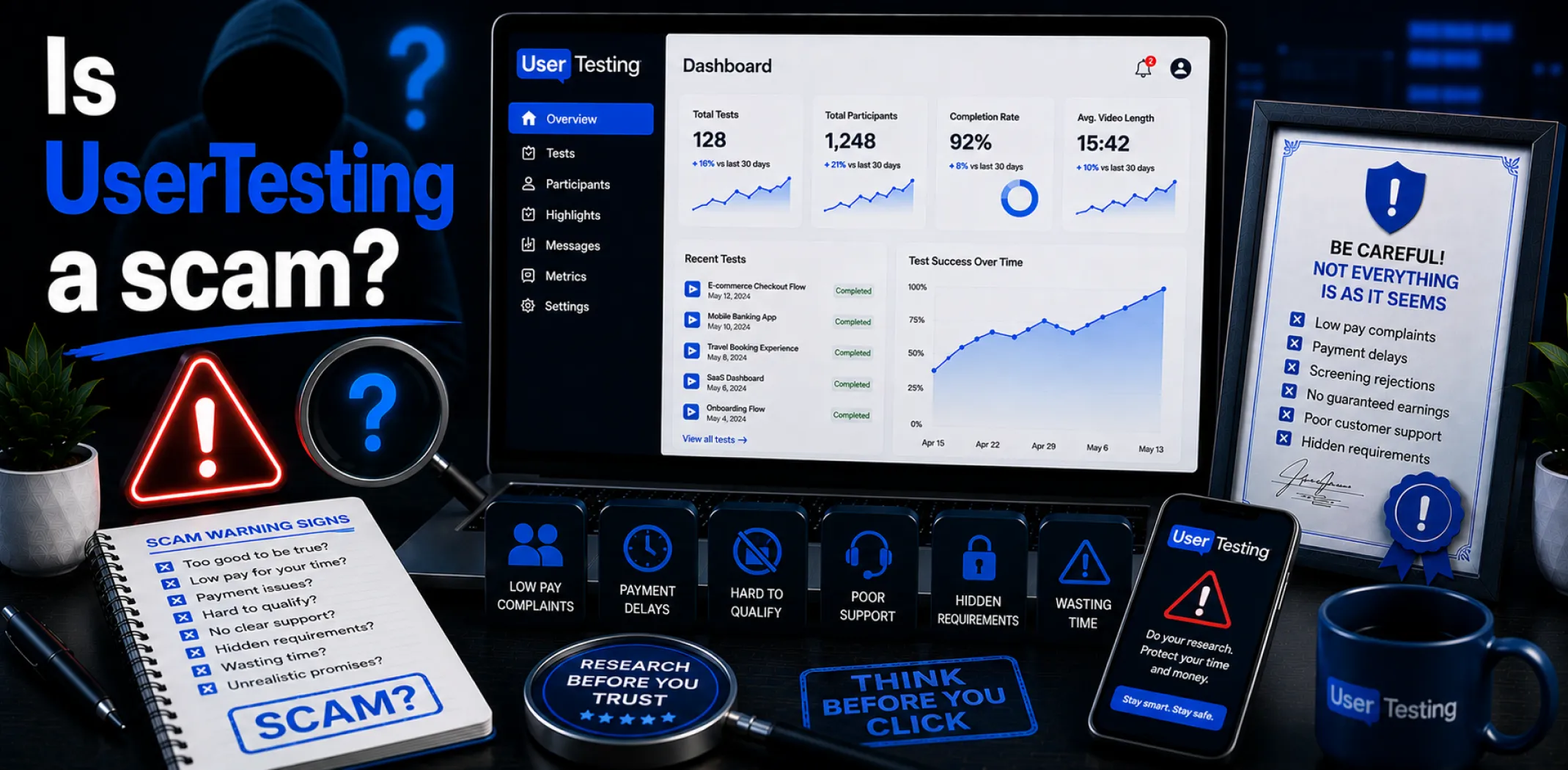
You heard something suspicious about UserTesting – maybe a listing that promised high pay and asked for a fee, or a contributor who got deactivated with no warning, or simply an online comment saying the whole thing is a waste of time. You want to know: is UserTesting a scam? The straight answer is no.
UserTesting is an 18-year-old company that was publicly traded on the New York Stock Exchange and acquired for 1.3 billion dollars in 2023. But there is a documented impersonation scam using its name on job boards, a contributor deactivation policy that catches many testers off guard, and a PayPal-only payment setup that frustrates people in certain countries.
This review addresses all three, along with every other complaint that drives the scam question, clearly and honestly.
Quick verdict
UserTesting is not a scam. It is a US-based company with 18 years of operation, a 1.3 billion dollar acquisition in 2023, and thousands of confirmed PayPal payments documented on Trustpilot. The scam-related complaints that circulate fall into three categories: an impersonation fraud that uses UserTesting’s name but has nothing to do with the real platform, a contributor deactivation policy that is real but structurally explained, and a PayPal-only payment constraint that is a limitation rather than a red flag.
Key takeaways
- UserTesting is not a scam – it is a PE-backed software company with an 18-year track record and no fraud findings on record.
- A documented impersonation scam uses UserTesting’s name on job boards to collect fees and personal data – this is not the real company.
- UserTesting deactivates contributor accounts that receive consistently low session ratings – this is a published policy, not arbitrary removal.
- PayPal is the only payment method – contributors in countries with limited PayPal access may find the platform impractical regardless of legitimacy.
- Earnings already credited before deactivation are paid out – the platform does not forfeit confirmed session payments when accounts are closed.
Why does UserTesting get called a scam?
UserTesting has been operating since 2007, served tens of thousands of companies including 75 of the Fortune 100, and processes contributor payments via PayPal automatically with no minimum threshold. By any standard measure of business legitimacy, calling it a scam is not accurate. Yet the question comes up consistently, and it comes from specific places that deserve to be taken seriously rather than dismissed.
The first source is impersonation fraud. UserTesting is a well-known brand in the side-hustle and remote-work space, which makes it a target for scammers who post fake job listings using its name and logo on external platforms – including Craigslist, LinkedIn, WhatsApp groups, and job board aggregators.
These fake listings look like UserTesting opportunities but direct applicants to external sites, ask for registration fees or equipment deposits, or collect personal identity information under the guise of payment setup. None of this involves or originates from the real UserTesting company.
The second source is contributor account deactivations. UserTesting removes contributors whose session quality consistently falls below client standards – measured through the star rating clients assign to completed sessions.
Contributors who are deactivated often do not understand why it happened, receive a generic notification, and interpret the closure as evidence of a scam or an attempt to avoid paying future earnings. The deactivation policy is real and documented, but it is a quality enforcement mechanism, not fraud.
The third source is the unpaid practice test. New applicants complete a sample session as part of the contributor application process, and that session is not compensated.
Contributors who go through the process expecting payment for the practice test, or whose practice test is rejected, sometimes characterize the experience as a waste of time or a deceptive signup process. The practice test is an explicit, documented application requirement – not a secret condition added after the fact.
The impersonation scam using UserTesting’s name – what it looks like
Because UserTesting is one of the most recognizable names in the paid user testing space, it is a natural target for impersonation. Scammers post fake listings on job boards, freelance platforms, WhatsApp groups, and social media using UserTesting’s brand, logo, and name to add a veneer of credibility.
The offers typically advertise unusually high pay – sometimes 50 to 100 dollars per test for minimal effort – and direct applicants away from usertesting.com to external sites where the fraud unfolds.
Impersonation warning: The real UserTesting never posts contributor opportunities on external job boards, never charges a fee to join, and only communicates via usertesting.com and its official support email. Joining as a contributor is always free. If an opportunity claiming to be UserTesting asks for payment, directs you to a site that is not usertesting.com, or contacts you unsolicited via WhatsApp or Telegram, it is not from UserTesting – it is a scam using its name.
The impersonation fraud typically operates in one of two modes. In the advance-fee version, the fake listing requires a registration deposit or equipment fee before the applicant can start receiving tests. In the phishing version, the goal is collecting identity documents – passport scans, national ID numbers, or banking details – under the pretext of payment setup. Once the information or money is obtained, the contact goes silent.
A recent Trustpilot review from 2026 illustrates the pattern directly: a person applied for what appeared to be a UserTesting minijob, was accepted, sent a link with credentials, and asked to submit identity documents including an ID and passport. The review was left as a fraud warning. This is textbook brand impersonation – not the UserTesting platform, but a third party exploiting its name.
If you have already responded to a fake listing using UserTesting’s name: do not send any further payments or documents, report it at reportfraud.ftc.gov if you are in the United States, and contact your bank to dispute any transactions. The real UserTesting company cannot be held responsible for third-party impersonators, but reporting the fraud protects other potential victims.
Account deactivation – the complaint that hits hardest and what causes it
Of all the UserTesting complaints that generate scam accusations, account deactivation is the most visceral. A contributor spends weeks building up a testing history, then receives a notification that their account has been deactivated – sometimes with only a vague explanation.
When this happens, the reaction is often to assume the platform deactivated the account to avoid paying future earnings. That interpretation is understandable but incorrect.
UserTesting’s contributor deactivation is directly tied to its session rating system. Every completed session is reviewed by the client who commissioned it and assigned a star rating. Contributors who consistently receive low ratings – indicating that their recordings are unclear, their narration is unhelpful, or their task completion is inadequate – are eventually removed from the contributor network.
This is a quality enforcement mechanism that protects the value of the research delivered to paying clients. UserTesting’s own documentation acknowledges that contributors with sustained low ratings can lose access.
The key fact that matters for scam assessment is this: confirmed, approved sessions are paid out before account closure. UserTesting does not forfeit earnings already credited to a contributor’s record when deactivating an account.
What the platform removes is future access – the ability to receive and complete new tests. That is a meaningful distinction. A scam would withhold money already earned. Deactivation for quality reasons removes future earning opportunity; it does not steal past earnings.
Four scam-adjacent UserTesting complaints decoded
Each of the following complaints appears in UserTesting reviews and forum discussions in a form that sounds like scam evidence. Each one has a structural explanation that does not require fraud to account for it.
“I did the practice test and never got paid for it”
What it actually is: The practice test is an explicit, documented application requirement – not a task. UserTesting’s contributor FAQ states clearly that the sample test is not compensated and is reviewed to verify the applicant can deliver quality sessions. It is the equivalent of a skills assessment for employment, not a service rendered. Every compensated session that follows is paid via PayPal automatically after approval. The practice test is the only unpaid session on the platform.
“My account was deactivated and I lost my earnings”
What it actually is: A conflation of two separate events. Account deactivations happen due to sustained low session ratings – UserTesting’s quality enforcement mechanism. But deactivation removes future access, not past earnings. Confirmed and approved sessions are paid out before the account is closed. If a contributor believes they were deactivated without payment for approved sessions, they should contact support directly – that scenario would be a policy violation on UserTesting’s part, not standard practice.
“UserTesting only pays via PayPal – that seems suspicious”
What it actually is: A payment method limitation, not a fraud signal. PayPal-only payment is a deliberate platform constraint – UserTesting cites speed and automation as the reasons for this choice. Contributors in countries where PayPal is unavailable or heavily restricted genuinely cannot use the platform effectively, and that is a legitimate reason to avoid it. But accepting PayPal and refusing to pay via bank transfer is not a pattern associated with fraud operations – it is a feature constraint with a practical explanation.
“I keep getting screeners but can never qualify for a test”
What it actually is: A demographic matching limitation shared by every platform in this category. Tests are configured by clients who define specific audience criteria – age, device usage, shopping behavior, professional background, and dozens of other variables. A contributor who does not match any of the criteria for currently available tests will be disqualified from every screener they attempt. The platform is not screening contributors out to avoid paying them – it is matching them against client requirements that they do not currently meet.
What real contributors report about payment and the platform in 2026
The UserTesting contributor experience documented across Trustpilot, Capterra, and G2 in 2025 and 2026 reflects a consistent split: contributors who qualify regularly report prompt PayPal payments, clear instructions, and a professional testing experience; those who do not qualify – or who encounter deactivation – describe the platform as frustrating or, in some cases, fraudulent. Both reactions are genuine, and both deserve context.
Looking for income that does not depend on client ratings or deactivation risk? User testing income requires maintaining a quality rating to stay active on the platform. For online income models where sustained effort is rewarded more directly, explore our make money online guide.
Every UserTesting scam complaint mapped to its real explanation
The table below covers every complaint category that generates scam-related language in UserTesting reviews across verified sources in 2025 and 2026. Each row identifies the structural explanation and classifies the complaint accurately.
Is UserTesting a scam – the honest final answer
No. UserTesting is not a scam. It is an 18-year-old company, formerly publicly traded, acquired for 1.3 billion dollars by a leading software PE firm, and trusted by 75 of the Fortune 100 for enterprise-scale user research. No fraud findings, regulatory actions, or class-action proceedings related to contributor non-payment are on record against it as of mid-2026.
What does exist around UserTesting is a genuine impersonation fraud that uses its brand name on external platforms – and that fraud is worth taking seriously, because it targets real money and real identity documents. The rule is simple: if you did not arrive at the opportunity through usertesting.com, treat it as fraudulent until confirmed otherwise.
The platform’s own limitations – PayPal-only payments, account deactivation for low ratings, an unpaid practice test – are real and deserve to be understood before you sign up. But limitations are not fraud. A company that deactivates low-quality contributors, pays only via PayPal, and requires an unpaid qualifying test is operating a quality-controlled research marketplace, not running a scheme.
Not a scam – but impersonators are active, and deactivation policy deserves understanding before you start
UserTesting is a legitimate, PE-backed platform with an 18-year operating history, automatic PayPal payments, and no regulatory actions on record. The impersonation fraud using its name is real and dangerous – verify you are at usertesting.com before providing any personal information. The deactivation policy is also real – building and maintaining a strong session rating is not optional for contributors who want to stay active on the platform long-term.
Want online income without the risk of deactivation or impersonation scams? For earning models where your account standing and demographic profile are not gating factors, explore our full guide to making money online.
Is there a UserTesting impersonation scam I should know about?
Why was my UserTesting contributor account deactivated without warning?
UserTesting deactivates contributor accounts when session ratings consistently fall below the quality threshold the platform maintains for its client network. Every completed session is rated by the client who commissioned it on a 1 to 5 star scale. Contributors who receive sustained low ratings are reviewed and may be removed from the network. The notification process for deactivation is often brief and lacks specific feedback, which is a genuine communication gap. But the deactivation itself is driven by session quality data, not arbitrary account management. Contributors who improve their think-aloud narration and audio quality before attempting sessions significantly reduce their deactivation risk.
Can UserTesting keep money I already earned if my account is deactivated?
No. UserTesting processes payment for approved sessions before a contributor account is closed. Deactivation removes future access to new tests – it does not forfeit earnings already credited from completed, approved sessions. If you believe your account was deactivated with approved and unpaid sessions still outstanding, contact UserTesting support directly. That scenario would be outside normal platform policy and should be escalated as a specific payment dispute rather than treated as a general scam pattern.
Why does UserTesting only pay through PayPal and not by bank transfer?
UserTesting uses PayPal for all contributor payments because PayPal allows automatic, immediate post-approval payment processing without requiring the platform to manage individual international bank transfer infrastructure. From a contributor perspective this means payments arrive quickly after session approval with no minimum balance threshold and no processing delay beyond PayPal standard clearing times. The practical limitation is that contributors in countries where PayPal is unavailable or heavily restricted cannot effectively use the platform – that is a genuine access constraint, but it is driven by platform design, not by an attempt to avoid paying contributors.
Is UserTesting still operating normally after the Thoma Bravo acquisition?
Yes. UserTesting continues to operate fully under its existing brand following the January 2023 take-private acquisition by Thoma Bravo and Sunstone Partners. The platform subsequently merged with UserZoom and acquired User Interviews in January 2026. Contributor payment processing, test delivery, and platform access have continued uninterrupted through both transactions. Current CEO Eric Johnson leads the combined company from its headquarters in Bellevue, Washington. The acquisition and subsequent activity represent ongoing investment in the platform, not wind-down.