Is Twitch Legit? An Honest Review For Streamers In 2026

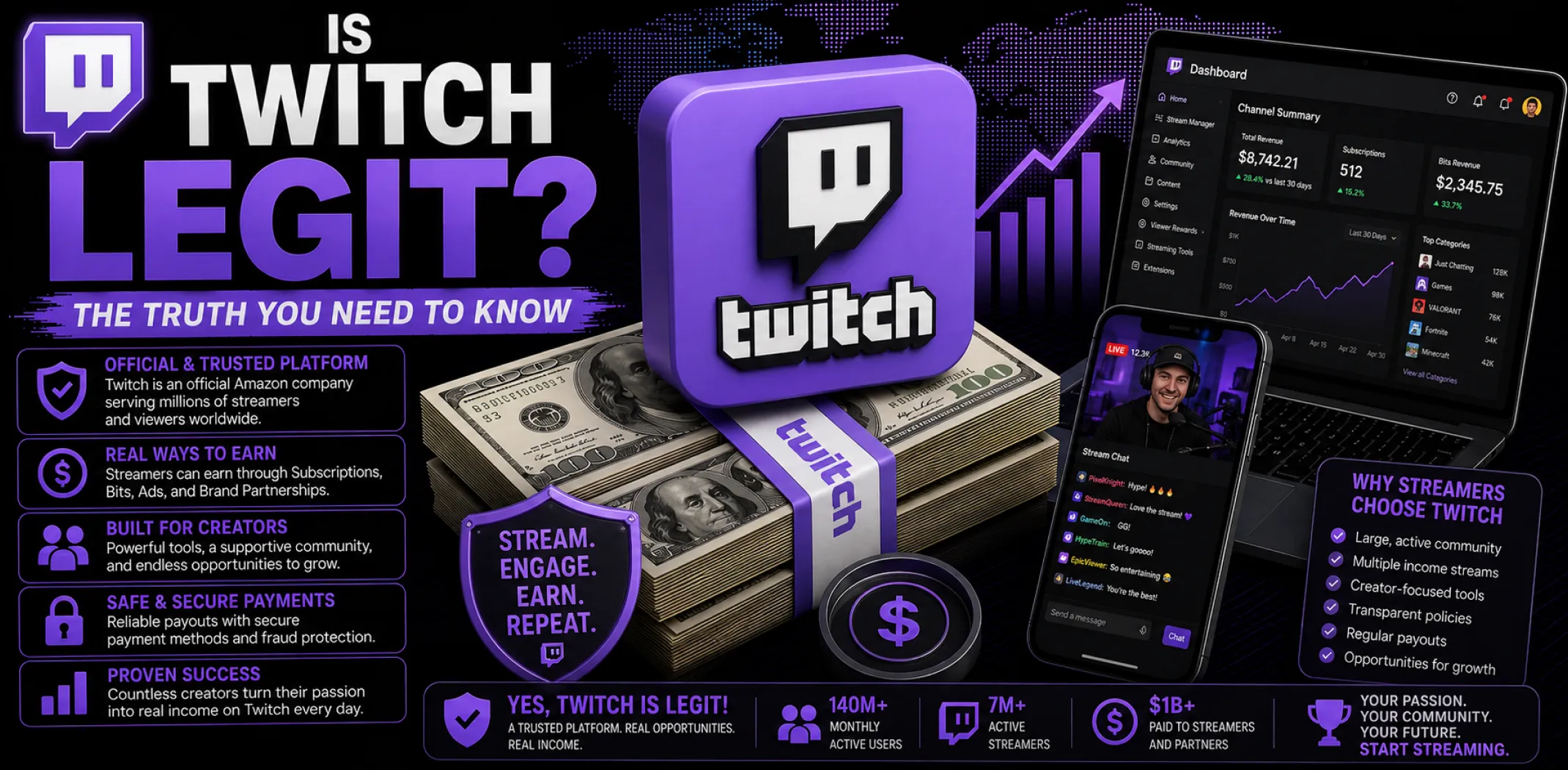
Twitch has 240 million monthly active users, generates $1.8 billion in annual revenue, and has been owned by Amazon since 2014. By any measure, it is a real, legitimate platform that has created real careers for thousands of streamers. But whether it is the right path to income for you depends on factors that are worth understanding clearly before you invest hundreds of hours trying to build a channel on it.
Is Twitch legit? Yes, unambiguously. Is it easy to earn meaningful income on Twitch? No – and the reasons why are structural, not random. The platform’s discovery algorithm buries new streamers by design, 72.8% of small streamers earn nothing, and the income is concentrated so heavily at the top that the 2021 data breach revealed just 1% of streamers earned roughly half of all platform revenue.
This review covers how the platform actually works, what you can realistically expect to earn, and the specific risks worth knowing about in 2026.
Quick verdict
Twitch is a legitimate, Amazon-owned live streaming platform with 240 million monthly active users and $1.8 billion in annual revenue. It is not a scam and it pays streamers reliably through subscriptions, Bits, ad revenue, and brand deals. Its documented limitations are structural: a discovery algorithm that buries new streamers with zero viewers, an income distribution where most small streamers earn nothing, and real DMCA enforcement and account security issues. Success requires bringing an external audience to Twitch, not building one from within it.
Key takeaways
- Twitch is owned by Amazon, which acquired it for $970 million in 2014. It has 240 million monthly active users and 7.3 million active streamers in 2026.
- Twitch’s browse page sorts streams by viewer count – channels with zero viewers are structurally invisible to new visitors, making organic discovery nearly impossible without an existing audience.
- Affiliates earn a 50/50 subscription split; Partners and Plus Program qualifiers can earn 60/40 or 70/30 splits. Small streamers typically earn $50 to $1,500 per month; 72.8% earn nothing at all.
- DMCA enforcement is aggressive and sometimes automated – class action lawsuits targeting Twitch’s DMCA practices are active in US courts as of 2026.
- In January 2026, a wave of account takeovers changed payout settings on hacked accounts despite 2FA being enabled; Twitch acknowledged the issue but did not recover funds already redirected.
What is Twitch and how does it work?
Twitch grew out of Justin.tv, a 2007 platform built by Justin Kan, Emmett Shear, Michael Seibel, and Kyle Vogt. After gaming content became the dominant category on Justin.tv, the gaming vertical was spun off as Twitch in 2011. Amazon acquired it in August 2014 for $970 million – one of the largest acquisitions in gaming and streaming history at the time.
Twitch is headquartered in San Francisco and operates as a subsidiary of Amazon under CEO Dan Clancy. In 2026, it commands 91% of all live streaming content by market share and 76% of total viewing hours, with 2.37 million average concurrent viewers at any given moment.
The core model is live streaming. Creators go live on camera – playing games, creating art, chatting, cooking, teaching, or performing – and build communities of viewers who support them through subscriptions, virtual currency called Bits, ad revenue, and direct donations.
Twitch does not pay you per view the way TikTok or YouTube might. Income depends almost entirely on how many people actively choose to pay for your content each month.
To earn anything on Twitch, you first need to reach Affiliate or Partner status. Affiliate requires 50 followers, an average of 3 concurrent viewers, 500 total minutes broadcast, and streaming on 7 different days – thresholds most dedicated new streamers reach within 2 to 4 months.
Partner status requires significantly more, typically 75+ average concurrent viewers over 30 days, and is held by around 68,000 streamers in 2026. The Plus Program – which unlocks the more favorable 60/40 and 70/30 splits – requires 100 and 300 Plus Points respectively, where each Tier 1 sub contributes 1 point, each Tier 2 contributes 2 points, and each Tier 3 contributes 6 points.
The income picture on Twitch is built from multiple stacking streams, not a single payout. Successful streamers in 2026 typically generate 30% to 60% of their income from Twitch itself (primarily subscriptions) and 40% to 70% from external sources – brand deals, YouTube channel monetization, merchandise, Patreon, affiliate marketing, and coaching.
Relying solely on Twitch’s in-platform revenue is considered risky even by established Partners, because platform changes, algorithm shifts, or audience migration can significantly impact income overnight.
Is Twitch legitimate? What the evidence shows
Twitch is legitimate – fully and without serious qualification. It is a subsidiary of one of the world’s largest companies, has been operating for 15 years, generates $1.8 billion in annual revenue, and has created verifiable full-time careers for thousands of creators.
The platform pays out reliably, its subscription and revenue-share mechanics are documented and transparent, and there is no credible evidence of systematic financial fraud against creators.
The platform’s Amazon ownership provides a stability floor that most independent creator platforms lack. Twitch is not going to collapse due to funding pressure or a bad funding round. Its infrastructure is backed by AWS.
Its payout system, while imperfect, has operated continuously for over a decade. The concerns worth examining are not about whether Twitch is legitimate – they are about whether it is the right environment for generating meaningful income given its specific structural limitations.
The real challenges on Twitch – what creators need to know
Twitch’s limitations for new and small streamers are structural, not random. Understanding them clearly separates realistic expectations from false hope.
Critical misconception: Many new streamers believe that if they stream consistently and produce good content, Twitch’s algorithm will eventually surface them to new viewers. This is not how Twitch works. Twitch’s browse page sorts streams by viewer count – highest to lowest. A channel with zero viewers appears at the very bottom of every category, below potentially hundreds of other streams, and is invisible to anyone browsing organically. Twitch is not a discovery platform; it is a community destination. Growth comes from driving external traffic in – not from Twitch surfacing you to new audiences.
The zero-viewer discovery trap is the most important structural fact about building a Twitch channel in 2026. Unlike YouTube, which surfaces videos based on search and recommendation regardless of the creator’s size, or TikTok, whose For You Page can show a first-time creator’s content to millions of people, Twitch’s category browse pages list streams in strict viewer-count order.
A new streamer with 0 to 3 viewers appears at the bottom of every category, buried below dozens or hundreds of other channels. Virtually no organic discovery happens at this level.
The only reliable path out is driving viewers to your stream from outside Twitch – through TikTok clips, YouTube Shorts, Discord communities, or networking with other streamers. This requires building an external presence before Twitch income becomes meaningful, which adds significant time to the path.
The 50/50 subscription split for Affiliates is the most-criticized aspect of Twitch’s economics. Affiliates keep $2.50 from every $4.99 Tier 1 subscription – roughly 50 cents less than what they would keep on Ko-fi (0% fee on tips) or what Substack offers (90% of subscription revenue).
Competitors like Kick offer a 95/5 split, meaning creators keep $4.74 of every $4.99. Twitch argues that its brand, community scale, and built-in viewer base justify the split – and for established streamers, that is a defensible argument. For new Affiliates earning their first few dozen subscriptions, it adds meaningfully to the income gap.
DMCA enforcement is a well-documented risk for streamers who use copyrighted music during their streams. Twitch’s automated detection system can flag and mute VODs, issue channel strikes, and – for repeat violations – suspend accounts.
As of 2026, at least two class action lawsuits targeting Twitch’s DMCA enforcement practices are active in the US District Court for Northern California. One targets revenue practices, another specifically targets DMCA enforcement that plaintiffs allege caused wrongful channel losses.
Both cases are in active litigation. For streamers who stream games with commercial soundtracks or use background music, understanding Twitch’s content rights policies is not optional.
Account security vulnerabilities are a real and documented concern. In January 2026, a wave of account takeovers changed payout settings on hacked accounts despite two-factor authentication being enabled. Twitch acknowledged the issue and investigated, but confirmed it could not recover funds already paid out to fraudulent bank accounts – a repeat of a similar episode in 2021.
Setting up account activity alerts, using a dedicated email address for Twitch, and reviewing payout settings monthly are protective measures that take minutes but guard against a risk Twitch itself has struggled to prevent.
How to protect yourself: Use royalty-free music services like Pretzel Rocks or Epidemic Sound for stream background music. Enable login notifications on your Twitch account and review your payout banking details monthly. Build your audience on TikTok and YouTube Shorts first – treat Twitch as the destination for an audience you build elsewhere, not as the discovery engine itself.
How much do Twitch streamers actually earn?
Twitch income ranges more widely than almost any other platform in this space – from literal zero for the majority of streamers to hundreds of thousands per month for the top tier. The distribution is extremely concentrated. Here is what the verified data shows for 2026.
What do real streamers say about Twitch in 2026?
Twitch experiences split predictably along audience size. Streamers who successfully navigated the zero-viewer period – usually by building an external social media presence first – describe a community and income model that works well once it gains momentum. Streamers who went live expecting organic discovery consistently describe frustration, isolation, and eventual burnout. Two representative stories illustrate both sides.
Is Twitch worth it – honest verdict
Twitch is worth pursuing for a specific type of person: someone who genuinely loves live interactive entertainment, is willing to treat streaming as a part-time or full-time job commitment, and understands that the path to income runs through building an external audience first rather than relying on Twitch to surface them organically.
For that person, Twitch remains the largest, most established live streaming platform on the planet, with a community and monetization infrastructure that no competitor has matched at scale.
For everyone else – people looking for flexible income that does not require being live on camera for 20+ hours per week, or people who want income that scales without being the product themselves – Twitch’s model is a poor fit.
The time investment is front-loaded and substantial, the discovery barrier is structural and requires external social media work on top of the streaming itself, and the income remains at zero for the vast majority of streamers for extended periods.
Legitimate and well-established – but requires genuine passion, time investment, and external audience building
Twitch is a real Amazon-owned platform that pays creators reliably and has built thousands of legitimate careers. Its limitations are structural: the discovery algorithm buries new channels, 72.8% of small streamers earn nothing, DMCA enforcement is aggressive, and meaningful income requires 15 to 25 hours of live presence per week plus additional social media work. It rewards those who treat it as a full creative business – and delivers poor outcomes for those who approach it casually or without an existing audience strategy.
A free store and a free Amazon business – launched in under 60 seconds
Sign up once and walk away with two complete income streams: a done-for-you store loaded with 100+ digital products, and an Amazon Seller Kit with listings already formatted and ready to go live. Keep 50–70% of every sale, with no inventory, no shipping, and no on-camera hours required.
Who should use Twitch – and who needs a different approach?
Based on the evidence, here is a clear-eyed breakdown of who Twitch is right for and who would be better served by a different model.
Strong fit: genuine passion for live entertainment plus external audience strategy
If you enjoy being live on camera, have a specific entertainment or educational angle, and are willing to build an external TikTok or YouTube Shorts presence to drive initial traffic, Twitch can become a meaningful income platform within 12 to 24 months. The community depth Twitch enables – live chat, subscription perks, raids – is genuinely differentiated from any other platform in 2026. Results vary widely.
Poor fit: passive or flexible income without live commitment
Twitch income requires live presence – you cannot schedule content in advance, automate your stream, or earn while you sleep the way ecommerce or ad-revenue platforms allow. If you want income that works around your schedule rather than requiring a fixed live schedule, Twitch’s model is fundamentally incompatible with that goal.
Risky as a sole income source: diversify aggressively
Even successful Twitch streamers treat the platform as one income stream among many. Platform policy changes, algorithm shifts, DMCA actions, and audience migration can impact Twitch income significantly. Established streamers supplement with YouTube, sponsorships, merchandise, and owned platforms. Building a single income stream on any live streaming platform is considered high-risk across the creator community.
Better for scalable income: an owned business that does not require live hours
For income that does not depend on being on camera for hours daily, that scales beyond what one person can physically stream, and that runs while you sleep – an owned ecommerce store operates on a completely different model. Products sell around the clock driven by paid advertising, with no streaming schedule, no zero-viewer discovery barrier, and no DMCA risk.
Want online income that does not require being live on camera? Here is how AliDropship works
Twitch income exists only when you are streaming – it stops the moment you go offline and requires tens of hours per week of live presence to maintain. AliDropship works the opposite way: a fully built ecommerce store with 100+ products pre-loaded runs around the clock, driven by built-in advertising that reaches customers while you sleep. No streaming schedule, no zero-viewer barrier, no DMCA risk, and no camera required.
Free turnkey store – built, designed, and filled with products
Your store arrives professionally designed, pre-loaded with 50 bestselling products, and fully optimized to convert. No setup fees, no coding, no design time. You start at the product-testing stage – not the store-building stage. Hosting, SSL, and payment gateway are all included.
Winning products, one-click import
Browse trending and niche items from AliDropship’s catalog – including brand-name and digital products – and import them to your store in one click. The catalog updates regularly so your store always has fresh, competitive inventory without manual research.
Automated fulfillment and real-time tracking
Orders are processed automatically through global supplier connections. Customers receive real-time tracking updates – building trust and reducing support volume. You do not touch the shipping logistics; the platform handles it end-to-end.
Built-in marketing and promotion tools
Email campaigns, discount management, abandoned-cart recovery, live countdown timers, and social media integration are all included or available as add-ons. No prior marketing experience required – the tools guide you through each campaign type.
Beginner-friendly – no coding, no learning curve
An intuitive dashboard walks you through every step. Adding products, running campaigns, and scaling your catalog require no technical knowledge. As your business grows, the platform scales with you – adding features without adding complexity.
AliExpress integration – one-click imports, synced inventory
AliDropship connects directly to AliExpress for one-click product imports, automated order processing, and synced tracking. Inventory stays current with the latest products and prices. Combined with the turnkey store and automated fulfillment, this integration makes the entire operation manageable for one person.
Is Twitch a legitimate platform for streamers?
How does Twitch pay streamers and what are the revenue splits?
Twitch pays streamers through four main streams. Subscriptions at 4.99, 9.99, or 24.99 dollars per month are the primary income source; Affiliates keep 50% of subscription revenue and top Partners in the Plus Program can keep up to 70%. Bits are TikTok-like virtual currency that viewers send during streams; streamers keep 100% of the value at 1 cent per Bit. Ad revenue from pre-roll and mid-roll ads averages a CPM of around 3.50 dollars per 1,000 impressions in 2025, with Affiliates and Partners splitting this with Twitch. Brand sponsorships are negotiated directly between streamers and brands; rates depend on concurrent viewer count and niche. Successful streamers in 2026 typically combine all four, with subscriptions providing the most reliable base.
Why is it so hard to grow on Twitch as a new streamer?
Twitch category browse pages sort streams strictly by viewer count – highest to lowest. A channel with zero viewers appears at the very bottom of every category, below potentially hundreds of other channels, and is essentially invisible to anyone browsing organically. There is no quality-based algorithmic sorting, no recommendation feed like the TikTok For You Page, and no search-driven discovery like YouTube. This creates a structural chicken-and-egg problem: you cannot get viewers because you have no viewers, and the algorithm will not help you until you already have them. The reliable solution is building an external audience on TikTok, YouTube Shorts, or Discord first, then directing that audience to Twitch. Treating Twitch as the destination – not the discovery engine – is the approach that consistently works for new streamers in 2026.
What are the biggest risks of streaming on Twitch?
The three biggest risks for Twitch streamers are DMCA enforcement, account security vulnerabilities, and income concentration risk. DMCA enforcement is aggressive and sometimes automated – streamers who play copyrighted music or stream without proper content rights can receive automated strikes and suspensions with limited warning. In January 2026, a wave of account takeovers successfully changed payout settings on hacked accounts despite two-factor authentication being enabled, and Twitch confirmed it could not recover funds already paid to fraudulent bank accounts. Income concentration risk means that even established streamers who depend primarily on Twitch are one policy change, ban, or audience migration away from significant income loss – successful streamers diversify across YouTube, Patreon, merchandise, and brand deals.
What are the best Twitch alternatives for making money online?
For streamers who want income that does not require live camera presence or a fixed streaming schedule, YouTube long-form content monetization offers significantly higher CPM rates than Twitch and the advantage of content that generates revenue indefinitely rather than only while you are live. Competitors like Kick offer a 95/5 subscription split, while Twitch offers a 50/50 split, which may attract streamers prioritizing subscription revenue share. For creators who want online income entirely independent of live content creation or an existing audience, an owned ecommerce store through a platform like AliDropship generates income through product sales and built-in advertising that operates around the clock – with no streaming schedule, no DMCA risk, and no zero-viewer growth barrier to overcome.