Is Twitch A Scam? The Truth Behind The Complaints In 2026

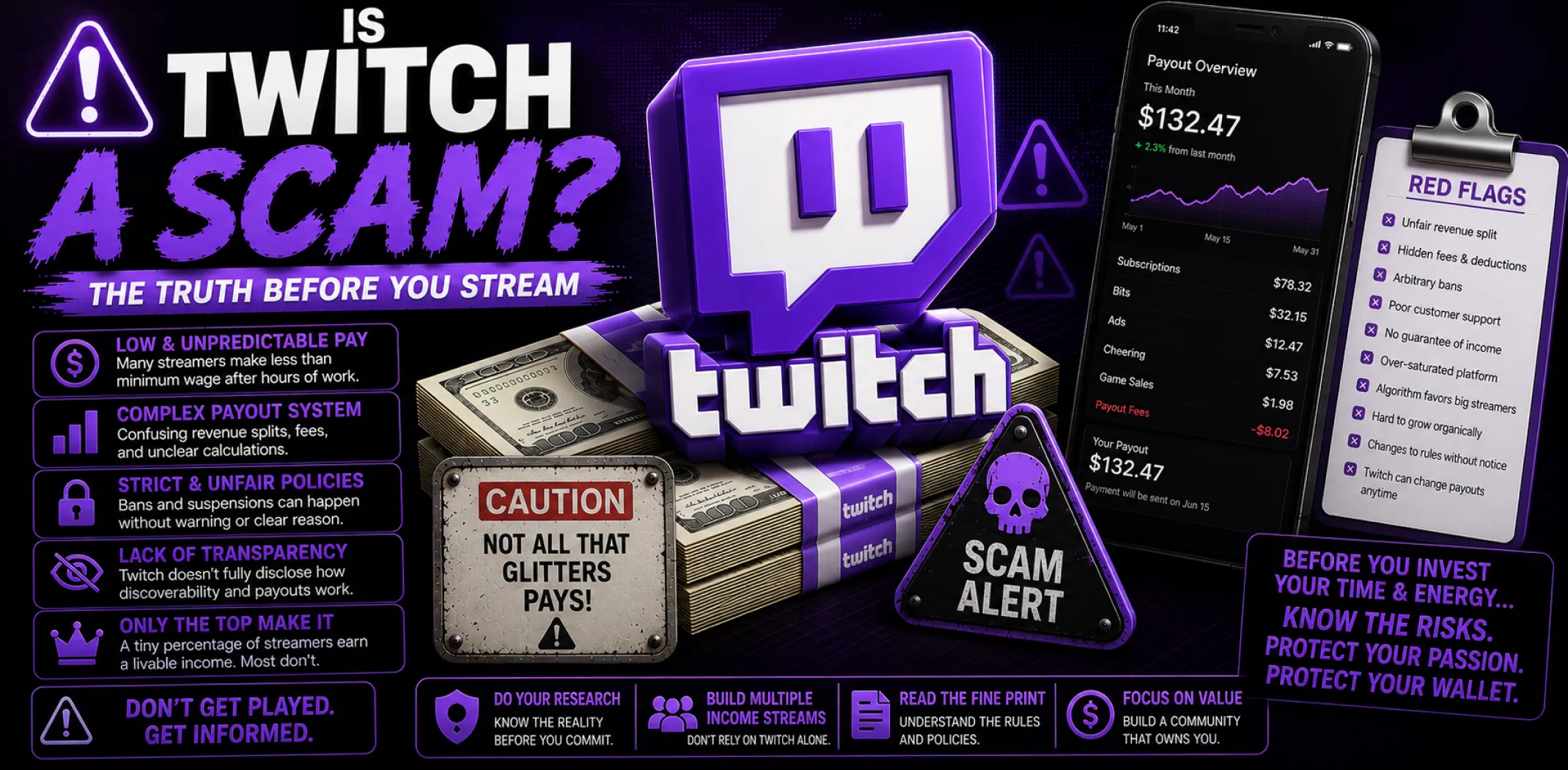
The scam accusations against Twitch tend to cluster around a few specific events. In January 2026, hackers changed payout settings on hundreds of streamer accounts despite two-factor authentication being enabled – and Twitch confirmed it could not recover funds already paid to fraudulent bank accounts. Streamers have been receiving automated DMCA bans for content they had been streaming without incident for months.
New creators pour hundreds of hours into streaming and earn nothing because the platform’s browse page buries zero-viewer channels in a way that makes organic discovery nearly impossible. Any of those experiences, or just reading about them, can reasonably prompt the question: is Twitch a scam?
The direct answer is no. Twitch is an Amazon-owned platform with 240 million monthly active users, $1.8 billion in annual revenue, and a 15-year track record of paying streamers.
The problems above are real – but they are real operational and security failures at a massive platform, not evidence that Amazon is committing fraud against its creator base. Understanding what is actually happening in each case is more useful than a simple verdict, because the risks that matter most depend entirely on what you are trying to do.
Quick verdict
Twitch is not a scam. It is a legitimate Amazon-owned platform with $1.8 billion in annual revenue and a 15-year history of paying creators. Its documented problems – account security vulnerabilities that allowed payout redirects in January 2026, aggressive automated DMCA enforcement, and a discovery algorithm that structurally buries new streamers – are real and serious. They are operational failures, not fraud. But they have direct financial consequences that every streamer should understand before building income here.
Key takeaways
- Twitch is owned by Amazon ($970M acquisition, 2014) and generates $1.8 billion annually – it is not a fraudulent operation.
- In January 2026, a verified account takeover wave changed payout banking details on hacked accounts despite 2FA; Twitch acknowledged it could not recover funds already paid to fraudulent destinations.
- DMCA enforcement is automated, aggressive, and currently the subject of active class action litigation in US federal court targeting wrongful channel losses.
- The platform’s browse page sorts by viewer count only – channels with zero viewers are structurally invisible, meaning organic discovery is essentially impossible without external traffic.
- 72.8% of small streamers earn nothing; meaningful income typically requires 12 to 24 months of consistent effort plus external audience building on TikTok or YouTube Shorts.
What is Twitch – and why does the scam question keep coming up?
Twitch launched in 2011 as a gaming-focused spin-off of Justin.tv, founded by Justin Kan, Emmett Shear, Michael Seibel, and Kyle Vogt. Amazon acquired it in August 2014 for $970 million.
Today it is the world’s dominant live streaming platform: 240 million monthly active users, 7.3 million active streamers, 2.37 million average concurrent viewers, and $1.8 billion in annual revenue. CEO Dan Clancy has led the platform since 2023, and it operates as a fully integrated Amazon subsidiary under the Twitch Interactive brand.
The scam accusations come from several distinct sources, and they are not all the same type of complaint. Some involve financial harm – streamers whose payout accounts were hijacked by hackers in January 2026, a repeat of a similar incident in 2021.
Some involve income frustration – new streamers who streamed for months, earned nothing, and concluded the platform was rigged against small creators. Some involve enforcement harm – channels suspended by automated DMCA detection for content that was clearly not infringing, with no functional appeal path.
And some involve a simple mismatch between expectation and reality – the idea that Twitch’s discovery system works like TikTok’s, when it demonstrably does not.
Separating these complaints into their actual categories is the most useful thing this article can do. Financial harm from hackers redirecting payouts is a different problem from low earnings from a discovery system that buries small channels, which is a different problem from DMCA automation suspending accounts incorrectly.
Treating all of them as evidence of the same “scam” flattens the picture in a way that makes it harder to know which risks actually apply to you – and which protective measures address which risk.
Is Twitch a scam? Breaking down what the evidence actually shows
The scam question requires separating two distinct things: whether Twitch the company is defrauding its creators, and whether there are documented harms affecting streamers that deserve serious attention. On the first question, the answer is clearly no. On the second, there are three specific and well-evidenced categories of harm – each worth understanding in detail.
Is Twitch committing financial fraud against streamers? No. The platform’s subscription, Bits, and ad revenue mechanics are documented, transparent, and consistently applied. Streamers receive their earnings on a regular payout schedule.
There are no credible documented cases of Twitch quietly taking more than its stated revenue share or withholding legitimate earnings without cause. The 2021 data breach that exposed creator payment data was a security incident, not a financial fraud.
Does Twitch have documented problems that cause real financial harm to creators? Yes – three specific ones, each different in nature and requiring different protective responses.
The three documented problems – examined in detail
Each of these three issues has been verified through independent reporting, public statements from Twitch, or active legal proceedings. Understanding which one is most relevant to your situation changes what precautions you need to take.
Common misconception: Many people conflate three completely different types of Twitch problems into a single “scam” accusation: financial harm from third-party hackers redirecting payouts, enforcement harm from automated DMCA bans, and income frustration from the zero-viewer discovery barrier. These are categorically different problems requiring different responses. Hacker-redirected payouts are a security issue. DMCA bans are an enforcement policy issue. Zero earnings are a discovery architecture issue. Twitch is not committing fraud in any of these cases – but the consequences for affected streamers can be severe.
The January 2026 payout redirect hack – what actually happened
In early January 2026, a wave of Twitch account takeovers was reported across streamer communities on X and Reddit. Affected streamers discovered that their Twitch payout banking details had been changed – even on accounts with two-factor authentication enabled. The hackers redirected payouts to their own bank accounts and drained whatever earnings had accumulated before the streamers noticed. Twitch acknowledged the issue publicly, confirmed an investigation, but stated it was unable to recover funds that had already been disbursed to fraudulent payment destinations. This is not the first time this has happened: a structurally similar attack occurred in 2021, when Twitch also received criticism for its inability to claw back redirected payouts. The attacker mechanism has not been definitively disclosed by Twitch. Protective measures: review your payout banking details in Twitch settings monthly, set up login activity notifications, use an authenticator app rather than SMS for 2FA, and request payouts frequently rather than letting balances accumulate.
Automated DMCA enforcement – legitimate policy, harmful automation
Twitch uses automated detection to enforce copyright compliance, and the system has generated significant controversy through what many streamers describe as over-aggressive and inconsistent application. Streamers have received automated DMCA strikes for music that had been playing without incident for months, for brief clips of copyrighted material in games, and – in documented cases – for content that was clearly licensed or in the public domain. As of 2026, at least one class action lawsuit targeting Twitch’s DMCA enforcement practices is in active litigation in the US District Court for Northern California, alleging that the automated system caused wrongful channel losses that Twitch failed to adequately remedy. The lawsuit is seeking class certification, which is still pending. The enforcement itself is not fraud – copyright law requires Twitch to remove infringing content under the DMCA. The problem is that automated systems applied at scale will produce false positives, and Twitch’s appeal process has not provided consistent or timely remediation for affected streamers. Protective measures: use royalty-free music services (Pretzel Rocks, Epidemic Sound, Artlist), enroll in the Twitch DJ Program before streaming commercial music, and never let a game’s soundtrack run automatically if you have not verified its streaming rights.
The zero-viewer discovery barrier – structural, not malicious
Twitch’s category browse pages sort channels by viewer count, highest to lowest. A channel with zero viewers sits at the bottom of every category, below potentially hundreds of other channels, and is functionally invisible to anyone browsing organically. This is not a bug – it is Twitch’s intended design, which prioritizes surfacing the most-watched content to viewers. It means that new streamers who go live without an existing external audience will spend months streaming to near-empty chat rooms while earning nothing. 72.8% of small streamers earn nothing at all. This experience generates “scam” accusations from streamers who feel the platform misled them about their income potential – but there is no deception: Twitch does not promise organic discoverability to new creators. The discovery barrier is a documented structural reality of the platform, not evidence of fraud.
The important distinction across all three: in none of these cases is Twitch the company directly taking money from creators for its own financial benefit. The January 2026 payout issue involved third-party attackers, not Twitch. The DMCA enforcement issue involves copyright law compliance with imperfect automation, not financial extraction.
The discovery barrier is an architectural choice that disadvantages small streamers, not a mechanism for Twitch to profit from their unpaid labor. The harms are real. The company is not perpetrating them for financial gain.
How Twitch makes money – and what that means for trust
Twitch’s revenue comes from advertising, subscriptions (it takes 50% of Affiliate subs and a negotiated share of Partner subs), Bits transactions, and brand partnerships. Its financial interest is aligned with creators earning more – when creators earn more subscriptions, Twitch earns more from its 50% share.
When viewers spend more Bits, Twitch earns from the processing. When streamers attract larger audiences, Twitch sells more advertising against those eyeballs.
This structure means Twitch has no financial incentive to suppress creator earnings, block legitimate channels, or redirect creator payouts. Every dollar a creator loses to a DMCA ban is a dollar Twitch is no longer earning 50% of. Every streamer whose account gets hacked and redirected is a creator Twitch loses money on.
These are harms that reduce Twitch’s revenue alongside the creator’s income – not harms Twitch profits from. That structural reality is one of the strongest arguments against the “Twitch is a scam” framing.
What do real streamers say about Twitch in 2026?
Twitch creator experiences split almost entirely along two axes: whether you were affected by one of the documented security or enforcement issues above, and whether you understood the discovery barrier before investing time in the platform. Two representative accounts illustrate the range.
Is Twitch worth it – honest verdict
Twitch is not a scam. Amazon does not run fraudulent platforms. The documented problems – the January 2026 payout redirects, DMCA automation errors, the zero-viewer discovery barrier – are real and consequential, but they are the problems of a large, imperfectly operated platform, not the fingerprints of a company stealing from its creator base.
The honest question is not whether Twitch is a scam – it is whether the specific documented risks match your situation, and whether the time and presence requirements Twitch demands match your income goals.
For someone who enjoys live streaming, has a content angle worth building an external audience around, and is willing to treat it as a part-time job commitment, Twitch remains the most powerful live community platform in the world.
For someone who wants income that does not require being on camera for 20+ hours per week, does not want to navigate DMCA music rights, and wants income that is not vulnerable to account takeover events – a different income model is better suited to those goals.
Not a scam – but with real, documented financial risks that require specific protective steps
Twitch is a legitimate Amazon-owned platform that pays creators reliably and operates at massive scale. The scam accusations are driven by real documented problems – a payout redirect hack that Twitch could not remediate, aggressive DMCA automation with an active class action challenging it, and a discovery architecture that earns nothing for 72.8% of small streamers. None of these constitute Twitch committing fraud. All of them require specific protective steps from any streamer who builds meaningful income here.
Your ecommerce store and Amazon business – both built and ready today
AliDropship sets up everything: a fully built store with 100+ best-selling digital products, plus an Amazon Seller Kit with a product import file, beginner guide, and access to 300 million active buyers. The 14-day free trial includes a $40 ad coupon – so your first campaign on either channel costs you nothing. No camera, no streaming schedule, no DMCA risk.
Who should use Twitch – and who is better served by something else?
The evidence points clearly to specific situations where Twitch makes sense and specific situations where a different approach to online income is better suited.
Worth it: genuine passion for live entertainment with off-platform strategy
If you enjoy live streaming as an activity, are willing to build an external TikTok or YouTube Shorts presence to drive initial viewers, and treat streaming as a part-time business commitment, Twitch remains the dominant live platform with the most developed community infrastructure in the world. Results vary, income takes 12 to 24 months of consistent effort to reach meaningful levels, and most streamers earn very little.
Protect yourself: security and DMCA precautions are non-optional
If you build a Twitch income, treat account security as a monthly maintenance task rather than a one-time setup. Review payout banking details before every stream. Use an authenticator app, not SMS, for 2FA. Request payouts every two weeks to minimize balance exposure. And never stream music without verifying your rights – the DMCA system acts fast and does not always wait for a human review.
Not suited: income that works without live camera commitment
Twitch income exists only when you are streaming. It cannot be scheduled, automated, or run while you sleep. If you want income that does not require blocking out 20 or more hours per week to be live on camera, Twitch is structurally the wrong tool. The time cost is front-loaded and ongoing, and income stops the moment you go offline.
Better for many goals: an owned business that runs without you being live
An owned ecommerce store with pre-loaded products and built-in advertising generates income around the clock through paid traffic – no streaming schedule, no discovery barrier to overcome, no DMCA music risk, and no payout banking that needs monitoring every two weeks. For people whose income goals do not require live entertainment as the vehicle, product-based ecommerce delivers more reliably and on a shorter timeline.
Want income without the streaming schedule, DMCA risk, or security vulnerabilities? Here is how AliDropship works
Twitch income stops when you stop streaming, requires weekly security monitoring, and carries DMCA enforcement risk that even careful creators are not fully protected from. AliDropship works on a completely different model: a fully built ecommerce store with 100+ products runs around the clock through built-in advertising, with no streaming schedule, no account security threats to monitor weekly, and no copyright enforcement risk on your income.
Free turnkey store – built, designed, and filled with products
Your store arrives professionally designed, pre-loaded with 50 bestselling products, and fully optimized to convert. No setup fees, no coding, no design time. You start at the product-testing stage – not the store-building stage. Hosting, SSL, and payment gateway are all included.
Winning products, one-click import
Browse trending and niche items from AliDropship’s catalog – including brand-name and digital products – and import them to your store in one click. The catalog updates regularly so your store always has fresh, competitive inventory without manual research.
Automated fulfillment and real-time tracking
Orders are processed automatically through global supplier connections. Customers receive real-time tracking updates – building trust and reducing support volume. You do not touch the shipping logistics; the platform handles it end-to-end.
Built-in marketing and promotion tools
Email campaigns, discount management, abandoned-cart recovery, live countdown timers, and social media integration are all included or available as add-ons. No prior marketing experience required – the tools guide you through each campaign type.
Beginner-friendly – no coding, no learning curve
An intuitive dashboard walks you through every step. Adding products, running campaigns, and scaling your catalog require no technical knowledge. As your business grows, the platform scales with you – adding features without adding complexity.
AliExpress integration – one-click imports, synced inventory
AliDropship connects directly to AliExpress for one-click product imports, automated order processing, and synced tracking. Inventory stays current with the latest products and prices. Combined with the turnkey store and automated fulfillment, this integration makes the entire operation manageable for one person.
Is Twitch a scam or a legitimate platform?
Did Twitch really get hacked and redirect creator payouts in 2026?
Yes. In January 2026, a wave of account takeovers successfully changed payout banking details on hacked Twitch accounts, redirecting creator earnings to fraudulent bank accounts. The attacks bypassed two-factor authentication on affected accounts by a mechanism Twitch has not publicly disclosed in detail. Twitch acknowledged the issue, confirmed an investigation, and stated that it could not recover funds that had already been disbursed to fraudulent payment destinations. A structurally similar attack occurred in 2021 with the same outcome. Streamers can reduce their exposure by requesting payouts every two weeks rather than monthly (to minimize accumulated balances), reviewing payout banking details before every stream session, and using an authenticator app rather than SMS for 2FA.
Why do so many new streamers earn nothing on Twitch?
Twitch category browse pages sort channels by viewer count, highest to lowest. A channel with zero viewers appears at the bottom of every category, below potentially hundreds of other channels, and is functionally invisible to anyone browsing the platform organically. This means new streamers who go live without an existing external audience generate almost no viewers through Twitch itself. The solution is building an external audience through TikTok clips, YouTube Shorts, and Discord networking before going consistently live on Twitch. Successful small-channel streamers treat Twitch as the destination for an audience they build elsewhere – not as the discovery engine. This is not fraud or a broken promise; Twitch does not market itself as an organic discovery platform. But the expectation gap between what new streamers assume and how the platform actually works is the primary driver of zero-earnings frustration.
What happens if Twitch gives you a DMCA ban?
A Twitch DMCA ban typically comes in one of two forms: a strike against specific content (usually VODs or clips), which can mute or remove individual videos; or an account suspension, which can range from temporary to permanent depending on violation history. Automated systems can issue these actions without human review, meaning false positives do occur – cases where content was legitimately licensed or clearly not infringing. Twitch has a formal appeals process, but response times and outcomes are inconsistent. As of 2026, a class action lawsuit challenging Twitch DMCA enforcement practices is in active federal litigation in California. To minimize DMCA risk, use royalty-free music services such as Pretzel Rocks, Epidemic Sound, or Artlist; enroll in the Twitch DJ Program before streaming commercial music; and verify streaming rights for any game soundtrack you do not control.
What are safer alternatives to Twitch for making money online?
For streamers who want income that does not require live camera presence and a fixed streaming schedule, YouTube long-form monetization offers significantly higher ad CPM rates and the advantage of content that generates revenue indefinitely rather than only while you are live. Competitors like Kick offer a 95/5 subscription split, while Twitch offers a 50/50 split, which benefits streamers focused on subscription revenue. For people who want online income that does not depend on live content creation at all, an owned ecommerce store through a platform like AliDropship generates income through product sales and built-in advertising around the clock – no streaming schedule, no DMCA risk, no account security vulnerabilities to monitor weekly, and no zero-viewer discovery barrier to overcome.