Is Trading 212 Legit? An Honest Review For Investors In 2026

This article is for informational purposes only and does not constitute financial advice. Investing involves risk. You may get back less than you invest. CFD trading carries a high risk of loss – 76% of retail investor accounts lose money when trading CFDs with Trading 212.
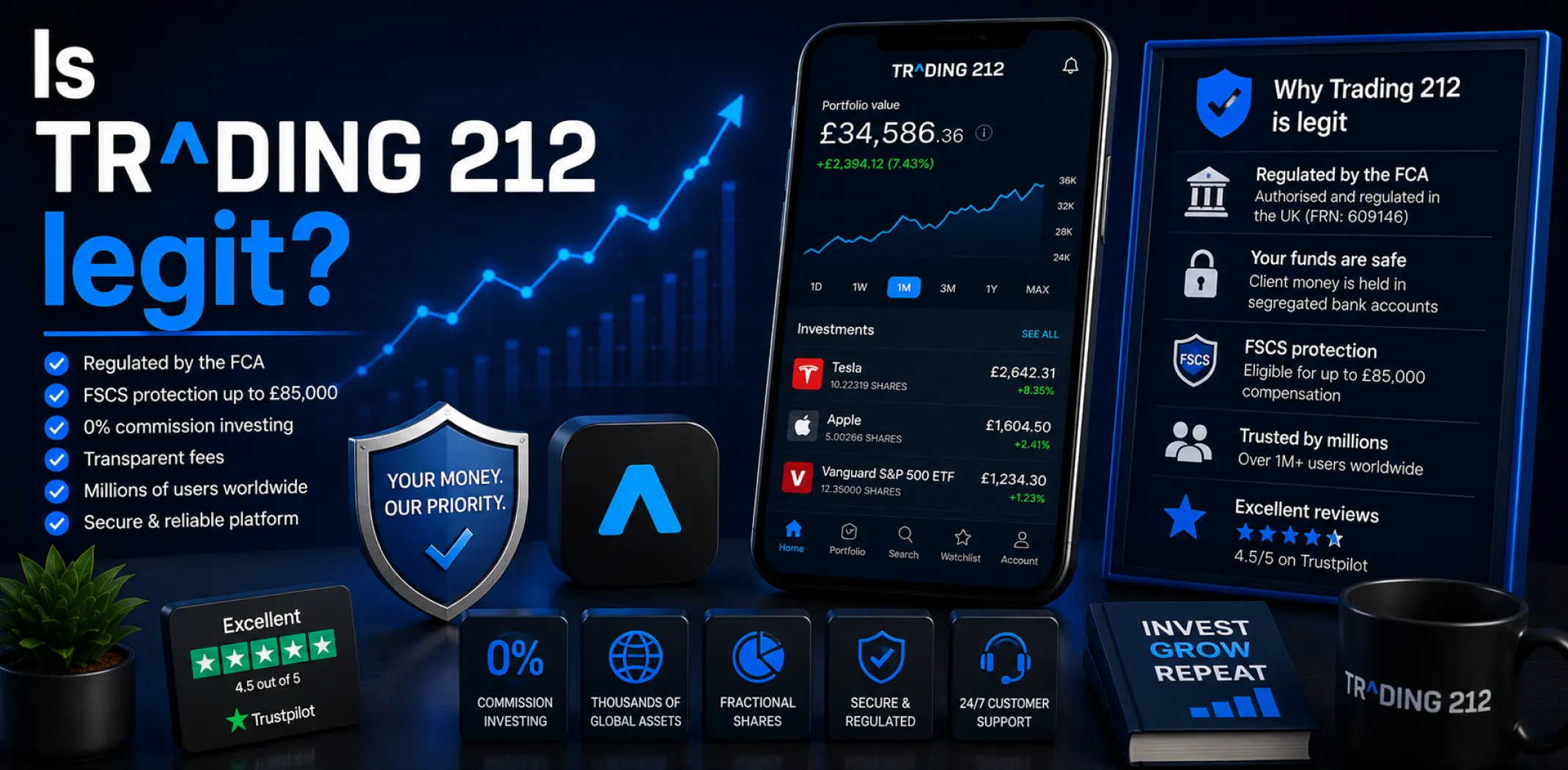
You have seen the ads for commission-free investing and you want to know one thing before you put any money in: is Trading 212 legit? The answer is yes – and the case for it rests on hard regulatory fact, not marketing copy.
Trading 212 is authorised and regulated by the UK’s Financial Conduct Authority, supervised by CySEC, BaFin, ASIC, and Bulgaria’s FSC, holds over 4.5 million clients with more than £25 billion in client assets, and posted £277.6 million in UK revenue in 2025. Client funds are segregated from company funds and protected under the FSCS up to £85,000 for investments.
That is the legitimacy picture. The honest picture – including the CFD risk warning, the withdrawal complaints, and the FCA clone warnings – follows below.
Quick verdict
Trading 212 is a legitimate, FCA-regulated investment broker founded in 2004. It holds client assets in segregated accounts protected by the FSCS up to £85,000 for investments, and up to £120,000 for eligible cash deposits. The zero-commission Invest account is well-suited to passive investors. The CFD account carries a mandatory regulatory warning that 76% of retail investor accounts lose money – that figure applies specifically to CFD trading and not to the standard Invest account.
Key takeaways
- Trading 212 is regulated by the FCA (UK), CySEC (Cyprus), BaFin (Germany), ASIC (Australia), and FSC (Bulgaria) – a multi-jurisdiction regulatory footprint.
- UK client investments are covered by FSCS compensation up to £85,000 and eligible cash deposits up to £120,000 if the firm were to fail.
- The platform earns revenue primarily through a 0.15% FX conversion fee, CFD spreads, and interest on uninvested cash – not hidden charges on equity trades.
- The 76% CFD loss warning is a mandatory regulatory disclosure required by the FCA and CySEC – it applies to CFD accounts only and reflects the risk of leveraged trading.
- The FCA has issued warnings about fraudulent clones using the Trading 212 name – always verify you are on trading212.com before entering any account details.
What is Trading 212 and how does it actually make money?
Trading 212 is a European fintech brokerage founded in 2004 in Sofia, Bulgaria by Ivan Ashminov and Borislav Nedialkov – originally under the name Avus Capital. It is now headquartered in London and operates across multiple regulated entities in the UK, EU, and beyond.
The platform offers commission-free investing in stocks and ETFs, a Stocks and Shares ISA and Cash ISA for UK investors, CFD trading for those who want leveraged instruments, and – since 2024 – a debit card with up to 2% cashback on spending. As of May 2025, the platform serves over 4.5 million clients with more than £25 billion in client assets under administration.
The most common question from new users is the one that also reveals the platform’s honest business model: if Trading 212 does not charge commission, how does it make money? The answer is transparent and documented.
The primary revenue source is a 0.15% currency conversion fee applied when you buy a stock denominated in a different currency from your account base currency.
Secondary sources include CFD spreads (the difference between the buy and sell price on leveraged instruments), overnight financing charges on held CFD positions, and the margin between what Trading 212 earns on uninvested client cash and what it passes on to clients as interest.
The company’s UK entity posted £277.6 million in revenue for the year ended 31 December 2025 – up 72% from the prior year – and net profit of approximately £43 million in 2024, confirming the business is solidly profitable without relying on hidden charges from equity investors.
Common misconception: ✕ If something is free, the company must be making money from you in a hidden way.
✓ Trading 212 publishes its exact revenue model. The 0.15% FX conversion fee is the primary cost for Invest account users. CFD spreads and overnight financing charges apply to CFD accounts only. There are no hidden equity trading commissions, no inactivity fees, and no withdrawal fees. The company is profitable and transparent about where its revenue comes from.
What regulatory protections does Trading 212 provide?
Trading 212’s regulatory structure is one of the strongest available to retail investors at a zero-commission broker. The following five safeguards are in place for UK clients – each one independently verifiable on the FCA register and the Trading 212 help centre.
FCA authorisation – verifiable on the UK Financial Services Register
Trading 212 UK Limited is authorised and regulated by the Financial Conduct Authority under FRN 609146. You can verify this directly at register.fca.org.uk. FCA-regulated firms are subject to conduct rules, capital adequacy requirements, client money rules, and ongoing supervisory oversight. This is not self-certification – it is a licence that must be maintained and can be revoked.
FSCS protection – government-backed compensation up to £85,000 for investments
UK clients are covered by the Financial Services Compensation Scheme. If Trading 212 were to fail and client assets could not be returned, the FSCS would compensate eligible investors up to £85,000 for investments. Eligible cash deposits (including Cash ISA) are separately covered up to £120,000 per person per banking group – a limit raised from £85,000 in December 2025. This is a statutory, government-backed scheme, not private insurance.
Segregated client funds – your money is held separately from company money
Under FCA Client Assets Sourcebook (CASS) rules, Trading 212 holds client cash in segregated bank accounts at institutions including J.P. Morgan, Barclays, and NatWest – entirely separate from Trading 212’s operating funds. Client shares and ETFs are held in nominee accounts on behalf of the client, not on Trading 212’s balance sheet. In the event of insolvency, segregated assets are not available to creditors of the firm.
Mandatory 2FA and negative balance protection on CFDs
Trading 212 requires two-factor authentication on all account logins – a baseline security measure that makes unauthorized access substantially harder. For CFD accounts, retail clients benefit from negative balance protection: you cannot lose more than you deposit, even if a market move exceeds your available margin. This is a regulatory requirement for FCA and CySEC-regulated CFD brokers.
Mandatory CFD risk disclosure – 76% of retail accounts lose money
The figure displayed on Trading 212’s site – that 76% of retail investor accounts lose money when trading CFDs – is not a marketing choice. It is a quarterly-refreshed regulatory disclosure required by the FCA, CySEC, and FSC for all CFD providers. Its presence signals that Trading 212 is complying with its regulatory obligations, not that the platform is unsafe. The disclosure applies exclusively to CFD accounts and is not relevant to the standard Invest, ISA, or Cash ISA accounts.
The CFD risk warning – what 76% actually means
The most alarming-looking number on the Trading 212 website is the regulatory disclosure that 76% of retail investor accounts lose money when trading CFDs with this provider. It is prominently displayed because the FCA and CySEC legally require it. Understanding what it actually means – and does not mean – is essential for evaluating the platform honestly.
CFDs are contracts for difference – leveraged financial instruments that allow investors to speculate on price movements without owning the underlying asset. Because leverage amplifies both gains and losses, CFD trading is inherently high-risk and has been restricted for retail investors in some markets.
The 76% figure reflects how many retail accounts at Trading 212 that hold CFD positions have lost money over the disclosure period. It is updated quarterly and reflects actual trading outcomes, not Trading 212’s marketing claims.
The critical point is that this figure applies exclusively to the CFD account. It has no bearing on the standard Invest account, the Stocks and Shares ISA, or the Cash ISA – all of which involve buying real shares or holding cash, with no leverage.
A passive investor who opens a Trading 212 Invest account and buys commission-free shares or ETFs does not have any exposure to the risks described in the CFD warning. If you are not planning to trade CFDs, this disclosure is not relevant to your use of the platform.
Important risk note: Even in the standard Invest account, the value of your shares and ETFs can fall as well as rise. You may get back less than you invest. The FSCS protects you if Trading 212 as a firm fails – it does not protect you against market losses. If you are new to investing, consider speaking with a regulated financial adviser before committing money to any investment platform.
What are the real complaints about Trading 212?
Trading 212’s 4.6-star Trustpilot rating from approximately 92,000 reviews is one of the strongest in the European broker category. But the negative reviews that do exist – roughly 8% of total reviews are one-star – cluster around a consistent set of complaints that are worth understanding before you deposit. These are drawn from verified review sources in 2025 and 2026, not invented scenarios.
KYC and account verification delays. The most frequently cited frustration in negative reviews is the identity verification (Know Your Customer) process – particularly when it involves withdrawal requests. Some users report being asked for documents from closed accounts, selfies with passports, or proof-of-address from addresses they no longer use.
These requirements are mandated by UK anti-money-laundering (AML) law and are not discretionary for Trading 212, but the process can be slow and the instructions unclear. Users who keep their identity documents updated and respond to verification requests promptly typically experience fewer delays.
Withdrawal delays. A minority of users report delays in processing withdrawals – most commonly when large withdrawals trigger additional AML verification, or when bank transfer details have changed.
These delays are not evidence of fund withholding; they reflect compliance requirements that every regulated UK broker must follow. Users who complete KYC proactively, maintain consistent bank account details, and request withdrawals via the same method used to deposit generally experience the smoothest process.
Share lending enabled by default. Trading 212’s securities lending feature – which lends your shares to other traders in exchange for a portion of the interest earned – is active by default for Invest account users. Users who discover this was enabled without their explicit consent report feeling uneasy.
The risk to investors is mitigated by 102% collateral backing the loans, but the default-on setting is a legitimate transparency gap. UK users who prefer not to participate can disable the feature in account settings at any time.
Customer support response times. Trading 212 offers 24/7 in-app support but relies heavily on automated responses for routine queries. Users with complex withdrawal issues or verification problems report that escalating beyond the automated tier is slow and sometimes requires repeated attempts.
The FCA clone warning – is there a fake Trading 212?
Yes, and this is important. The FCA has issued warnings about fraudulent firms impersonating Trading 212. These clone operations use Trading 212’s branding, name, and sometimes its FCA registration number to present themselves as legitimate. They typically solicit investments through cold calls, social media ads, or messaging platforms, and are entirely separate from the real company.
The real Trading 212 operates exclusively through its official website at trading212.com and its official iOS and Android apps, which are available only through the Apple App Store and Google Play. Legitimate FCA-regulated firms do not cold-call unsolicited investment offers.
If you receive an approach from someone claiming to be Trading 212 through any other channel – email, phone, WhatsApp, Telegram, or a website with a slightly different URL – treat it as fraud and report it to the FCA at fca.org.uk/consumers/report-scam.
Looking for other ways to build income online? Platforms like Trading 212 are for investing money you already have – not for creating new income streams from scratch. If you are interested in ways to earn online that do not require upfront capital at risk, explore our make money online guide.
Is Trading 212 legitimate – the honest verdict
Yes. Trading 212 is a legitimate, FCA-regulated investment broker with a 20-year operating history, multi-jurisdiction regulatory oversight, segregated client funds, and FSCS protection for eligible UK investors.
Its zero-commission business model is financed by transparent revenue sources – primarily the 0.15% FX fee and CFD-side income – not hidden charges. The platform is used by over 4.5 million clients and has built one of the strongest Trustpilot review records of any European retail broker.
The caveats are real and worth restating. The CFD account carries the FCA-mandated disclosure that 76% of retail CFD accounts lose money – leveraged trading is genuinely high-risk and unsuitable for most beginners.
KYC and withdrawal delays are a documented frustration for a minority of users. The share lending feature is enabled by default. And FCA clone warnings confirm that fraudulent entities impersonating Trading 212 are active – verify the URL and app source before entering any account details.
Legitimate and recommended for passive investors – with clear limitations for CFD traders and active traders
Trading 212 is a properly regulated, profitable, and well-protected broker for passive investors who want commission-free equity exposure and ISA access. The CFD side of the platform carries a high loss rate that is honestly disclosed – anyone considering CFD trading should approach it with great caution and a full understanding of leverage risk. For beginners and buy-and-hold investors, Trading 212 competes strongly on cost and simplicity. Capital at risk. This is not financial advice.
Who is Trading 212 best suited for?
Best for passive, long-term investors
Trading 212 is built around the Invest account and AutoInvest Pies – a feature that automates regular deposits into a custom mix of stocks and ETFs. For anyone pursuing a long-term, low-cost investing strategy with fractional shares from £1 and no dealing commissions, this is the platform’s strongest offering.
Best for UK ISA investors
Trading 212 offers a fee-free Stocks and Shares ISA and a Cash ISA with competitive interest rates. Both are FSCS-protected, both are zero-fee, and both are accessible within the same app. UK investors who want to use their annual ISA allowance without paying a platform fee or dealing charges will find few better options in the zero-cost bracket.
Best for European investors under CySEC or BaFin
Non-UK EU clients use Trading 212 Markets Ltd (Cyprus, CySEC regulated) or Trading 212 EU (Germany, BaFin regulated). CySEC clients have access to the Investor Compensation Fund (ICF) up to €20,000. The platform’s multi-language app and multi-currency wallet serve European investors who want commission-free access to global equities without needing a UK bank account.
CFD trading – for experienced traders only
Trading 212’s CFD account offers access to forex, indices, commodities, and crypto with leverage. The FCA-mandated disclosure is explicit: 76% of retail CFD accounts with this provider lose money. CFD trading is complex, involves leverage, and can result in losses equalling your entire deposit. This account type is not suitable for beginners or those who have not fully understood leverage risk.
Want to generate income online without putting capital at risk? Investing always involves the risk that your capital may fall in value. For ways to generate income online through effort and sales rather than market exposure, read our make money online guide.
Is Trading 212 commission-free investing actually profitable for the company?
What happens to my money if Trading 212 goes bust?
Your investments and cash are protected by two mechanisms. First, under FCA Client Assets Sourcebook rules, Trading 212 holds client cash and assets in segregated accounts separate from the company balance sheet. In an insolvency, your shares and cash would not be available to Trading 212 creditors. Second, the Financial Services Compensation Scheme provides additional protection for UK clients up to 85,000 pounds for eligible investments and up to 120,000 pounds for eligible cash deposits if segregated assets cannot be fully returned. European clients are protected by CySEC Investor Compensation Fund up to 20,000 euros or the German Investor Compensation Scheme.
Is the 76% CFD loss figure a red flag about the platform?
No. The 76 percent figure is a mandatory quarterly-updated regulatory disclosure required by the FCA and CySEC for all CFD brokers operating in the UK and EU. Its presence on the platform demonstrates regulatory compliance, not platform failure. The figure applies only to CFD accounts – it reflects the statistical outcome for retail traders using leveraged instruments, not the performance of standard stock and ETF investing. A passive investor using the Trading 212 Invest account or ISA is not exposed to CFD-related risks.
Has the FCA issued a warning about Trading 212?
The FCA has issued warnings about fraudulent firms impersonating Trading 212 by using its name, branding, and registration number. These clone operations are separate from and unaffiliated with the real company. The FCA warning confirms that Trading 212 itself is a genuine FCA-authorized firm with FRN 609146 – verifiable at register.fca.org.uk. The existence of clone warnings is a consequence of Trading 212 being a well-known brand, not evidence of wrongdoing by the company. Always access Trading 212 only through trading212.com or the official app stores.
Is Trading 212 available in the United States?
No. Trading 212 does not accept clients based in the United States due to US regulatory requirements for brokers serving American investors. The platform is primarily available to residents of the UK, EU member states, Australia, and a range of other countries outside the US. US investors looking for commission-free equity investing should consider US-regulated alternatives such as Fidelity, Charles Schwab, or Robinhood.