Is The YouTube Partner Program A Scam? The 2026 Truth

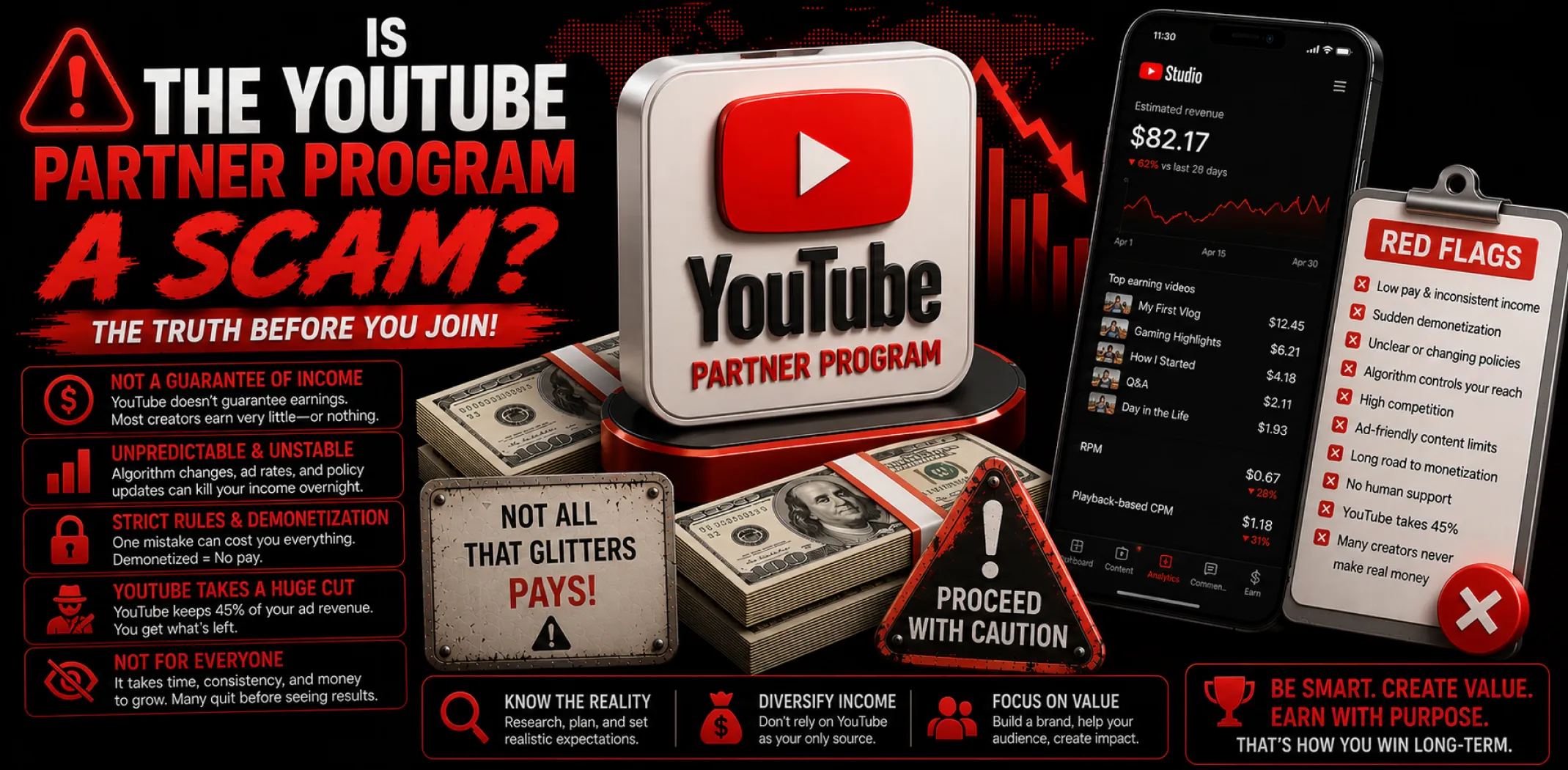
Complaints about the YouTube Partner Program are easy to find. Channels demonetized by automated systems for content that was clearly original. Applications rejected after months of work building toward the eligibility threshold. Videos earning pennies despite millions of views.
The 2026 enforcement wave removing monetization from channels that had been in good standing for years. And the persistent accusation that YouTube’s 45% cut of all ad revenue is itself a form of theft. If you have encountered any of this and wondered whether the YPP is a scam, the frustration is understandable.
The answer is no – and the evidence for that is about as strong as it gets. The YouTube Partner Program is owned by Alphabet, a publicly listed company whose revenue figures are disclosed in quarterly SEC filings reviewed by independent auditors. YouTube generated $40.4 billion in advertising revenue in 2025.
At the 55/45 split, $22 billion of that went into the creator pool. These are not marketing claims – they are financial disclosures. What the program has are real operational problems that cause genuine frustration. They are not fraud, and distinguishing between them is the most useful thing this article can do.
Quick verdict
The YouTube Partner Program is not a scam. It is owned by Alphabet (Google), disclosed in audited SEC filings, and distributed over $20 billion to creators in 2025. Its documented problems – aggressive automated demonetization, the 45% revenue share that many creators call unfair, rejection of applications for opaque reasons, and zero income for 6 to 18 months pre-monetization – are real frustrations. None of them constitute financial fraud. Each has a specific explanation that changes how you respond to it.
Key takeaways
- The YPP is owned by Alphabet (Google), a NASDAQ-listed company. Its $40.4 billion in 2025 ad revenue is an audited public financial disclosure – not a self-reported marketing figure.
- YouTube’s 45% revenue share is high compared to some competitors, but it is transparent, consistently applied, and reflects the traffic, infrastructure, and discovery that YouTube provides to creators.
- Automated demonetization is a real problem – the 2026 enforcement wave produced documented false positives – but the appeals process resolves most legitimate cases within 1 to 2 weeks.
- The 6 to 18 months of zero ad income before reaching monetization thresholds is the program’s most painful real limitation – it is structural, not deceptive.
- YouTube Shorts RPM of $0.01 to $0.06 per 1,000 views is genuinely very low – but this is disclosed and reflects how the Shorts Creator Pool distributes revenue across billions of daily views.
What is the YouTube Partner Program – and why do people call it a scam?
The YouTube Partner Program launched in 2007 when Google, which had acquired YouTube the year before for $1.65 billion, began sharing advertising revenue directly with the creators making the content. The program was formalized with its current eligibility structure in 2012 and has been the primary mechanism for creator ad income ever since.
In 2026, over 5 million channels participate in the YPP across 2.7 billion monthly active users. YouTube’s $40.4 billion in 2025 ad revenue, at the standard 55/45 creator split, produced a $22 billion annual creator pool – the largest in digital video by a significant margin.
The scam accusation comes from several distinct sources, and examining them separately is more useful than treating them as a single indictment. Creators who spent a year building toward the 1,000-subscriber threshold, got approved, and earned $80 their first month feel misled by the implied promise of the program.
Creators whose channels were demonetized by automated systems for content they believe was legitimate feel cheated. Creators who received automated rejection letters with vague explanations feel the process is rigged.
And critics who focus on the 45% revenue cut argue that YouTube is taking too large a share of value it did not create. Each of those claims deserves a direct response.
The context that matters most for the scam question: Alphabet’s YouTube revenue is the most transparently documented income figure in the creator economy. It appears in SEC-filed quarterly earnings reports that institutional investors, regulators, and independent auditors scrutinize. The creator revenue split of 55/45 is documented in YouTube’s public partner terms.
There is no mechanism by which YouTube hides a different fee structure or quietly takes more than stated – all payments flow through Google AdSense, which creators can audit independently. This level of transparency separates YouTube from every other platform reviewed in this space.
Is the YouTube Partner Program a scam? Examining the four main accusations
The scam accusation against the YPP typically traces back to one or more of four specific complaints. Examining each one against the evidence changes how alarming they should seem.
Common misconception: Many creators conflate four completely different sources of frustration into a single “YPP scam” accusation: the 45% revenue cut (a contractual fee), automated demonetization (an enforcement problem), low Shorts RPM (a structural revenue distribution reality), and the zero-earnings pre-monetization period (a program design feature). None of these involve YouTube secretly taking more than it says, withholding earnings it owes creators, or misrepresenting the program’s terms. Calling them a scam misidentifies what is actually happening – and makes it harder to respond effectively to the real issues.
“YouTube takes 45% – that is theft”
The 45% revenue share is high compared to some alternatives – Ko-fi takes 0% on tips, and Kick offers 5/95 streaming splits. But it is disclosed in YouTube’s partner terms before you join, has not changed significantly in years, and reflects something real: YouTube provides the platform, the hosting, the CDN infrastructure, the global audience discovery, the advertising relationships, and the AdSense payment infrastructure. Without YouTube’s 2.7 billion monthly user audience, the advertiser relationships that produced $40.4 billion in 2025 ad revenue, and the search and recommendation system that surfaces videos to new viewers, there is no ad revenue to split. Calling a disclosed, consistently applied fee “theft” conflates dissatisfaction with fraud. The fee is worth debating. It is not a scam.
Automated demonetization – real problem, not fraud
In 2026, YouTube tightened enforcement of its policies against reused content, AI-generated low-effort videos, and compilation channels. The automated systems enforcing these policies produce false positives – channels with genuine original content have been incorrectly flagged and demonetized. As of 2026, a class action lawsuit against YouTube specifically alleges that automated terminations were issued without adequate human review, causing wrongful channel losses at scale. This is a real, documented, and serious operational failure. It is not YouTube secretly extracting revenue from creators for its own financial benefit – every channel that gets wrongly demonetized is a channel YouTube loses its 45% from too. The financial incentive runs the other way. The problem is scale: enforcing policies across billions of videos using automated systems at the speed required will always produce errors. Appeals resolve most legitimate cases within 1 to 2 weeks. The system is imperfect. It is not a scam.
Shorts RPM is very low – but it is disclosed and explained
YouTube Shorts creators earn $0.01 to $0.06 per 1,000 views – far below the $2 to $35 RPM range for long-form content. This generates strong frustration from creators who produce Shorts that go viral with tens of millions of views and earn a few hundred dollars. The explanation is structural: Shorts ad revenue is distributed through a Creator Pool model where all Shorts ad revenue is pooled and allocated proportionally by view share. With 70 billion Shorts views per day globally, the revenue per view dilutes dramatically. YouTube discloses the Shorts monetization model in its partner documentation – it is not hidden. The low earnings are a design consequence of the volume. Creators who treat Shorts as a primary income source will be disappointed; creators who treat them as a discovery and audience-building tool and monetize through long-form, memberships, and sponsorships reach different outcomes.
Zero income before monetization – design feature, not deception
The most common source of “scam” frustration is the pre-monetization period. A creator builds toward 1,000 subscribers and 4,000 watch hours over 9 to 18 months, gets approved, and earns $120 their first month from a gaming channel at $3 RPM. This feels disproportionate to the effort invested. But YouTube has never advertised the program as fast income, and the thresholds are published clearly before anyone begins. The zero income during the build phase is a documented feature of how the program works. The disappointment is real – particularly when creators build in low-CPM niches without understanding the RPM variance – but it stems from a mismatch between expectation and published program reality, not from YouTube misrepresenting what the program offers.
What is consistently absent from the documented complaint record is what genuine scam behavior looks like: YouTube secretly taking more than the disclosed 45%, withholding earnings that belong to creators, or misrepresenting the revenue split in a way that deceives partners. None of that appears in the evidence. The problems are real. The company is not committing financial fraud.
How YouTube’s revenue model works – and why the incentives matter
Understanding YouTube’s financial model clarifies why the scam framing is structurally wrong. YouTube earns 45% of ad revenue from successful creator content. It earns nothing from demonetized channels. It earns nothing from channels that quit.
Its financial interest is precisely the opposite of what a scam operation would have: YouTube makes more money when creators earn more, stay longer, and produce better content that advertisers want to spend against.
Every automated demonetization that hits a legitimate channel is a channel YouTube loses 45% from – the platform has no financial motive to remove monetization incorrectly. Every creator who builds toward the 1,000-subscriber threshold and then earns less than expected is someone YouTube wants to retain because engaged creators bring audiences that advertisers pay to reach.
The incentive structure of the platform runs toward supporting creator earnings, not undermining them. The demonetization problems stem from operating automated enforcement at billion-scale, not from misaligned financial incentives.
What do real creators say about the YouTube Partner Program in 2026?
Creator experiences with the YPP split along two axes: niche selection (which determines income) and whether they were affected by automated enforcement actions. Two representative accounts illustrate the range of what the program actually delivers.
Is the YouTube Partner Program worth it – honest verdict
The YouTube Partner Program is not a scam. The case for that is built on public financial disclosures, audited by independent accountants, reported to the SEC, and verified by $22 billion in creator ad payments in 2025 alone. No other creator monetization program in existence is more transparently documented or more thoroughly evidenced.
The honest limitations are different in kind from what scam accusations imply. The 45% YouTube keeps is high but disclosed and reflects the distribution infrastructure, audience, and advertiser relationships that make the $22 billion creator pool possible.
Automated demonetization produces genuine false positives and the class action challenging this is real – but the appeals process works for most legitimate channels and YouTube has no financial incentive to wrongly remove monetization. Shorts RPM is very low but this is disclosed and follows from the volume of the Creator Pool. And the zero-income pre-monetization period is a documented design feature, not a hidden trap.
Not a scam – the most transparently documented creator monetization program that exists
The YouTube Partner Program is backed by a publicly listed company with SEC-audited financials. Its revenue split is publicly documented and consistently applied. Its problems – automated demonetization false positives, high revenue share, low Shorts RPM, and a long pre-monetization build – are real frustrations but are distinct from financial fraud in every meaningful way. For creators willing to invest in the right niche for 12 to 24 months, it remains the best-evidenced and most financially significant creator ad revenue program available.
One signup. Two income streams. Zero upfront cost.
AliDropship builds your ecommerce store and gives you a complete Amazon Seller Kit – product listings ready to upload, a step-by-step guide, and access to 300 million buyers on a $514 billion marketplace. Your $40 ad coupon covers your first campaign, and the 14-day free trial means you risk nothing to get started.
Who should pursue the YouTube Partner Program – and who is better served elsewhere?
The evidence points clearly to who the YPP works for and who would be better served by a different approach.
Strong fit: patient creators in high-CPM niches
Finance, business, technology, health, and legal content attract $8 to $35 RPM. Creators who choose these niches, produce videos over 8 minutes (unlocking mid-roll ads), target search-intent topics that rank over time, and are willing to invest 12 to 24 months before seeing significant income will find the YPP the most financially rewarding creator ad program in existence. Back-catalog compounding makes each video a lasting asset.
Protect yourself: demonetization monitoring is non-optional
The 2026 enforcement environment makes weekly YouTube Studio monitoring non-negotiable for any monetized channel. Check your video monetization status, not just your analytics. Document your original production process for every video – scripts, source files, recording sessions – so you can immediately substantiate an appeal when automated systems act. Most false positives are resolved within two weeks for channels with clear original-content documentation.
Not suited to Shorts-only income strategies
Shorts are powerful for audience discovery and channel growth. They are not a viable primary income source under the YPP. At $0.01 to $0.06 RPM, a Shorts video needs 100 million views to earn $1,000 to $6,000 from Creator Pool revenue. Creators who build on Shorts should be building toward long-form conversion and supplementary income streams – not treating Shorts views as a revenue source in themselves.
Better for immediate income: an owned business alongside YouTube
The YPP earns nothing during the 6 to 18 month pre-monetization build. Many successful YouTubers run an owned ecommerce business in parallel – generating product income immediately from paid advertising while the YouTube channel builds toward monetization. The two are genuinely complementary: the store generates cash flow while you wait; the YouTube channel provides organic reach and authority that benefits the store once it grows.
Want income that does not require waiting 18 months? Here is how AliDropship works
The YouTube Partner Program is worth building toward – but it earns zero during the pre-monetization period and requires significant niche strategy to generate meaningful income once approved.
AliDropship generates income from day one: a fully built store with 100+ products pre-loaded, one-click advertising that reaches customers immediately, and a free Amazon Seller Kit that opens 300 million buyers without any eligibility threshold to clear first.
Free turnkey store – built, designed, and filled with products
Your store arrives professionally designed, pre-loaded with 50 bestselling products, and fully optimized to convert. No setup fees, no coding, no design time. You start at the product-testing stage – not the store-building stage. Hosting, SSL, and payment gateway are all included.
Winning products, one-click import
Browse trending and niche items from AliDropship’s catalog – including brand-name and digital products – and import them to your store in one click. The catalog updates regularly so your store always has fresh, competitive inventory without manual research.
Automated fulfillment and real-time tracking
Orders are processed automatically through global supplier connections. Customers receive real-time tracking updates – building trust and reducing support volume. You do not touch the shipping logistics; the platform handles it end-to-end.
Built-in marketing and promotion tools
Email campaigns, discount management, abandoned-cart recovery, live countdown timers, and social media integration are all included or available as add-ons. No prior marketing experience required – the tools guide you through each campaign type.
Beginner-friendly – no coding, no learning curve
An intuitive dashboard walks you through every step. Adding products, running campaigns, and scaling your catalog require no technical knowledge. As your business grows, the platform scales with you – adding features without adding complexity.
AliExpress integration – one-click imports, synced inventory
AliDropship connects directly to AliExpress for one-click product imports, automated order processing, and synced tracking. Inventory stays current with the latest products and prices. Combined with the turnkey store and automated fulfillment, this integration makes the entire operation manageable for one person.
Is the YouTube Partner Program a scam?
Is YouTube taking too much with its 45% revenue cut?
The 45% YouTube retains is high compared to some alternatives, but it reflects real value the platform provides: 2.7 billion monthly active users, the second-largest search engine in the world, a global CDN and streaming infrastructure, the advertising relationships that generated 40.4 billion dollars in 2025 ad revenue, and the discovery and recommendation systems that surface videos to new viewers. Without those assets, the creator pool does not exist at all. Whether the split is fair is a legitimate debate among creators and platform observers – but it is disclosed before you join, consistently applied, and auditable through AdSense. Calling it theft conflates dissatisfaction with fraud.
Why do so many creators get demonetized after joining the YouTube Partner Program?
YouTube uses automated systems to enforce monetization policies at the scale of billions of videos, and these systems produce false positives – channels with genuine original content incorrectly flagged for reused content, repetitive formats, or advertiser-unfriendliness. The 2026 enforcement wave targeting AI-generated and compilation content increased the frequency of automated actions, including some that affected clearly legitimate channels. YouTube has no financial incentive to wrongly demonetize creators – every incorrectly removed channel is revenue YouTube loses alongside the creator. The problem is the inherent error rate of automated enforcement at platform scale, not intentional misdirection. Appeals resolve most legitimate cases within 1 to 2 weeks. Document your original production process and file appeals immediately when automated actions occur.
Why does YouTube pay so little for Shorts views?
YouTube Shorts RPM is low – $0.01 to $0.06 per 1,000 views – because Shorts ad revenue is distributed through a Creator Pool model. All advertising revenue allocated to Shorts is pooled and distributed proportionally based on each creator share of total Shorts views. With 70 billion Shorts views per day globally, the revenue per view dilutes to very small numbers even when the total pool is substantial. This model is disclosed in the YouTube Shorts monetization documentation. The practical implication is straightforward: Shorts drive audience discovery and channel growth effectively, but are not a viable primary income source under the current Creator Pool model. Creators who build on Shorts should plan to convert that audience to long-form content and supplementary income streams rather than relying on Shorts RPM as a revenue source.
What should you do instead of waiting 18 months for YouTube monetization?
The 6 to 18 months before reaching the YouTube Partner Program threshold is a documented design feature of the program, not a hidden surprise. During this period, building a parallel income stream is a practical and common approach among creators who become successful YouTubers. An owned ecommerce store through a platform like AliDropship generates product-based income from day one through built-in advertising – no eligibility threshold, no content schedule, and no 18-month wait. Many successful YouTube creators use the pre-monetization period to fund their channel production by running an ecommerce business alongside it, then scale both simultaneously once YouTube ad revenue kicks in.