Is The Creator Rewards Program A Scam? The 2026 Truth

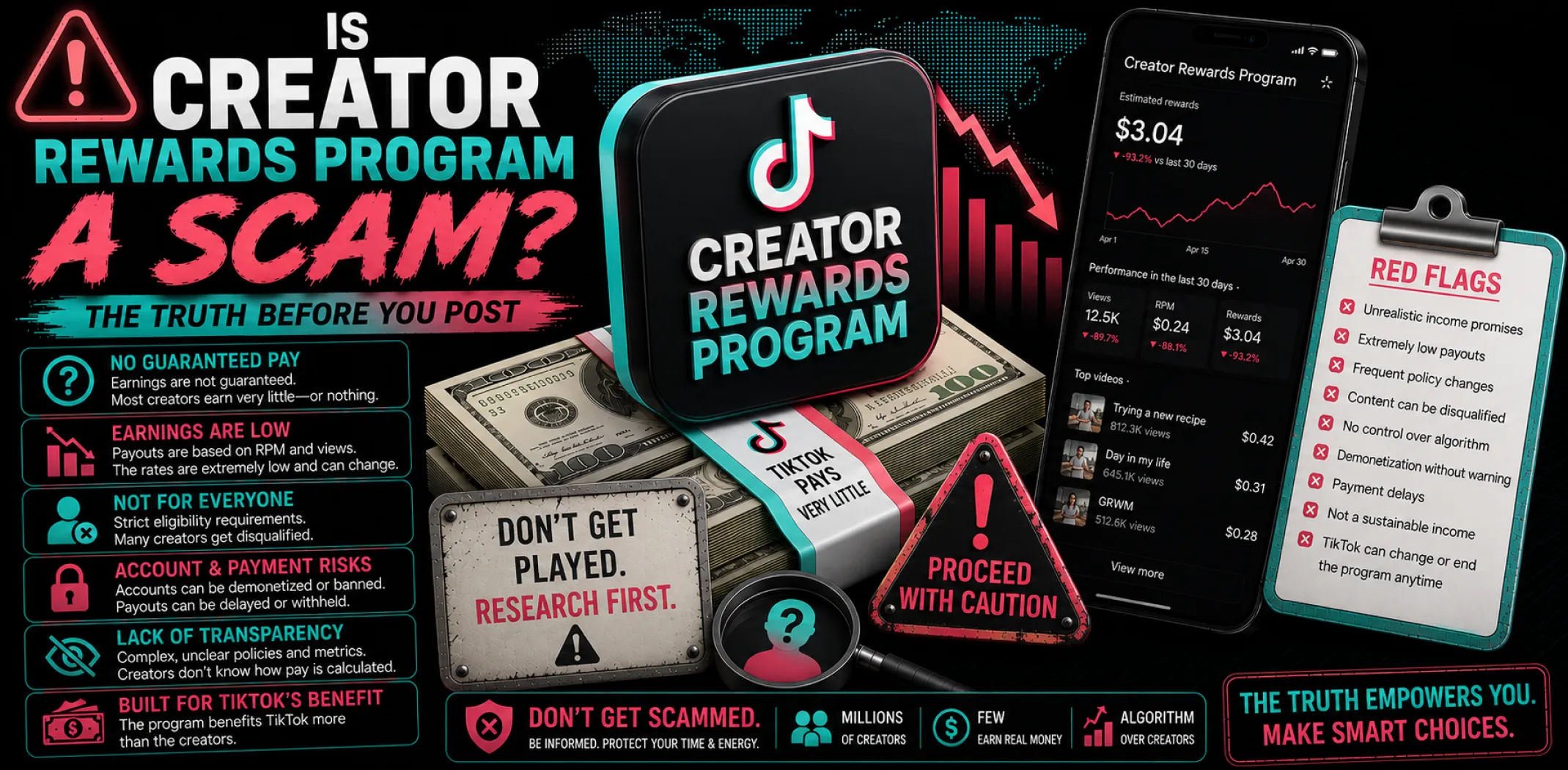
Creators across TikTok, Reddit, and X have been calling the Creator Rewards Program a scam since early 2026. Videos with millions of views generating a few dollars. RPMs cratering after the January ownership transition. Qualified view counts that seem completely disconnected from reality.
If you have seen these complaints and wondered whether there is anything real to them, the honest answer is: some yes, some no, and the distinction matters for anyone thinking about building income through TikTok.
The Creator Rewards Program is not a scam in the sense of being designed to take money from creators or deceive them into spending. TikTok pays out real money – the program is a genuine upgrade on the discredited Creator Fund that preceded it, and in the right conditions it delivers meaningful earnings.
But it has real documented problems: an opaque “qualified views” filter that can quietly discount the majority of your actual views, RPM volatility that is difficult to understand or plan around, and a significant post-January 2026 earnings disruption tied to the US ownership transition that affected many creators. Understanding those problems clearly is the most useful thing this article can do.
Quick verdict
The TikTok Creator Rewards Program is not a scam – it pays real money and is a significant improvement on the old Creator Fund. But it has genuine documented problems: an opaque qualified views system that discounts a significant portion of total views, RPM rates that fluctuate without transparent explanation, and a post-January 2026 earnings drop tied to the US ownership transition that remains partially unresolved. Treat it as a supplementary income stream with real earning potential, not a reliable primary income source.
Key takeaways
- The Creator Rewards Program replaced the original Creator Fund in late 2023. It pays $0.40 to $1.00+ per 1,000 qualified views – up to 20 times more than the old fund paid per view.
- Only “qualified views” count toward earnings – views from the For You feed lasting over 5 seconds on videos at least 1 minute long. Total view counts and qualified view counts can differ dramatically.
- RPM fluctuates based on your audience’s geography, content niche, watch time, engagement, and advertiser demand – TikTok does not publish a fixed rate, making earnings difficult to predict.
- Following the January 22, 2026 US ownership transition to TikTok USDS Joint Venture LLC (Oracle, Silver Lake, MGX), many US creators reported significant RPM drops linked to algorithm retraining and infrastructure outages.
- To earn $1,000 per month from Creator Rewards alone requires approximately 1 to 2.5 million qualified views monthly – a level most creators cannot sustain consistently.
What is the Creator Rewards Program – and what replaced what?
TikTok’s original Creator Fund launched in 2020 with a $200 million commitment, later expanded to $1 billion. It paid creators based on a shared pool of money split across all participants – which meant that as more creators joined, each individual’s share shrank.
The pay rates became notorious: creators routinely reported earning $0.02 to $0.04 per 1,000 views, meaning a video with 1 million views might generate $20 to $40. MrBeast famously stated he earned around $15,000 from the Creator Fund despite having tens of millions of followers. The Fund was widely criticized as tokenistic.
TikTok launched a “Creativity Program Beta” in early 2023 as a replacement, testing a new performance-based model that moved away from the shared pool toward RPM – revenue per 1,000 views – calculated from actual advertising revenue.
In December 2023, TikTok retired the Creator Fund in its major markets and fully transitioned to what is now called the Creator Rewards Program. In spring 2025, TikTok added an Additional Reward layer – a quality bonus on top of base RPM for videos with high engagement, retention, and originality scores. As of 2026, the Creator Rewards Program is TikTok’s primary direct creator monetization tool.
The program is available in a limited set of countries as of 2026, including the US, UK, France, Germany, Japan, South Korea, Brazil, and several others. Availability is tied to your account’s registered country – determined by the SIM and IP address used at registration, not just your profile settings. Creators in countries where the program is not available cannot earn Creator Rewards regardless of view counts.
Is the Creator Rewards Program a scam? What the evidence actually shows
To answer the question honestly requires separating three distinct things that often get conflated in creator communities: whether the program is designed to defraud creators, whether it has genuine opaque design problems, and whether the post-January 2026 earnings drops represent a systemic failure or a temporary transition disruption.
Is the program designed to defraud creators? No. The mechanics are documented in TikTok’s help center, and the RPM model – while opaque – does tie creator earnings to actual advertising revenue in a more transparent way than the old Creator Fund’s black-box pool.
Creators who meet the eligibility requirements and produce qualifying content receive real payouts. The minimum threshold of $50 is low, and payments process monthly between the 1st and 15th of each month for the previous month’s qualified earnings.
Does the program have genuine problems that explain creator frustration? Yes – four specific ones, each well-documented and worth understanding in detail.
The four real problems creators report – examined in detail
Most of what gets called a scam in creator communities traces back to one or more of these four documented issues. Understanding each one changes whether you should dismiss the complaints or take them seriously.
Common misconception: Many creators assume that total TikTok view counts translate directly into Creator Rewards earnings. They do not. TikTok only pays for “qualified views” – a subset of total views that meet specific criteria around traffic source, watch duration, video length, and content originality. A video with 1 million total views may have significantly fewer qualified views depending on how those views were generated. This gap is the single largest source of “scam” frustration and is a real design issue with transparency consequences, even though it is documented in TikTok’s own help resources.
The qualified views gap – total views vs paying views
A “qualified view” requires all of the following: the view came from the For You Page (not a profile visit, the Following tab, a direct share, or an embedded link), the viewer watched for at least 5 seconds, the video is at least 1 minute long, the video is original and not a Duet or Stitch, and the video has reached at least 1,000 qualified views total. Views that do not meet every criterion generate zero Creator Rewards income. A viral video shared heavily through direct links or profile visits can accumulate millions of total views while generating only a small fraction in qualified views. TikTok does display qualified view counts separately in Creator Studio – but the gap between total and qualified often comes as a shock to creators checking their dashboard for the first time.
RPM volatility – rates that move without explanation
TikTok does not publish a fixed RPM rate. Your earnings per 1,000 qualified views fluctuate based on your audience’s geographic location (US and UK audiences pay more because advertisers pay more to reach them), your content niche (finance, tech, and business niches attract higher CPM advertisers), overall advertiser demand (which fluctuates with the broader advertising market), watch time and engagement rates, and platform-level factors. This means two creators with identical qualified view counts can earn very different amounts, and the same creator can see their RPM shift significantly month to month with no explanation from TikTok. Creators who track their dashboard carefully describe this as the most disorienting aspect of the program – earning unpredictably even when content performance is consistent.
The January 2026 ownership transition – what actually happened
On January 22, 2026, TikTok completed the formation of TikTok USDS Joint Venture LLC – the new US operating entity controlled by Oracle, Silver Lake, and MGX (80% combined), with ByteDance retaining a 19.9% stake. Oracle took over US data infrastructure, triggering a multi-month process of algorithm retraining on US-based servers. Two significant infrastructure outages occurred in the weeks following the transition – one shortly after the January 22 close and a second on March 3, 2026 at Oracle’s Ashburn, Virginia data center (approximately 20 hours). During these periods, some creators reported view counts stalling and qualified views registering inaccurately. US creators broadly documented RPM drops in the weeks following the transition, with some reporting earnings falling to a fraction of pre-January levels. As of mid-2026, RPM appears to be partially stabilizing for many creators, but the situation remains in flux during ongoing algorithm retraining.
The 1-minute content requirement mismatch
Creator Rewards only pays for videos at least 1 minute long – but TikTok’s algorithm and culture are still heavily oriented toward short-form content under 30 seconds. Many creators who built their following on short viral content find that their audience does not engage with longer videos at the same rate, reducing both qualified view counts and RPM simultaneously. The platform’s push for longer content through the rewards program creates a real tension for creators who have built successful short-form channels. Switching to longer content to access better pay often means relearning what resonates with your specific audience.
None of the four issues above constitute fraud. The qualified views system, while frustrating in its opacity, is documented by TikTok and reflects legitimate quality filtering to prevent gaming by creators using bots or low-quality traffic. The RPM volatility is real but reflects the actual advertising market rather than TikTok manipulating payouts arbitrarily.
The January 2026 disruption was a genuine infrastructure transition with documented outages. And the 1-minute requirement is a stated program rule, not a hidden trap. What all four share is a transparency gap – TikTok does not communicate these mechanics loudly enough at the point where creators enroll, and that gap generates the frustration that fuels scam accusations.
How the Creator Rewards Program works – the full payment mechanic
Understanding exactly how payouts are calculated demystifies the gap between what creators expect and what they receive.
The Additional Reward component, added in spring 2025, sits on top of this base calculation. TikTok evaluates videos for production quality, specificity to a niche, depth of engagement, and overall originality – and awards a bonus payment on top of standard RPM for videos that score highly across these dimensions.
This bonus is not separately applied for; it is calculated automatically for every eligible video. It explains why two videos with similar qualified view counts can earn significantly different amounts.
In practical earnings terms: at $0.40 RPM, 1 million qualified views generates $400. At $1.00 RPM, that same 1 million qualified views generates $1,000. To earn $1,000 per month requires between 1 million and 2.5 million qualified views monthly, depending on your RPM.
For context on what that means – a creator who consistently generates 1 million qualified For You Page views per month is performing at a level most creators cannot sustain. This is where the income ceiling bites hard for anyone who sees the Creator Rewards Program as a path to meaningful standalone income.
What do real creators say about the Creator Rewards Program in 2026?
Creator experiences with the program divide along a clear line: those who understand the qualified views system, produce long-form content strategically, and treat Creator Rewards as one income stream among several report a functional program that pays what it says it pays.
Those who enrolled expecting view counts to translate directly into payments – or who were affected by the post-January 2026 disruptions – report a frustrating and opaque experience. Here are two representative accounts.
Is the Creator Rewards Program worth it – honest verdict
The Creator Rewards Program is not a scam. It pays real money to eligible creators whose content meets its documented requirements. The RPM range of $0.40 to $1.00+ per 1,000 qualified views is a genuine improvement on the Creator Fund’s $0.02 to $0.04 rate, and high-CPM niches with US or UK audiences can push toward the top of that range consistently.
The honest picture is more nuanced. The qualified views system is real but creates a gap between visible view counts and actual paying views that TikTok does not communicate clearly enough at enrollment. RPM volatility is a genuine operational reality that makes Creator Rewards income difficult to plan around as a primary source.
The January 2026 transition created a documented and significant earnings disruption for US creators that is only partially resolved. And the 1-minute content requirement creates a real friction for creators whose audiences were built on short-form content.
Not a scam – but genuinely opaque, volatile, and currently disrupted for many US creators
The Creator Rewards Program is a real, functioning monetization system that pays qualified creators for eligible content. The scam accusations are driven by a genuine transparency gap around qualified views, opaque RPM calculation, and a real post-January 2026 earnings drop that affected many US creators. The program works best for long-form creators in high-CPM niches with US or UK audiences who treat it as one stream among several. It is poorly suited to primary income reliance, short-form content strategies, or creators in low-CPM entertainment niches.
One signup. Two income streams. Zero upfront cost.
AliDropship builds your ecommerce store and gives you a complete Amazon Seller Kit – product listings ready to upload, a step-by-step guide, and access to 300 million buyers on a $514 billion marketplace. Your $40 ad coupon covers your first campaign, and the 14-day free trial means you risk nothing to get started.
Who should – and should not – rely on the Creator Rewards Program?
Based on the evidence, here is a clear-eyed breakdown of when the program is worth pursuing and when a different approach to online income makes more sense.
Worth pursuing: long-form creators in high-CPM niches
Creators who produce 1 to 3 minute educational, finance, tech, legal, or business content with audiences concentrated in the US or UK are positioned to earn toward the top of the RPM range. For this profile, Creator Rewards can generate $500 to $2,000 per month as one income stream – meaningful as a supplement, not a primary source. Track qualified views and RPM in Creator Studio monthly to understand your actual rates.
Approach carefully: US creators post-January 2026
US creators experienced the most significant RPM disruptions following the USDS Joint Venture transition and Oracle infrastructure migration. By mid-2026 earnings appear to be partially stabilizing, but the algorithm is still being retrained on US servers and full normalization has not been confirmed. US creators should monitor their RPM monthly and avoid making financial plans based on pre-January 2026 earnings rates until stability is clearly re-established.
Poor fit: short-form creators and entertainment niches
Creators whose content and audience success is built around videos under 30 seconds will find Creator Rewards structurally inaccessible without a major content pivot. Entertainment, lifestyle, and comedy niches also attract lower CPM advertisers, keeping RPM toward the lower end of the range even for eligible content. For this profile, TikTok Shop affiliate commissions, LIVE gifts, or brand partnerships typically generate better returns per unit of effort than the Creator Rewards Program.
Better for stable income: an owned business that does not depend on algorithm RPM
Creator Rewards income is entirely subject to TikTok’s algorithm, ownership transitions, and advertiser demand – factors entirely outside your control. An owned ecommerce store generates income through your own advertising and products, with margins that do not fluctuate when a data center migrates to Oracle infrastructure. For income that scales independently of any platform’s monetization decisions, product-based ecommerce is structurally more resilient.
Want income that does not move with TikTok’s algorithm? Here is how AliDropship works
Creator Rewards pays when TikTok’s RPM cooperates, when the algorithm sends your videos to the For You Page, and when your content meets all eligibility criteria.
AliDropship generates income through a completely different mechanism: a built-for-you ecommerce store with 100+ products pre-loaded, one-click advertising tools that drive sales regardless of any platform’s RPM changes, and a free Amazon Seller Kit that opens 300 million buyers from day one – with no dependency on TikTok infrastructure or ownership transitions.
Free turnkey store – built, designed, and filled with products
Your store arrives professionally designed, pre-loaded with 50 bestselling products, and fully optimized to convert. No setup fees, no coding, no design time. You start at the product-testing stage – not the store-building stage. Hosting, SSL, and payment gateway are all included.
Winning products, one-click import
Browse trending and niche items from AliDropship’s catalog – including brand-name and digital products – and import them to your store in one click. The catalog updates regularly so your store always has fresh, competitive inventory without manual research.
Automated fulfillment and real-time tracking
Orders are processed automatically through global supplier connections. Customers receive real-time tracking updates – building trust and reducing support volume. You do not touch the shipping logistics; the platform handles it end-to-end.
Built-in marketing and promotion tools
Email campaigns, discount management, abandoned-cart recovery, live countdown timers, and social media integration are all included or available as add-ons. No prior marketing experience required – the tools guide you through each campaign type.
Beginner-friendly – no coding, no learning curve
An intuitive dashboard walks you through every step. Adding products, running campaigns, and scaling your catalog require no technical knowledge. As your business grows, the platform scales with you – adding features without adding complexity.
AliExpress integration – one-click imports, synced inventory
AliDropship connects directly to AliExpress for one-click product imports, automated order processing, and synced tracking. Inventory stays current with the latest products and prices. Combined with the turnkey store and automated fulfillment, this integration makes the entire operation manageable for one person.
Is the TikTok Creator Rewards Program a scam?
What are qualified views on TikTok and why do they matter for earnings?
Qualified views are the subset of total views that TikTok actually pays for under the Creator Rewards Program. To count as a qualified view, the view must come from the For You Page (not from a profile visit, the Following tab, or a direct share link), the viewer must have watched for at least 5 seconds, the video must be at least 1 minute long, the video must be original and not a Duet or Stitch, and the video must have reached at least 1,000 qualified views in total before it begins generating earnings. Views that do not meet every criterion contribute zero to Creator Rewards income. The gap between a total view count of a video and its qualified view count is the most common source of creator frustration with the program – a viral video shared heavily through direct links can accumulate millions of total views while generating a small fraction in qualified views.
Why did TikTok Creator Rewards payouts drop in early 2026?
Following the formation of TikTok USDS Joint Venture LLC on January 22, 2026 – in which Oracle, Silver Lake, and MGX took approximately 80% control of US operations of TikTok – the platform began migrating its data infrastructure and retraining its recommendation algorithm on US-based Oracle servers. Two data center outages occurred in the weeks following the transition: one shortly after the January 22 close, and a second on March 3, 2026 at an Oracle facility in Ashburn, Virginia lasting approximately 20 hours. During these periods, some creators experienced stalled view counts and inaccurate qualified view reporting. More broadly, many US creators documented significant RPM drops across January and February 2026 that appear linked to the algorithm retraining process. By mid-2026, RPMs appear to be partially stabilizing, but the situation remains in flux.
How much can creators realistically earn from the Creator Rewards Program?
At the standard RPM range of 0.40 to 1.00 dollars per 1,000 qualified views, a creator needs between 1 million and 2.5 million qualified views per month to earn 1,000 dollars from Creator Rewards alone. High-CPM niches such as finance, technology, legal, and business content – particularly with US or UK audiences – can push RPM toward the top of the range or beyond it. Most creators earning meaningful income from Creator Rewards treat it as one stream among several, combining it with brand partnerships, TikTok Shop affiliate commissions, LIVE gifts, and other monetization sources. Creator Rewards as a standalone primary income source requires a level of consistent qualified view volume that most creators cannot sustain. Results vary widely.
What are the best alternatives to the Creator Rewards Program for making money online?
For TikTok creators who want income that does not depend on RPM stability, qualified view counts, or algorithm decisions, TikTok Shop affiliate commissions offer a different model where income is tied to product sales rather than view metrics. For creators who want income entirely independent of any single platform, an owned ecommerce store through a platform like AliDropship generates income through product sales driven by paid advertising – with margins that do not fluctuate when TikTok undergoes an ownership transition or infrastructure migration.