Is Substack Legit? An Honest Review For Writers In 2026

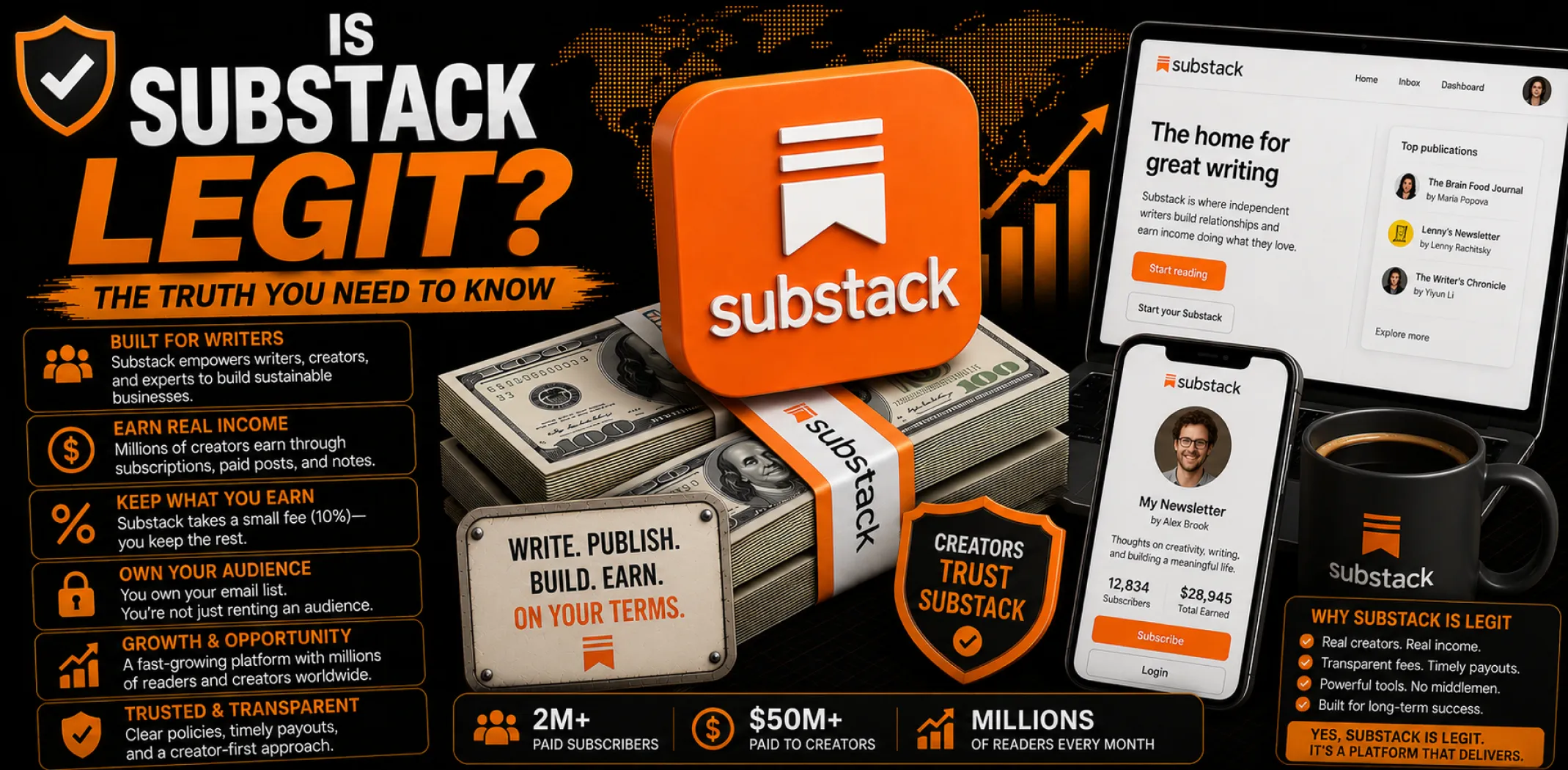
If you have been researching Substack and spotted its 1.4-star Trustpilot rating, you might be wondering whether something is seriously wrong with the platform. That score does reflect real problems – mainly poor customer support and billing cancellation issues – but it is drawn from a tiny sample of around 150 reviews on a platform used by millions of writers and readers worldwide. The fuller picture is considerably more positive.
Substack is a legitimate, well-funded publishing platform that has paid out approximately $450 million to writers in 2025 alone, crossed a $1.1 billion valuation in its July 2025 Series C funding round, and has more than 50 writers earning over $1 million per year through paid subscriptions.
It is genuinely one of the most creator-friendly newsletter platforms available in 2026. The honest caveats are about income reality and support quality – not about whether the platform is trustworthy.
Quick verdict
Substack is a legitimate, VC-backed publishing platform founded in 2017, valued at $1.1 billion in 2025, and responsible for $450 million in gross writer payments that year. It is free to start, takes a transparent 10% cut of paid subscription revenue, and has built-in audience discovery tools that most competing platforms lack. Its real limitations are a poor customer support experience and an income curve where 50% of paying creators earned under $500 in 2025. For writers willing to invest consistently in their craft, it is one of the best newsletter platforms available.
Key takeaways
- Substack is a real US company, founded in 2017 in San Francisco, that raised $190 million across six funding rounds including a $100 million Series C in July 2025 at a $1.1 billion valuation.
- The platform is free to use; it takes a 10% cut of paid subscription revenue plus Stripe processing fees – effective take rate of roughly 13% to 16%.
- Substack paid out approximately $450 million to writers in 2025; over 50 writers earn $1 million or more per year on the platform.
- The 1.4-star Trustpilot score comes from only around 150 reviews and reflects customer support and billing cancellation frustrations – not fraud or stolen earnings.
- The income reality is stark: the median earning creator makes around $4,000 per year, and nearly 50% of creators with paid subscriptions earned under $500 in 2025.
What is Substack and how does it work?
Substack was founded in October 2017 by Chris Best, Hamish McKenzie, and Jairaj Sethi in San Francisco. Its founding premise was simple: give writers a direct path to earning from their audience without advertising, editorial gatekeepers, or algorithmic throttling.
The business model it introduced – subscription revenue shared directly between platform and writer – has since shaped how most independent publishing platforms think about creator economics.
In 2026, Substack is considerably more than a newsletter tool. It hosts text posts, podcasts, video, live streams, and a short-form feed called Notes that functions as an in-platform social network.
Writers can publish free content to build an audience, gate premium content behind a paid subscription, or do both simultaneously. Readers subscribe – either for free to receive posts in their inbox, or by paying a monthly or annual subscription fee for access to paid-tier content. Substack takes 10% of all paid subscription revenue; writers keep 90% minus Stripe processing fees.
One of Substack’s genuine competitive advantages over most creator tip-and-support platforms is its built-in discovery infrastructure. The Notes feed – Substack’s short-form social layer – uses an algorithm to surface content to people who do not yet follow you.
The Recommendations network lets established writers recommend newer ones to their audiences. This means Substack is one of the few newsletter platforms where organic audience growth is possible without external social media promotion, though building from zero still takes significant time and consistency.
The economics of Substack scale well at the right audience size. At 1,000 paid subscribers paying $10 per month, a writer grosses $10,000 monthly and keeps approximately $8,700 after Substack’s cut and processing fees.
At 100 paid subscribers at the same price point, monthly net is around $870. The threshold most writers describe as “life-changing” – enough to replace a full-time salary – sits at roughly 1,000 paid subscribers at $8 to $10 per month. Getting there is the hard part.
Is Substack legitimate? What the evidence shows
Substack is legitimate. It is a real, well-funded US company with institutional backing, a verified payout record, and a product that has demonstrably helped thousands of writers build sustainable income from their work. The evidence for this is not anecdotal – it is in the funding history, the published revenue figures, and the independently reported earnings of writers on the platform.
The 44% average email open rate is worth pausing on. Industry standard open rates for commercial newsletters hover around 20% to 25%. Substack’s double-digit advantage reflects a structural reality: subscribers who actively choose to pay for or follow a specific writer are far more likely to read what that writer sends than someone on a commercial marketing list. That attention is the economic foundation of everything Substack writers build.
The funding trajectory also matters for the legitimacy question. A company that raised $100 million in Series C funding in July 2025 at a $1.1 billion valuation – with institutional investors who have done due diligence – is not a fly-by-night operation.
Substack has been independently audited, has transparent public financials available through press reporting, and has a CEO who gives on-record interviews citing specific platform metrics. This is what a legitimate business looks like.
What about the 1.4-star Trustpilot rating? Here is the full context
Substack’s 1.4-star Trustpilot score is real and should not be dismissed – but it needs context to be interpreted correctly. That score comes from approximately 150 reviews. Compare that to Buy Me a Coffee (1,400+ reviews at 3.5 stars) or OnlyFans (4,000+ reviews at 1.3 stars). The sample size is too small to be statistically representative of a platform used by millions of writers and readers.
Common misconception: Many creators see Substack’s 1.4-star Trustpilot rating and assume the platform is defrauding writers or withholding earnings. The actual complaints are categorically different: payment double-charges, inability to cancel subscriptions through a confusing UI, chatbot support loops that do not resolve issues, and account access problems related to two-factor authentication. These are real, legitimate frustrations – but they are support and billing UX failures, not evidence that Substack is stealing from creators or subscribers.
Looking at what the Trustpilot complaints actually say, the dominant themes are:
- being charged multiple times for the same subscription without being able to reach human support to fix it;
- difficulty cancelling a paid newsletter subscription due to unclear UI;
- getting stuck in automated support loops with no human resolution;
- and account access problems when two-factor authentication fails.
Several writers also report random automated account suspensions for alleged spam when their content clearly does not qualify.
These are genuine problems. Substack’s customer support is a documented weakness – TechRadar’s 2025 review estimated that only around 10% of support callers reach a human agent, and the primary support channel is an AI chatbot that users consistently describe as inadequate for anything beyond basic questions.
For a billion-dollar company, the support infrastructure is not where it should be. That said, the nature of these complaints – billing glitches and support access – is meaningfully different from a platform committing financial fraud against its creators.
Practical takeaway: Use a dedicated email address for your Substack account so login access is never at risk. Set up billing notifications so you catch any double-charge immediately and can dispute it with your bank directly. Do not rely on Substack support for urgent issues – the response time and quality are insufficient for time-sensitive problems.
How much can you realistically earn on Substack?
The headline earnings on Substack – more than 50 writers earning $1 million or more per year, the top 10 newsletters collectively generating $40 million annually – are real and verified. But the distribution behind those numbers is severely skewed, and understanding where most writers actually sit is essential before you invest significant time in the platform.
What do real users say about Substack in 2026?
Across Product Hunt, Reddit, and independent creator communities, the Substack experience divides cleanly along two axes: how writers feel about the product and platform, and how frustrated they are with support. The writing and publishing experience consistently draws praise. The support experience consistently draws criticism. Here are two representative creator experiences.
Is Substack worth it – honest verdict
For writers who are willing to publish consistently, have something genuinely valuable to say, and are patient enough to let the compounding mechanics of the Recommendations network do their work, Substack is one of the best platforms available in 2026. The 10% fee is competitive compared to alternatives at similar revenue levels.
The built-in discovery tools – Notes, Recommendations, search – are a genuine advantage that most competing newsletter platforms do not offer. And the 44% average email open rate means the audience you build is unusually engaged.
The honest limitations are two: the income curve is heavily concentrated at the top, meaning most writers earn modestly or nothing for an extended period before seeing meaningful revenue; and the customer support is poor enough that billing and account access problems can take weeks to resolve.
Neither of those is a reason to avoid Substack – but both are reasons to go in with realistic expectations and protective habits around account security and billing monitoring.
Legitimate, well-backed, and genuinely one of the best newsletter platforms for writers
Substack is a real, well-funded company with a transparent fee structure, $450 million in verified 2025 writer payments, and a product that has created real financial independence for thousands of independent writers. Its 1.4-star Trustpilot score is driven by support and billing UX problems – not fraud. The real limitations are a steep income curve and inadequate customer support. For writers willing to invest time consistently, it is among the best options available. For people who want income that does not depend on writing skill, publishing frequency, or a patient 18-to-36-month build, a product-based ecommerce model reaches profitability faster.
Your ecommerce store and Amazon business – both built and ready today
AliDropship sets up everything: a fully built store with 100+ best-selling digital products, plus an Amazon Seller Kit with a product import file, beginner guide, and access to 300 million active buyers. The 14-day free trial includes a $40 ad coupon – so your first campaign on either channel costs you nothing.
Who should use Substack – and who needs a different approach?
Substack excels in specific situations and falls short in others. Here is a clear breakdown based on the evidence above.
Strong fit: writers with a specific niche and consistent output
If you have a specific subject matter expertise – finance, technology, health, policy, culture – and can publish at least once a week, Substack’s discovery network and high email open rates work in your favor. The platform rewards depth and consistency over viral content. Writers who build slowly over 18 to 36 months typically describe the experience as among the best in independent publishing.
Accelerated fit: writers with an existing audience to migrate
Writers who already have a Twitter, LinkedIn, YouTube, or Instagram audience can dramatically compress the timeline to meaningful Substack income. Writers with existing followings of 10,000 or more report reaching $1,000 per month in net Substack income within 3 to 6 months – rather than the 18 to 36 months typical when building from zero.
Weaker fit: creators who need fast income from zero
If you need meaningful income within the first three months, Substack is unlikely to deliver it without an existing audience. The compounding growth mechanics that power long-term success on the platform require time. Writers starting from zero typically earn under $500 in their first year. For faster income that does not depend on an 18-month build, a product-based business model starts generating revenue much sooner.
Best combination: Substack plus an owned ecommerce business
Many of the highest-earning Substack writers in 2026 treat their newsletter as an audience-building engine and monetize that audience through additional income streams: courses, consulting, digital products, or ecommerce. An owned ecommerce store with built-in advertising provides immediate product-based income while your Substack audience compounds in the background.
Want income that does not require 18 months to build? Here is how AliDropship works
Substack is one of the best long-term income platforms available to writers – but it is slow to build and entirely dependent on the quality and consistency of your writing output.
AliDropship works on a different timeline: a fully built ecommerce store with 100+ products pre-loaded, one-click advertising that can generate sales from day one, and a free Amazon Seller Kit that opens 300 million buyers immediately – no writing, no publishing schedule, and no 18-month audience build required.
Free turnkey store – built, designed, and filled with products
Your store arrives professionally designed, pre-loaded with 50 bestselling products, and fully optimized to convert. No setup fees, no coding, no design time. You start at the product-testing stage – not the store-building stage. Hosting, SSL, and payment gateway are all included.
Winning products, one-click import
Browse trending and niche items from AliDropship’s catalog – including brand-name and digital products – and import them to your store in one click. The catalog updates regularly so your store always has fresh, competitive inventory without manual research.
Automated fulfillment and real-time tracking
Orders are processed automatically through global supplier connections. Customers receive real-time tracking updates – building trust and reducing support volume. You do not touch the shipping logistics; the platform handles it end-to-end.
Built-in marketing and promotion tools
Email campaigns, discount management, abandoned-cart recovery, live countdown timers, and social media integration are all included or available as add-ons. No prior marketing experience required – the tools guide you through each campaign type.
Beginner-friendly – no coding, no learning curve
An intuitive dashboard walks you through every step. Adding products, running campaigns, and scaling your catalog require no technical knowledge. As your business grows, the platform scales with you – adding features without adding complexity.
AliExpress integration – one-click imports, synced inventory
AliDropship connects directly to AliExpress for one-click product imports, automated order processing, and synced tracking. Inventory stays current with the latest products and prices. Combined with the turnkey store and automated fulfillment, this integration makes the entire operation manageable for one person.
Is Substack a legitimate platform for writers?
How does Substack make money?
Substack makes money by taking a 10% cut of all paid subscription revenue generated by writers on the platform. It charges no monthly fee to writers – the platform is free to use for publishing and distributing content. When a subscriber pays for a paid newsletter, Substack keeps 10% and the writer keeps 90%, minus Stripe payment processing fees of approximately 2.9% plus 30 cents per transaction and a 0.5% recurring billing fee. The total effective take rate is approximately 13% to 16% of gross revenue.
How much do Substack writers realistically earn?
The median earning Substack writer makes around 4,000 dollars per year – approximately 333 dollars per month. Nearly 50% of writers with paid subscriptions earned under 500 dollars in 2025. The top 10% of writers capture approximately 62% of all platform revenue. Writers who reach 1,000 paid subscribers at 8 to 10 dollars per month earn roughly 85,000 to 110,000 dollars per year after fees. Getting to 1,000 paid subscribers typically takes 18 to 36 months when building from zero, or 3 to 6 months for writers who already have an existing audience on another platform.
Why does Substack have such a low Trustpilot rating?
Substack holds a 1.4 out of 5 Trustpilot rating, but this is based on only around 150 reviews – a very small sample relative to the millions of writers and readers using the platform. The complaints that drive the low score are primarily about poor customer support, double billing charges, difficulty cancelling paid subscriptions through the app, and account access problems with two-factor authentication. These are real, documented weaknesses in Substack support and billing UX – but they are not evidence of fraud or withheld earnings. The writing and publishing experience receives consistently strong reviews in creator community forums and on Product Hunt.
What are the best Substack alternatives for making money online?
For writers who want a newsletter platform with lower fees at scale, Ghost charges a flat monthly fee rather than a revenue percentage and may be more cost-effective for newsletters earning more than 3,000 to 5,000 dollars per month. For creators who want income that does not require a writing schedule or 18 months of audience building, an owned ecommerce store through a platform like AliDropship provides product-based income from day one using built-in advertising – no publishing frequency required. For creators who want to supplement Substack earnings with fan support income, Ko-fi charges 0% on tips and pays instantly with no platform fee on donations.