Is Substack A Scam? The Truth Behind The Bad Reviews

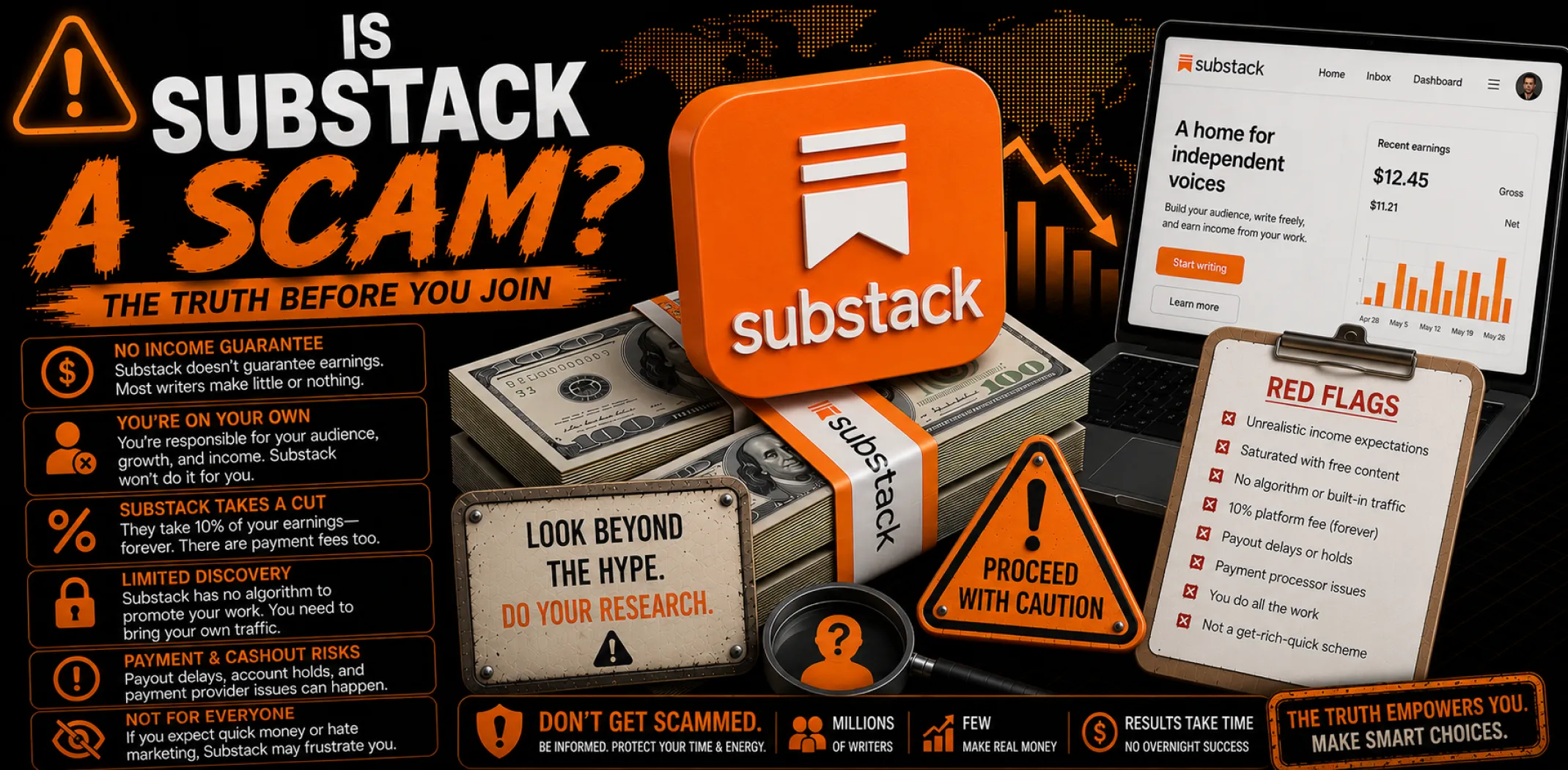
The complaints about Substack are real. People have been double-charged for subscriptions and struggled to cancel them. Accounts have been suspended by automated systems without explanation. Support tickets have gone into chatbot loops that never reach a human being. If you have read any of this and wondered whether Substack is a scam, that reaction is understandable.
But the answer is no – and the gap between “Substack has genuine problems” and “Substack is a scam” is significant. Substack is a US-registered company that raised $190 million in institutional funding, reached a $1.1 billion valuation in July 2025, and paid out approximately $450 million to writers in 2025 alone.
The problems it has are real operational failures – poor customer support, billing UX that makes cancellation harder than it should be, and automated moderation that sometimes acts incorrectly. Those are legitimate criticisms of a billion-dollar company. They are not evidence of financial fraud.
Quick verdict
Substack is not a scam. It is a legitimate, VC-backed US company that paid $450 million to writers in 2025 and has over 50 writers earning $1 million or more per year. Its documented problems – poor customer support, billing cancellation UX, and automated account suspensions – are operational failures, not fraud. Writers and readers should go in aware of these limitations, but the platform itself is trustworthy.
Key takeaways
- Substack is a real US company, founded in 2017, that raised $100 million in Series C funding in July 2025 at a $1.1 billion valuation – not a fly-by-night operation.
- The 1.4-star Trustpilot score comes from approximately 150 reviews – a statistically tiny sample for a platform used by millions – and reflects support and billing UX failures, not financial fraud.
- Substack paid $450 million to writers in 2025 and has over 50 writers earning $1 million or more annually – it demonstrably pays out.
- The real complaints cluster around double billing charges, inability to cancel subscriptions easily, chatbot support that does not resolve issues, and automated account suspensions.
- None of those complaints involve Substack withholding writer earnings or committing financial fraud against creators or subscribers.
What is Substack – and why does the scam question come up?
Substack launched in October 2017, founded by Chris Best, Hamish McKenzie, and Jairaj Sethi in San Francisco. The idea was straightforward: give writers a direct revenue relationship with their readers through paid subscriptions, without advertising or editorial middlemen. Early adopters were mostly journalists who had left traditional media and wanted to build independent audiences.
By 2026 the platform had expanded well beyond newsletters – it now hosts podcasts, video, live streams, and a short-form social feed called Notes – and had raised $190 million in total funding, with its most recent round being a $100 million Series C in July 2025 that valued the company at $1.1 billion.
The scam question arises from a specific combination: a 1.4-star Trustpilot rating that looks alarming at first glance, a pattern of complaints about billing charges that are difficult to dispute or cancel, and automated account suspensions that arrive without explanation.
For someone who has encountered any of those problems personally, or who has read about them before signing up, the word “scam” is a natural shorthand for the frustration. Whether it accurately describes what Substack is doing is a different question.
The financial facts above tell one story. The Trustpilot score tells another. Reconciling them requires looking at what the complaints are actually about – and comparing the sample size to the scale of the platform. Approximately 150 Trustpilot reviews is a vanishingly small number for a company with millions of active users and $450 million in annual creator payments.
Trustpilot reviews skew heavily negative by nature – people who have a smooth experience rarely write reviews, while people who hit a problem feel motivated to. Those 150 reviews tell you something real about the support and billing experience. They do not tell you that the company is fraudulent.
Is Substack a scam? What the evidence actually shows
To answer the question properly, the right framework is to ask: is Substack the company defrauding writers or subscribers, and separately, does the platform have real operational problems that cause genuine harm to users? The answers are different, and both matter.
Is Substack defrauding writers? No. The platform takes a transparent 10% of paid subscription revenue and pays writers the remaining 90% minus Stripe processing fees – a well-documented, consistently applied model. Writers receive their payouts through Stripe on a standard schedule.
There are no documented cases of Substack withholding writer earnings without basis, redirecting payments to its own accounts, or changing fee terms without notice. The company has institutional investors who require audited financials; systematic payment fraud would not survive that scrutiny.
Does Substack have real operational problems? Yes, specifically three. Poor customer support that relies heavily on a chatbot and rarely escalates to human agents. A billing and subscription cancellation UX that makes it harder than it should be for readers to stop charges.
And an automated content moderation system that occasionally suspends writer accounts for alleged spam without adequate review. All three are real, well-documented, and legitimate criticisms of the platform. None of them constitute financial fraud.
What the complaints are actually about – examined in detail
Looking across Trustpilot, PissedConsumer, and creator community forums, the Substack complaints cluster into four specific categories. Understanding each one changes how seriously to take the scam accusation.
Common misconception: Many people read “double charged” or “impossible to cancel” in Substack reviews and conclude the company is intentionally taking money it is not entitled to. In practice, the double-charge issue is a billing system error – the kind that occurs on many subscription platforms – and the cancellation difficulty reflects poor UX design rather than intentional barriers. Substack does not financially benefit from holding on to incorrectly billed money the way a fraudulent operation would. The harm is real; the intent is not malicious.
Billing errors and double charges
Multiple Trustpilot reviewers describe being charged twice for the same newsletter subscription, or charged after cancelling. This is a billing system error that Substack has acknowledged and worked to fix, but the resolution process – which requires going through support – is slow and frustrating. Because support is AI-first and rarely escalates to a human agent, people who hit this problem frequently describe spending weeks trying to recover a relatively small amount. Substack does not financially benefit from double-billing subscribers – it keeps 0% of subscription revenue and earns only its 10% from the legitimate payment – which points to system error rather than intentional fraud.
Cancellation UX that buries the exit
Cancelling a paid Substack newsletter subscription is more difficult than it should be. The cancellation option is accessible on desktop through account settings but is not available in the Substack mobile app – a design choice that forces subscribers to remember to cancel on a different device. Readers who pay on mobile and expect to cancel on mobile find the process confusing. This is a deliberately conservative UX design that advantages subscriber retention – it is not unique to Substack – but it creates real frustration and occasional charges subscribers did not intend to continue. The fix is straightforward: manage subscriptions exclusively on desktop and bookmark the account settings page.
AI support that does not resolve account issues
Substack’s primary support channel is a chatbot. For simple FAQs it works adequately. For anything account-specific – billing disputes, two-factor authentication failures, suspended account appeals – reviewers consistently describe the same experience: circular bot responses, promises of a human follow-up that never arrives, and issues left unresolved for weeks. A TechRadar investigation estimated that only around 10% of people who call Substack’s support line reach a human agent. For a $1.1 billion company, the support infrastructure is a significant gap. The harm is real and well-documented; it does not make the platform fraudulent.
Automated account suspensions without explanation
A smaller but more serious complaint category: writers whose accounts are suspended by Substack’s automated spam detection system, sometimes without warning and without a clear explanation of what triggered the action. Documented cases include newsletters with clearly non-spam content being suspended because automated rules flagged volume or frequency patterns. Substack does have an appeals process, but the support quality issues above make navigating it difficult. Unlike financial fraud, these suspensions affect platform access rather than withheld earnings – Substack does not hold writer revenue in a central account in a way that would allow it to capture funds from suspended creators.
What is notably absent from the Substack complaint picture is the category of complaint that defines genuine scam behavior: the platform holding and redirecting creator earnings, refusing to pay out money that belongs to writers, or taking more than its stated 10% fee.
None of that appears in the documented complaint record. The problems are real – but they are the problems of a fast-growing technology company with underbuilt support infrastructure, not the problems of a fraudulent operator.
How Substack makes money – and why that matters for the scam question
Substack earns its 10% from successful, completed subscription transactions. That is its only revenue. It charges no monthly platform fee to writers. It earns nothing from a writer who publishes only free content, nothing from a double-billing error that does not produce a valid subscription, and nothing from holding creator earnings – because it does not hold creator earnings.
Payments flow from subscriber to Stripe to writer; Substack takes its 10% cut as part of that transaction.
This incentive structure actually aligns Substack with creators rather than against them. When a writer earns more, Substack earns more. When a billing error causes a chargeback, Substack loses its fee along with the writer.
There is no financial mechanism by which Substack benefits from the complaints documented in its reviews – which is one of the clearest signals that what it has is an operational quality problem, not a fraudulent business model.
For comparison: platforms where scam-adjacent behavior has been documented – Buy Me a Coffee, OnlyFans – involve a central funds holding model where the platform accumulates creator earnings before disbursing them. Substack does not hold funds this way. The payment flows through Stripe directly, and Substack’s only financial position in the transaction is its 10% cut at the point of payment.
What do real users say about Substack in 2026?
The experience of using Substack divides almost exactly along the line between people who have encountered support or billing issues and people who have not. Those who have not report one of the best writing and publishing platforms available. Those who have describe frustrating weeks of chatbot responses. Here are two representative accounts.
Is Substack worth using – honest verdict
Substack is not a scam. The case for that verdict is straightforward: $190 million in institutional funding, $450 million in verified 2025 writer payments, 50+ writers earning over $1 million annually, a transparent and consistently applied fee structure, and no documented pattern of the company withholding or redirecting creator earnings. These are not the attributes of a fraudulent operation.
The case for taking the complaints seriously – while still recognizing them as operational failures rather than fraud – is equally straightforward. The support infrastructure is badly underbuilt for a billion-dollar company. Billing errors are not adequately resolved when they occur.
The cancellation UX prioritizes retention over user experience in a way that creates avoidable charges. And automated account moderation catches legitimate writers in its net often enough that it is a real risk for creators who publish consistently at volume.
Not a scam – but with real support failures worth knowing about before you commit
Substack is a legitimate, well-funded company that pays writers reliably and operates with full transparency about its fee structure. The 1.4-star Trustpilot score reflects genuine failures in customer support and billing UX – not fraud. Writers who publish consistently, never hit a billing issue, and do not require time-sensitive support account for the vast majority of platform users and report an excellent experience. The platform is worth using for writers with the patience for its income timeline and the awareness to protect themselves against its support weaknesses.
One signup. Two income streams. Zero upfront cost.
AliDropship builds your ecommerce store and gives you a complete Amazon Seller Kit – product listings ready to upload, a step-by-step guide, and access to 300 million buyers on a $514 billion marketplace. Your $40 ad coupon covers your first campaign, and the 14-day free trial means you risk nothing to get started.
Who should use Substack – and who is better served elsewhere?
The evidence points clearly to who Substack works well for and who would be better served by a different approach to online income.
Strong fit: patient writers with a specific niche
Writers who have genuine expertise in a specific subject, publish consistently, and are willing to invest 18 to 36 months in building an audience before expecting meaningful income will find Substack’s economics genuinely compelling. The 10% fee is fair, the email open rates are excellent at 44%, and the Recommendations network provides real organic growth unavailable on most competing platforms.
Protect yourself: account setup and billing habits
Whether you are a writer or a reader, the most effective protection against the problems documented above is simple: use a dedicated email address for your Substack account to avoid 2FA complications, manage all subscriptions on desktop rather than mobile, set calendar reminders before annual subscription renewals, and use a credit card rather than a debit card so you have chargeback rights if billing errors are not resolved by support.
Weaker fit: writers who need income quickly
Substack’s growth mechanics reward patience. Writers building from zero typically earn under $500 in their first year. The compounding that makes long-term Substack economics compelling does not start producing meaningful numbers until somewhere between month 12 and month 24. If you need income within the first three to six months, Substack is unlikely to deliver it without an existing audience to bring over at launch.
Better for fast income: an owned ecommerce business
If your goal is scalable online income that does not require a writing cadence or an 18-month audience build, ecommerce is a fundamentally different model. A store with pre-loaded products and built-in advertising can generate sales from day one – not from an audience you already have, but from new customers discovered through paid advertising that scales as the business grows.
Want online income that does not require a two-year build? Here is how AliDropship works
Substack is worth using – but it asks for patience that not everyone has or needs. AliDropship works on a completely different timeline: a fully built ecommerce store with products pre-loaded, one-click advertising that starts driving sales from day one, and a free Amazon Seller Kit that opens 300 million buyers immediately. No writing schedule, no 18-month compounding curve, no audience required to get started.
Free turnkey store – built, designed, and filled with products
Your store arrives professionally designed, pre-loaded with 50 bestselling products, and fully optimized to convert. No setup fees, no coding, no design time. You start at the product-testing stage – not the store-building stage. Hosting, SSL, and payment gateway are all included.
Winning products, one-click import
Browse trending and niche items from AliDropship’s catalog – including brand-name and digital products – and import them to your store in one click. The catalog updates regularly so your store always has fresh, competitive inventory without manual research.
Automated fulfillment and real-time tracking
Orders are processed automatically through global supplier connections. Customers receive real-time tracking updates – building trust and reducing support volume. You do not touch the shipping logistics; the platform handles it end-to-end.
Built-in marketing and promotion tools
Email campaigns, discount management, abandoned-cart recovery, live countdown timers, and social media integration are all included or available as add-ons. No prior marketing experience required – the tools guide you through each campaign type.
Beginner-friendly – no coding, no learning curve
An intuitive dashboard walks you through every step. Adding products, running campaigns, and scaling your catalog require no technical knowledge. As your business grows, the platform scales with you – adding features without adding complexity.
AliExpress integration – one-click imports, synced inventory
AliDropship connects directly to AliExpress for one-click product imports, automated order processing, and synced tracking. Inventory stays current with the latest products and prices. Combined with the turnkey store and automated fulfillment, this integration makes the entire operation manageable for one person.
Is Substack a scam or a legitimate company?
Why do people say Substack is a scam?
The scam accusation typically comes from three specific experiences: being double-charged for a subscription and struggling to get a refund through Substack support, being unable to cancel a paid subscription easily because the cancellation option is only accessible on desktop and not in the mobile app, and having a writer account suspended by automated spam detection without explanation. All three of these problems are real and well-documented. None of them involve Substack stealing money or committing financial fraud – they reflect poor customer support infrastructure and UX design choices that create avoidable frustration.
Can Substack withhold or take your earnings as a writer?
No. Substack does not hold creator earnings in a central account in a way that would allow it to capture or withhold funds. Subscription payments flow through Stripe, and Substack takes its 10% cut at the transaction level. The remaining amount is credited to the writer and paid out through Stripe on a standard schedule. There is no holding period analogous to the 7-day hold on platforms like OnlyFans. Writers who have been suspended by Substack for content policy violations may lose access to their publication, but their earned revenue is not withheld or redirected.
What should you do if Substack double-charges you or you cannot cancel a subscription?
The most direct path to resolving a Substack billing issue is to contact your bank or credit card company directly and initiate a dispute for any unauthorized or incorrectly continued charges – do not wait for Substack support to resolve it through normal channels, as response times can extend to weeks. For subscription cancellations, go to the Substack website on desktop, navigate to account settings, and manage subscriptions from there – the mobile app does not offer a cancellation option. If you have an account access issue that standard support cannot resolve, escalating publicly on social media with the Substack account tagged has been documented as the fastest path to a human support agent.
What are the best alternatives to Substack for earning money online?
For writers who want a newsletter platform with lower fees at higher revenue levels, Ghost charges a flat monthly subscription fee rather than a percentage of revenue, making it more cost-effective once monthly earnings exceed roughly 3,000 to 5,000 dollars. For creators who want online income that does not require writing consistently over an 18-to-36-month build period, an owned ecommerce store through a platform like AliDropship provides product-based income from day one using built-in paid advertising – no publishing schedule and no audience required to get started.