Is Stash Legit? An Honest Review For 2026

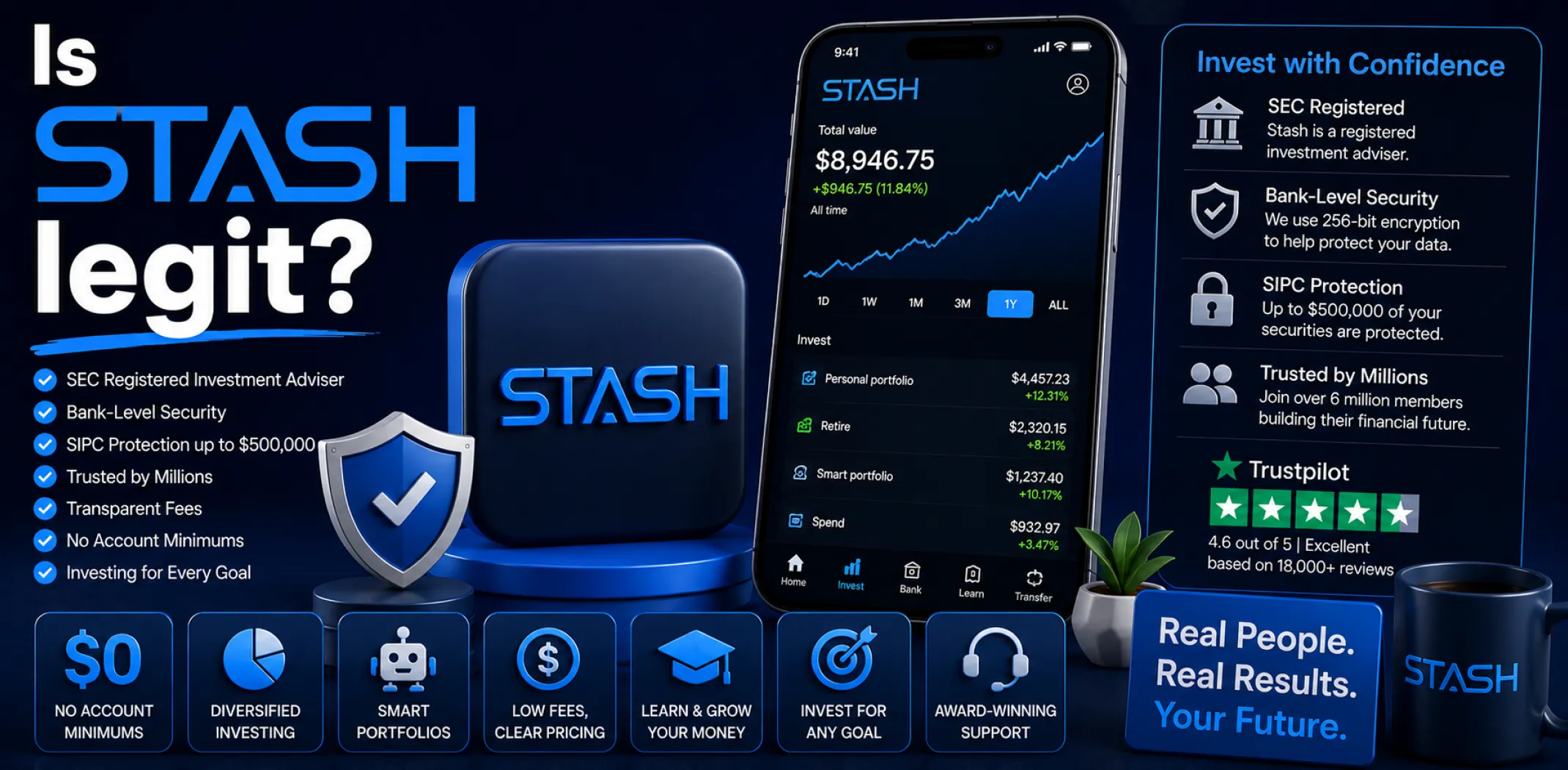
If you have come across Stash and want to know whether it is a legitimate investing app before handing over your money – or your Social Security number – you are asking the right question. In 2026, the micro-investing space is crowded, and not every platform that looks polished is worth trusting.
The short answer is yes, Stash is a legitimate, regulated brokerage. But the longer answer matters more: there are specific ways the platform can quietly work against you if you do not understand how its fee structure operates at small portfolio sizes, and its customer support record has documented weaknesses worth knowing upfront.
Quick verdict
Stash is a legitimate, FINRA-registered and SIPC-insured micro-investing app founded in 2015 and operating under SEC oversight. It suits beginners who want to start investing with as little as 5 dollars. The key caveat: flat monthly fees of 3 to 9 dollars per month can erode returns significantly on small balances, and its customer support has a documented history of slow responses to account issues.
Key takeaways
- Stash is registered with the SEC as an investment adviser and broker-dealer, and is a FINRA and SIPC member.
- In February 2026, Southeast Asian tech company Grab agreed to acquire Stash at a 425 million dollar enterprise value, with the deal expected to close in Q3 2026.
- Stash manages approximately 5 billion dollars in assets across more than 1 million paying subscribers.
- The flat monthly fee of 3 or 9 dollars represents a meaningful cost drag on portfolios under a few hundred dollars.
- Stash scores 1.08 out of 5 on the BBB from user reviews but 4.5 out of 5 on Trustpilot – a pattern driven largely by complaint selection bias.
What is Stash and how does it work?
Stash is a New York City-based personal finance app founded in 2015 by Brandon Krieg and Ed Robinson, two former Wall Street professionals who set out to make investing accessible for everyday Americans. In 2026, Stash combines self-directed investing, automated portfolio management, banking, and financial education in a single mobile app.
The platform gives you two ways to invest. You can pick your own individual stocks and ETFs from a catalog of thousands, or use the Smart Portfolio feature – an automated service that builds and rebalances a diversified portfolio based on your risk tolerance and goals.
Both options are accessible within the same account, and you can run them in parallel. Fractional shares mean you can invest with as little as 5 dollars, making it one of the more accessible entry points in the micro-investing category.
Is Stash legitimate? What the regulation record shows
In 2026, Stash has a verifiable and clean regulatory record. Stash Investments LLC is registered with the SEC as an investment adviser – you can confirm this directly on the SEC’s Investment Adviser Public Disclosure database at adviserinfo.sec.gov. The brokerage operations run through a FINRA-registered broker-dealer entity, also checkable on FINRA BrokerCheck.
The investment custody sits with Apex Clearing Corporation, which carries SIPC protection up to 500,000 dollars per account, including up to 250,000 dollars for cash claims.
The biggest news affecting Stash’s legitimacy picture in 2026 is the Grab acquisition. In February 2026, Singapore-based super-app Grab Holdings (Nasdaq: GRAB) announced a definitive agreement to acquire 100% of Stash Financial, Inc. at an enterprise value of 425 million dollars.
Grab will acquire an initial 50.1% equity stake at closing – expected in Q3 2026 – with the remaining interest purchased at fair market value over three years. Stash will continue operating as an independent US brand under its existing leadership post-acquisition.
Far from raising legitimacy concerns, this deal adds a layer of financial credibility: a publicly traded, Nasdaq-listed acquirer with 50 million monthly users across Southeast Asia does not spend 425 million dollars on a fraudulent platform.
SIPC insurance is a meaningful protection, but it is important to understand what it covers and what it does not. SIPC protects your securities and cash if Stash’s custodian (Apex Clearing) fails as a firm – not against normal investment losses or a market downturn.
Your stocks can lose value, and SIPC will not compensate for that. What it does mean is that if Apex Clearing became insolvent, your holdings would be returned to you up to the coverage limits rather than becoming the custodian’s assets in bankruptcy proceedings.
What are the common complaints and red flags?
Stash is legitimate – but it has a genuine set of recurring issues documented across review platforms that are worth examining before you open an account. Two patterns stand out clearly.
Common misconception:
✕ Stash is free to use because it charges no trading commissions.
✓ Stash charges a flat monthly subscription fee regardless of whether you trade – 3 dollars per month for Stash Growth and 9 dollars per month for Stash+. On a 100-dollar portfolio, the Stash Growth fee alone represents 36% of your balance per year in fees. The no-commission structure only becomes a genuine advantage once your portfolio is large enough that the monthly fee is a small fraction of assets.
The first major complaint category is the fee drag on small portfolios. Unlike percentage-based advisers, Stash charges a fixed monthly amount. If you are investing 30 dollars per month and paying 3 dollars for the plan, that is 10% of your contribution going to fees before a cent touches the market.
Stash is transparent about this in its disclosures, but many new users do not run the math until they notice their portfolio is not growing as expected. This is not a scam – but it is a structural disadvantage for very small investors that some platforms handle more fairly with percentage-based pricing.
The second pattern is customer support quality and fund access delays. BBB complaints document account freezes, slow identity verification processes, and funds going missing after account closures, with support teams that are difficult to reach and slow to escalate.
One BBB complaint from late 2025 described a user who logged in after a period of inactivity, found their balance had been zeroed out, and received no satisfactory explanation from support.
In the cases where resolution is documented, funds were ultimately returned, but the process was described as opaque and frustrating. Stash’s BBB score of 1.08 out of 5 from 78 complaints is a notable signal, even accounting for the fact that complaint platforms skew negative.
Important: Stash charges a 75-dollar fee to transfer your assets out to another brokerage (ACAT transfer). This is significantly higher than many competitors. If you ever decide to move to a different platform, factor this cost into your decision before you fund your account.
What do real users say about Stash?
User experiences on Stash split consistently along two lines: beginners who appreciate the app design, the Round-Ups feature, and the low barrier to getting started; and users who ran into support or fee issues and felt the platform did not serve them well at small portfolio sizes. Both experiences are genuine, and both reflect real aspects of how the product works.
How does Stash compare to its alternatives?
In 2026, Stash sits squarely in the micro-investing tier alongside Acorns and Robinhood. Its strongest differentiator over Acorns is the ability to choose your own investments rather than being locked into preset portfolios.
Its biggest structural disadvantage versus most competitors is the flat monthly fee, which becomes a percentage-based drag that can be severe on small balances. Here is how the platforms compare on the dimensions that matter most to beginners.
Is Stash worth it – honest verdict
Stash is legitimate. The regulatory record is clean, the custody arrangement with Apex Clearing is standard and SIPC-covered, and the acquisition by Grab Holdings adds a layer of financial backing that strengthens the platform’s long-term stability. A 425-million-dollar acquisition of a company with genuine assets under management and positive cash flow is not the profile of a scam or a failing operation.
The real question is not whether Stash is legitimate – it clearly is. The question is whether it is the right platform for you. If you are a complete beginner with a small starting amount and want the simplest possible way to get into the market, Stash delivers on that. The Round-Ups feature, fractional share access, and Stash Learn education content are genuinely useful for first-time investors.
But if your portfolio is small – under a few hundred dollars – the flat monthly fee will eat into your returns in a way that percentage-based platforms like Betterment or Acorns do not. And if you ever want to leave, the 75-dollar ACAT exit fee is worth knowing before you commit your first dollar.
Legitimate platform – best for beginners who can grow past the fee drag
Stash is a properly regulated, SIPC-insured micro-investing app that is best suited to complete beginners who want a low-barrier entry into investing. It is not a scam and it is not going anywhere – the February 2026 Grab acquisition confirms its trajectory. The most important thing to know before signing up is that the 3-dollar monthly flat fee is costly relative to small balances, and the 75-dollar exit fee makes leaving expensive. Use it as a starting platform and plan to reassess once your balance grows.
A free ecommerce store and Amazon channel – both ready from one signup
AliDropship builds and launches your online store, then hands you a full Amazon Seller Kit. No inventory to buy, no coding required, and no monthly fee eating into zero-balance returns. Start generating active income while your investment portfolio grows.
Want to build an income stream that does not charge you a monthly fee to exist?
One of the frustrations with micro-investing platforms like Stash is that the monthly fee exists whether your portfolio grows or not. If you are looking to build an income stream in 2026 where your effort – not market performance – determines the outcome, ecommerce is worth understanding.
AliDropship removes the main barriers that stop most people from starting: there is no inventory to manage, no coding required, and no technical knowledge needed. You get a fully built online store from day one.
Free turnkey store – built, designed, and filled with products
Your store arrives professionally designed, pre-loaded with 50 bestselling products, and fully optimized to convert. No setup fees, no coding, no design time. You start at the product-testing stage – not the store-building stage. Hosting, SSL, and payment gateway are all included.
Winning products, one-click import
Browse trending and niche items from AliDropship’s catalog – including brand-name and digital products – and import them to your store in one click. The catalog updates regularly so your store always has fresh, competitive inventory without manual research.
Automated fulfillment and real-time tracking
Orders are processed automatically through global supplier connections. Customers receive real-time tracking updates – building trust and reducing support volume. You do not touch the shipping logistics; the platform handles it end-to-end.
Built-in marketing and promotion tools
Email campaigns, discount management, abandoned-cart recovery, live countdown timers, and social media integration are all included or available as add-ons. No prior marketing experience required – the tools guide you through each campaign type.
Beginner-friendly – no coding, no learning curve
An intuitive dashboard walks you through every step. Adding products, running campaigns, and scaling your catalog require no technical knowledge. As your business grows, the platform scales with you – adding features without adding complexity.
AliExpress integration – one-click imports, synced inventory
AliDropship connects directly to AliExpress for one-click product imports, automated order processing, and synced tracking. Inventory stays current with the latest products and prices. Combined with the turnkey store and automated fulfillment, this integration makes the entire operation manageable for one person.
Free ecommerce store – ready to sell today
Built, stocked, and launched for you. Digital and physical products included. Automated fulfillment so you never touch inventory.
Full Amazon Seller Kit – 300M buyers waiting
Product import file ready to upload. Step-by-step Amazon setup guide included. Tap into a $514B marketplace from the same free signup.
Is Stash a legitimate investing app?
Is Stash safe for beginners?
Stash is reasonably safe for beginners from a regulatory standpoint. Your investments are held in custody by Apex Clearing Corporation and covered by SIPC insurance up to 500,000 dollars. The app uses 256-bit encryption and supports biometric login. The main risk for beginners is not regulatory but financial: the flat monthly fee of 3 dollars per month is disproportionately large relative to very small balances. A 100-dollar portfolio paying 3 dollars per month in fees is paying 36% per year in fees before any returns are earned. Start Stash only if you plan to invest regularly and grow the balance beyond a few hundred dollars.
How does Stash make money?
Stash earns revenue primarily through its monthly subscription fees – 3 dollars per month for Stash Growth and 9 dollars per month for Stash+. These fees are charged regardless of whether you trade or how the market performs. Stash also charges a 1% fee on instant transfers and a 75-dollar ACAT fee for transferring assets out to another brokerage. The banking side generates interchange revenue from debit card transactions via the Stock-Back card. There are no trading commissions on stocks or ETFs.
What are the biggest risks of using Stash?
The three main risks of using Stash are the flat fee drag on small balances, the 75-dollar exit fee for transferring assets to another brokerage, and the documented pattern of slow customer support response times during account freezes or fund access issues. Stash does not offer tax-loss harvesting on its Smart Portfolio, which puts it behind competitors like Betterment and Wealthfront for tax efficiency. The pending Grab acquisition – expected to close in Q3 2026 – introduces some uncertainty about future product changes, though Stash has committed to operating as an independent US brand.
What are the best alternatives to Stash?
The best Stash alternatives depend on what you need. For zero-commission investing with no monthly fee and a broader feature set, Fidelity and Charles Schwab are strong options. For automated investing with tax-loss harvesting, Betterment charges 0.25% per year – a much better deal than 3 dollars per month for small balances. Acorns is a closer micro-investing competitor at 3 dollars per month but is more limited in investment choice. If you want to build active online income rather than invest existing savings, the AliDropship ecommerce platform offers a free store plus Amazon Seller Kit as an alternative income-building approach.