Is Stash A Scam? What The Evidence Shows In 2026

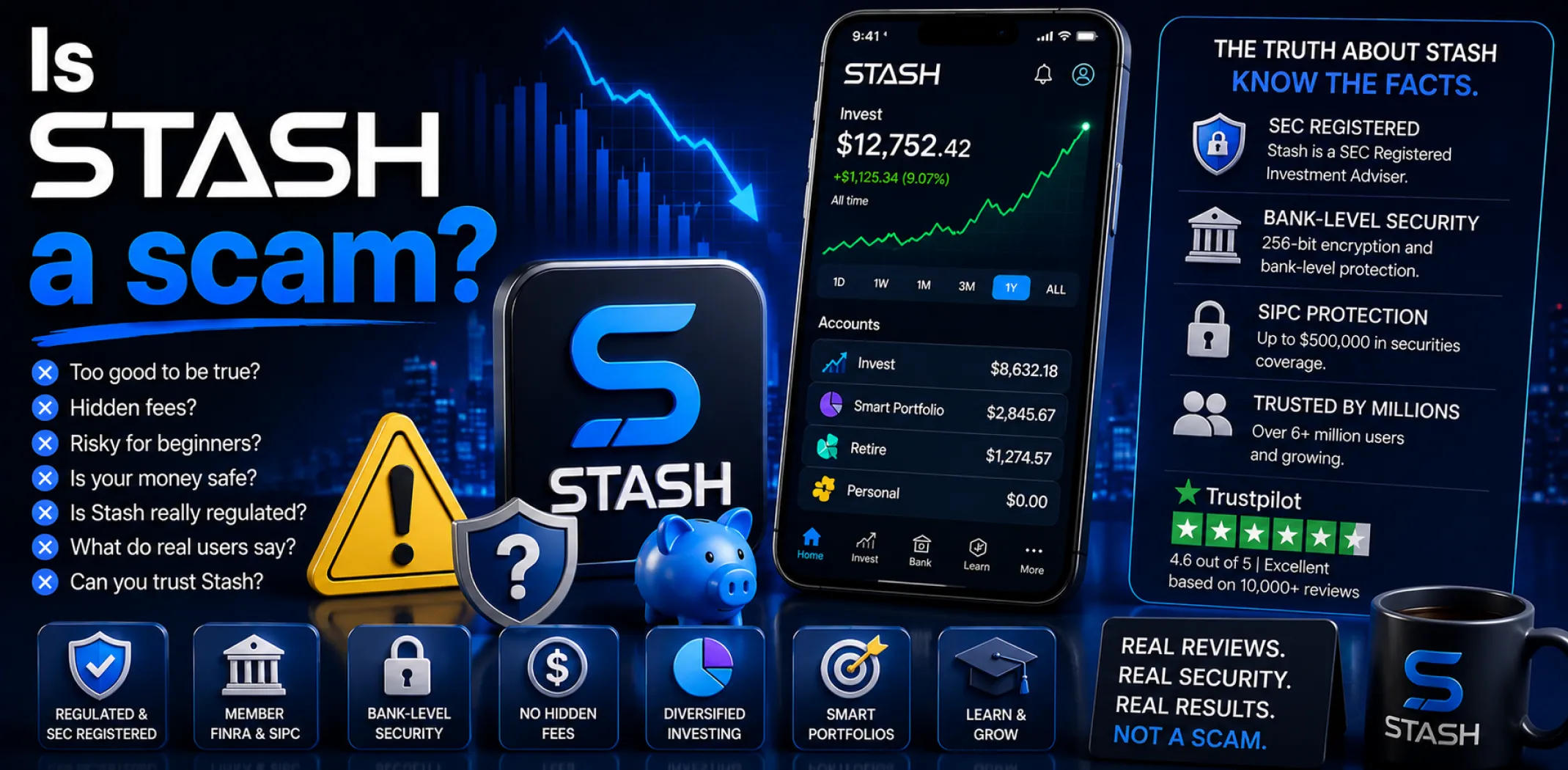
The “is Stash a scam” question shows up often enough that it deserves a serious answer rather than a one-line dismissal. The frustration behind it is real: some users have logged in to find their balance zeroed out, others have had accounts frozen with no clear explanation, and the BBB review score sits at a bleak 1.08 out of 5.
So here is the honest breakdown. Stash is not a scam by any regulatory or legal definition. But there are specific ways the platform can feel like one if you run into its documented failure points – and knowing those in advance makes all the difference.
Quick verdict
Stash is not a scam. It is an SEC-registered investment adviser and FINRA/SIPC-regulated broker-dealer that has operated since 2015 and was acquired by Grab Holdings at a 425 million dollar enterprise value in February 2026. Complaints stem from account freeze incidents, poor customer support responsiveness, and a flat monthly fee that disproportionately hurts small balances – none of which constitute fraud.
Key takeaways
- Stash is registered with the SEC as an investment adviser and broker-dealer and is a FINRA and SIPC member – verifiable on public government databases.
- The most common complaint pattern involves account freezes and slow support – documented on BBB and Reddit – not missing funds or fabricated charges.
- Grab Holdings agreed to acquire Stash at a 425 million dollar enterprise value in February 2026, with the deal expected to close in Q3 2026.
- Stash manages approximately 5 billion dollars in assets across more than 1 million paying subscribers.
- The flat 3-dollar monthly fee is the most financially damaging aspect of the platform for small investors – a structural issue, not deception.
What is Stash and who is behind it?
Stash is a New York City-based micro-investing and personal finance app founded in 2015 by Brandon Krieg and Ed Robinson – two former Wall Street professionals. The platform is designed around one core idea: make it possible for people with no experience and very little money to start investing.
In 2026, it offers fractional share investing, an automated Smart Portfolio, a banking account with a Stock-Back debit card, IRA accounts, and an AI Money Coach. The minimum to start investing is 5 dollars.
The corporate structure behind Stash is worth understanding clearly, because it is directly relevant to whether a scam accusation holds up. Stash Investments LLC is the SEC-registered investment adviser that manages the robo-advisor Smart Portfolio. The brokerage operations run through a FINRA-registered broker-dealer entity.
Custody of all invested assets is held by Apex Clearing Corporation, a well-established third-party custodian. Apex carries SIPC protection up to 500,000 dollars per account, including up to 250,000 dollars for uninvested cash. Every one of those registrations is publicly verifiable right now – on adviserinfo.sec.gov and FINRA BrokerCheck.
In February 2026, Singapore-based super-app Grab Holdings (Nasdaq: GRAB) announced a definitive agreement to acquire 100% of Stash at a 425 million dollar enterprise value. Grab – which serves 50 million monthly users across Southeast Asia – will acquire an initial 50.1% stake at closing, expected in Q3 2026, with the remainder purchased at fair market value over three years.
Stash will continue operating as an independent US brand. This is not the trajectory of a company running a fraudulent scheme. A publicly traded Nasdaq-listed acquirer performing due diligence on a 425 million dollar purchase is, by definition, validating the legitimacy of the business it is buying.
Is Stash a scam? Breaking down every complaint category
Scam accusations against Stash tend to fall into three distinct categories. Each one deserves a straight look at the evidence, because lumping them together obscures what is actually happening.
“My balance disappeared” – what actually happened
This is the complaint category that most frequently gets labeled a scam. BBB reports include accounts where users returned after a period of inactivity to find a zero balance with no transaction history visible. In documented cases, the most common causes are: accounts being closed by Stash after prolonged inactivity with funds mailed out by check to the address on file; identity re-verification failures locking users out of balance history; or display glitches in the app that were resolved on follow-up. These are serious operational failures – but in every documented case where the outcome is known, funds were present and ultimately returned or confirmed. That is not fraud; it is a support and communication failure.
Account freezes during time-sensitive moments
Multiple BBB complaints from 2025 and 2026 describe accounts being frozen mid-transaction – often after unusual credits or larger-than-normal activity – with Stash citing an “Operations review” that provides no timeline and no supervisor access. This fraud-detection mechanism is standard across digital-first financial institutions. The real problem is that Stash does not handle the escalation process well: support responses are templated, callbacks are rare, and users with time-sensitive needs are left without options. These are real service failures that Stash has not resolved, but they do not meet any definition of fraud.
The fee structure that quietly works against small investors
Stash charges 3 dollars per month for its Growth plan and 9 dollars per month for Stash+. These fees apply regardless of whether you trade or whether the market goes up or down. On a 100-dollar portfolio, that 3-dollar monthly fee equals a 36% annual cost – before a cent of market return is earned. Many users who sign up without doing the math feel deceived when their portfolio barely moves despite regular contributions. This is a genuine structural problem with Stash’s fee model for very small balances, but it is disclosed in Stash’s terms. Calling it a scam conflates a bad product fit with intentional fraud.
Common misconception:
✕ Stash stole my money – my balance showed zero after I logged in.
✓ A zero balance after inactivity typically means one of three things: the account was closed after a prolonged dormancy period and a check was mailed to the address on file; an identity re-verification step locked balance history from view; or an app display error occurred. Stash has no documented pattern of taking customer funds. If your balance appears to be missing, call Stash at the number on their official website and request written confirmation of your account status – do not assume the money is gone.
What does Stash’s regulation actually protect you from?
Regulation matters when assessing a scam claim, because it establishes what protections exist and what consequences the platform faces if it acts dishonestly. Stash operates under a layered structure that makes outright fraud both illegal and practically difficult to execute without detection.
The most important structural protection is the separation of custody. Your investments are not held by Stash – they are held by Apex Clearing Corporation. This means that even if Stash itself encountered financial trouble or were shut down by regulators, your securities would be held by an independent custodian and returned to you. This is the same structure used by most major online brokerages in the US, and it is specifically designed to prevent the scenario where a firm disappears with customer assets.
How to verify Stash yourself: Search “Stash Investments LLC” on the SEC IAPD at adviserinfo.sec.gov for the investment adviser registration. For the broker-dealer, search FINRA BrokerCheck at brokercheck.finra.org. Both checks take under two minutes and show the full registration history and any disciplinary actions on record.
What do real users say about Stash?
The ratings picture for Stash is one of the most polarized in the micro-investing space.
A 4.5 out of 5 on Trustpilot and a 1.08 out of 5 on the BBB from the same platform sounds contradictory until you understand the selection dynamic: Trustpilot ratings capture a broad cross-section of users leaving reviews during normal app use, while BBB reviews are almost exclusively filed by people who experienced a serious problem and got no resolution through normal channels.
Both signals are real – and together they tell you that Stash works well for most users but handles its failure cases particularly badly.
How does Stash actually make money – and is that a concern?
Understanding how Stash generates revenue is a useful check on whether its business model is aligned with your interests or working against them.
The subscription model is the most important thing to understand. Unlike percentage-based advisers that only earn more when your portfolio grows, Stash earns the same 3 dollars per month whether your balance is 50 dollars or 50,000 dollars. That means the fee is most punishing at exactly the moment when you are least able to absorb it – when you are just starting out with a small balance.
A user contributing 30 dollars per month and paying 3 dollars for the plan is handing 10% of their contributions to Stash before the market even gets a look at their money. This is not fraud. It is a disclosed fee structure that works against small balances in a way that percentage-fee platforms do not. The 75-dollar exit fee adds another real financial friction if you eventually decide to move to a platform that suits you better.
The break-even math: At a 3-dollar monthly fee, the fee equals 1% annually only once your balance reaches 3,600 dollars. At 1,000 dollars it is 3.6% per year – still high for a passive investment account. For context, Betterment charges 0.25% per year, making it roughly 14 times cheaper than Stash for a 1,000-dollar balance. Knowing this before you open an account is the difference between a platform that works for you and one that quietly erodes your returns.
Is Stash worth using – honest verdict
Stash is not a scam. A decade of SEC-regulated operation, 5 billion dollars in managed assets, a clean regulatory history you can verify in two minutes, and a 425 million dollar acquisition by a publicly listed Nasdaq company – none of that describes a fraudulent enterprise.
The complaints that fuel the scam question are real, but they describe a support quality problem and a fee structure that punishes small balances, not deliberate deception or theft.
The honest verdict on whether Stash is worth using depends entirely on context. If you are a complete beginner who wants the simplest possible way to start investing with small amounts, and you plan to build the balance consistently over time, the platform delivers on its core promise.
The Round-Ups feature, the fractional share access, and the Stash Learn education content are genuinely useful for people who have never invested before. But if your balance will stay small, if you need reliable fast access to your funds, or if you want tax efficiency through loss harvesting, there are platforms that serve those needs considerably better.
Not a scam – but the fee math is the real risk for small investors
Stash is a regulated, SIPC-protected micro-investing app with a verifiable decade of operation and a major acquisition deal confirming its business value. The account freeze and support complaints are operational failures, not evidence of fraud. What actually threatens small investors on this platform is the 3-dollar monthly flat fee, which represents a disproportionately high annual cost on balances under 1,000 dollars. Know that number before you fund your account, and Stash can be a reasonable starting point. Go in without doing the math, and you may feel deceived when your portfolio barely grows.
A free ecommerce store and Amazon channel – launched from one signup
AliDropship builds and launches your online store, then delivers a complete Amazon Seller Kit. No inventory, no monthly subscription on a zero balance, no technical knowledge needed. Two income channels from one free signup.
Want to build income that is not held hostage by a monthly fee?
One thing that makes Stash frustrating for small investors is that the platform charges you 3 dollars a month whether your portfolio grows or not. If you are at the stage where you want to generate active income – money that comes from effort and sales rather than waiting for market returns – ecommerce is worth understanding as a parallel track.
AliDropship sets up your store and loads it with products so you can focus on selling, not building infrastructure.
Free turnkey store – built, designed, and filled with products
Your store arrives professionally designed, pre-loaded with 50 bestselling products, and fully optimized to convert. No setup fees, no coding, no design time. You start at the product-testing stage – not the store-building stage. Hosting, SSL, and payment gateway are all included.
Winning products, one-click import
Browse trending and niche items from AliDropship’s catalog – including brand-name and digital products – and import them to your store in one click. The catalog updates regularly so your store always has fresh, competitive inventory without manual research.
Automated fulfillment and real-time tracking
Orders are processed automatically through global supplier connections. Customers receive real-time tracking updates – building trust and reducing support volume. You do not touch the shipping logistics; the platform handles it end-to-end.
Built-in marketing and promotion tools
Email campaigns, discount management, abandoned-cart recovery, live countdown timers, and social media integration are all included or available as add-ons. No prior marketing experience required – the tools guide you through each campaign type.
Beginner-friendly – no coding, no learning curve
An intuitive dashboard walks you through every step. Adding products, running campaigns, and scaling your catalog require no technical knowledge. As your business grows, the platform scales with you – adding features without adding complexity.
AliExpress integration – one-click imports, synced inventory
AliDropship connects directly to AliExpress for one-click product imports, automated order processing, and synced tracking. Inventory stays current with the latest products and prices. Combined with the turnkey store and automated fulfillment, this integration makes the entire operation manageable for one person.
Free ecommerce store – ready to sell today
Built, stocked, and launched for you. Digital and physical products included. Automated fulfillment so you never touch inventory.
Full Amazon Seller Kit – 300M buyers waiting
Product import file ready to upload. Step-by-step Amazon setup guide included. Tap into a $514B marketplace from the same free signup.
Is Stash a scam?
Why do people say Stash stole their money?
Most complaints about missing funds involve accounts closed after prolonged inactivity, with funds mailed out by check to the address on file – not taken. Other reports describe app display errors or identity re-verification locks that make the balance temporarily invisible. In documented BBB cases where the outcome is known, the funds were present and ultimately returned to the account holder. The real failure is that Stash does not communicate clearly about account closures or verification holds, leaving users in distress while the issue is resolved.
Is Stash safe to invest with in 2026?
Stash is safe from a regulatory standpoint in 2026. Your investments are held in custody by Apex Clearing Corporation, not Stash, and covered by SIPC insurance up to 500,000 dollars per account. The app uses 256-bit encryption and biometric login. The Grab Holdings acquisition announced in February 2026 adds a well-capitalised backer with resources to invest in platform stability. The practical safety concern is the account freeze pattern and slow support response – not regulatory risk.
What are the hidden costs of using Stash?
The main costs beyond the monthly subscription are a 1% fee on instant transfers and a 75-dollar ACAT fee to transfer your assets to another brokerage. The monthly subscription itself is the biggest structural cost for small balances: at 3 dollars per month, a 100-dollar portfolio pays 36% of its value per year in fees. The break-even point where the fee reaches 1% per year is a balance of 3,600 dollars. Betterment charges 0.25% per year regardless of balance, making it a significantly cheaper option for investors under that threshold.
What are better alternatives to Stash for small investors?
For beginners who want no monthly fee, Fidelity and Charles Schwab offer commission-free investing with no account minimums and no flat subscription charges. For automated investing with tax-loss harvesting, Betterment charges 0.25% annually – far more cost-effective than 3 dollars per month on a small balance. Acorns is a closer micro-investing alternative at 3 dollars per month but offers less investment choice. For people looking to build active income rather than grow existing savings, the AliDropship ecommerce platform offers a free online store plus Amazon Seller Kit as a starting point with no monthly fee on an empty account.