Is Public Legit? An Honest Review Of Public.com For 2026

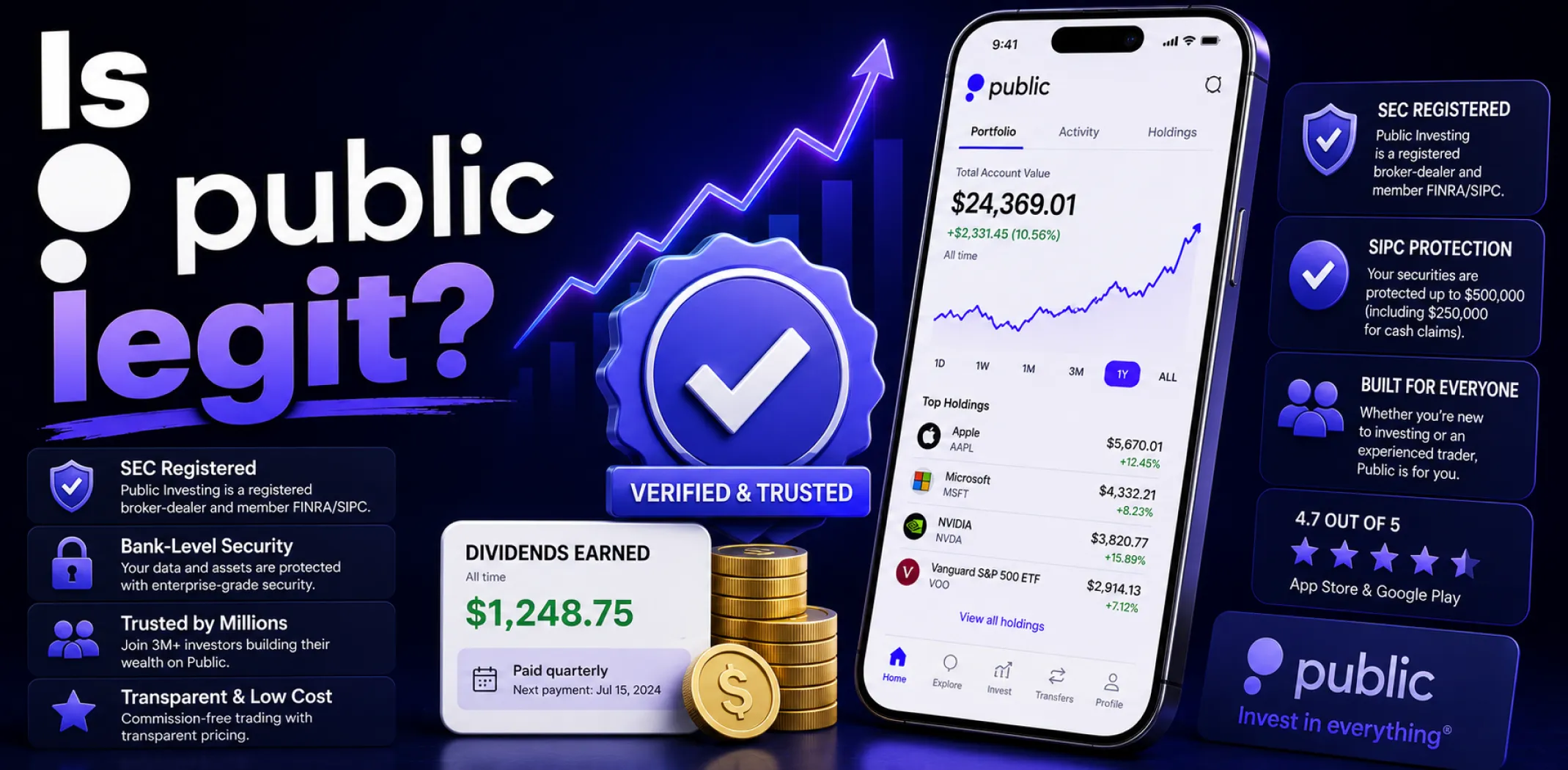
Public.com is one of those platforms that inspires genuine curiosity: it offers stocks, bonds, options, crypto, and high-yield cash in one place, pays you a rebate when you trade options, and was one of the first retail brokers to publicly push back on payment for order flow. If something sounds too good to be true, it is natural to wonder what the catch is.
The answer, in 2026, is that there is no hidden catch – but there are specific fees and limitations worth knowing before you open an account. Public is a legitimate, FINRA-regulated and SIPC-insured broker, and this review gives you the complete picture.
Quick verdict
Public is a legitimate, SEC-registered and FINRA/SIPC-regulated multi-asset broker founded in 2019 in New York City, with 446 million dollars in institutional backing. It offers commission-free stocks and ETFs, a unique options rebate program, bonds, crypto, and a high-yield cash account. The main caveats are a 3.99-dollar monthly inactivity fee for low-balance inactive accounts, a 75-dollar ACAT exit fee, no IRA accounts (except crypto IRA), and no robo-advisor.
Key takeaways
- Public Investing Inc. (Open to the Public Investing, Inc.) is a FINRA member and SIPC member – both registrations are publicly verifiable on government databases.
- Public is the only major retail broker that pays users an options rebate of 0.06 to 0.18 dollars per contract – sharing its payment-for-order-flow revenue with the trader.
- Cash held at Public is FDIC-insured up to 5 million dollars through a network of 20 partner banks – far above the standard 250,000-dollar single-bank limit.
- The most common documented complaints involve withdrawal delays and the inactivity fee charged on accounts with under 70 dollars that have been inactive for six months.
- Public does not currently offer traditional or Roth IRA accounts (the crypto IRA launched in early 2026 via acquisition), making it unsuitable as a sole retirement account provider.
What is Public and how does it work?
Public.com is a New York City-based multi-asset investing platform founded in 2019 – originally operating under the name Matador before rebranding. The company is co-led by co-CEOs Leif Abraham and Jannick Malling, with the legal entity operating as Open to the Public Investing, Inc. under the parent company Public Holdings, Inc.
In 2026, Public positions itself as the investing platform for people who take their finances seriously – offering a notably broader asset range than most mobile-first brokers, combined with a mobile-first design and commission-free trading.
The platform covers stocks, ETFs, options, bonds (including US Treasuries), cryptocurrency, and fractional shares starting from 1 dollar.
What distinguishes Public from most of its competitors is the combination of a high-yield cash account paying over 4% APY, a Bond Account targeting 5%+ yield on a 1,000-dollar minimum, and an options rebate program that pays traders 0.06 to 0.18 dollars per contract – sharing back the payment-for-order-flow revenue that most brokers keep for themselves.
In March 2026, Public began rolling out AI-powered portfolio automation called Agents, which lets investors automate investment strategies without a human adviser.
Is Public legitimate? What the regulatory record shows
In 2026, Public has a verifiable and clean regulatory record. Open to the Public Investing, Inc. is registered with the SEC as a broker-dealer and is a FINRA member – both checkable within two minutes on FINRA BrokerCheck at brokercheck.finra.org.
SIPC membership covers your securities and cash up to 500,000 dollars per account in the event the brokerage fails as a firm. That is the same coverage level carried by Fidelity, Schwab, and most major US brokers.
What makes Public’s insurance picture particularly strong is the FDIC coverage on uninvested cash. Rather than routing cash through a single bank with the standard 250,000-dollar FDIC limit, Public sweeps uninvested cash across 20 partner banks – providing FDIC coverage of up to 5 million dollars per depositor. That is 20 times the standard single-bank protection.
On the institutional side, Public has raised 446 million dollars across 10 funding rounds, with its Series D in February 2021 valuing the company at 1.2 billion dollars. In May 2026, it acquired Treasury Interactive, its most recent M and A activity. A company under regulatory scrutiny or running a dishonest operation does not attract that level of institutional capital or maintain an A+ rating with the BBB.
One regulatory note worth addressing directly: Public originally built its reputation on refusing payment for order flow for equity trades – a practice where market makers pay brokers to route orders through them, which can result in slightly worse execution prices for the trader.
In recent years, Public has shifted its model somewhat: free stock and ETF trades are now routed through wholesalers that do pay for order flow, but traders who want non-PFOF execution can opt into paid routing for a per-share fee. The transparency around this shift is public and disclosed. It is not the behavior of a company operating deceptively.
What are the common complaints and red flags?
Legitimate platforms have real failure points, and Public is no different. Two complaint categories show up consistently across BBB and Trustpilot, and both are worth understanding before you open an account.
Common misconception:
✕ Public charged me a fee without warning – that is a scam.
✓ The inactivity fee of 3.99 dollars per month is disclosed in Public account terms. It applies only to accounts with a total balance under 70 dollars that have had no trading activity for six months or more. It does not apply to active accounts or accounts with meaningful balances. If your account was charged this fee, it means the account was dormant with a very small balance – not that Public is deducting fees arbitrarily.
The first complaint category is the inactivity fee. A number of users who opened accounts, deposited a small amount to test the platform, and then forgot about it for several months returned to find their balance reduced by a 3.99-dollar monthly charge. The fee is disclosed in account terms, but it is not prominently surfaced during the sign-up flow in a way that prevents surprises.
The solution is simple: either keep your balance above 70 dollars, make at least one trade every six months, or close the account if you are not actively using it. This is not fraud – it is an underpromoted disclosure.
The second category is withdrawal delays. Some users have reported waiting longer than expected for funds to clear after selling securities or requesting withdrawals. Standard settlement in US markets is T+1 for most equities as of 2024, meaning proceeds from a sale are typically available the next business day.
Instant withdrawals are available on Public but carry a 3.5% fee with a 1-dollar minimum – a meaningful cost if you are withdrawing frequently.
One notable February 2026 BBB complaint documented unauthorized transactions on a user account – multiple securities liquidated and crypto transferred to an external wallet within minutes – which Public ultimately resolved but drew criticism for its slow initial response. This was an account security incident, not a platform-level fraud.
Important: Public charges a 75-dollar ACAT outgoing transfer fee to move your assets to another brokerage – the same level as Stash and higher than many competitors. If you plan to eventually migrate to a different platform, factor this into your decision before you transfer significant assets in.
What makes Public stand out from other brokers?
Once the legitimacy question is settled, Public has several genuinely differentiating features that are worth understanding – because they are rare or unique in the retail broker space.
Options rebate – you get paid to trade
Public pays options traders a rebate of 0.06 to 0.18 dollars per contract as a share of its PFOF revenue. No other major retail broker does this. Volume traders who are active in options will find this meaningfully improves their cost basis over time.
High-yield cash and Bond Account
Uninvested cash earns 4%+ APY – comparable to a high-yield savings account. The Bond Account targets 5%+ yield on a 1,000-dollar minimum, making Public one of the few brokers where your idle cash works meaningfully.
AI Agents and Investment Plans
Launched in March 2026, AI Agents let investors automate portfolio strategies using natural-language prompts. Investment Plans allow multi-asset baskets with recurring buys – a middle ground between full DIY trading and a traditional robo-advisor.
What Public does not offer
No traditional or Roth IRA accounts (crypto IRA available from early 2026). No robo-advisor. No mutual fund selection beyond limited coverage. The Bond Account requires a 1,000-dollar minimum. Crypto spreads of 1.25% are higher than dedicated exchanges like Coinbase Advanced.
What do real users say about Public?
User sentiment on Public divides along predictable lines. Investors who actively trade across the asset classes it supports – particularly those who use options and benefit from the rebate – tend to rate it highly. Users who opened accounts with small amounts, became inactive, and were surprised by the inactivity fee represent the most consistent negative experience. Here are two representative scenarios.
Is Public worth it – honest verdict
Public is legitimate, well-regulated, and – for the right investor profile – genuinely one of the more differentiated platforms available in 2026.
The combination of a high-yield cash account, an options rebate program unique in the industry, bond access without a separate brokerage account, and the FDIC coverage extending to 5 million dollars through its bank network adds up to a product that is more thoughtfully designed than most mobile-first brokers.
The platform is not, however, the right fit for everyone. Retirement savers who need a traditional or Roth IRA will need a separate account elsewhere – Public does not offer those products outside of the crypto IRA that launched in early 2026. Mutual fund investors will find the selection thin.
Serious crypto traders will find the 1.25% spread expensive compared to dedicated exchanges. And anyone who opens a small account and goes inactive for six months without crossing the 70-dollar balance threshold will encounter the inactivity fee.
The complaints that appear on the BBB and Trustpilot are real, but they are operational and disclosure issues – not evidence of a fraudulent operation. Public has an A+ BBB rating, has not been subject to any significant regulatory enforcement actions, and responded to the documented February 2026 account security incident by ultimately resolving the user complaint. That is not a perfect record, but it is not a scam record either.
Legitimate and differentiated – best for active multi-asset investors
Public is a properly regulated, SIPC and FDIC-protected broker with 446 million dollars in institutional backing, a clean regulatory history, and a genuinely unique set of features including the options rebate program and 5-million-dollar FDIC cash coverage. It suits active investors who trade across multiple asset classes and want their idle cash working hard. The inactivity fee on dormant low-balance accounts and the 75-dollar ACAT exit fee are the two costs most likely to surprise users – know them upfront and they are easily managed.
A free ecommerce store and Amazon channel – both ready from one signup
AliDropship builds your online store and delivers a complete Amazon Seller Kit. No monthly fee on a zero balance, no inventory, no coding needed. Generate active sales income while your investment portfolio runs on Public.
Want to build income that does not wait on market returns?
Investing platforms like Public let your money work in the background – but market returns depend on market conditions and time in the market. For people who want to build active income that responds to their own effort rather than index movements, ecommerce offers a different model.
AliDropship removes the biggest barriers to starting: you get a fully built store, products already loaded, and the infrastructure to sell from day one without touching inventory or writing a line of code.
Free turnkey store – built, designed, and filled with products
Your store arrives professionally designed, pre-loaded with 50 bestselling products, and fully optimized to convert. No setup fees, no coding, no design time. You start at the product-testing stage – not the store-building stage. Hosting, SSL, and payment gateway are all included.
Winning products, one-click import
Browse trending and niche items from AliDropship’s catalog – including brand-name and digital products – and import them to your store in one click. The catalog updates regularly so your store always has fresh, competitive inventory without manual research.
Automated fulfillment and real-time tracking
Orders are processed automatically through global supplier connections. Customers receive real-time tracking updates – building trust and reducing support volume. You do not touch the shipping logistics; the platform handles it end-to-end.
Built-in marketing and promotion tools
Email campaigns, discount management, abandoned-cart recovery, live countdown timers, and social media integration are all included or available as add-ons. No prior marketing experience required – the tools guide you through each campaign type.
Beginner-friendly – no coding, no learning curve
An intuitive dashboard walks you through every step. Adding products, running campaigns, and scaling your catalog require no technical knowledge. As your business grows, the platform scales with you – adding features without adding complexity.
AliExpress integration – one-click imports, synced inventory
AliDropship connects directly to AliExpress for one-click product imports, automated order processing, and synced tracking. Inventory stays current with the latest products and prices. Combined with the turnkey store and automated fulfillment, this integration makes the entire operation manageable for one person.
Free ecommerce store – ready to sell today
Built, stocked, and launched for you. Digital and physical products included. Automated fulfillment so you never touch inventory.
Full Amazon Seller Kit – 300M buyers waiting
Product import file ready to upload. Step-by-step Amazon setup guide included. Tap into a $514B marketplace from the same free signup.
Is Public.com a legitimate investing app?
Is Public.com safe to use in 2026?
Public.com is safe by regulatory and security standards. Securities are SIPC-protected up to 500,000 dollars. Cash is FDIC-insured up to 5 million dollars through a 20-bank sweep network – 20 times the standard single-bank limit. The platform uses two-factor authentication, AES 128-bit bank-grade encryption, and biometric login. One documented February 2026 BBB complaint described unauthorized account activity – multiple liquidations and crypto transfers within minutes – which Public ultimately resolved. That incident points to the importance of strong account passwords and two-factor authentication, not a platform-level security failure.
What are the fees on Public.com?
Public.com charges no commissions on stock and ETF trades and no per-contract fees on equity options. The main fees to know are: a 3.99-dollar monthly inactivity fee on accounts with balances under 70 dollars that have been inactive for six months or more; a 75-dollar ACAT outgoing transfer fee to move assets to another brokerage; a 3.5-percent fee on instant withdrawals with a 1-dollar minimum; and a 1.25-percent spread on crypto trades above 500 dollars. Public Premium costs 10 dollars per month or 96 dollars per year for access to advanced analytics. There is no annual fee or account maintenance fee for standard accounts.
What are the biggest limitations of Public.com?
Public.com does not currently offer traditional or Roth IRA accounts – only a crypto IRA launched in early 2026 via the Alto acquisition. This makes it unsuitable as a sole retirement savings platform for most investors. The Bond Account requires a 1,000-dollar minimum, locking out small-balance investors from one of the platform strongest features. Mutual fund selection is limited compared to Fidelity or Schwab. Crypto spreads of 1.25% are higher than dedicated exchanges like Coinbase Advanced. There is no robo-advisor, so all investment decisions are self-directed or managed through Investment Plans and AI Agents.
What are the best alternatives to Public.com?
For retirement accounts, Fidelity and Charles Schwab offer no-fee traditional and Roth IRAs with far broader investment options. For automated investing with tax-loss harvesting, Betterment and Wealthfront charge 0.25% annually and handle the portfolio entirely. For active traders who want more advanced tools, Webull and Interactive Brokers offer superior charting and order types. For beginner investors who want a fully hands-off automated experience with Round-Ups, Acorns and Stash are closer micro-investing alternatives. Public stands apart from all of these with its options rebate program and its 5-million-dollar FDIC cash coverage – features that currently have no direct equivalent at competing retail brokers.