Is Public A Scam? What The Evidence Shows In 2026

The “is Public a scam” question gets asked for specific reasons: people encounter the inactivity fee without warning, read about a documented account hack on the BBB, or spot negative reviews on Trustpilot and wonder whether something dishonest is going on.
The direct answer is no – Public.com is a FINRA-regulated, SIPC-insured broker with 446 million dollars in institutional backing and a clean regulatory record. But the complaints behind the question are pointing at real problems, and understanding exactly what they are – and what they are not – is how you make a genuinely informed decision about the platform.
Quick verdict
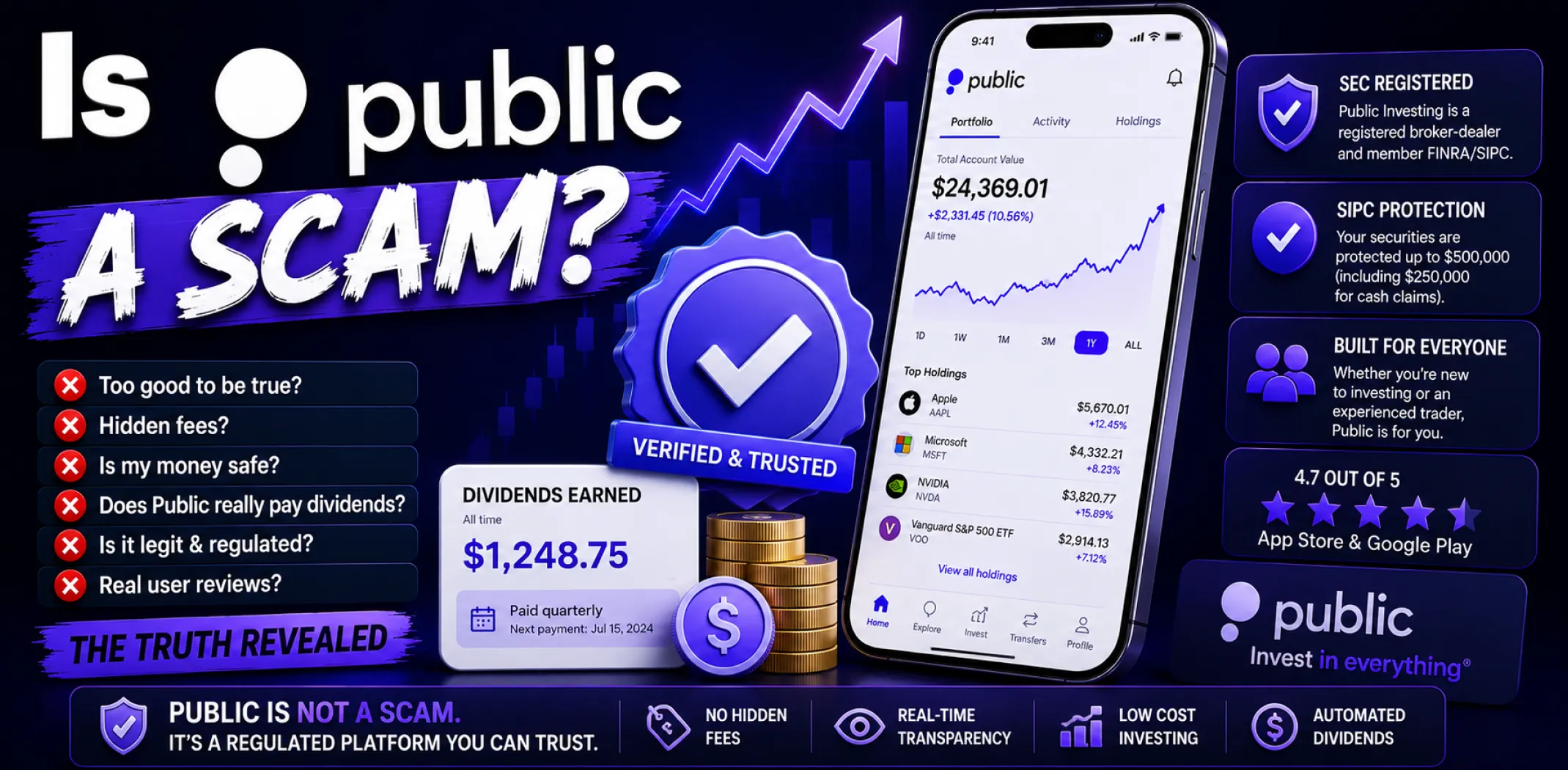
Public is not a scam. Open to the Public Investing, Inc. is an SEC-registered, FINRA and SIPC-regulated broker founded in 2019, backed by 446 million dollars in institutional funding, with an A+ BBB rating and no major regulatory enforcement actions. Documented complaints focus on a surprise inactivity fee, withdrawal processing times, and one account-level security incident – none of which constitute platform-level fraud.
Key takeaways
- Open to the Public Investing, Inc. is SEC-registered, a FINRA member, and a SIPC member – all verifiable on public government databases within two minutes.
- The inactivity fee of 3.99 dollars per month applies only to accounts with balances under 70 dollars that have been inactive for six months or more – it is disclosed in account terms, not a hidden charge.
- A February 2026 BBB complaint documented a legitimate account security incident involving unauthorized transactions – Public resolved it, but its initial response drew criticism.
- Public has raised 446 million dollars from institutional investors including a 1.2 billion dollar Series D valuation in 2021, and holds an A+ BBB rating.
- The shift away from its original payment-for-order-flow-free stance is real and documented – free trades now use PFOF routing, and PFOF-free execution requires a paid opt-in.
What is Public and who runs it?
Public.com is a New York City-based multi-asset investing platform founded in 2019, operating under the legal entity Open to the Public Investing, Inc. (a subsidiary of Public Holdings, Inc.). The company is led by co-CEOs Leif Abraham and Jannick Malling. Public launched as a rebranded version of an earlier app called Matador, pivoting to a social investing model before evolving into the broader multi-asset platform it is in 2026.
The platform offers stocks, ETFs, options, bonds (including US Treasuries), cryptocurrency, and fractional shares starting from 1 dollar. Its differentiating features in 2026 include a high-yield cash account paying over 4% APY, a Bond Account targeting 5%+ yield, an options rebate program that pays traders 0.06 to 0.18 dollars per contract, and AI-powered portfolio automation called Agents launched in March 2026.
In May 2026, Public acquired Treasury Interactive – its most recent M and A activity – signaling continued investment in the platform rather than a business in decline.
The corporate structure matters when evaluating a scam claim. Open to the Public Investing, Inc. is an SEC-registered broker-dealer whose registration and any disciplinary history is publicly searchable on FINRA BrokerCheck at brokercheck.finra.org right now. SIPC membership means your securities – up to 500,000 dollars – are protected by an independent government-backed scheme if the brokerage fails.
Cash is protected by FDIC up to 5 million dollars through a 20-bank sweep network, 20 times the standard single-bank FDIC limit. These are not self-reported claims. They are government registrations you can verify in under two minutes.
Is Public a scam? Breaking down every complaint category
Every scam accusation against Public traces back to one of four documented issues. Examining each one against the evidence produces a clear picture.
The inactivity fee – a disclosure failure, not fraud
The most common complaint on Trustpilot and the BBB involves users discovering a 3.99-dollar monthly fee charged to their account without feeling they were warned. The fee is real and it is documented in account terms: it applies to accounts with balances under 70 dollars that have had no trading activity for six consecutive months or more. It does not apply to active accounts or accounts above the balance threshold. Users who opened accounts with 20 to 50 dollars to test the platform, then went inactive, are the people who hit this fee. The charge is disclosed – but it is not surfaced prominently enough during sign-up to prevent surprises. That is a UX and disclosure failure. It is not fraud.
Withdrawal delays – processing times, not theft
Some users report waiting longer than expected for funds to clear after selling securities or requesting a cash withdrawal. Standard US equity settlement is T+1 – one business day after a trade. Instant withdrawals are available but cost 3.5% of the amount, with a 1-dollar minimum. Users who expect same-day access to proceeds without paying the instant withdrawal fee sometimes experience what feels like a delay when they are actually waiting on standard settlement mechanics. Public does not charge a fee for standard withdrawals – but it does not process them instantly for free. That is a product limitation, not evidence of a platform withholding funds.
The February 2026 account hack – real incident, not platform fraud
One of the more alarming BBB complaints from February 2026 described a user who logged in to find multiple securities liquidated and crypto transferred to an external wallet – all within about four minutes, during or immediately after a suspicious login. The user had two-factor authentication enabled via SMS. Public ultimately resolved the complaint and the user recovered their funds, but the initial response was described as a generic statement that did not address the specific Regulation E investigation request. This was a targeted account-level security incident – likely enabled through SIM-swapping or credential theft – not a platform-level operation to steal user assets.
The PFOF shift – a policy change, not a hidden scheme
Public built early brand equity on refusing payment for order flow for equities – a practice where market makers pay brokers to route trades, potentially at a slight cost to execution quality. In recent years, Public shifted: free stock and ETF trades are now routed through wholesalers that do pay for order flow. Traders who want non-PFOF execution can opt into a paid routing option. Some users who joined Public specifically because of its anti-PFOF positioning felt misled by this change. The shift is real and represents a meaningful change from the platform original identity – but it is publicly disclosed and was communicated to users. A policy change you disagree with is not a scam.
What Public regulation actually protects you from
The regulatory structure around Public is worth understanding in full, because it directly addresses the scenarios that would constitute actual fraud.
Common misconception:
✕ Public charged my account a fee I never agreed to – that is theft.
✓ The 3.99-dollar monthly inactivity fee is in Public account terms and applies only when two conditions are both met: your account balance is under 70 dollars AND you have had zero trading activity for six consecutive months. Accounts above 70 dollars are never charged this fee regardless of inactivity. If you were charged it, check when you last made a trade and what your balance was at the time. The fee is not applied arbitrarily or to active users.
A genuinely fraudulent brokerage typically has no verifiable registration, makes it structurally impossible to withdraw funds, promises unusually high fixed returns, and operates without any oversight that could hold it accountable. Public fails every one of those indicators. You can verify its FINRA registration today.
Withdrawals are processed at standard settlement times at no charge (or faster for a disclosed fee). No fixed returns are promised anywhere on the platform. And FINRA membership means Public is subject to examination, audits, and arbitration if a customer has a valid complaint. That is the opposite of what a scam looks like.
How to verify Public yourself: Go to brokercheck.finra.org and search “Open to the Public Investing.” You will see the full registration history, any disciplinary actions, and the firm membership status. For the SEC registration, search the same entity on the SEC EDGAR system. Both checks take under two minutes.
The account hack incident – what actually happened
The February 2026 BBB account security incident deserves its own section because it is the most alarming complaint in the documented record and the one most likely to fuel scam accusations. Here is what the BBB filing describes.
The pattern of the February 2026 attack is consistent with a SIM-swapping attack: the perpetrator likely obtained the user phone number, transferred the SIM to a device they controlled, intercepted the SMS-based two-factor authentication code, logged in, and then rapidly liquidated assets and transferred cryptocurrency to a wallet they controlled before the user could respond.
This attack vector is not unique to Public – it has been documented across Coinbase, Robinhood, and other platforms. It does not indicate that Public is operating dishonestly or has a systematic security failure at the platform level.
The criticism that is valid is that Public initial response was a generic statement that did not address the user specific Regulation E investigation request. Regulation E governs electronic fund transfer disputes and requires financial institutions to investigate claims of unauthorized transactions within specific timeframes.
Public eventually resolved it, but the complaint processing was slow and impersonal in a way that left the user feeling dismissed. That is a customer service failure – a serious one when the stakes involve the person entire account balance – but it is not evidence of institutional dishonesty.
Important: If you have crypto assets on Public, use an authenticator app for two-factor authentication rather than SMS. SMS-based 2FA is vulnerable to SIM-swapping attacks. Authenticator app codes are generated locally on your device and cannot be intercepted by transferring a phone number. This applies to every platform where you hold crypto – not just Public.
What do real users say about Public?
The user sentiment picture on Public is more negative on review sites than the regulatory and institutional record would suggest – and the pattern, once you look at it carefully, reflects a mismatch between the platform intended audience and the users leaving complaints rather than evidence of systematic bad behavior.
Who should and should not use Public in 2026?
The complaints about Public cluster almost exclusively around two types of users: people who open small accounts and go inactive, and people who joined for the original anti-PFOF positioning and feel the brand has changed. Both grievances are understandable. Neither reflects a fraudulent platform. The honest way to assess Public in 2026 is to understand clearly who it is built for – and who it is not.
Best for: active multi-asset investors
If you actively trade stocks, ETFs, options, and bonds and want to earn a rebate on options trades while keeping uninvested cash at 4%+ APY, Public offers a genuinely differentiated package. The options rebate program is unique among retail brokers and the Bond Account interest is competitive with standalone savings accounts.
Best for: cash-heavy investors
Investors who hold significant uninvested cash between positions benefit from the high-yield account at 4%+ APY and the 5-million-dollar FDIC coverage. These are genuinely better than what most competing mobile-first brokers offer on idle cash.
Poor fit: retirement savers
Public does not offer traditional or Roth IRA accounts outside the crypto IRA launched in early 2026. Anyone whose primary goal is tax-advantaged retirement saving needs a separate account at Fidelity, Schwab, or a comparable platform. Using Public as your only investment account means leaving significant tax benefits on the table.
Poor fit: small inactive accounts
The inactivity fee is the single biggest risk for users who open a small account, buy one position, and stop trading. If your balance drops under 70 dollars and you make no trades for six months, the fee erodes the remainder. If you are not planning to trade regularly, either keep your balance above 70 dollars at all times or close the account and withdraw your funds.
Is Public worth it – honest verdict
Public is not a scam. The regulatory evidence – FINRA membership, SEC registration, SIPC insurance, FDIC cash coverage, A+ BBB rating, 446 million dollars in institutional capital, and no major enforcement actions – rules that out definitively.
The documented complaints describe four operational issues: an underpromoted inactivity fee, standard settlement processing times confused for withdrawal delays, a resolved account security incident consistent with SIM-swapping, and a PFOF policy shift that frustrated users who valued the original positioning. None of those things meet any reasonable definition of fraud.
What they do mean is that Public is the wrong platform for certain users. If you plan to open a small account and trade infrequently, the inactivity fee will eventually surprise you. If you need a traditional IRA, Public cannot provide it.
If you need instant withdrawal access without paying a 3.5% fee, standard settlement timelines will feel like a friction point. And if you have crypto on the platform, use an authenticator app instead of SMS for two-factor authentication. Knowing these things going in eliminates the main sources of the “scam” experience that some users describe.
Not a scam – but the inactivity fee and PFOF shift are real gotchas
Public is a regulated, SIPC and FDIC-protected broker with clean regulatory history and genuinely differentiated features for active investors. The inactivity fee on dormant low-balance accounts is the primary complaint driver and is easily avoided with one simple rule: keep your balance above 70 dollars or make at least one trade every six months. The PFOF policy change from the original no-PFOF stance is a legitimate grievance but a disclosed one. Neither issue constitutes fraud – they are product design choices that some users find unacceptable, and knowing them upfront is how you decide whether the platform suits you.
A free ecommerce store and Amazon channel – both ready from one signup
AliDropship builds your online store and delivers a full Amazon Seller Kit. No inactivity fee. No monthly charge on a dormant balance. No inventory or coding needed. Two active income channels from one free signup while your investment portfolio runs.
Want to build income that charges nothing while you are not active?
One of the things that makes Public frustrating for casual investors is the inactivity fee – a cost that applies specifically when you are not using the platform. For people who want to build income that is responsive to their effort rather than penalizing inactivity, ecommerce offers a fundamentally different model.
AliDropship sets up your store and loads it with products so there is no charge for simply having the platform available – your costs scale with your activity, not against it.
Free turnkey store – built, designed, and filled with products
Your store arrives professionally designed, pre-loaded with 50 bestselling products, and fully optimized to convert. No setup fees, no coding, no design time. You start at the product-testing stage – not the store-building stage. Hosting, SSL, and payment gateway are all included.
Winning products, one-click import
Browse trending and niche items from AliDropship’s catalog – including brand-name and digital products – and import them to your store in one click. The catalog updates regularly so your store always has fresh, competitive inventory without manual research.
Automated fulfillment and real-time tracking
Orders are processed automatically through global supplier connections. Customers receive real-time tracking updates – building trust and reducing support volume. You do not touch the shipping logistics; the platform handles it end-to-end.
Built-in marketing and promotion tools
Email campaigns, discount management, abandoned-cart recovery, live countdown timers, and social media integration are all included or available as add-ons. No prior marketing experience required – the tools guide you through each campaign type.
Beginner-friendly – no coding, no learning curve
An intuitive dashboard walks you through every step. Adding products, running campaigns, and scaling your catalog require no technical knowledge. As your business grows, the platform scales with you – adding features without adding complexity.
AliExpress integration – one-click imports, synced inventory
AliDropship connects directly to AliExpress for one-click product imports, automated order processing, and synced tracking. Inventory stays current with the latest products and prices. Combined with the turnkey store and automated fulfillment, this integration makes the entire operation manageable for one person.
Free ecommerce store – ready to sell today
Built, stocked, and launched for you. Digital and physical products included. Automated fulfillment so you never touch inventory.
Full Amazon Seller Kit – 300M buyers waiting
Product import file ready to upload. Step-by-step Amazon setup guide included. Tap into a $514B marketplace from the same free signup.
Is Public.com a scam?
Why did Public charge me a fee I did not expect?
The fee you most likely encountered is the inactivity fee: 3.99 dollars per month charged to accounts with balances under 70 dollars that have had no trading activity for six or more consecutive months. This fee is documented in account terms. It does not apply to accounts above the 70-dollar balance threshold or to accounts that have made at least one trade within the last six months. The fix going forward is to either keep your balance above 70 dollars, make at least one trade every six months, or close the account if you are not actively using it. Standard withdrawal and instant withdrawal (3.5% fee, 1-dollar minimum) are the other fees that sometimes surprise users.
Is Public safe to use in 2026?
Public is safe from a regulatory and security standpoint. Securities are SIPC-protected up to 500,000 dollars. Cash is FDIC-insured up to 5 million dollars through a 20-bank sweep network. The platform uses AES 128-bit encryption, two-factor authentication, and biometric login. One documented February 2026 account security incident involved unauthorized transactions consistent with a SIM-swapping attack on a single user account – not a platform-level breach. Public resolved that complaint. For accounts holding crypto, an authenticator app is strongly recommended over SMS two-factor authentication to reduce SIM-swapping risk.
Did Public get hacked?
One documented February 2026 BBB complaint described a single user account where multiple securities were liquidated and cryptocurrency was transferred to an external wallet within approximately four minutes of suspicious login activity – consistent with a SIM-swapping or credential theft attack. Public ultimately resolved the complaint and the user recovered their funds. This was an account-level security incident, not a platform-wide hack or systematic theft. No major platform-level security breach has been publicly reported for Public.com. Switching from SMS to an authenticator app for two-factor authentication significantly reduces exposure to SIM-swapping attacks.
What are the best alternatives to Public.com?
For retirement accounts, Fidelity and Charles Schwab offer full traditional and Roth IRA accounts with no fees and a broader range of investment options. For automated investing with tax-loss harvesting, Betterment and Wealthfront charge 0.25% annually with no inactivity fee. For active traders who want advanced charting, Webull and Interactive Brokers offer deeper tools. For micro-investing with automated Round-Ups, Acorns and Stash are closer alternatives with no inactivity fee concern for small balances. None of these platforms offer the options rebate program or the 5-million-dollar FDIC cash coverage that distinguishes Public from its competitors.