Is Plus500 Legit? What You Need To Know In 2026

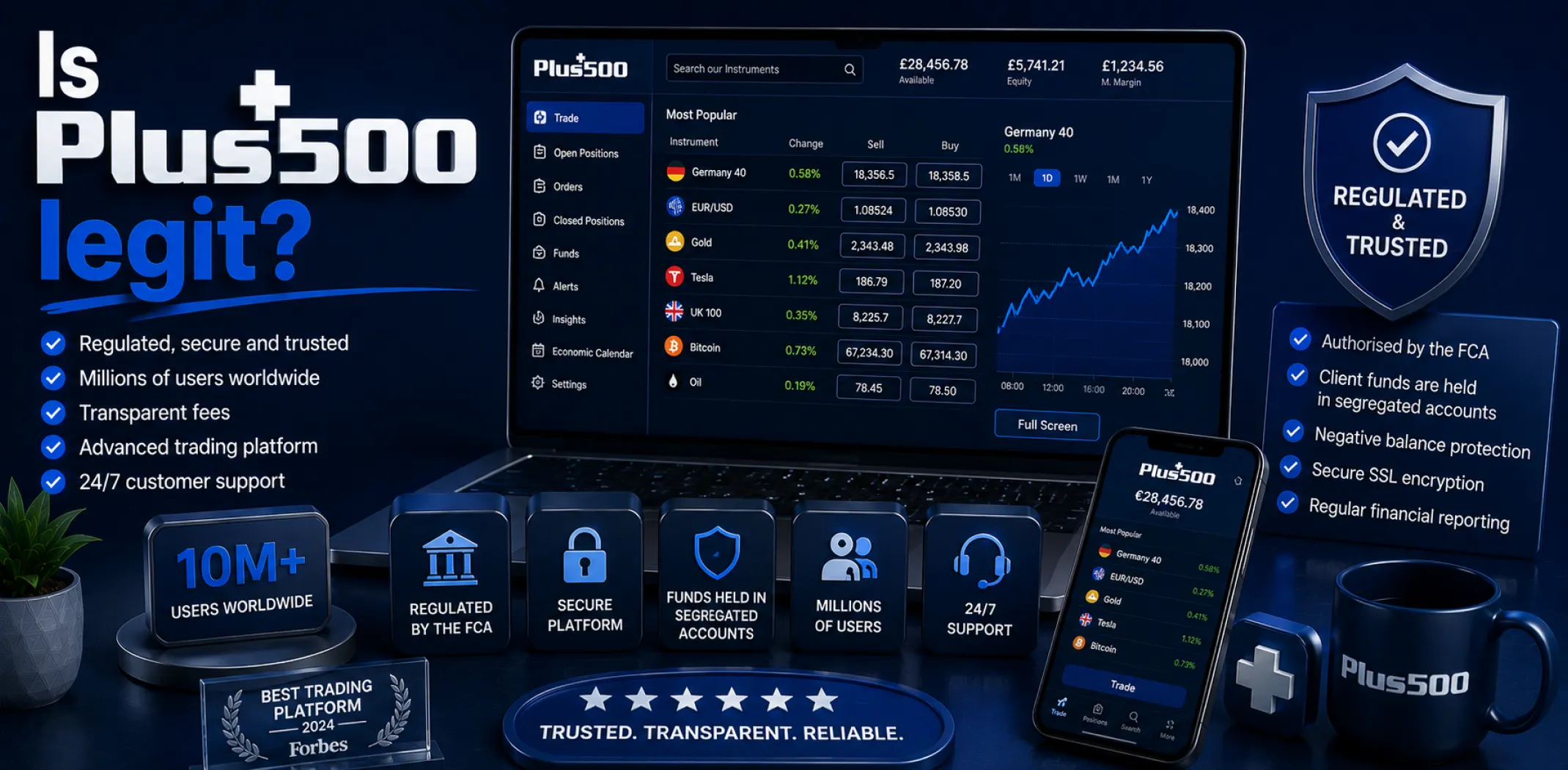
Plus500 is a legitimate, publicly listed CFD broker regulated by the FCA, ASIC, CySEC, and eight other authorities. It is not a scam. However, CFD trading is high-risk by its nature: regulators require Plus500 to disclose that around 76-80% of retail accounts lose money. The platform is real, licensed, and pays out – but the product it offers carries serious financial risk that most people underestimate.
- Plus500 has been operating since 2008 and is listed on the London Stock Exchange FTSE 250 index.
- It holds regulatory licenses from 11+ authorities including the FCA (UK), ASIC (Australia), and CySEC (Cyprus).
- Around 76-80% of retail CFD accounts with Plus500 lose money – this figure comes from the regulators, not detractors.
- Common complaints include wide spreads on some instruments, occasional account freezes, and overnight funding charges.
- Plus500 generated $792 million in revenue in 2025, making it one of the largest CFD brokers globally by turnover.
What is Plus500 and how does it work?
In 2026, Plus500 is one of the best-known CFD trading platforms in the world. It was founded in 2008 by six alumni of the Technion Institute in Haifa, Israel, and has grown from a bootstrapped startup into a FTSE 250-listed fintech group with operations across more than 50 countries. If you are seeing Plus500 ads and wondering whether it is a legitimate business or something you should steer clear of, this review gives you a straight answer.
The platform lets you trade contracts for difference (CFDs) – financial instruments that let you speculate on the price movements of assets like forex pairs, stock indices, commodities, and cryptocurrencies without actually owning the underlying asset. In the US, Plus500US operates as a separate CFTC-regulated entity focused on futures contracts, since CFDs are not permitted for retail clients under US law.
So how does it actually work? You open an account, deposit funds, and then open positions on the price movements of assets. If the price moves in your favor, you profit. If it moves against you, you lose. Leverage amplifies both outcomes.
Plus500 earns money from the spread between buy and sell prices on each trade, plus overnight funding charges on positions held past trading hours – not from your losses directly, though it does act as the market maker on many instruments.
Is Plus500 legitimate? What the evidence shows
As of 2026, Plus500 is unambiguously a legitimate and licensed financial services company. The case for legitimacy is not a matter of opinion – it is a matter of public record.
The company is listed on the London Stock Exchange’s Main Market, meaning it files quarterly earnings reports, undergoes annual audits, and operates under the oversight of the UK’s Financial Conduct Authority as a listed entity. That level of institutional transparency is not available to scam operations.
Beyond its listing status, Plus500 holds regulatory licenses from more than 11 financial authorities. The FCA (UK), ASIC (Australia), CySEC (Cyprus), MAS (Singapore), DFSA (Dubai), and FSCA (South Africa) are among those that have licensed Plus500 subsidiaries to operate in their jurisdictions. Each of those licenses requires the company to hold client funds in segregated accounts, maintain capital adequacy ratios, and meet conduct standards.
One regulatory action worth knowing about: in 2017 the FCA investigated Plus500 over risk warning disclosures and client onboarding practices. No fine was imposed, but Plus500 updated its processes in response. Since then, its compliance record has been clean.
There was also a separate action by Belgium’s FSMA regarding CFD distribution rules specific to that country, which resulted in Plus500 exiting the Belgian market. Neither episode constitutes evidence of fraud – both are examples of how regulated entities are held to account by their supervisors.
In short: the question of whether Plus500 is a scam has a clear answer. It is not. The tougher question is whether CFD trading itself is right for you – and that is where the real caution kicks in.
What are the common complaints and red flags with Plus500?
Acknowledging that Plus500 is legitimate does not mean it is free of problems. A review of Trustpilot feedback (19,000+ reviews as of mid-2026), Reddit discussions, and broker comparison sites reveals a consistent cluster of recurring complaints. None of these constitute scam behavior, but they are worth understanding before you deposit.
✗ Misconception: “Plus500 is a scam because people lose money on it.”
✓ Reality: Most users losing money is an expected and legally mandated disclosure for all CFD brokers – it reflects the nature of leveraged trading, not fraud. Plus500 is required by the FCA and CySEC to publish its retail loss rate, which is 76-80% across its platform.
✗ Misconception: “Withdrawal problems mean Plus500 steals your money.”
✓ Reality: Withdrawal delays reported on Trustpilot are real, but the majority are linked to AML verification checks – standard compliance requirements for regulated brokers. Plus500 must verify the source of funds under financial crime rules, which can freeze accounts temporarily. Verified accounts generally report fast withdrawals.
✗ Misconception: “No commission means no fees.”
✓ Reality: Plus500 earns through spreads (the gap between buy and sell price), overnight funding charges, currency conversion fees, and an inactivity fee after 3 months of no trading. Spreads widen on some instruments during volatile periods.
The complaints that come up most often in independent reviews fall into three areas. First, spread costs: some instruments have notably wide spreads compared to platforms like IG or CMC Markets, making Plus500 less cost-effective for active, high-frequency traders.
Second, account restrictions: a subset of users report accounts being temporarily frozen during compliance checks, particularly following logins from new locations or large deposit activity. This is standard regulatory KYC/AML behavior, but the lack of proactive communication from Plus500 during these episodes is a genuine service gap.
Third, overnight funding charges: traders holding CFD positions open overnight accumulate daily funding costs that can erode positions over time, and some users report being surprised by these charges despite them being disclosed in the instrument details.
None of these make Plus500 a scam. But they do make it a platform where understanding the fee structure in advance – particularly the cost of holding positions – is genuinely important.
What do real users say about Plus500?
Trustpilot feedback for Plus500 sits at 4.2 stars from over 19,000 reviews as of mid-2026. That is a reasonable score for a financial services provider, though the distribution matters: positive reviews cluster around the platform’s ease of use and the quality of the demo account, while negative reviews focus on the issues described above. Here is a representative cross-section of what real users say.
The picture that emerges from genuine user feedback is consistent: Plus500 works as advertised for traders who understand what CFDs are, use the demo account before going live, and keep positions short-term. The negative experiences cluster around users who were surprised by fees they did not research, or who triggered compliance checks through unusual account activity.
CFD trading is not the only way to build an income online. If you are researching Plus500 because you want to make money independently – rather than out of a specific interest in leveraged trading – there are business models with more predictable economics and no leverage risk.
How does Plus500 compare to its main alternatives?
If you are evaluating Plus500 against other CFD or online trading platforms, here is how it stacks up on the dimensions that matter most to retail traders.
The main trade-off between Plus500 and competitors like eToro or IG is breadth versus simplicity. IG and CMC Markets offer tighter spreads, MetaTrader access, and more sophisticated research tools – but they come with steeper learning curves.
eToro adds social and copy-trading features Plus500 does not have. Plus500 wins on platform simplicity and the absence of withdrawal fees, making it a reasonable starting point for people exploring CFD trading for the first time.
Is Plus500 worth it – our honest verdict
In 2026, the honest verdict on Plus500 is nuanced. As a business, it is legitimate, well-regulated, financially transparent, and has paid out customers for 17 years. As a trading environment, it is clean, accessible, and genuinely good for beginners who want to practice with a demo account before committing real money.
The caveat is not about Plus500 specifically – it is about CFD trading as a product. Regulators in the UK, EU, and Australia all require CFD platforms to disclose their retail loss rates. Plus500’s current disclosure sits at 76-80% of retail accounts losing money.
That is not a Plus500 problem; it is a feature of leveraged, short-term speculation on asset prices. Most people who open a CFD account lose money. That is not a conspiracy or a scam – it is the statistical reality of a product that most retail participants are underequipped to use profitably.
Legitimate platform – but CFD trading is high-risk for most retail users
Plus500 is a real, licensed, publicly listed broker that has operated for 17 years and generated $792 million in revenue in 2025. It is not a scam. However, the product it offers – leveraged CFD trading – results in the majority of retail users losing money, as disclosed in its own regulatory filings. Plus500 is worth considering if you understand CFDs, have used the demo account, and can afford to lose what you deposit. It is not well suited to anyone looking for a reliable income source or a low-risk way to grow money.
If your goal is to build an online income stream – rather than to speculate on markets – there are business models with clearer economics and no risk of losing more than you put in. Ecommerce, digital products, and other online businesses have different risk profiles worth exploring alongside any trading activity.
Is Plus500 a legitimate platform?
How does Plus500 make money?
Plus500 earns revenue through the spread between the buy and sell price on each trade, overnight funding charges on positions held past trading hours, currency conversion fees, and an inactivity fee charged after 3 months without trading. It does not charge commission on most trades. In FY 2025, the company reported total revenue of 792 million US dollars.
Does Plus500 really pay out withdrawals?
Based on user reports and Trustpilot reviews (4.2 stars, 19,000-plus reviews as of mid-2026), the majority of verified users report that withdrawals process without issues. Delays do occur, usually during compliance verification checks triggered by unusual account activity or new login locations. These are standard AML procedures required by financial regulators.
What are the main risks of using Plus500?
The primary risk of using Plus500 is the product itself, not the company. Plus500 is required by regulators to disclose that approximately 76 to 80 percent of retail CFD accounts on its platform lose money. This is due to the use of leverage, which amplifies both gains and losses. Additional risks include overnight funding costs on open positions, spread costs that vary by instrument, and a potential 3-month inactivity fee of 10 dollars per month.
What are the best alternatives to Plus500 for beginners?
The most commonly compared alternatives to Plus500 include eToro (which adds copy trading and real share ownership in some regions), IG Markets (tighter spreads and more research tools, steeper learning curve), CMC Markets (professional-grade platform with wider instrument range), and Plus500US (futures-only platform for US residents regulated by the CFTC and NFA). Each platform has different fee structures and feature sets worth comparing before depositing.