Is Plus500 A Scam? The Evidence Reviewed For 2026

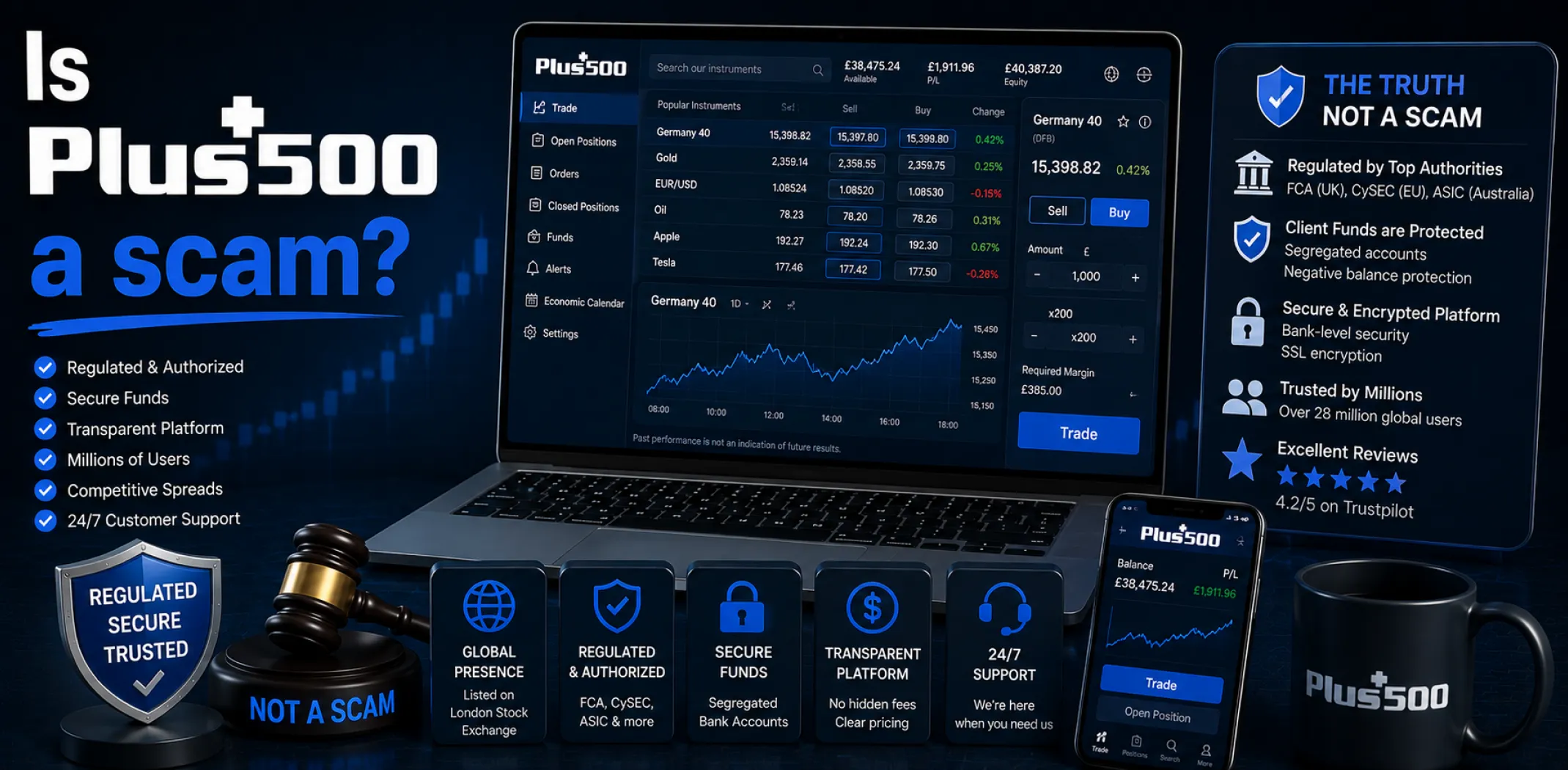
Plus500 is not a scam. It is a publicly listed, FTSE 250 company regulated by 11+ financial authorities including the FCA, ASIC, and CySEC. It has been paying out traders since 2008 and reported $792 million in revenue in 2025. The reason so many people ask whether it is a scam is simpler than fraud: around 76-80% of retail CFD accounts on the platform lose money – a figure Plus500 is legally required to publish. That loss rate is a product risk, not evidence of dishonesty.
- Plus500 is listed on the London Stock Exchange FTSE 250 and is regulated by the FCA, ASIC, CySEC, MAS, and seven other authorities.
- The most common reason people lose money on Plus500 is leveraged CFD trading – not fraud. The platform discloses this loss rate publicly.
- A 2017 FCA investigation led to improved risk warnings; no fine was imposed and the company has had a clean regulatory record since.
- Recurring real complaints include wide spreads on some instruments, surprise overnight funding charges, and occasional account freezes during KYC checks.
- Plus500 is not suitable as an income source – it is a speculative trading platform, and most retail users who treat it as one lose money.
Why do so many people think Plus500 is a scam?
In 2026, a search for “is Plus500 a scam” returns thousands of results – forum threads, review aggregators, and complaint sites that paint a confusing picture. To answer the question properly, you first need to understand why it gets asked so often. The answer is not what most people expect.
Plus500 is a CFD broker. Contracts for difference are leveraged instruments that let you speculate on whether an asset’s price will rise or fall. Leverage amplifies both gains and losses – and for most retail traders, it amplifies losses. Plus500 is required by its regulators to publish the percentage of retail accounts that lose money on its platform. That figure currently sits at 76-80%.
When three in four people who try a platform lose money on it, a significant number of them will feel they were misled – even if the platform operated exactly as described. That perception gap, not fraud, is where most “Plus500 scam” claims originate.
A second factor is the market maker model. Plus500 acts as the counterparty to many of its clients’ trades. Some traders interpret this as meaning the platform profits when you lose, and therefore has an incentive to work against you. This is a misunderstanding of how regulated CFD brokers work – the FCA and ASIC both regulate this model – but it is a persistent source of suspicion.
Is Plus500 regulated – and does that actually protect you?
Yes – and more than most platforms. Plus500 holds regulatory licenses from over 11 financial authorities, and its public listing on the London Stock Exchange adds a further layer of oversight that private brokers are not subject to. Here is what that regulatory structure means in practical terms.
The FCA authorization (UK) requires Plus500 to hold client funds in segregated accounts, maintain capital adequacy ratios, and provide negative balance protection for retail clients. That means you cannot lose more than the funds in your Plus500 account – your losses are capped at your deposit.
The FTSE 250 listing requires Plus500 to publish quarterly earnings reports and undergo annual independent audits. Every revenue figure, active customer count, and deposit statistic cited in this article comes from those mandatory disclosures. Scam operations do not file quarterly earnings reports with the London Stock Exchange.
One genuine regulatory incident is worth knowing about. In 2017, the FCA investigated Plus500 over the quality of its risk warnings and its client onboarding practices – specifically whether new users were being properly informed of the risks of CFD trading before depositing. No fine was imposed. Plus500 updated its disclosure practices and onboarding flows in response, and its regulatory record has been clean since.
Belgium’s financial regulator, the FSMA, also took separate action after Plus500 offered CFDs in Belgium without meeting a country-specific prospectus requirement, leading Plus500 to exit the Belgian market. Neither episode constitutes fraud. Both are examples of a regulated entity being held to account by its supervisors – which is how the regulatory system is supposed to work.
What do real complaints about Plus500 actually show?
Reviewing the genuine negative feedback about Plus500 – on Trustpilot, Reddit, and broker comparison forums – reveals a consistent set of issues. None of them constitute a scam. All of them are worth understanding before you deposit.
✗ Claim: “Plus500 stole my money.”
✓ Reality: In nearly all documented cases, the money was lost through CFD trades that moved against the user, or was temporarily withheld during AML identity verification. Plus500 is required by regulators to verify identity and the source of funds before large withdrawals. Funds released once verification is complete – but the process can take days and the communication is often poor, which feels like theft when you are waiting.
✗ Claim: “Plus500 manipulates prices against you.”
✓ Reality: Plus500 acts as a market maker, meaning it takes the other side of many client trades. This is a standard and FCA-regulated model, not manipulation. Spreads do widen during volatile market conditions – this is disclosed and applies to all market makers – but prices track the underlying market. Independent broker audits have not found evidence of systematic price manipulation.
✗ Claim: “The fees are hidden – it is a scam.”
✓ Reality: Plus500 charges no commissions and no deposit or withdrawal fees. Its revenue comes from spreads, overnight funding charges, currency conversion fees, and a 10-dollar-per-month inactivity fee after three months of no trading. All of these are disclosed in the platform’s fee schedule. The surprise element for most users is not hidden fees but misunderstood fees – particularly overnight funding costs that compound on positions held for multiple days.
The complaints that hold up under scrutiny cluster into three areas. First, above-average spreads on some instruments. Some stock CFDs and forex pairs on Plus500 have wider spreads than specialist alternatives like IG or CMC Markets – making the platform less cost-effective for active traders.
Second, overnight funding charges that erode positions held for days or weeks. Traders who hold CFD positions open overnight accumulate a daily financing cost; this is standard across all CFD platforms but catches out traders who did not read the fee schedule.
Third, account freezes during compliance checks. A subset of users – typically those logging in from new devices or countries, or making unusually large deposits – find their accounts temporarily restricted while Plus500 meets its AML obligations. The freezes are genuine, the communication during them is often poor, and for traders in the middle of an open position the experience is genuinely stressful. None of this is fraud.
What do real users say about Plus500?
Plus500 holds a 4.2-star Trustpilot rating from over 19,000 reviews as of mid-2026. That is a middling score for a financial platform, and the distribution is telling: the positive reviews concentrate on the platform’s simplicity and accessibility, while the negative reviews track the complaint patterns described above. Here is a representative cross-section.
CFD trading carries a documented majority-loss rate for retail users. If your underlying goal is to build an online income – rather than to speculate on markets specifically – there are business models worth comparing that do not involve leverage, overnight funding costs, or counterparty risk.
How does Plus500 make money – and does that make it a scam?
Understanding Plus500’s revenue model is the clearest path to understanding why people call it a scam – and why that label is technically wrong. Plus500 earns through four mechanisms: spreads (the gap between the buy and sell price on each instrument), overnight funding charges (a daily fee on CFD positions held past market close), currency conversion fees, and inactivity fees. No commissions. No withdrawal fees.
The part that feels unfair to many users is the market maker structure. As a market maker, Plus500 prices the instruments itself and takes the other side of many trades. When you buy a CFD and the price moves against you, Plus500 as the counterparty benefits from that movement. This creates an apparent conflict of interest.
However, it is the same model used by every major CFD broker including IG, CMC Markets, and eToro – and it is explicitly regulated and overseen by the FCA. The regulator requires that market makers do not manipulate prices, maintain adequate risk management, and treat customers fairly. Plus500 is audited against these requirements annually.
The bottom line on the revenue model: Plus500 earns money whether you win or lose (from spreads and overnight fees), and earns more if the aggregate of client positions moves against clients (from the market maker spread).
This is not a scam structure – it is the standard economic model of retail CFD trading globally. What it does mean is that Plus500’s interests are not perfectly aligned with yours as a trader, which is why the regulatory oversight and the mandatory loss-rate disclosure exist.
Is Plus500 worth using – honest verdict
As of 2026, Plus500 is a legitimate, regulated, financially transparent broker. The scam question has a clear answer: no. The more useful question – whether it is the right platform for you – has a more nuanced one.
Plus500 is well suited to traders who specifically want a beginner-friendly CFD platform, value simplicity over advanced tooling, and want to start with the free unlimited demo account before committing real money. Its low minimum deposit, zero withdrawal fees, and clean mobile interface are genuine advantages.
It is not well suited to active forex traders who want tight spreads, to traders who need MetaTrader or advanced charting, or to anyone who is looking for a reliable income source. The documented 76-80% retail account loss rate is not a scare statistic – it is the platform’s own regulatory disclosure, and it should be taken seriously.
Not a scam – but CFD trading loses money for most retail users
Plus500 is a publicly listed, FTSE 250 CFD broker regulated by 11+ authorities. It has operated since 2008, paid out customers across 17 years, and generated $792 million in audited revenue in 2025. It is not a scam. The reason it attracts scam accusations is the product it sells: leveraged CFD trading results in the majority of retail accounts losing money. That is a product risk clearly disclosed by regulators. Plus500 is appropriate for traders who understand CFDs, use the demo first, and can afford to lose what they deposit. It is not appropriate as an income-building strategy for most people.
If what you are really after is a way to build income online – not to speculate on markets – it is worth exploring approaches where your results are not determined by a market maker and leverage does not amplify your losses. Ecommerce, digital products, and other online business models work differently.
Is Plus500 a scam or legit?
Why do so many people lose money on Plus500?
The majority of users lose money on Plus500 because of the nature of leveraged CFD trading, not because of anything fraudulent. Leverage amplifies price movements in both directions. A small adverse move in the underlying asset can wipe out a significant portion of a leveraged position. Overnight funding charges also erode positions held open for multiple days. These are structural features of CFD trading, not unique to Plus500 – every FCA-regulated CFD broker publishes a similar retail loss rate.
Does Plus500 manipulate prices against traders?
No evidence of systematic price manipulation has been found by independent broker auditors or regulators. Plus500 operates as a market maker, meaning it prices instruments and takes the other side of many client trades. Spreads do widen in volatile conditions, which is standard across all market-maker brokers. The FCA and other regulators require that market makers do not manipulate prices and are audited against this requirement. The 2017 FCA investigation found issues with risk disclosures, not price manipulation, and resulted in improved practices with no fine imposed.
Is it safe to deposit money with Plus500?
Yes, depositing with Plus500 is safe in the sense that the company is regulated, client funds are held in segregated accounts at authorized financial institutions, and negative balance protection means you cannot lose more than your deposit. UK and EU clients also benefit from compensation scheme protections if the company became insolvent. The risk in using Plus500 is not company insolvency or fraud – it is that CFD trading itself results in the majority of retail users losing money on their trades.
What are safer alternatives to Plus500 for beginners?
For traders interested in a zero-commission investing platform rather than leveraged CFDs, Trading 212 and eToro both offer real stocks and ETFs alongside CFDs. For serious forex and CFD traders who need tighter spreads, IG Markets and CMC Markets offer more competitive pricing with more advanced research tools. For US-based traders, Plus500US operates as a separate CFTC and NFA regulated entity offering futures contracts, which is the only Plus500 product legally available to US retail clients.