Is Pepperjam A Scam? The Truth About This Affiliate Network

Quick verdict
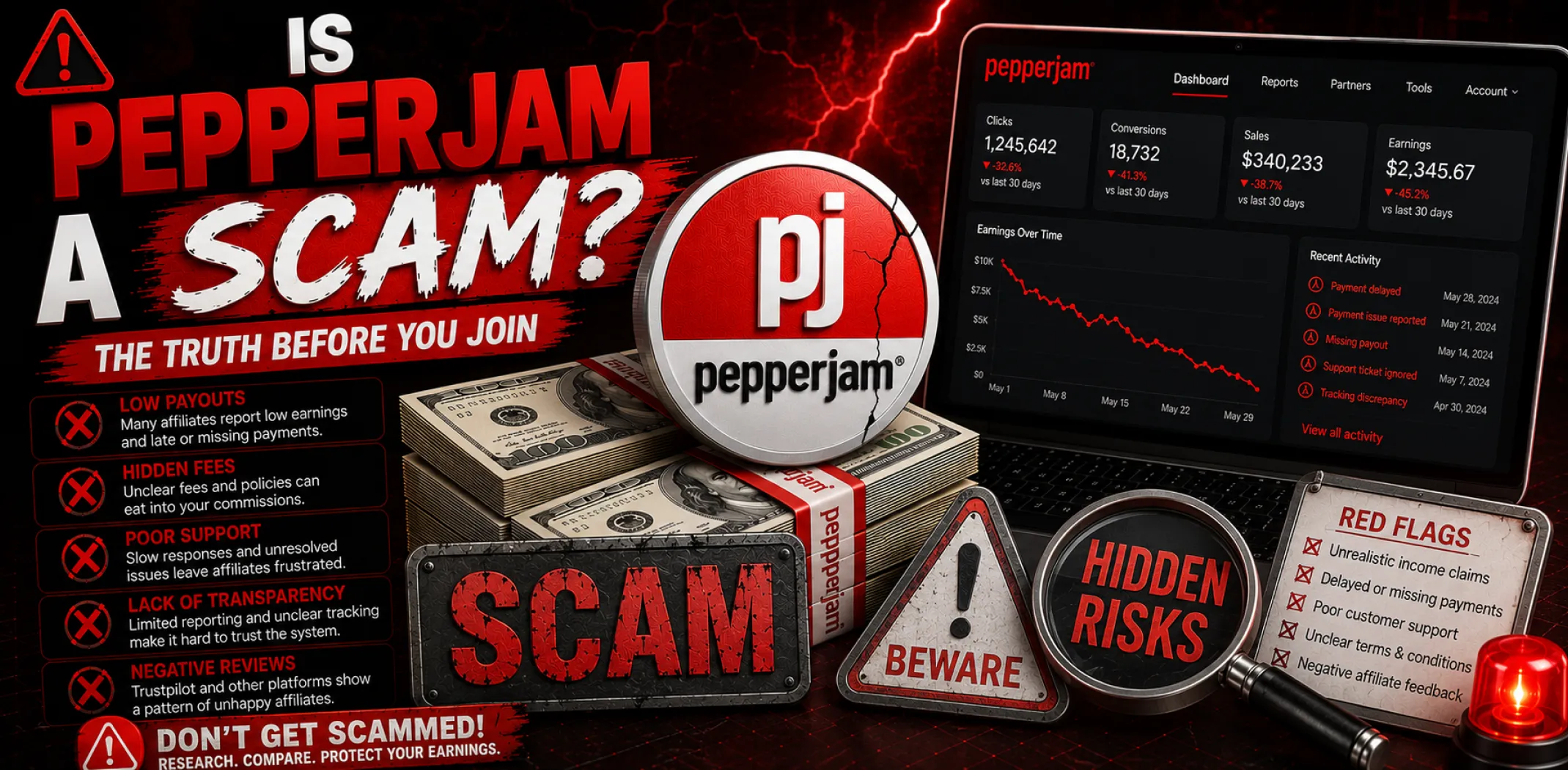
Pepperjam is not a scam. It was a legitimate affiliate marketing network founded in 1999, backed by institutional investors including eBay and private equity firm Permira, and acquired by Partnerize in July 2020. The platform no longer operates independently – it now runs as Ascend by Partnerize – but it was never fraudulent at any stage of its history.
Key takeaways
- Pepperjam is not a scam – it operated as a legitimate affiliate network for over 21 years before being acquired by Partnerize in 2020.
- The platform has been discontinued as a standalone brand and now exists as Ascend by Partnerize, which targets enterprise clients rather than independent publishers.
- Most scam complaints about Pepperjam stem from misunderstood program requirements – such as individual brand approval gates and the $25 minimum payout threshold – rather than fraud.
- Pepperjam served approximately 950 brands and around 4,000 affiliate partners at the time of its acquisition, processing transactions for major retail and direct-to-consumer companies.
- Publishers starting from zero will face the same structural barriers on any affiliate network – including Pepperjam’s successor – because all of them require an existing audience before approving publisher applications.
What is Pepperjam and why do people think it might be a scam?
In 2026, if you search for “Is Pepperjam a scam,” you will find a mix of outdated review articles, forum threads, and a platform that no longer exists in the form most of those articles describe. That gap between what people read and what is actually true is exactly where scam suspicions tend to grow. So let us deal with it head-on.
Pepperjam started in Wilkes-Barre, Pennsylvania in 1999 – originally as a gourmet food retailer, of all things. Founder Kristopher Jones pivoted the company into affiliate marketing, and over the following two decades it became one of the more well-regarded performance marketing networks in North America.
It was sold to GSI Commerce in 2009, absorbed into eBay Enterprise by 2011, acquired by private equity firm Permira and Banneker Partners in 2015, and finally purchased by Partnerize in July 2020. That chain of institutional ownership is not what you see with scam operations. Scam platforms do not attract private equity and eBay as owners across a 21-year span.
As of 2026, the Pepperjam brand has been retired. The technology and publisher network that powered it now runs under Partnerize as “Ascend by Partnerize.” If you are trying to sign up for Pepperjam directly, that page no longer exists – and that confusion is one of the primary reasons the scam question keeps circulating.
How did Pepperjam make money – and is that model suspicious?
One reason people reach for the word “scam” when researching affiliate networks is that the business model can look opaque if you are not familiar with it. Pepperjam made money as a performance marketing intermediary: advertisers paid Pepperjam a network fee, and Pepperjam took a cut of commissions before passing the remainder to publishers.
It was a three-way arrangement between the advertiser (brand), the publisher (you), and the network (Pepperjam).
There is nothing inherently suspicious about this. The same structure powers CJ Affiliate, Rakuten Advertising, ShareASale, and virtually every other major affiliate network. The advertiser is happy to pay a network fee because it gets access to a curated publisher base and reliable tracking.
The publisher earns a commission each time a referred visitor converts. Pepperjam kept the infrastructure running and took a margin in the middle. In 2026, this model is standard practice across a global affiliate marketing industry estimated at over $17 billion.
The reason some people experience frustration – and occasionally label it a scam – is not the model itself but the friction points built into the publisher side. You have to be approved by Pepperjam as a network member first.
Then you have to apply separately to each individual brand program. Then you have to generate enough sales to hit the $25 minimum before you see any money. For someone who signs up expecting immediate income and instead spends weeks getting rejected from programs, that frustration is real. But frustration is not fraud.
Is Pepperjam a scam? Breaking down the real complaints
To answer this properly, it is worth separating the three things people commonly conflate when calling a platform a scam: outright fraud, structural barriers that feel unfair, and simply a poor fit for what someone needed. Pepperjam has no documented history of the first. It has a real record of the second. And it is clearly not a fit for beginners without an existing audience. Here is how the most common complaints break down.
Common misconception:
✕ “Pepperjam took my commissions and never paid me – that is theft.”
✓ Pepperjam does not pay commissions until they are locked and cleared by the advertiser, and until the publisher balance reaches the $25 threshold. If a sale is reversed, cancelled, or flagged as fraudulent by the advertiser, the commission is voided. This is standard practice on every major affiliate network – not unique to Pepperjam.
The complaints that do have merit fall into four categories. First, slow or non-responsive support – multiple reviewers on TrustRadius and Trustpilot cited publisher managers going quiet on unresolved issues, including at least one case where a user reported making personal test purchases through their own affiliate links with no commissions recorded and no resolution after weeks of follow-up.
Second, double-approval friction – being accepted by Pepperjam does not mean being accepted by any brand on the network. Each program has its own approval criteria, and low-traffic publishers are routinely declined.
Third, the platform was historically limited to PayPal for international publishers before later adding direct deposit and checks. Fourth, and most relevant in 2026, is the discontinuation itself: Pepperjam no longer exists as a product people can join, and the confusion around that has generated a new wave of frustrated searches.
None of these add up to a scam. A scam takes your money or fabricates results to extract payment. Pepperjam was free for publishers to join, paid commissions on a documented biweekly schedule once thresholds were met, and operated transparently under institutional ownership for over two decades. The platform had real limitations and genuine support failures for some users – but that is a very different thing from fraud.
What do real users say about Pepperjam?
Reviews of Pepperjam across G2, TrustRadius, and affiliate marketing forums tell a consistent story: the experience divides sharply along the advertiser-publisher line. Brands and agencies using Pepperjam on the merchant side rated it highly – praising the commission control tools, dynamic commissioning features, and partner discovery capabilities.
Publisher experiences were more variable, particularly for smaller operators who ran into approval rejections and reporting limitations. Here are two representative accounts from opposite ends of that spectrum.
How does Pepperjam compare to other affiliate networks and alternatives?
In 2026, Pepperjam is no longer an active standalone platform, so a direct comparison is partly historical. But understanding how it stacked up – and how the current affiliate network landscape looks – is useful context if you are trying to decide where to focus your energy.
The table above highlights a structural reality: every active affiliate network in this space – CJ, ShareASale, Rakuten, Impact – shares the same barrier Pepperjam had. You need an existing content property with meaningful traffic before most brand programs will approve you.
That is not a Pepperjam problem. That is an affiliate marketing model problem. If the traffic-first requirement is a blocker for you, affiliate networks of any kind are not the right starting point.
Is Pepperjam safe – and is it worth trying today?
Pepperjam was safe in the sense that it never exposed publishers to financial risk. Joining was free, it did not require payment to access brand programs, and it processed commissions on a documented schedule once thresholds were met. The platform had real shortcomings – particularly for newer publishers and for international affiliates limited by payout options – but it was not a vehicle for extracting money from users.
As for whether it is worth trying today: the question is moot for most readers, because the platform you are researching no longer exists. If you want to work with the successor platform, Ascend by Partnerize is the current home for the technology and publisher network – but it is designed for established enterprises and agencies, not for individual publishers building income from scratch.
The more useful question to ask in 2026 is not whether Pepperjam was a scam, but whether the affiliate network model is the right path for your goals right now. If you are starting from zero – no established blog, no significant social following, no email list – the affiliate model will put you through the same approval friction and minimum threshold delays regardless of which network you choose.
Building an audience first is a multi-month project. That is real and worth knowing before you invest time into any affiliate platform.
Not a scam – a legitimate network that no longer exists as a standalone product
Pepperjam operated transparently for over 21 years under institutional ownership, paid commissions on a documented biweekly schedule, and served nearly 1,000 advertiser brands before being absorbed into Partnerize in 2020. The frustrations real users experienced – rejection from brand programs, slow support responses, payout thresholds – are structural features of the affiliate network model, not indicators of fraud. In 2026, Pepperjam is discontinued; the relevant questions are whether Ascend by Partnerize fits your business scale, or whether a different income model fits your current situation better.
Your own store needs no brand to approve you first
AliDropship builds your store, loads products, and includes the Amazon Seller Kit – giving you two income channels from day one with no existing traffic needed. Over 1,500,000 stores have been launched across 150+ countries, with results varying by niche, effort, and advertising spend. Start free with a 14-day trial and a 40 dollar ad coupon.
What is a better way to start earning online without the affiliate approval barrier?
If your research into Pepperjam is really a search for a legitimate way to build online income without waiting months to accumulate enough traffic to pass brand approval gates, that is a completely reasonable reframe. The affiliate network model is one route – but it is one that rewards established publishers more than beginners. A fully built ecommerce store changes that dynamic entirely.
AliDropship has been building turnkey ecommerce stores for beginners since 2015, with more than 1,500,000 stores launched across 150+ countries. The platform carries a 4.7-star rating on Trustpilot and has been featured by Forbes, Entrepreneur, and Inc.
The core difference from an affiliate network is ownership: your store sells products you list at your own margins, without needing any third-party brand to approve your application or set your commission rate. Physical dropshipping products are shipped directly from suppliers, and digital products deliver instantly – both from the same store.
Free turnkey store – built, designed, and filled with products
Your store arrives professionally designed, pre-loaded with 50 bestselling products, and fully optimized to convert. No setup fees, no coding, no design time. You start at the product-testing stage – not the store-building stage. Hosting, SSL, and payment gateway are all included.
Winning products, one-click import
Browse trending and niche items from AliDropship’s catalog – including brand-name and digital products – and import them to your store in one click. The catalog updates regularly so your store always has fresh, competitive inventory without manual research.
Automated fulfillment and real-time tracking
Orders are processed automatically through global supplier connections. Customers receive real-time tracking updates – building trust and reducing support volume. You do not touch the shipping logistics; the platform handles it end-to-end.
Built-in marketing and promotion tools
Email campaigns, discount management, abandoned-cart recovery, live countdown timers, and social media integration are all included or available as add-ons. No prior marketing experience required – the tools guide you through each campaign type.
Beginner-friendly – no coding, no learning curve
An intuitive dashboard walks you through every step. Adding products, running campaigns, and scaling your catalog require no technical knowledge. As your business grows, the platform scales with you – adding features without adding complexity.
AliExpress integration – one-click imports, synced inventory
AliDropship connects directly to AliExpress for one-click product imports, automated order processing, and synced tracking. Inventory stays current with the latest products and prices. Combined with the turnkey store and automated fulfillment, this integration makes the entire operation manageable for one person.
Your ecommerce store
Built, loaded with products, and ready to sell. Physical dropshipping and digital products both available. Built-in ad system lets you run promotion at 10 to 50 dollars per day with no marketing experience required.
Your Amazon business
The Amazon Seller Kit gives you a ready-to-upload import file for a $514B marketplace with 300M active buyers. No warehouse, no inventory, no Amazon experience required to get started.
Is Pepperjam a scam or a legitimate affiliate network?
Why do people say Pepperjam is a scam?
Most scam accusations against Pepperjam come from publishers who experienced frustration with the double-approval process – being accepted to the network does not automatically grant access to individual brand programs, and low-traffic sites are frequently rejected. Others stem from the 25 dollar minimum payout threshold, which means commissions must accumulate before any payment is issued. These are structural features of the affiliate network model that exist on virtually every major platform, not indicators of fraud.
How does Pepperjam make money from publishers?
Pepperjam made money as a performance marketing intermediary. Advertisers paid a network access fee and a percentage of commission revenue to Pepperjam in exchange for access to the publisher base and tracking technology. Publishers earned a share of commissions on sales or leads generated through their affiliate links. Pepperjam kept a margin in the middle – the same business model used by CJ Affiliate, Rakuten Advertising, ShareASale, and Impact.
What happened to Pepperjam – is it still active in 2026?
Pepperjam is no longer active as a standalone platform. Partnerize acquired Pepperjam on July 29, 2020, and the brand was subsequently retired and rebranded as Ascend by Partnerize. The original network accessible to individual publishers no longer exists in the same form. As of 2026, Ascend by Partnerize is focused on enterprise and midmarket clients rather than independent affiliate publishers starting from scratch.
What are the best Pepperjam alternatives for earning online?
For publishers with an existing audience, CJ Affiliate, ShareASale, Rakuten Advertising, and Impact are the most active alternatives in the affiliate network space. For people starting without an established audience, a fully built ecommerce store removes the approval barrier entirely. AliDropship builds your store, loads it with products, and includes a complete Amazon Seller Kit – no traffic threshold or brand approval required. The platform has launched over 1.5 million stores across 150 plus countries and holds a 4.7-star rating on Trustpilot.